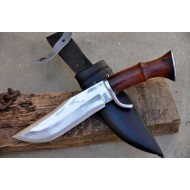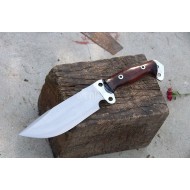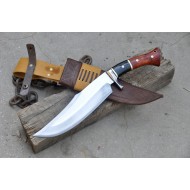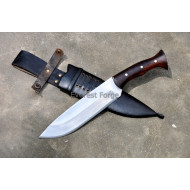


- Model: Hunting and survival knife
- Product Code: CLAWKARAMBIT09
- Location: Kathmandu, Nepal
Available Options
What Is a Faceted Blade Ring Pommel Knife?
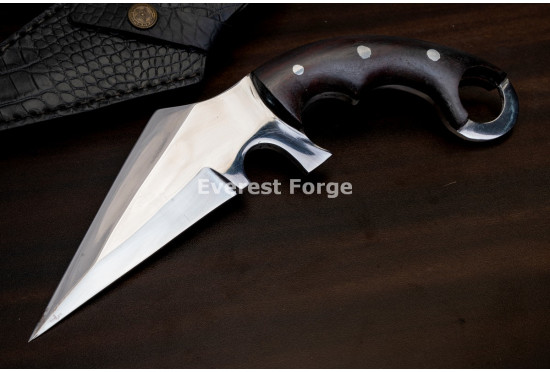
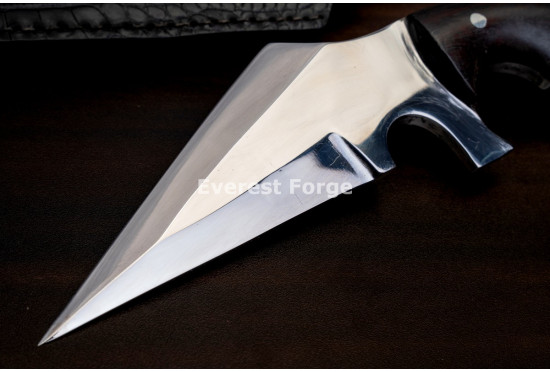
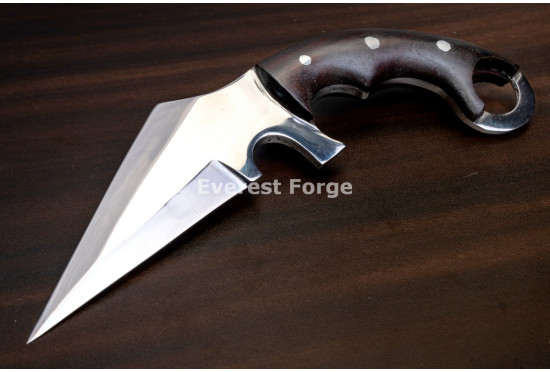
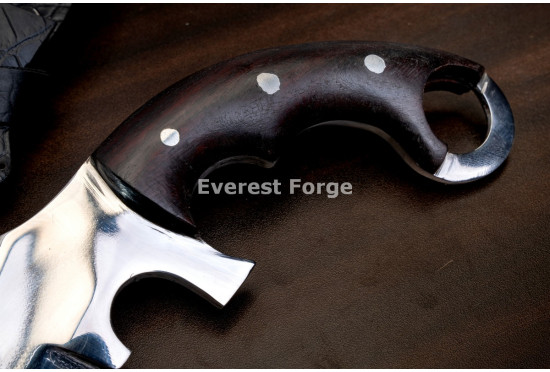
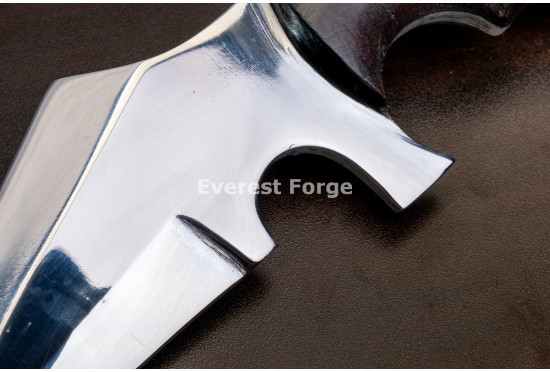
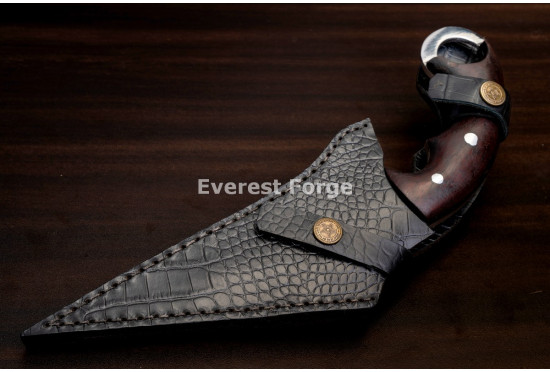
Most knife blades are ground with a single continuous bevel that runs from the spine to the edge, and the eye reads it as one smooth surface. This one is ground in flat planes that meet each other in hard, deliberate lines, so the blade reads as a series of facets rather than a curve. It is a broad wedge, 6 inches long, with a deep choil cut into the underside at the base for a forward finger, a steel ring at the butt of a curved rosewood handle, and 11.5 inches overall. Hand-forged from 5160 high-carbon spring steel, mirror polished, in a fitted crocodile-embossed leather sheath cut to the angle of the blade.
It is a modern design and not a historical type, and the two things worth understanding before you buy are the faceting and the choil. The facets are what you are paying for in labour, because flat planes meeting cleanly are considerably harder to grind than a rounded bevel and there is nowhere to hide a mistake. The choil is the part that makes it usable, because it gives you somewhere to put your index finger ahead of the handle and therefore a second hand position on a knife whose ring would otherwise allow only one.
It is not a karambit and it is not a hunting knife. A karambit hooks back so the point finishes aimed at the hand holding it and every cut is a pull; this point runs forward and it cuts on a push. And a fixed finger ring gives you far too few grip options for field dressing, whatever the shape suggests. We forge four proper karambits and a full range of straight-bladed hunting knives, and our pierced blade ring pommel knife page sets out both arguments in full.
An honest note on the styling. Angular faceting reads as tactical, and we should be straight with you: it is an aesthetic decision, not a performance one. A hard-faceted wedge does not cut better than a conventionally ground blade of the same thickness and geometry, and the facets add nothing to strength. What they add is labour, difficulty and a look that nothing else in our range has. They also make the blade slightly harder to sharpen well, which is covered below. Buy it because you like how it looks, which is a perfectly good reason, and not because you have been told the angles do something.
Please check your local law before ordering. A finger ring is a named restricted feature in a good deal of knife legislation, independently of blade length or shape, and this knife has one. Rules vary by country and, within countries, by state, province and city, and import rules differ again from carry rules. We ship worldwide but we cannot advise on your jurisdiction. If the ring is the obstacle, we will forge the same blade on a plain handle at no extra cost.
We Will Size the Ring to Your Finger
Send us a measurement and our smiths will forge the ring to your hand rather than to an average. It costs nothing extra, and on a ringed knife it is the difference between something you use and something you look at.
Order It Built to Fit →Why This Knife Is Built the Way It Is
Full Specifications
Blade length, grip material and ring size are selectable on this listing. Blade finish is not: see the question on polish below. The figures above describe the standard build as photographed. Small variations in weight, dimension and finish are normal in hand-forged work.
Build It Your Way
What This Knife Does Well, and What It Does Not
What It Is Good At
- Display. The facets catch light in a way no conventionally ground blade does, and it photographs unusually well
- Retention. The ring means it cannot be dropped or twisted out of the hand
- Close work. The forward choil lets you choke up and shorten the working edge for control
- Piercing and slicing on a push, which is what a long acute wedge is for
- Costume and prop use, where the silhouette is genuinely distinctive
What It Is Not Good At
- Performing better than a plain blade. The angles are a look, and we say so above rather than pretending otherwise
- Easy sharpening. Keeping the facet lines crisp takes more care than a conventional bevel
- Hunting or food preparation. The ring allows too few grips for either
- Being a karambit. The point runs forward, so it will not hook or trap
- Low maintenance. A mirror polish on carbon steel marks if you look at it
How to Order a Custom Knife
The Other Ring Pommel Knife
Same hilt arrangement, a completely different blade: a smooth upswept belly with graduated cutwork through the flat. Softer to look at, easier to sharpen, and it carries its decoration in the steel rather than in the grind.
See the Pierced Blade →Who This Knife Is For
- Buyers who collect for the grinding and can tell hand-cut facets from a moulded imitation of them
- Display and interior buyers who want something with hard geometry rather than traditional curves
- Costume, prop and photography buyers who need a silhouette nobody else has
- People who want retention plus a choked-up grip, which is an unusual combination on a ringed knife
- Anyone commissioning a one-off, since the facet layout is a design decision rather than a fixed pattern
It is not for you if you want a working knife you will sharpen often, in which case a conventional grind will be less trouble, or if you hunt or want a karambit, in which cases we make better things for both.
What Is Included
- The hand-forged ring pommel knife, sharpened and ready to use
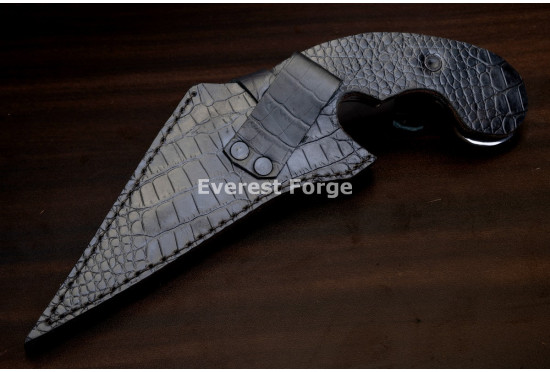
- A fitted leather sheath cut to the angle of the blade, with a handle retaining strap
- A certificate of authenticity from the workshop
- Care instructions for high-carbon steel and polished finishes
- Everest Forge manufacturer warranty against forging and material defects
Other Blades From the Everest Forge Workshop
Shipping, Returns and Care
Dispatch. Stock pieces leave the workshop within 2-3 business days. Custom builds take 4-6 weeks depending on the queue, and a custom facet layout sits at the longer end because each plane is set up separately.
Shipping. Tracked worldwide by DHL or FedEx, typically 7-14 business days in transit from Kathmandu. Customs paperwork is completed accurately and in full. Some countries restrict the import of ringed blades specifically; please check before ordering, because a parcel seized at your border cannot be recovered.
Returns and warranty. Covered by the Everest Forge manufacturer warranty against defects in forging and materials. Custom builds made to your own specification cannot be returned for a change of mind, which is why we confirm everything in writing first.
Care. Mirror-polished high-carbon steel is the least forgiving finish we sell, and our wheel pommel dagger page explains why in detail. Wipe the blade after every handling and keep a light film of oil on it. On this build there is one extra thing to watch: the facet lines are the first place a polish dulls, because a cloth dragged across a ridge wears it faster than it wears a flat. Wipe along the planes rather than across them. Pay attention to the inner face of the ring and the inside of the choil, which are enclosed surfaces a cloth never reaches. Do not store the knife sheathed for long periods.
Questions Answered
What is a faceted grind?
An ordinary blade is ground with one bevel per side, a single surface running from somewhere on the flat down to the edge, and whether it is flat, hollow or convex it reads as one continuous plane. A faceted grind replaces that with several distinct flat planes set at different angles, meeting each other along crisp lines. The difference in the making is larger than it looks. Each plane has to be set up and ground separately with the blade held at a fixed angle, and the line where two planes meet must be dead straight along its whole length, because the eye picks up any wander in it instantly. A rounded bevel hides a hand that drifts; a facet line displays it. That is most of what you are paying for here, and it is why very few makers offer it.
How do I sharpen it without losing the facets?
Carefully, and only on the edge bevel. The trap is treating the whole blade as one surface and running it flat on a stone, which rounds the facet lines and turns a faceted blade into a scratched conventional one within a few sharpenings. What you want is to work only the small bevel immediately at the edge, holding a consistent angle, using a stone narrow enough that it does not ride up onto the planes behind it. A guided system or an angle jig is genuinely useful here in a way it is not on most knives. Do not use a pull-through sharpener, which will not respect any of this. And if you ever want the whole blade refinished, send it back to us; re-establishing facet lines is a grinding job rather than a sharpening one.
What is the cutout at the base of the blade for?
It is a finger choil, and on this knife it does something genuinely useful. Put your index finger into it and your hand moves forward, past the handle and onto the blade itself, which shortens the working edge and puts your grip much closer to the point. That is the standard hold for detailed cutting on any knife that offers it. What makes it worth pointing out here is the combination: a ringed knife normally gives you exactly one hand position and will not let go of it, which is the main criticism of the type and one we make ourselves on our other ringed pages. The choil gives you a second. You still cannot reverse the knife or release it quickly, but you can choose between a full grip at the handle and a choked-up grip at the blade, and that is more than most ringed knives allow.
Does the angular styling do anything, or is it just looks?
Just looks, and we would rather say so. Angular faceting has become a visual shorthand for tactical, and a fair amount of marketing implies that hard geometry means hard performance. It does not. A faceted wedge does not cut better, penetrate better or hold up better than a conventionally ground blade of the same steel, thickness and edge geometry, and the facets add no strength; the primary grind and the heat treatment decide all of that, and both are the same here as on our plainer knives. What the facets do add is a great deal of hand grinding, a look nothing else in our range has, and a slightly harder sharpening job. That is an honest trade and plenty of people will happily take it. It is only a bad trade if somebody has told you the angles are doing engineering.
Why is it mirror polished? Can I have satin?
We would rather you did not, and this is the one build in our range where we say that. Facets are visible only because each plane reflects light at a different angle, and the crisper the reflection the sharper the boundary between them looks. A mirror polish gives you that. A satin finish scatters light across the surface and softens every line, and a dark forge finish removes them almost entirely, so you end up paying for grinding you can no longer see. If you want a knife with a low-maintenance finish, the honest answer is that this is the wrong blade for it and our pierced blade ring pommel knife takes a forge finish very happily. If you specifically want this blade in satin we will grind it, but we will ask you once whether you are sure.
How does it compare with your other ring pommel knife?
Same hilt idea, opposite blade philosophy. The Pierced Blade build has a smooth upswept belly with three graduated holes drilled through the flat, so its decoration sits in the steel and the grind itself is conventional. It slices better on a draw, sharpens normally, takes any finish you like, and is the easier of the two to own. This one puts all its work into the grind: hard flat planes, crisp lines, a long acute wedge and a forward choil, and it needs the polish to read. Take the pierced blade if you want something to use and a softer look; take this one if the grinding is the point and you will keep it polished. They are 6 and 6.5 inches respectively, so size is not the deciding factor.
Is this a karambit?
No. On a karambit the blade hooks back so the tip finishes pointing toward the hand that holds it, and every cut is a pull. Here the wedge runs forward and the point finishes ahead of the handle, so it cuts on a push like an ordinary knife. The ring at the butt is the only thing the two share, and a ring is a handle feature rather than a blade one. We forge four karambits if a hooked pull-cutting blade is what you actually want.
Is it a hunting knife?
No. Field dressing needs a different hold for almost every stage, from a pinch grip for caping to a full grip for long pulls to a reversed grip for opening skin, and a fixed finger ring gives you very few of them. The forward choil helps more here than on most ringed knives, but not enough. Our pierced blade page sets the argument out in full, and any of our straight-bladed hunting knives will serve a hunter far better.
Will the ring fit my finger?
Measure before you order, because on a ringed knife a poor fit makes the piece unusable rather than merely uncomfortable. Wrap a strip of paper around the second knuckle of your index finger, which is the widest part that has to pass through, mark the overlap and measure the strip. You want roughly two to four millimetres of clearance on that figure: too tight and your finger will not pass, too loose and the knife rotates around the ring instead of being indexed by it. Send us the measurement and we forge the ring to it at no extra cost.
Is a ring pommel knife legal where I live?
We cannot answer that for you and you should be wary of any seller who claims they can. A finger ring is named as a restricted feature in its own right in a good deal of knife legislation, separately from blade length and separately from blade shape, so a ringed knife can be restricted where an identical knife with a plain handle is unremarkable. Rules vary by country and, within countries, by state, province and city, and import rules differ again from carry rules. Check yours before ordering. If the ring is the problem, the plain-handle build costs no more.
What steel is it, and how is it heat treated?
5160 high-carbon spring steel, the same stock our smiths use for kukris and swords, forged down from leaf spring in the Nepali tradition. It is oil-quenched and then tempered back, giving a blade that holds a hard working edge but stays tough rather than brittle. It is not stainless. It will take a patina with use and it will rust if left wet, which is the trade every high-carbon blade asks in exchange for an edge that sharpens easily.
Will my knife look exactly like the photographs?
Closer than on most of our knives, and further away in one respect. The facet layout is set up to a pattern, so the geometry repeats accurately from piece to piece. But every line between two planes is finished by hand, so their exact crispness varies slightly, and on a design where the lines are the entire point that is the difference you are most likely to notice. Rosewood also varies board to board in colour and figure. What does not vary is the specification: length, steel, construction, heat treatment and sharpness are held to the same standard on every piece. Our kukri machete page explains in more detail what can and cannot differ between two blades from the same bench.
| Specification | |
| Blade: | 6 inches. Hand forged from 5160 carbon steel |
| Total Length: | 11.5 inches |
| Handle: | 5.5 inches, full-length tang with rosewood scales pinned through with three pins, steel ring forged as part of the tang at the butt, deep forward finger choil at the blade base |
| Weight: | 430 grams the knife, 590 grams with the sheath |
| Note: | handmade variation in weight, dimensions and finish may occur; keep blade lightly oiled when not in use |