- Model: Flame Dagger
- Product Code: FlameD015
- Location: Kathmandu,Nepal
Available Options
A Hand-Forged Renaissance Dagger With a Flame Blade
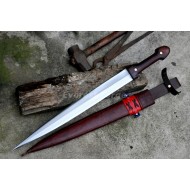
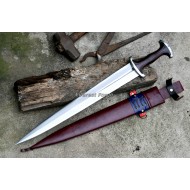
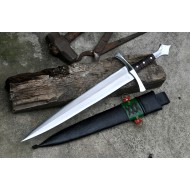
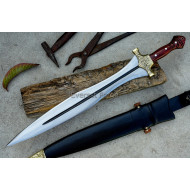
This is a hand-forged flame-bladed dagger: 15 inches of double-edged blade running in deep waves through its upper two thirds before settling and running out straight to an acute point. The hilt is a polished steel cross whose quillon ends curl back toward the hand, a stepped collar with incised rings, and a timber grip with a flared butt. It comes with a tooled leather sheath with a laced throat. Forged from 5160 high-carbon spring steel in our workshop in Tokha-3, Kathmandu, after your order arrives — so the dimensions, the wave depth, the grip and the edge are all yours to set at no extra cost.
Waved blades are usually thought of as a sword treatment, but the same profile was put on daggers throughout the sixteenth and seventeenth centuries, and particularly on the left-hand parrying daggers carried alongside a rapier. An expensive, difficult blade on a small weapon was exactly what a gentleman paid for, and the hooked quillons on this one are the other half of that tradition.
At 670 grams over a 15 inch blade this sits comfortably inside the weight range a blade of this length and section historically occupied. That is worth saying plainly, because it is not true of everything we make and we say so on the pages where it is not.
An honest note. Two things, and neither is a reason not to buy it. The waves are decoration with a small functional side effect — they put more edge in contact and they bind slightly better, and they do not make the blade cut deeper, make it stronger, or set up any vibration that damages a parried weapon. Those stories follow wavy blades everywhere and none of them are true. Second, and more practical: a waved edge takes about three times as long to sharpen as a straight one and needs a round file or rod rather than a flat stone, because a stone rides the crests and never reaches the hollows. That is the genuine ownership cost and almost nobody mentions it before you buy.
Why It Is Built This Way
Full Specifications
Figures are taken from the dagger shown and describe the standard build. Hand-forged work varies a little from piece to piece, so read these as close rather than exact. If a dimension matters, tell us before we start and we will build to it and measure the finished dagger for you.
Build It Your Way
None of this costs extra, because none of it is made before you ask for it. Work down these six and put what you want in the order note.
Tell us a weight, not an adjective
Most of what we build is specified by dimensions and we work to our usual robust standard. On a dagger of this pattern that is not always what you want — a parrying dagger for paired work wants to be light in a way a display piece does not, and "lighter" is not a specification a smith can work to. Give us a number in grams and we will forge to it, tell you honestly if it is not achievable in this profile, and measure the finished piece against it. That offer is open on anything we make and almost nobody takes it up.
Talk to the Forge →What It Does Well, and What It Does Not
What it does well
- A silhouette that stops people. A waved blade on a piece this size is uncommon, and it is the reason to own it.
- Hooked quillons that are a real feature of the parrying dagger rather than a decorative flourish, explained properly rather than asserted.
- An edge actually finished through the hollows, by hand. Most wavy blades arrive sharp on the crests and blunt between them.
- A sensible weight for the blade length, which is not true of everything we make and is worth saying where it is.
- A sheath that holds by its laced throat rather than by a strap fighting its way around the quillons.
- Everything configurable at no extra cost, including wave depth and a target-weight build for anyone who wants it light.
What it does not do
- The waves do not improve the cut. They bind slightly better and they look magnificent, and that is the honest list.
- It is roughly three times slower to sharpen than a straight edge, and it needs a round file or rod rather than a stone.
- At 15 inches the blade is long for a dagger, which matters legally as well as practically. Ten to twelve is easier to own in many places.
- A double-edged symmetrical blade is regulated more tightly than a single-edged knife almost everywhere, often with no length threshold.
- It is built to our usual robust standard rather than to a fencer's weight. Ask for a target-weight build if you want it for paired work.
- It is not stainless. 5160 rusts if left damp and wants an occasional wipe of oil.
How to Order
Who It Is For
- Collectors who want a flame blade at dagger scale, which is considerably rarer than the sword version.
- Historical fencers and students of rapier and dagger, who will recognise the hooked quillons for what they are.
- Buyers who want one striking piece on a shelf rather than another sword on a wall.
- Stage combat and theatrical armourers, who can order this rebated and round-tipped at no extra cost.
- Anyone who would rather be told a wavy edge takes three times as long to sharpen than discover it with a stone.
- Buyers who want a target-weight build and are used to being told that is not an option.
What Is Included
- The dagger, hand-forged in Tokha-3, Kathmandu, Nepal.
- A tooled leather sheath with an incised lattice, a laced throat through brass eyelets and a belt fitting.
- A protective coat of oil on the blade for transit, wiped off before handling.
- Care instructions, and the Everest Forge manufacturer warranty against defects in materials and workmanship.
Want the matched pair?
A flame-bladed dagger was rarely carried alone. The natural companion is a rapier or a side sword with the same treatment on the blade and the same hand on the furniture, and a matched pair is one of the more satisfying things to commission. Send us what you have in mind and we will quote both together before anything goes on the fire.
Start a Custom Forge Request →Related Blades and Reading
Shipping, Returns and Care
Dispatch and transit. Standard builds leave the workshop in 2 to 3 business days. Genuinely custom work — a different length, different wave depth, a target-weight build or a different grip — runs 4 to 6 weeks depending on the queue. We ship by DHL or FedEx with tracking, typically 7 to 14 business days from Kathmandu, sheathed and braced in a rigid carton.
Duties, import and the law. Import duty and local taxes are the buyer's responsibility and vary by country. A double-edged symmetrically tapering blade is restricted in many jurisdictions where a single-edged knife of the same size is not, frequently with no length threshold, and in some places the classification follows the shape whether or not it is sharpened. At 15 inches this is the long end of that problem. Please check what applies where you live before ordering, and ask us if a shorter blade would make the difference.
Returns and warranty. Because every blade is forged after the order, a custom build cannot be restocked, so please make sure the specification is right before you confirm. Anything damaged in transit, or showing a defect in materials or workmanship, is covered by the Everest Forge manufacturer warranty and we will repair or replace it. Photograph the packaging as well as the dagger if something has gone wrong on the way.
Care. 5160 is a high-carbon steel and it is not stainless. Wipe the transit oil off before handling and put a light film back on before the dagger goes away. Fingerprints are acidic and will etch a polished blade if left for weeks. On a flame blade the hollows are the part to watch: a cloth drawn straight down the blade skips them entirely and that is where rust will start. Sharpening needs a round file or ceramic rod worked along each wave, never a flat stone. Do not store the dagger in the sheath for long periods, since leather holds moisture against steel.
Questions About the Flame-Bladed Dagger
What is a flame-bladed dagger?
A dagger whose edges run in a series of waves rather than a straight line. The German sources call the blade type a Flammenschwert when it appears on a sword, and the same treatment was applied to daggers — particularly to the left-hand parrying daggers of the sixteenth and seventeenth centuries, where an expensive, difficult blade on a small weapon was exactly the sort of thing a gentleman paid for.
This one carries 15 inches of double-edged waved blade on a 6 inch hilt, with a straight steel cross whose quillon ends curl back toward the grip, a stepped collar, a timber grip with a flared butt and a tooled leather sheath. The waves run from just above the guard through the upper two thirds of the blade, then the profile settles and runs out straight to an acute point.
What do the hooked quillons do?
Catch things. The quillon ends on this dagger curl back toward the grip rather than finishing flat or flaring outward, and that shape is the signature of the parrying dagger: a hook gives an opposing blade somewhere to stop rather than sliding off. Bind an incoming blade against the cross and the hook is what keeps it there for the half-second that matters.
That is the historical function and we are not going to overstate it on a piece that will mostly hang on a wall. What the hooks genuinely do for a modern owner is protect the hand from a blade sliding down toward the fingers, and give the guard a purposeful shape rather than a decorative one. Everest Forge has never opened this subject on another page, so here it is properly rather than as a passing note.
Do the waves actually do anything?
Very little, and we cover this at length on our flame-bladed sword page rather than repeating the whole argument here. The short version: a waved edge puts more inches of steel in contact with what you are cutting, and in a bind it gives an opposing blade something to catch on. That is the honest list.
What the waves do not do is make the blade cut deeper, make it stronger, or set up any vibration that damages a parried weapon. Those stories follow wavy blades everywhere and none of them survive contact with how blades are actually used. Buy this one because it looks extraordinary, which it does.
How do you sharpen a wavy edge?
Not on a flat stone. A bench hone rides across the crests and never reaches the hollows, so the edge ends up sharp on the high points and dull in the troughs — the worst of both. You need a round tool that follows the curve: a tapered round file to reprofile, a ceramic or diamond rod to maintain, worked along each wave in turn.
It takes roughly three times as long as a straight edge of the same length. On a 15 inch blade with waves through two thirds of it, that is a real commitment, and it is the genuine ownership cost of a flame blade. Worth knowing before rather than after, which is why it is here and not in small print.
How heavy is it?
670 grams, which over a 15 inch blade works out at about 45 grams per inch. For a 15 inch double-edged blade that is a sensible figure rather than a heavy one — historical blades of this length and section run somewhere in the region of 500 to 800 grams, and this sits comfortably in the middle of that.
It is worth saying plainly because it is not true of everything we make. Several of our swords run well above their historical comparators, and we say so on those pages. This one does not, and part of the reason is the waves themselves: cutting an undulating profile removes steel from the edges along the whole length, which takes weight out without taking strength from the spine.
What size is it, and can I change it?
The standard build carries a 15 inch blade and a 6 inch hilt, 21 inches overall. That is a default rather than a fixed specification — everything we make is forged after the order, so the dimensions are yours to set.
Fifteen inches is long for a dagger and short for a sword, which is roughly where the historical left-hand daggers sat. Shorter, around 10 to 12 inches, brings it closer to a belt dagger and is easier to own in a good many places. Longer takes it toward short-sword territory and changes both the handling and the legal picture. Tell us which and we will build the sheath to match.
Can it be used as a parrying dagger?
It is built on the pattern, and the hooked quillons are the reason. A parrying dagger is a left-hand weapon: it holds the line and traps an opposing blade while the sword hand does the work, which is why the guard matters more on one of these than the point does.
For actual use, order the stage combat build — rebated edge, rounded tip, free of charge — and understand that this one is built to our usual robust standard rather than to a fencer's weight. If you want a properly light historical parrying dagger for paired work, ask and we will build to a target weight rather than to the standard specification. That is a more useful conversation than a checkbox.
Does it arrive sharp?
Yes, both edges sharpened through every wave and ready to use, unless you tell us otherwise. Sharpening a flame blade properly takes longer than a straight one and it is done by hand along each undulation rather than dragged down the blade.
Unsharpened builds are free for display or for an awkward import, and on a blade bought for its silhouette an unsharpened build loses you very little. A stage combat build — rebated edge, rounded tip — is available at the same price.
What steel is it, and how is it heat treated?
5160 high-carbon spring steel, which we use across the whole range. The blade is forged to shape, quenched, and then tempered back by hand as a separate operation afterwards. Those two steps are distinct and the second is what matters: quenching alone leaves a blade hard and brittle, and tempering trades a little hardness for toughness.
It matters slightly more on a waved blade than a straight one, because the profile means the blade is narrower at the hollows than at the crests and the section is not constant along its length. A blade left hard and untempered finds the narrow points first. 5160 is not stainless, rusts if left damp, and holds an edge far better than any stainless we could sensibly forge. We do not make pattern-welded or laminated blades at all, by choice.
What are the grip and furniture made of?
A timber grip with a flared butt, a stepped steel collar with incised rings between the grip and the guard, and a polished steel cross with quillon ends curling back toward the hand. The metal is forged and hand-finished rather than cast.
Grip material and colour are both selectable at no extra cost — horn, bone, micarta and leather over timber are all available, and the sheath is matched to whatever you choose. If you want a wire-wrapped grip, which is the most period-plausible option for a dagger of this pattern, that is available too.
What does the sheath include?
A tooled leather sheath shaped to the blade, with an incised lattice worked into the body, a laced panel over the throat through brass eyelets, brass studs and a belt fitting. The incised lines are cut into the leather rather than printed on it.
The lacing draws the throat closed around the blade, so the sheath holds without needing a strap over the guard — which matters on a dagger with hooked quillons, because a retaining strap would have to work around them. Colour, tooling and carry arrangement are all yours to specify.
How long does it take, and how is it shipped?
Nothing is held in stock. Every blade is forged after the order arrives, which is why the dimensions, the grip, the furniture and the edge are all free to change — there is no standard version already made. Standard builds dispatch in 2 to 3 business days; genuinely custom work runs 4 to 6 weeks depending on the queue.
It ships sheathed and braced in a rigid carton, by DHL or FedEx with tracking, typically 7 to 14 business days from Kathmandu. Import duty and local taxes are the buyer's responsibility. Note that a double-edged symmetrical blade is regulated more tightly than a single-edged knife in many places, often with no length threshold — please check what applies where you live before ordering.
| Specification | |
| Blade: | 15 inches. Hand forged from 5160 carbon steel |
| Total Length: | 21 inches long in total. |
| Handle: | 6 inches. Full tang, timber grip, steel cross with hooked quilling |
| Weight: | 670 grams the dagger, 910 grams with the sheath |
| Note: | Handmade variation in weight, dimensions and finish may occur. Keep blade lightly oiled when not in use. |