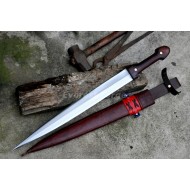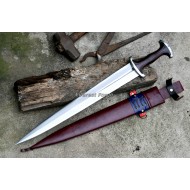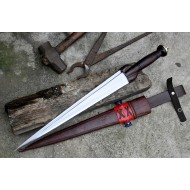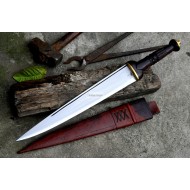
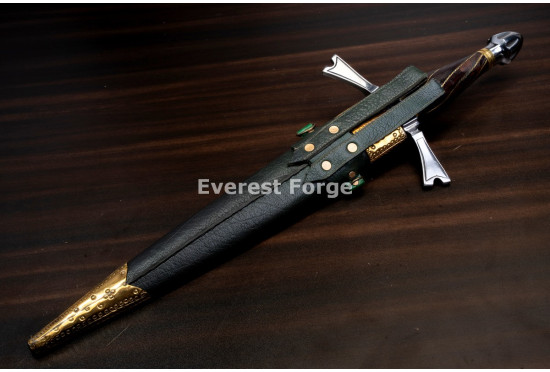


- Model: Hand forged Dagger
- Product Code: Quillon15
- Location: Kathmandu,Nepal
Available Options
What Is a Fishtail Guard Quillon Dagger?
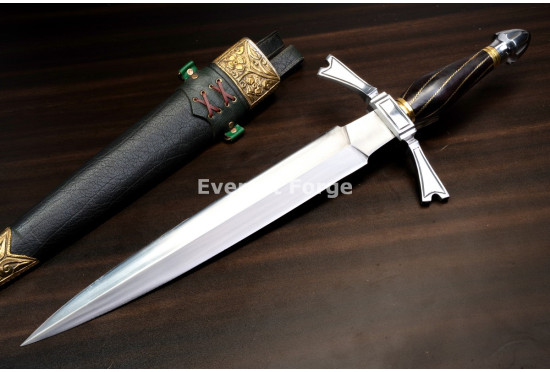
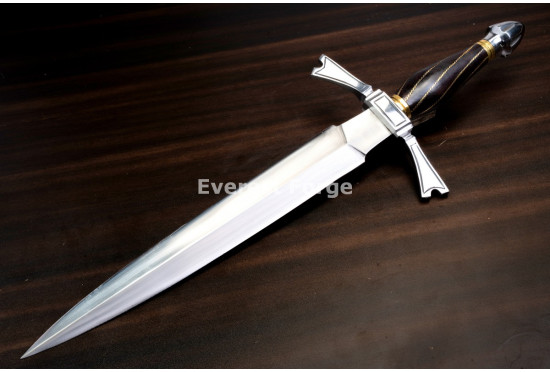
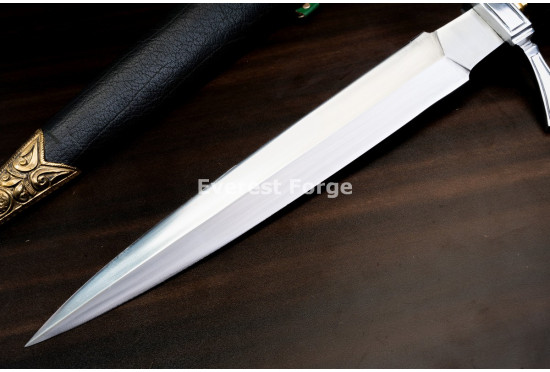
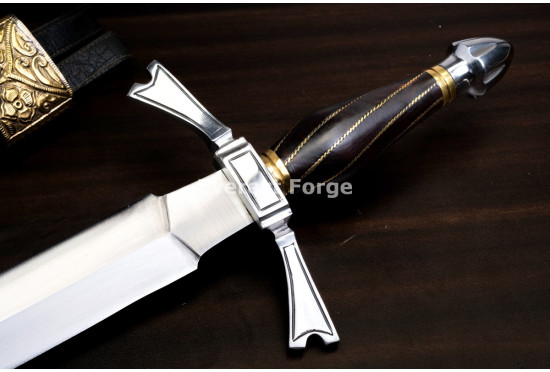
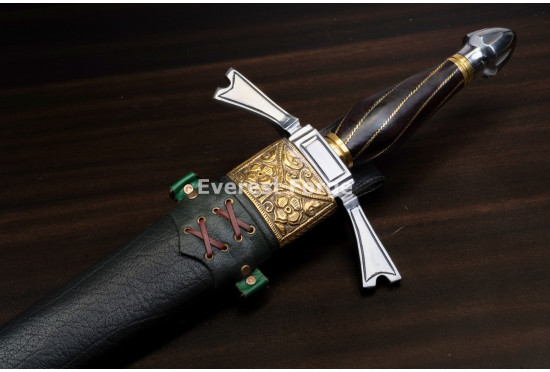
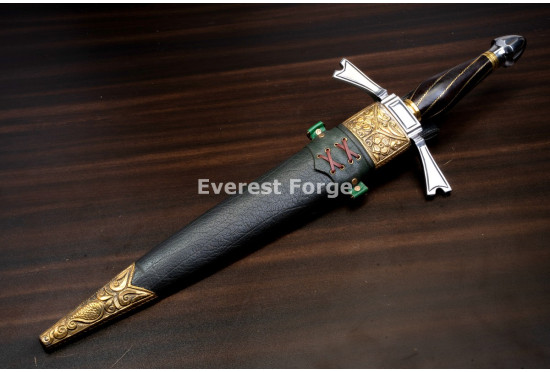
This is a medieval quillon dagger built as a decorated piece rather than a plain sidearm. A quillon dagger uses sword furniture at dagger scale: a cross guard, a shaped grip and a pommel, rather than the lobes or discs of other dagger forms. What sets this one apart is the guard. Each quillon flares outward to a broad end split by a V-notch, in the shape arms scholars call a fishtail, with incised borders running the length of both arms and a raised rectangular block at the centre of the cross. The blade is 15 inches, double-edged and mirror polished, on a 23 inch overall length, and the scabbard carries cast brass mounts at both ends.
The rest of the hilt matches that intent. A waisted rosewood grip with twisted brass wire laid into spiral grooves, a brass ferrule at the guard, and a polished steel bud pommel. It is hand-forged in Nepal from 5160 high-carbon spring steel, and it is the ornamented member of our quillon dagger pair, sitting beside a plainer knightly build for anyone who wants the same form without the decoration.
An honest note. This is a historically informed dagger rather than a copy of a documented find, and there are two things to say plainly. The form is orthodox in every respect that matters. Fishtail quillons, a central block on the cross, a wire-wrapped grip and cast fittings are all genuine features of late medieval decorated daggers, and the construction here follows the period method rather than imitating its appearance. But the combination is ours, not a reproduction of a specific piece in a specific collection, and the decorative vocabulary on the brass mounts is our smiths' own foliate work rather than a European pattern copied from an original. It is also, at 1180 grams, a genuinely heavy dagger. Most of that is furniture rather than blade, which is what happens when a hilt carries this much steel and brass, and you should expect it to feel substantial rather than quick.
Please check your local law before ordering. This is a double-edged fixed blade of 15 inches, and both facts carry legal weight. A great deal of knife legislation treats double-edged daggers as a restricted category in their own right, independent of size, and blade length thresholds then apply on top. At 15 inches this piece sits above ordinary knife allowances in most places and may be regulated as a sword or a bladed weapon rather than as a knife. Import rules frequently differ from possession and carry rules, so check all three for your own address. We ship worldwide but we cannot advise on your jurisdiction. If the second edge is the obstacle, we will sharpen one side and leave the other blunt at no extra cost, and a shorter blade brings the piece back inside far more allowances.
Want the Decoration Taken Further, or Taken Off?
Different quillon terminals, a plain guard, silver rather than brass mounts, a different wire, or your own arms worked into the fittings. Our smiths forge and chase to order in Kathmandu and quote before any steel is cut.
Start a Custom Build →Why This Dagger Is Built the Way It Is
Full Specifications
Blade length, blade finish and grip material are selectable on this listing. The figures above describe the standard build as photographed; what you receive will match the options you choose at checkout. Small variations in weight, dimension and finish are normal in hand-forged work, and cast and chased fittings vary more than machined ones do.
Build It Your Way
Every option below is forged, cast or chased to order in the same workshop. None of them is a part bought in and fitted afterwards.
What This Dagger Does Well, and What It Does Not
What It Is Good At
- Display. Between the fishtail guard, the wire grip and the cast mounts there is more to look at here than on anything else in the dagger range
- Presentation and gifting, which is exactly what decorated daggers were for in period
- Costume and film work at close quarters, where the detail actually reads on camera
- Thrusting, which is what the broad forte and the even taper are for
- Grip security. The wire wrap gives real purchase where polished timber alone would slip
What It Is Not Good At
- Being quick. At 1180 grams with heavy steel and brass furniture, this is a substantial dagger rather than a lively one
- Strict reenactment. The form is orthodox but the decorative vocabulary is our own, not a copied European pattern
- Low maintenance. Mirror-polished steel, brass mounts and leather all want different care
- Utility work. A double-edged thrusting blade cannot be gripped by the spine or used against a board
- Carry. At 15 inches it will fall outside ordinary knife allowances in most jurisdictions
How to Order a Custom Dagger
Want the Same Form Without the Decoration?
Our other quillon dagger is the plain knightly build: a straight cross, a leather grip over a shaped core and a peened wheel pommel, on a longer blade. Same tradition, different intent.
See the Wheel Pommel Dagger →Who This Dagger Is For
- Collectors who buy for the furniture rather than the blade, and want a hilt with genuine work in it
- Buyers looking for a presentation piece or a significant gift, which is what daggers of this class were made to be
- Display and interior buyers who want brass and steel together rather than plain polished steel
- Costume and film buyers working close to camera, where detail reads and a plain hilt does not
- Anyone commissioning armorial work, since the cast mounts can carry a device instead of the foliate pattern
It is not for you if you want a plain working sidearm, in which case take the wheel pommel build, or something to carry and use, in which case any of our single-edged knives will serve you better and be legal in more places.
What Is Included
- The hand-forged quillon dagger, sharpened and ready for display or use
- A leather scabbard with cast brass locket and chape, cross-laced throat and studded belt fitting
- A certificate of authenticity from the workshop
- Care instructions for high-carbon steel, brass fittings and leather
- Everest Forge manufacturer warranty against forging and material defects
Other Blades From the Everest Forge Workshop
Shipping, Returns and Care
Dispatch. Stock pieces leave the workshop within 2-3 business days. Custom builds take 4-6 weeks depending on the queue and the complexity of the work, and decorated pieces sit at the longer end of that because the casting and chasing are done after the blade is finished.
Shipping. Tracked worldwide by DHL or FedEx, typically 7-14 business days in transit from Kathmandu. Customs paperwork is completed accurately and in full. At 15 inches and double-edged, this piece attracts more import scrutiny than an ordinary knife; please check your own country's rules before ordering.
Returns and warranty. Covered by the Everest Forge manufacturer warranty against defects in forging and materials. Custom builds made to your own specification cannot be returned for a change of mind, which is exactly why we confirm everything in writing first.
Care. This piece carries three materials that want three different things, and the commonest mistake is treating them as one. The steel is mirror-polished high-carbon, so wipe it after every handling and keep a light film of oil on it; our wheel pommel dagger page explains why a mirror finish is the least forgiving one we sell. The brass mounts and grip wire will tarnish to a warm dull gold, which most owners prefer to leave; if you would rather keep them bright, use a brass polish and keep it off the steel, because brass compounds are more abrasive than the steel wants. Feed the leather once or twice a year, keeping conditioner off both metals. Do not store the dagger sheathed for long periods.
Quillon Dagger Questions Answered
What kind of dagger is this?
A quillon dagger, which means a dagger built with a cross guard and sword-style furniture rather than the lobes, discs or plain scales that define other dagger forms. It was the sidearm of anyone who already carried an arming sword, and matching pairs were made deliberately. This particular build is the decorated end of the type: fishtail quillons, a wire-wrapped grip, a bud pommel and cast brass scabbard mounts. Our wheel pommel quillon dagger covers the typology and its history in full, and is the plainer working build of the same form.
How does it compare with your other quillon dagger?
Same hilt tradition, opposite intent. The Quillon Dagger, Wheel Pommel is a plain knightly sidearm: a straight cross with flat flared terminals, a black leather grip over a shaped core, a peened wheel pommel and a 17 inch blade with an etched panel as its only ornament. This one is 15 inches with fishtail quillons and incised borders, a raised central block on the cross, brass wire in a waisted timber grip, a bud pommel, and cast brass mounts at both ends of the scabbard. It is also 260 grams heavier despite being two inches shorter, almost all of it in the furniture. Choose the wheel pommel if you want a dagger that reads as a weapon, and this one if you want a dagger that reads as an object.
What is the raised block in the middle of the cross guard for?
It solves a problem most buyers never notice. A cross guard has a slot cut through its middle for the tang to pass through, and that slot removes material from precisely the point where the guard is most heavily loaded, because everything the arms do is levered against the centre. A guard that is a uniform bar is therefore at its weakest exactly where it needs to be strongest. Thickening the middle into a raised block puts that material back, and it does so without making the arms clumsy, which is why the quillons on a piece like this can be slender and still hold shape. It also gives the pommel and grip a defined shoulder to compress against when the hilt is drawn up tight. The decorative panel worked into the face of the block is a bonus rather than the reason it is there.
What is a dagger's cross guard actually for?
Not parrying, which is the assumption most people arrive with. On a sword, the cross does defensive work. On a dagger it has one primary job: to stop the hand travelling forward onto the blade when a thrust lands and comes to a sudden stop. Anyone who has driven a knife into something hard and felt their hand slide will understand immediately why it matters. That single purpose is also why a dagger guard can be as thin and as decorated as this one is. It only ever loads along the line of the blade, not sideways against another weapon, so it does not need the section a sword guard needs, and makers were free to shape the terminals into whatever their eye and their customer preferred. That is exactly why quillon terminals are the most varied element on surviving daggers and why they are useful for dating them.
Why are the fittings brass when the hilt is steel, and how do I tell cast from chased?
Brass is used for the locket, the chape, the ferrule and the grip wire because it does things steel will not do easily at this scale. It casts cleanly into fine relief, it can be chased and punched cold without cracking, and it takes and holds a bright colour against dark leather. Reproducing this foliate work in steel is possible but costs many times the labour. The trade is that brass is soft, so mounts will mark where steel would not, and it tarnishes on a different schedule from the blade. Telling cast from chased is worth learning on any decorated piece: a purely cast fitting has soft, rounded detail, identical repeats and often a faint seam where the mould halves met, while chased work shows crisp tool marks, slight variation between repeats and undercut edges a mould cannot release. On these mounts the form is cast and the detail is then sharpened by hand, which is the normal and honest arrangement for work at this price.
How is the wire-wrapped grip made?
Spiral grooves are cut into the shaped timber, twisted brass wire is laid into them, and the ends are captured under the brass ferrule at the guard and beneath the pommel so there is nothing to catch or unwind. It is decoration, but it is not only decoration: the raised wire gives a positive purchase on a polished waisted grip that would otherwise be slippery in a wet or gloved hand, which is the same reason cord and wire wraps appear on swords. The buyer's test is to press the wire with a thumbnail. It should sit down in a cut groove and not move at all; wire glued onto a smooth surface will give slightly and will eventually lift. For how a grip is built underneath, our wheel pommel dagger page sets out the core-and-covering construction in detail.
Why were medieval daggers decorated like this?
Because a dagger was the one weapon a man wore indoors. A sword came off at the door; the dagger stayed on the belt through dinner, through business and through court, which made it the piece of arms most people actually saw you carrying. It became a statement of rank and taste accordingly, and by the late Middle Ages the decorated dagger was as much dress as weapon, subject in some cities to the same sumptuary rules that governed clothing. There is a useful consequence for anyone looking at museum collections today. Decorated daggers survive in numbers out of all proportion to how common they were, because they were kept, inherited and displayed while plain working daggers were used until they wore out and were thrown away. If your impression of medieval daggers is that they were mostly ornate, that is survivorship at work rather than an accurate picture of what hung on most belts.
Is it sharpened on both edges, and how is the blade ground?
Both edges as standard. The blade is broad at the forte, with a stepped shoulder just above the guard where the grind begins, and tapers evenly from there to a fine point rather than running parallel and dropping to a tip. That keeps width and stiffness where the leverage is greatest and puts fineness only in the last few inches, which is the correct arrangement for a blade meant to thrust first and cut second. If a double edge is a problem where you live, we will sharpen one side and leave the other blunt at no extra cost, and the piece looks identical.
Is a blade this long legal where I live?
We cannot answer that for you, and you should be wary of any seller who claims they can. Two separate provisions tend to apply. A great many jurisdictions treat double-edged daggers as their own restricted category regardless of size, and blade length thresholds apply independently on top of that. At 15 inches this sits above the ordinary knife allowance in most places, which means it may be regulated as a sword or a bladed weapon rather than as a knife, and import rules are frequently different again from possession and carry rules. Check all three for your own address before ordering. If length is the obstacle, an 11 or 13 inch build costs no more and is closer to the historical proportion anyway.
Is this historically accurate?
The form is, the specific decoration is not, and we would rather draw that line ourselves than have you find it. Fishtail quillons, incised guard borders, a raised central block, a wire-wrapped waisted grip and cast mounts at the throat and point of the scabbard are all genuine features of late medieval decorated daggers, and they are made here by the period methods rather than imitated. What is ours is the combination and the ornament: the foliate work on the brass is our smiths' own hand, not a European pattern copied from a documented original, and no museum holds a piece this is a reproduction of. If you need something defensible at a strict reenactment, order it plain and shorter and you will have it. If you want a handsome decorated dagger in an orthodox medieval idiom, this is that.
What steel is it, and how is it heat treated?
5160 high-carbon spring steel, the same stock our smiths use for kukris and swords, forged down from leaf spring in the Nepali tradition. It is oil-quenched and then tempered back, producing a blade that holds an edge but stays tough rather than brittle. Toughness matters on any long thrusting blade, because a thrust that lands off-line loads the blade sideways, and that is exactly where a hard, brittle steel snaps and a properly tempered one flexes and returns. It is not stainless and it will take a patina with use.
Will my dagger look exactly like the photographs?
Close, but not identical, and less identical than on a plain piece. The blade profile is drawn out by eye against a pattern and the taper is ground by hand, but it is the decorated elements that vary most: the guard is forged and filed individually so no two sets of fishtail terminals match exactly, the brass mounts are cast and then chased by hand so the foliate work differs in its detail, and the wire is wound one grip at a time. What does not vary is the specification: length, steel, construction, heat treatment and sharpness are held to the same standard on every piece. Our kukri machete page sets out in more detail what can and cannot differ between two blades from the same bench.
| Specification | |
| Blade: | 15 inches. Hand forged from 5160 carbon steel |
| Total Length: | 23 inches |
| Handle: | 8 inches with a 4.5 inch grip, steel cross with fishtail quillons and a raised central block, waisted rosewood grip with twisted brass wire in spiral grooves, brass ferrule, polished steel bud pommel |
| Weight: | 1180 grams the dagger, 1450 grams with the scabbard |
| Note: | Some variation in weight, dimensions and finish may occur as each piece is hand forged. Keep the blade lightly oiled when not in use |