- Model: Historical khukuri
- Product Code: MK1KUKRI
- Location: Kathmandu, Nepal
Available Options
What Is an MK1-Pattern Khukuri?
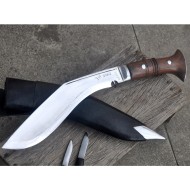
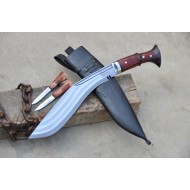
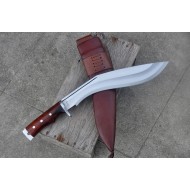
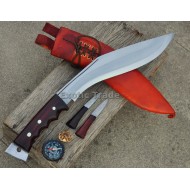
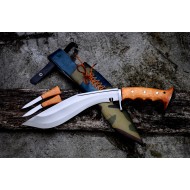
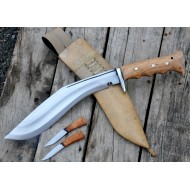
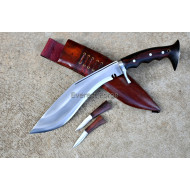
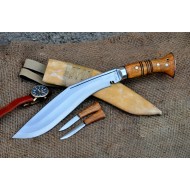
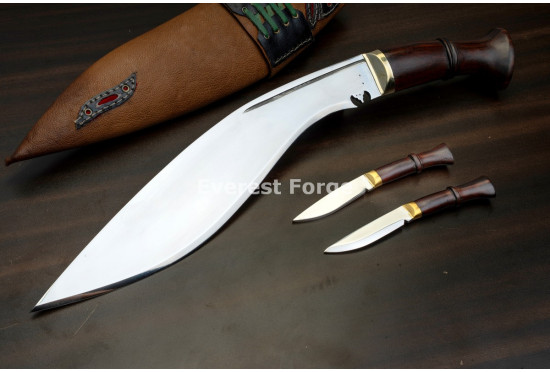
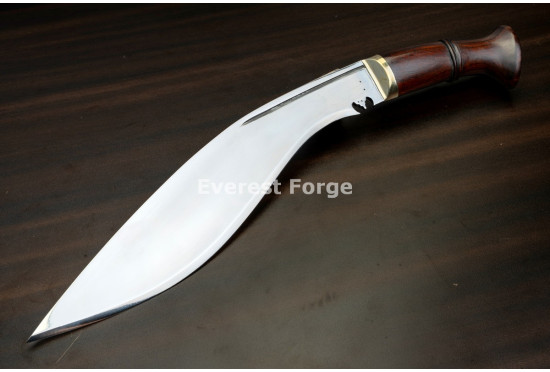
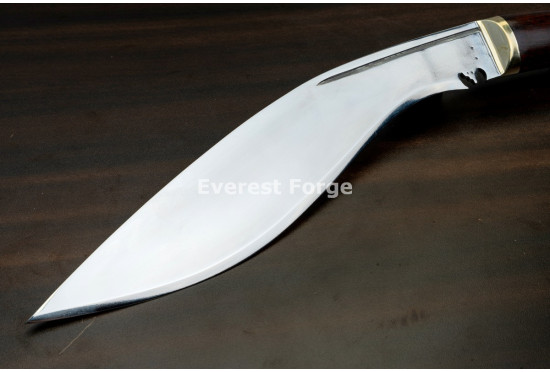
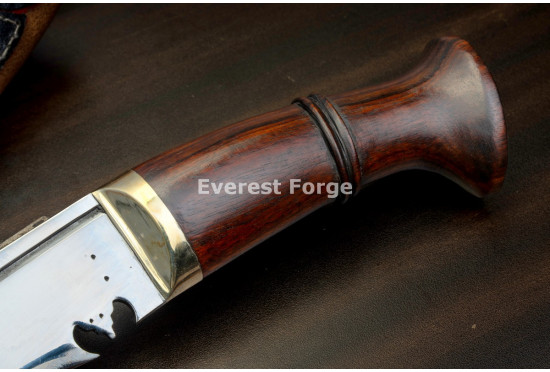
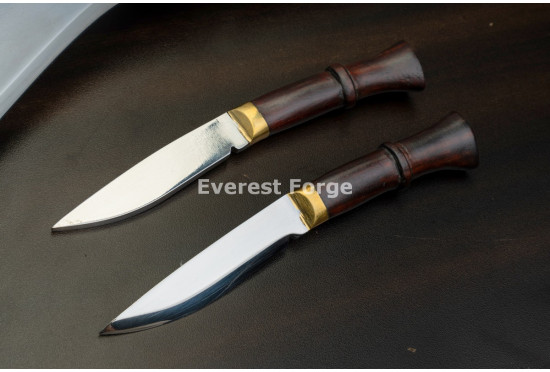
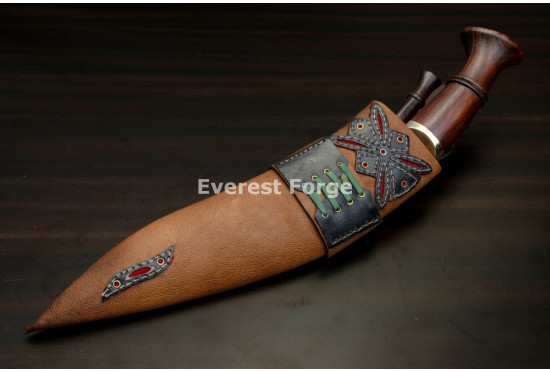
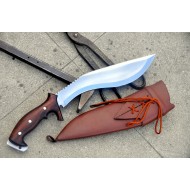
The MK1 was the first officially specified Gurkha service khukuri, formalised by the British Indian Army in 1903 and produced until around 1915. It set the shape every later service khukuri descends from, and of all the numbered patterns it is the one that looks most like an ordinary Nepali working knife, because it was drawn from one. This is a khukuri built to that pattern: a 13 inch broad blade with a single spine fuller, a brass bolster, a flared rosewood grip and 18.5 inches overall, with karda and chakmak in a tan leather scabbard with an applied rosette panel.
It is hand-forged in Kathmandu from 5160 high-carbon spring steel. We describe it as MK1-pattern rather than an MK1 replica, and the distinction is set out plainly below rather than buried.
An honest note on the pattern. A genuine MK1 is identified by its construction, not its silhouette. The 1903 pattern replaced the traditional hidden partial tang with a full-length rat-tail tang closed by a circular nut recessed into the butt, an arrangement borrowed from rifle stock fittings, and that sunken nut is the single clearest way collectors identify these knives. Issue examples also carried steel fittings and plain military scabbards. This khukuri has a flared timber butt with no nut, a brass bolster and a decorated scabbard, so it follows the MK1 shape without the MK1 construction. If you want the real arrangement, we build it; see the question below and our historical replica collection.
An honest note on markings. Genuine service khukuris carry inspection and issue stamps, most commonly FW for Fort William in Calcutta and more rarely QA and RP for Quetta and Rawalpindi. We do not stamp reproduction arsenal marks on new knives, and we will not do it as a custom request. A marked new blade may be honestly sold and honestly bought, but knives outlive their paperwork, and by the third owner a stamped reproduction is indistinguishable from a genuine one. That is the mechanism by which fakes enter the collector market, and we would rather not contribute to it. Engraving your own name, a date or a regimental association is a different matter and we are happy to do that.
Please check your local law before ordering. At 13 inches this blade is above the everyday carry allowance in most jurisdictions, and the khukuri's distinctive shape draws customs attention in some countries. Rules for owning one at home, carrying one in the field and importing one across a border are frequently three separate questions with three different answers.
Want the Real MK1 Construction?
Full rat-tail tang closed with a circular nut sunk into the butt, steel fittings, and a plain military scabbard with a belt frog. Our smiths build it properly. Tell us and we will quote.
Commission a Replica →Why This Khukuri Is Built the Way It Is
Full Specifications
Blade length, blade finish and handle material are selectable on this listing. The figures above describe the standard build as photographed; what you receive will match the options you choose at checkout. Small variations in weight, dimension and finish are normal in hand-forged work.
Build It Your Way
What This Khukuri Does Well, and What It Does Not
What It Is Good At
- Chopping. The MK1 proportions are a working shape first and a military one second
- Camp and field work: clearing, splitting kindling, general heavy cutting
- Handling. At 630 grams for a 13 inch blade it is lively rather than punishing
- Display, particularly with the decorated scabbard, which is more attractive than any issue one
- Being a complete set, with the karda for small jobs and the chakmak for edge maintenance
What It Is Not Good At
- Passing as a genuine MK1. No sunken butt nut, brass fittings, decorated scabbard
- Fine work. It is far too large, which is exactly why the karda is in the scabbard
- Reenactment where kit is inspected. Order the service construction build instead
- Neglect. Carbon steel spots within a day of being put away damp
- Discreet carry. At 18.5 inches with a curved scabbard it is conspicuous
How to Order a Custom Khukuri
Comparing the Period Patterns?
We build the WWI-era pattern at 15 inches and the WWII-era chirra at 13, alongside documented service reproductions. Each covers a different point in the khukuri's military history.
See the Historical Replicas →Who This Khukuri Is For
- Buyers who want the 1903 shape without needing a collector's construction checklist satisfied
- Campers and outdoors users wanting a service-proportioned working blade that is not too heavy
- Collectors building a period series alongside our WWI-era and WWII-era patterns
- Gift buyers, since the decorated scabbard presents far better than a plain military one
- Anyone considering a true replica, since every civilian feature here can be specified out
It is not for you if you need a documented service reproduction, in which case order the service construction build or browse the historical replica collection, or something small and discreet, in which case nothing about a khukuri this size will suit.
What Is Included
- The hand-forged khukuri, sharpened and ready to use
- A karda companion utility knife and a chakmak companion burnisher
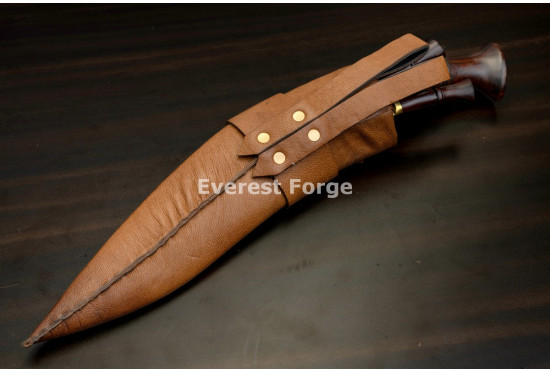
- A tan leather scabbard over a rigid core, with fitted pockets for both companions
- A certificate of authenticity, care instructions, and the Everest Forge manufacturer warranty
Other Blades From the Everest Forge Workshop
Shipping, Returns and Care
Dispatch. Stock pieces leave the workshop within 2-3 business days. Custom builds take 4-6 weeks depending on the queue, and a service construction build sits at the longer end because the tang and butt nut are a different arrangement entirely.
Shipping. Tracked worldwide by DHL or FedEx, typically 7-14 business days in transit from Kathmandu. Customs paperwork is completed accurately and in full. The khukuri is a recognisable shape and attracts more import scrutiny than a plain knife; please check your own country's rules before ordering.
Returns and warranty. Covered by the Everest Forge manufacturer warranty against defects in forging and materials. Custom builds made to your own specification cannot be returned for a change of mind, which is why we confirm everything in writing first.
Care. Wipe the blade dry after every use and keep a light film of oil on it; carbon steel spots within a day of being put away damp, and there are three blades here rather than one, so check the companion pockets too. Run a cloth along the fuller specifically, since a groove holds moisture and a general wipe skips over it. Oil the timber once or twice a year and feed the scabbard leather at the same interval, keeping conditioner off the brass and off the applied rosette, where a dressing can lift the stitching over time. Store all three out of the scabbard.
Questions Answered
What was the MK1, and when was it used?
It was the first officially specified Gurkha service khukuri, formalised by the British Indian Army in 1903 and produced until around 1915, when the MK2 replaced it. Before 1903 there was no standard: khukuris were bought individually in Nepal or carried from home, and no two units carried the same thing. The MK1 changed that, and it is the pattern from which every later British military khukuri descends. What makes it interesting is that of all the numbered marks it stayed closest to the everyday Nepali working shape, because it was drawn from one rather than designed from scratch. The later patterns drifted further from the village original with each revision. So an MK1 is both a military specification and, more or less, a good working khukuri of its day.
Is this a genuine MK1 replica?
No, and the difference is construction rather than shape. The defining feature of the 1903 pattern is not its outline but its tang: the MK1 abandoned the traditional hidden partial tang for a full-length rat-tail tang threaded at the end and drawn up under a circular nut recessed into the butt, an arrangement lifted from rifle stock fittings. That sunken nut is what collectors look for first, and this khukuri does not have one; its butt is plain flared timber. Two further differences: issue khukuris used steel fittings where this has a brass bolster, and issue scabbards were plain where this carries an applied rosette panel and contrast lacing. It follows the MK1 shape faithfully and the MK1 construction not at all, which is why the page says pattern rather than replica. We build the service construction to order.
What do FW and other stamps on old khukuris mean?
They are inspection and issue marks, and they tell you where a blade passed through rather than who made it. FW is the commonest and stands for Fort William in Calcutta, the arsenal and depot through which enormous quantities of equipment moved; the mark usually appears on the spine. QA and RP turn up more rarely for Quetta and Rawalpindi. Some later examples also carry an armoury stamp for the manufacturing arsenal, and British-contracted pieces may carry a broad arrow indicating government property. It is worth understanding that these are provenance marks rather than pattern designations: a khukuri is not a "Fort William pattern", because Fort William did not design anything. It inspected and issued. If a seller offers you a knife described by an arsenal name as though it were a type, that is a small sign they may not know the field well.
Will you stamp reproduction arsenal marks on a knife for me?
No, and this is a firm policy rather than a matter of price or difficulty. Stamping FW, a broad arrow or an armoury mark onto a new blade is easy, and the first sale would be entirely honest: you would know what you had bought and so would we. The problem is what happens afterwards. Knives outlive their paperwork and their owners. A stamped reproduction passes to a second owner with a story attached, and to a third with no story at all, at which point it is indistinguishable from a genuine issue piece to anyone without the blade in hand and the experience to judge it. That is precisely how fakes enter a collector market, and it damages the people who study these things and the honest dealers who trade in them. We would rather decline the work. What we will happily do is engrave your own name, a date, a unit or a dedication, cut properly rather than punched, which is a personal record rather than a false provenance.
How does it compare with your other period khukuris?
Three pages covering three points in the military history. This one is the earliest, built to the 1903 MK1 proportions at 13 inches with a single spine fuller. Our WWI-era pattern khukuri is the largest at 15 inches, with older, longer proportions closer to the nineteenth century heritage sizes that the service patterns were shrinking away from. Our WWII-era chirra khukuri is 13 inches with chirra fullering and panawal riveted construction, which is the most robust build of the three. All three are period patterns rather than service replicas, and all three say so. For documented reproductions with the correct tang and fittings, the historical replica collection is the right place to look.
Why did the MK1 change how the handle was attached?
Because an army needs equipment it can inspect and repair, and the traditional construction allows neither. A village khukuri has a partial tang set into a drilled handle and fixed with laha, a resin adhesive. It is genuinely strong and it is completely invisible from outside, which means nobody can assess a given knife without destroying it. Replacing that with a full-length tang threaded at the end and drawn up under a nut sunk into the butt changed three things at once: the handle could be tightened when it worked loose, replaced when it split, and checked by an inspector in seconds. It is a small change that tells you a great deal about the difference between a knife made for a household and one made for a quartermaster. Our chirra khukuri page sets out the third method, panawal riveted construction, which is what a modern working khukuri usually uses.
Does it come with the karda and chakmak?
Yes, both, in fitted pockets on the scabbard. The karda is the small sharpened utility knife for jobs a 13 inch blade cannot manage, and the chakmak is a burnisher for truing the khukuri's edge between sharpenings and for striking sparks from flint. The chakmak is meant to be blunt and that is not a fault; our kukri with karda and chakmak page explains what both tools do and how to use the chakmak properly. Worth reading if you have not used a set before.
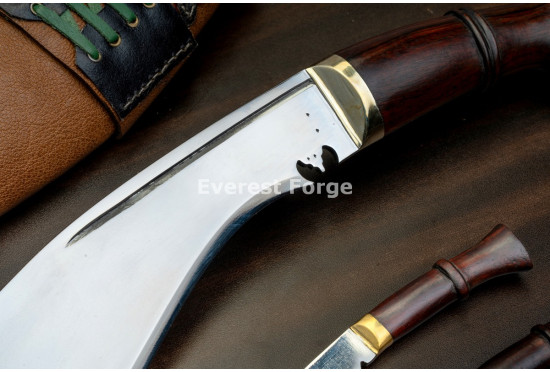
What is the notch cut into the blade at the bolster?
That is the cho, and on this piece it is cut in the more elaborate form you often see on dress and better-quality khukuris rather than the plain rounded notch of a working blade. Its practical job is to interrupt a crack: a split starting at the edge travels back along the blade until something stops it, and the rounded terminus of the cho is that stop, which is why it is always finished round rather than left sharp. It also marks where the sharpened edge terminates, so a stone has a definite place to stop. It carries symbolic meaning in Nepal as well, and that meaning varies by region and by who you ask, so we will not flatten several traditions into one tidy sentence. As a buyer's test it is genuinely useful: a khukuri without a cho is almost always a foreign-made copy.
Is it a working knife or a display piece?
Both, more comfortably than most in this range. The blade is a genuine working shape at a genuine working weight, forged and heat treated the same way as the khukuris our smiths send to households in Nepal, and it will chop, split and clear without complaint. The scabbard is the decorative half: the applied rosette, the contrast lacing and the tan leather are dress work rather than field kit, and they will mark and weather if you carry it seriously. That is a fair combination for most buyers. If you want a hard-use piece, order the plain scabbard and a forge finish and you will have something that looks better after five years of work rather than worse.
Is a khukuri this size legal where I live?
We cannot answer that for you and you should be careful of any seller who claims they can. At 13 inches this blade is above the everyday carry allowance in most jurisdictions, and the khukuri's distinctive shape means it is sometimes named or recognised specifically where a plain knife of the same size would pass without comment. Rules for owning one at home, carrying one while working outdoors and importing one across a border are frequently three separate matters with three different answers. Check all three for your own address before ordering. If length is the obstacle, a 10 or 11 inch build costs no more.
What steel is it, and how is it heat treated?
5160 high-carbon spring steel, forged down from leaf spring in the Nepali tradition, which is the same stock and the same method our smiths use for khukuris that go to working households in Nepal. It is oil-quenched and then tempered back. On a chopping blade toughness matters more than outright hardness, because the edge will meet things it was not aiming at, and a blade that rolls and can be trued back is far more use than one that chips. It is not stainless: it will take a patina with use and it will rust if left wet.
Will my khukuri look exactly like the photographs?
Close, but not identical. The curve is drawn out by eye and hammered rather than cut from a template, so the sweep of the belly varies from smith to smith and from piece to piece; two khukuris from the same bench on the same day differ visibly in profile. The cho is cut by hand, the bolster is fitted by hand, and rosewood differs board to board in colour and figure. The scabbard varies most of all here, because the rosette is cut, stitched and laced individually rather than pressed from a die. What does not vary is the specification: length, steel, construction, heat treatment and sharpness are held to the same standard on every piece.
| Specification | |
| Blade: | 13 inches. Hand forged from 5160 carbon steel |
| Total Length: | 18.5 inches |
| Handle: | 5.5 inches. Rosewood with brass bolster and flared butt |
| Weight: | 630 grams the khukuri, 1020 grams with the scabbard |
| Note: | Handmade variation in weight, dimensions and finish may occur. Keep blade lightly oiled when not in use. |