Menu
Your Cart

Hand-Forged Medieval Quillon Dagger, Knotwork Pommel

Hand-Forged Medieval Quillon Dagger, Knotwork Pommel
$219.99
Ex Tax: $219.99
  • Model: Hand forged Dagger
  • Product Code: DAGGER1005
  • Location: Kathmandu,Nepal

Available Options

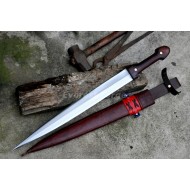
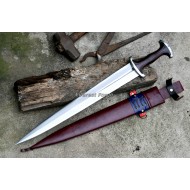
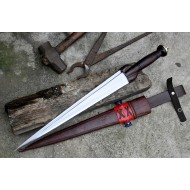
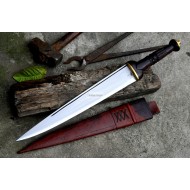
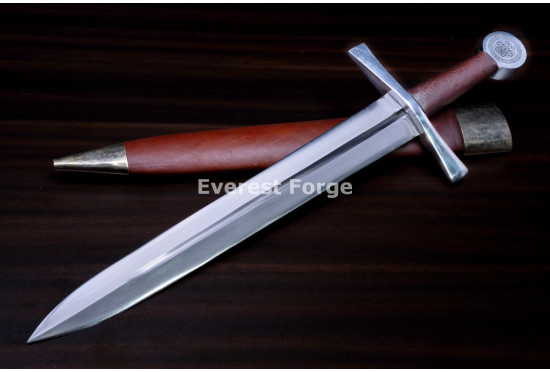
Hand-Forged Medieval Quillon Dagger — Knotwork Pommel and Diamond Blade

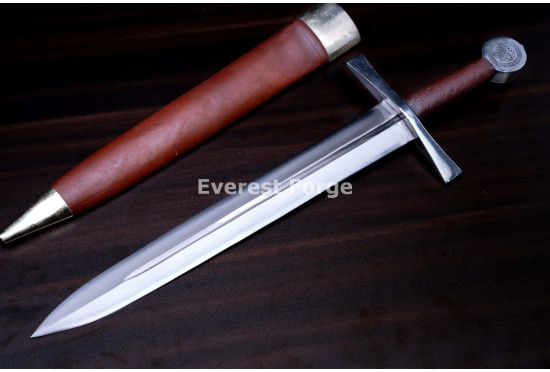
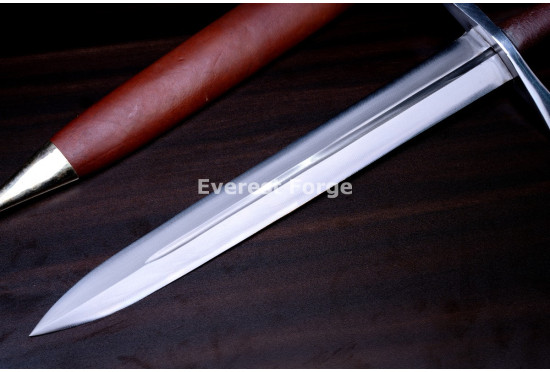
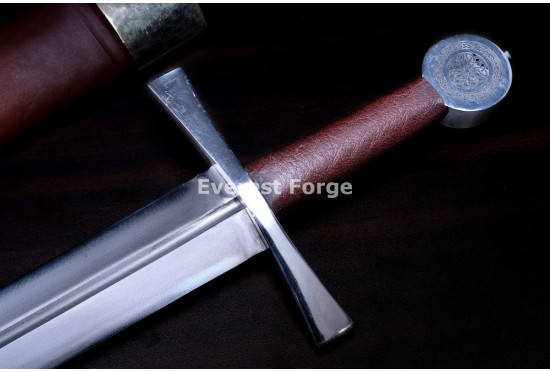
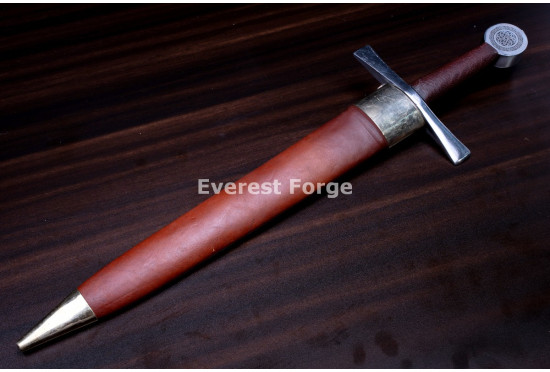
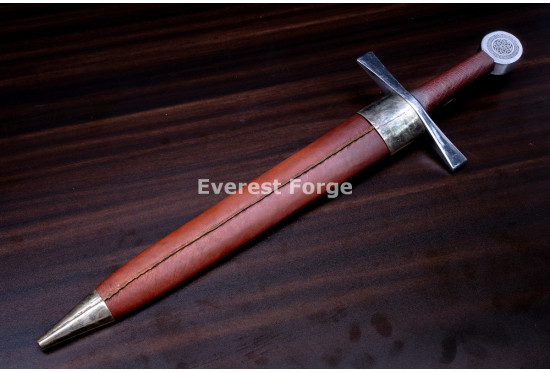
This is a hand-forged, fully functional medieval quillon dagger — a broad double-edged blade of diamond section tapering to a strong point, forged in Nepal from 5160 high-carbon spring steel, oil-tempered, full tang, and sharpened to a true edge. The hilt is a sword hilt in miniature: a straight steel cross with squared flared terminals, a wood grip under an oxblood leather wrap, and a disc pommel carrying an engraved knotwork roundel. It ships with a matching leather scabbard with a steel throat and chape. Every piece is made to order in your chosen size, finish, and engraving.

The standard blade is 16 inches on a 6-inch hilt with a 4-inch grip, for an overall length around 22 inches at about 1 kg. That is a large quillon dagger — the knightly sidearm carried alongside an arming sword rather than instead of one — with enough blade to have real presence and a grip sized for a single hand. The oil-tempered 5160 steel and full tang make it a working blade, not a cast wall-hanger.

An honest note. One point of precision worth making. At sixteen inches of blade this sits right at the top of what anyone would call a dagger — most daggers stop around twelve inches, and even the large medieval quillon daggers rarely passed fifteen. It is a fair name for this hilt form, but a museum cataloguing it would probably note that it is on the boundary with a short sword. We would rather tell you that than let you find out from a collector. The other honest point: this is a modern piece built in the medieval tradition, not a reproduction of a specific catalogued dagger.

Bespoke Service

Forge a Dagger to Your Own Design

Want a shorter historical blade length, a different pommel, a fullered blade instead of diamond section, or your own engraving? Our Custom Forge service builds to your spec, by hand in Kathmandu.

Request a Custom Forge →

What Is a Quillon Dagger?

A quillon dagger is a medieval dagger built like a small sword — a straight double-edged blade, a cruciform cross guard whose arms are the quillons, and a pommel to balance it. The name comes from those cross arms, which is what distinguishes the form from the other medieval dagger families: the rondel dagger with its flat discs above and below the grip, the ballock dagger with its lobed base, and the baselard with its I-shaped hilt. Quillon daggers were the sidearm of the knightly class from roughly the 13th century onward, worn on the belt alongside an arming sword and often made to match it, so that a man's dagger and his sword shared the same fittings and the same maker's style. They ran from small belt knives up to the very large examples of which this one is a modern interpretation.

Real Forged BladeHand-forged 5160 spring steel, full tang, oil-tempered and sharpened.
Diamond SectionCentral ridge running the length of the blade — stiff, and built to thrust.
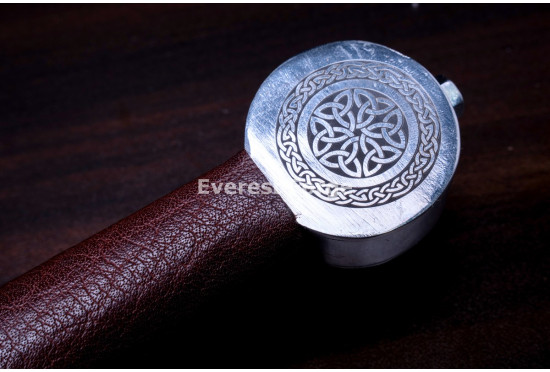
Knotwork PommelDisc pommel with an engraved interlace roundel, in polished steel.
5160 Spring SteelTruck leaf-spring steel — tough, shock-resistant, holds an edge.
Wrapped Leather GripWood core under an oxblood leather wrap, sized for one hand.
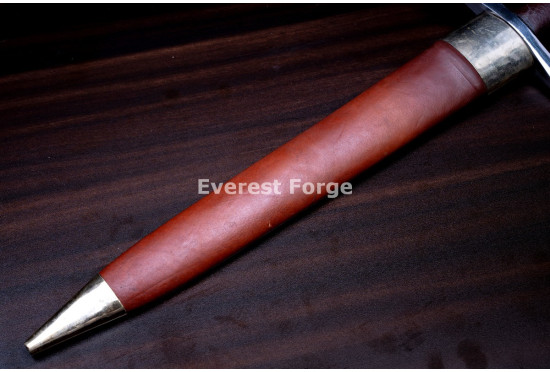
Fitted ScabbardMatching leather scabbard with a steel throat and chape at the tip.

Specifications

TypeHand-forged medieval quillon dagger, cruciform hilt
Blade Length16 inches standard (custom lengths to order)
Handle Length6 inches overall, 4-inch grip section
Overall LengthApprox 22 inches at standard blade size
WeightApprox 1000 g total, 820 g blade
Blade Steel5160 high-carbon spring steel (truck leaf spring)
Heat TreatmentOil-tempered — hard edge, flexible spine
Blade StyleDouble-edged, diamond section with a central ridge, tapering to a strong point, satin finish, sharpened
TangFull tang, peened at the pommel
HandleWood grip under an oxblood leather wrap
FittingsPolished steel cross with squared flared terminals, disc pommel with engraved knotwork roundel
ScabbardLeather with steel throat and chape, included
OriginHand-forged in Tokha-3, Kathmandu, Nepal

Customize Your Dagger

Every piece is forged to order. Set your options before you add to cart:

Blade LengthStandard 16 inches, or a shorter historical dagger length, or longer to your spec.
Blade SectionDiamond section as standard, or a fullered blade if you want it lighter.
Blade FinishSatin as standard, or mirror-polished, dark forge finish, or antiqued.
Pommel StyleKnotwork disc as standard, or a plain disc, wheel, or brazil-nut pommel.
Grip WrapOxblood leather as standard, or black, brown, green, or cord.
EngravingYour own pattern on the pommel, or a name or date on the blade.

Hand-Forged, Not a Wall-Hanger

This Dagger

  • Hand-forged 5160 high-carbon spring steel
  • Oil-tempered, hard edge and flexible spine
  • Full tang, peened over the pommel
  • Diamond section forged and ground, with a real distal taper
  • Sharpened, balanced, made to your spec

A Wall-Hanger

  • Cast stainless, brittle under load
  • No real heat treatment
  • Rat-tail tang that snaps at the guard
  • Flat blade with no section and no taper
  • Blunt, display-only

How It Is Made

You set the spec — blade length, section, finish, pommel style, wrap colour and any engraving.
A smith forges the blade from a 5160 leaf-spring billet and grinds the diamond section and taper.
The blade is oil-tempered, then polished to a satin finish and hand-sharpened along both edges.
We fit the cross and pommel, engrave the roundel, wrap the grip, peen the tang, build the scabbard, and ship worldwide tracked.

Who It Is For

  • Collectors of medieval European arms who want a dagger that matches a sword rather than a novelty blade
  • Reenactors and living-history groups needing a knightly sidearm to wear with an arming sword
  • Buyers who want a large, impressive blade without the length of a full sword
  • Larp and costume users, who should order the display-blunt option
  • Gift buyers personalizing the pommel roundel or the blade
  • Anyone who wants a matched pair — order this alongside a sword and we will build the fittings to match

What Is Included

  • One hand-forged medieval quillon dagger, built to your chosen spec
  • Leather scabbard with steel throat and chape
  • Wood grip under an oxblood leather wrap, with polished steel cross and knotwork disc pommel
  • Any personalization or engraving you ordered
  • A satin-finished, diamond-section, sharpened blade
  • Everest Forge manufacturer warranty

Explore More Medieval Blades

Medieval Fantasy LongswordHand-and-a-half blade →
Swords by CultureBrowse by tradition →

Shipping, Returns & Care

Shipping

In-stock specs dispatch within 2 to 3 business days; fully custom builds take roughly 4 to 6 weeks to forge before dispatch. We ship worldwide by DHL or FedEx in 7 to 14 business days, tracked. Import and blade laws vary by country, so please check your local rules before ordering — double-edged blades are restricted in more places than single-edged ones, so this is worth checking carefully.

Returns & Warranty

Every blade is backed by the Everest Forge warranty against forging and material defects. If something is wrong with your order, we will repair, replace, or refund it. Personalized and custom-engraved pieces are made to order, so please confirm your spec carefully before purchase.

Care

Wipe the blade clean and dry after handling, and apply a light coat of oil before storage to protect the high-carbon steel from moisture. The engraved roundel on the pommel holds dust in its grooves, so give it an occasional brush. Treat the leather wrap and scabbard with a conditioner now and then, and do not store the dagger inside the scabbard for long periods.

From The Forge

Build a Matched Sword and Dagger

Medieval daggers were often made to match their owner's sword, sharing the same fittings and the same hand. Our Custom Forge service will build a dagger and sword as a matched pair — same cross, same pommel, same wrap. Roughly 4 to 6 weeks from order.

Start a Custom Forge →

Frequently Asked Questions

What is a quillon dagger?

A quillon dagger is a medieval dagger built like a small sword: a straight double-edged blade, a cruciform cross guard whose arms are the quillons, and a pommel to balance it. The name comes from those cross arms. It is one of four main medieval dagger families, and the cross is what separates it from the others — the rondel dagger has flat discs above and below the grip, the ballock dagger has a lobed base, and the baselard has an I-shaped hilt. Quillon daggers were the knightly sidearm from roughly the 13th century onward.

Why is a 16-inch blade called a dagger?

Because the type is defined by the hilt form rather than by length, and this is unambiguously a quillon dagger hilt — a cross, a single-hand grip and a pommel, in the proportions a dagger uses rather than a sword. That said, sixteen inches is at the very top of the range. Most daggers stop around twelve inches of blade, and even the large medieval quillon daggers rarely passed fifteen, so a museum cataloguing this would likely note that it sits on the boundary with a short sword. We would rather say that plainly than have you learn it from someone else. If you want a blade squarely inside the historical dagger range, order a shorter one through Custom Forge.

What is a diamond section, and why does it matter?

Look at the blade end-on and you will see it is not flat — it rises from each edge to a ridge running down the centre, so the cross-section is a flattened diamond. That shape is the main alternative to a fullered blade and it does a completely different job. A fuller removes metal from the middle to save weight; a diamond section keeps metal in the middle and makes the blade far stiffer, because stiffness in a beam comes from depth at the centre. The result is a blade that resists flexing when you drive the point into something, which is exactly what you want on a thrusting weapon. The trade-off is that a diamond-section blade is heavier than a fullered one of the same dimensions and it does not cut quite as cleanly, because the thick centre has to be pushed through the target behind the edge. Medieval smiths chose between the two deliberately: fullers on cutting swords, diamond sections on blades meant to thrust into the gaps in armour.

What was a knightly dagger actually used for?

Three things, and only one of them is fighting. It was a sidearm of last resort — a knight in armour who lost or could not use his sword closed the distance and went for the gaps at the visor, armpit and groin, which is why so many medieval daggers are built stiff and pointed rather than broad and sharp. It was everyday equipment, used for eating, cutting cord and the hundred small jobs a belt knife handles. And it was a status object: a well-made dagger was worn visibly, often matched to the owner's sword with the same fittings by the same maker, and it said as much about a man as his horse did. That last point is why we offer sword and dagger as a matched pair.

How does this differ from your Crusader Arming Sword?

Scale and role. The Crusader Arming Sword has a 22-inch blade and is a sword — a primary weapon, meant to be used with a shield. This has a 16-inch blade and a shorter grip, and is a sidearm: worn on the belt alongside a sword rather than instead of it. Both are single-hand and both carry a diamond-section blade, so they are close cousins in construction, and the fittings differ mainly in the pommel — this one carries an engraved knotwork roundel where the crusader is plainer. If you are buying one blade, buy the sword. If you want the pair as a knight would actually have worn them, order both and we will match the fittings.

Is this a real, functional blade?

Yes. It is hand-forged from 5160 high-carbon spring steel, full tang, oil-tempered, and sharpened to a true cutting edge before it ships. The cross and pommel are solid steel and the tang is peened over the pommel rather than glued or threaded. It is built to be handled and used. Do not use the point as a pry bar and do not cut anything you would not put a good knife through.

What steel is it, and is it oil-tempered?

The blade is forged from 5160 high-carbon spring steel, the same alloy used in heavy-duty truck leaf springs, prized for toughness and edge retention. It is oil-tempered for a hard cutting edge backed by a flexible, shock-absorbent spine. On a stiff thrusting blade that toughness matters — a hard, brittle point is the part most likely to snap under load, and 5160 gives you a point that bends before it breaks.

Is it full tang?

Yes. The tang runs the full length of the hilt and is peened over at the pommel, so the cross and grip are mechanically captured on the tang itself. There is no rat-tail, no weld, and no glued-in stub to fail. This matters more on a thrusting blade than people expect: driving a point into something loads the hilt in compression against the pommel, and a threaded or glued assembly works loose.

What is the design engraved on the pommel?

An interlace roundel — the continuous woven line-work found across medieval European decorative metalwork, best known from Insular and Celtic sources but used far more widely than that. It is engraved into the face of the disc pommel rather than cast or stamped into a fitting, which is why the lines have depth and why the pattern varies slightly between pieces. You can specify your own pattern, a monogram or a date instead, or a plain undecorated pommel if you prefer restraint.

Does it arrive sharpened?

Yes, sharpened as standard along both edges, finished by hand. If you need it blunt for reenactment, larp, stage use, display, or to satisfy import rules where you live, choose the display-blunt option or tell us in your order notes. There is no extra charge either way. Note that double-edged blades face tighter import restrictions than single-edged ones in a number of countries, so check your local rules before ordering.

Can I order a different length, section, or pommel?

Yes. Blade length, blade section, pommel style, wrap colour and engraving are all adjustable to order. The section is the interesting choice: a fullered blade in place of the diamond section gives you something lighter and faster in the hand that cuts better and thrusts less stiffly. Tell us what you want the blade to do rather than only what dimensions you want, and we will tell you honestly what the trade-off costs you.

Do you ship worldwide, and how long does it take?

Yes. We ship worldwide from Nepal by DHL or FedEx in 7 to 14 business days with tracking. In-stock specs dispatch within 2 to 3 business days; fully custom builds take roughly 4 to 6 weeks to forge first. Import and blade laws vary by country and double-edged blades are restricted in more places than single-edged ones, so please check your local rules carefully before ordering.

Specification
Blade: 16 inches. Hand forged from 5160 carbon steel
Total Length: 21 inches long in total
Handle: 6 inches overall with a 4 inch grip section. Full tang, wood under an oxblood leather wrap, with polished steel cross and engraved knotwork disc pommel
Weight: Approx 1000 grams total (blade approx 820 grams)
Note: As every piece is forged by hand, slight variation in weight, dimensions and finish may occur. Leather colour and engraving detail vary slightly between pieces. Keep the blade lightly oiled when not in use.

Write a review

Note: HTML is not translated!
Bad Good
Captcha