Menu
Your Cart

Hand-Forged Hunting Dagger, Rosewood Handle

Hand-Forged Hunting Dagger, Rosewood Handle
$144.99
Ex Tax: $144.99
  • Model: Quillon Dagger
  • Product Code: HuntingDagger012
  • Location: Kathmandu,Nepal

Available Options

Hand-Forged Hunting Dagger — Broad Blade with Rosewood Handle

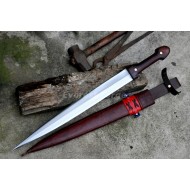
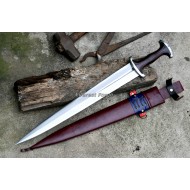
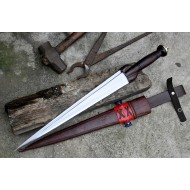
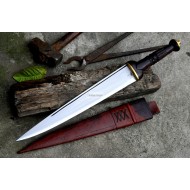
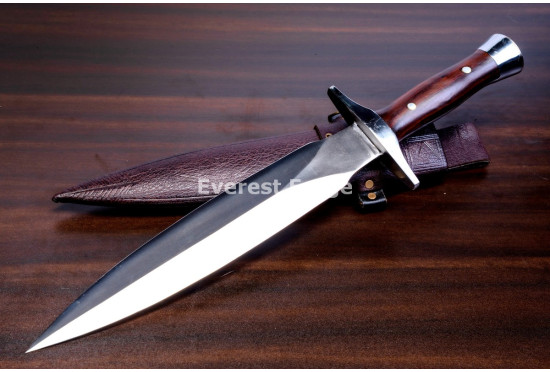
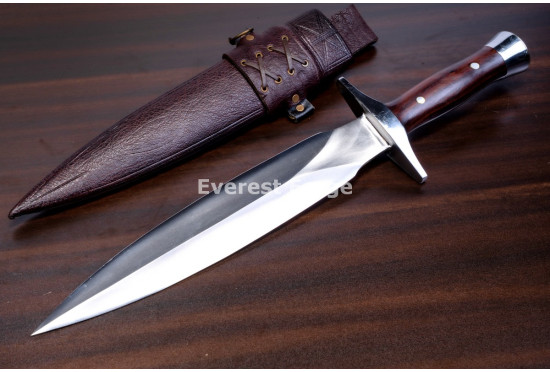
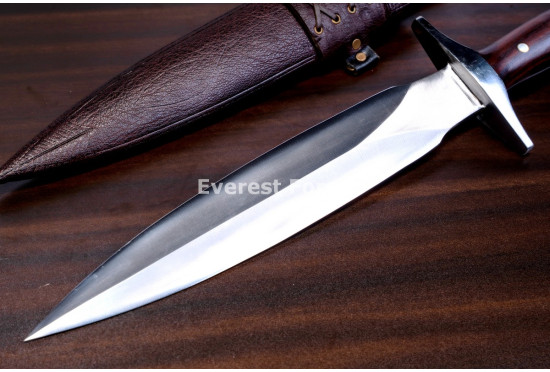
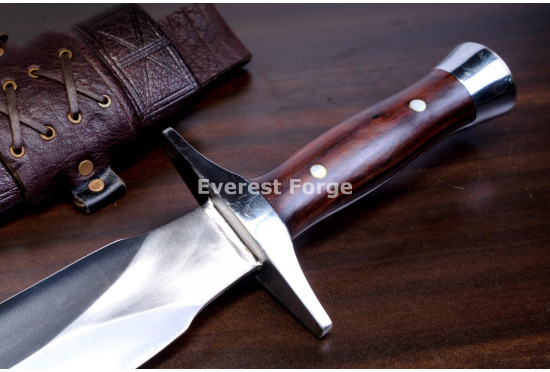
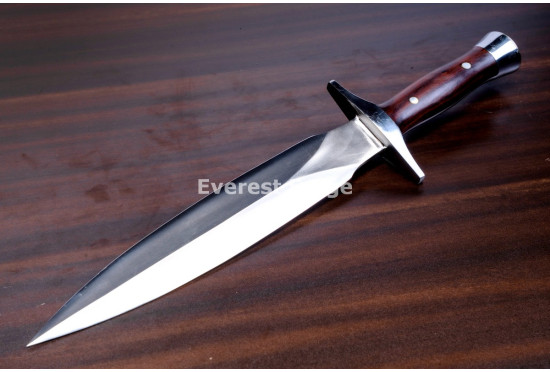
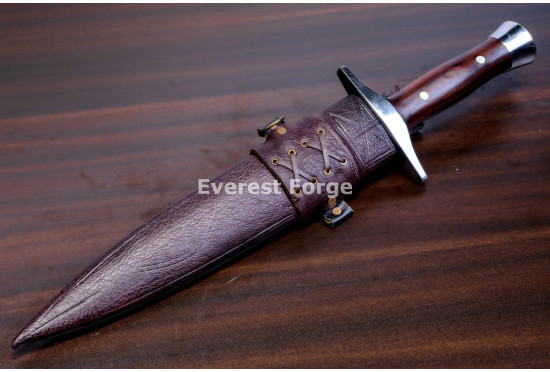
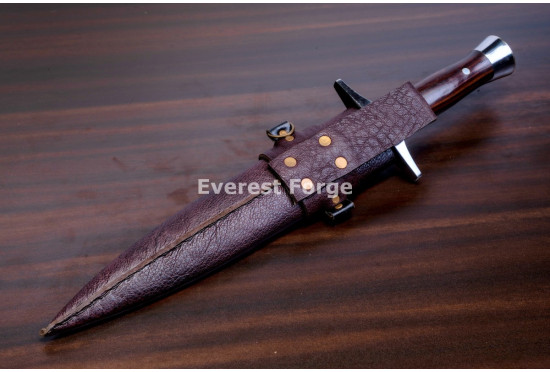
This is a hand-forged, fully functional hunting dagger — a broad, double-edged blade with a central ridge running to a strong point, forged in Nepal from 5160 high-carbon spring steel, oil-tempered, full tang, and sharpened to a true edge. The blade is finished satin. The fittings are plain and purposeful: a squared steel cross guard, a shaped rosewood grip pinned through the tang, and a polished steel pommel cap. It ships with a brown leather sheath with cross-lacing and brass eyelets. Every piece is made to order in your chosen size, finish, and engraving.

The standard blade is 12 inches on a 6-inch hilt with a 4.5-inch grip, for an overall length around 18 inches at about 830 g. That is a true dagger size — long enough to be a serious blade, short enough to wear on a belt all day without thinking about it. It is also light in the hand for its length, which is what a working hunting blade wants.

An honest note. This is a modern hunting dagger built in the European tradition rather than a reproduction of a specific historical piece. The form is genuine — a broad double-edged blade with a stiff central ridge and a simple cross guard is exactly what a hunting dagger looked like across several centuries — but the dimensions are ours and the satin finish is brighter than a period working blade would have carried. It is also worth saying plainly that a double-edged blade of this size faces tighter import restrictions in a number of countries than a single-edged one of the same length. Please check your local rules before ordering.

Bespoke Service

Forge a Dagger to Your Own Design

Want a shorter blade, a single-edged version, a matched set with one of our hunting swords, or your own engraving? Our Custom Forge service builds to your spec, by hand in Kathmandu.

Request a Custom Forge →

What Is a Hunting Dagger?

The hunting dagger is one of the longest-lived blade types in Europe, carried by hunters from the medieval period through to the nineteenth century and still made today. In German-speaking countries it is the Hirschfanger family, literally the stag-catcher, and it existed because hunting produced a job a bow, a spear or a gun could not finish: a wounded animal at close quarters. A dagger of this size is stiff enough to be driven accurately, short enough to control in a struggle, and useful afterwards for the field work that follows a kill. Because hunting was also a display of status, these blades were often finely made — staghorn grips, engraved blades, decorated scabbards — but the working form underneath is always the same: broad, double-edged, stiff through the middle, and unfussy at the hilt.

Real Forged BladeHand-forged 5160 spring steel, full tang, oil-tempered and sharpened.
Broad Double EdgeWide blade with a central ridge — stiff enough to drive, keen on both edges.
True Dagger SizeTwelve inches of blade, light in the hand and easy to wear all day.
5160 Spring SteelTruck leaf-spring steel — tough, shock-resistant, holds an edge.
Pinned Rosewood GripShaped rosewood pinned through the tang, with a polished steel cap.
Laced SheathBrown leather with cross-lacing and brass eyelets.

Specifications

TypeHand-forged hunting dagger, double-edged
Blade Length12 inches standard (custom sizes to order)
Handle Length6 inches overall, 4.5-inch grip section
Overall LengthApprox 18 inches at standard blade size
WeightApprox 830 g total, 660 g blade
Blade Steel5160 high-carbon spring steel (truck leaf spring)
Heat TreatmentOil-tempered — hard edge, flexible spine
Blade StyleBroad double edge with a central ridge, tapering to a strong point, satin finish, sharpened
TangFull tang with pinned grip
HandleShaped rosewood, pinned through the tang
FittingsPolished steel squared cross guard and pommel cap
SheathBrown leather with cross-lacing and brass eyelets, included
OriginHand-forged in Tokha-3, Kathmandu, Nepal

Customize Your Dagger

Every piece is forged to order. Set your options before you add to cart:

Blade LengthStandard 12 inches, or shorter, or longer to your spec.
EdgesDouble-edged as standard, or single-edged where import rules require it.
Blade FinishSatin as standard, or polished, dark forge finish, or antiqued.
Grip MaterialRosewood as standard, or buffalo horn, bone, or walnut.
Matched SetOrder alongside one of our hunting swords and we will match the fittings.
EngravingAdd a name, date, or your own pattern to the blade or sheath.

Hand-Forged, Not a Wall-Hanger

This Dagger

  • Hand-forged 5160 high-carbon spring steel
  • Oil-tempered, hard edge and flexible spine
  • Full tang with the grip pinned through it
  • Central ridge forged and ground, with a real distal taper
  • Sharpened, balanced, made to your spec

A Wall-Hanger

  • Cast stainless, brittle under load
  • No real heat treatment
  • Rat-tail tang glued into a hollow grip
  • Flat blade with no section and no taper
  • Blunt, display-only

How It Is Made

You set the spec — blade length, edges, finish, grip material and any engraving.
A smith forges the blade from a 5160 leaf-spring billet and draws the central ridge and the taper.
The blade is oil-tempered, then finished to satin and hand-sharpened along both edges.
We fit the cross guard, pin the rosewood grip, fit the cap, cut and lace the sheath, and ship worldwide tracked.

Who It Is For

  • Collectors of European hunting arms who want the working form rather than a decorated presentation piece
  • Buyers who want a large dagger that is genuinely wearable rather than a display blade
  • Anyone building a matched hunting set alongside a hanger or hunting sword
  • Reenactors and living-history groups, who should order the display-blunt option
  • Gift buyers personalizing a blade with a name, date, or engraving
  • Not for buyers in jurisdictions restricting double-edged blades — order the single-edged version

What Is Included

  • One hand-forged hunting dagger, built to your chosen spec
  • Brown leather sheath with cross-lacing and brass eyelets
  • Shaped rosewood grip pinned through the tang, with steel cross guard and pommel cap
  • Any personalization or engraving you ordered
  • A satin-finished, sharpened double-edged blade
  • Everest Forge manufacturer warranty

Explore More Hand-Forged Blades

Shipping, Returns & Care

Shipping

In-stock specs dispatch within 2 to 3 business days; fully custom builds take roughly 4 to 6 weeks to forge before dispatch. We ship worldwide by DHL or FedEx in 7 to 14 business days, tracked. Import and blade laws vary by country, and double-edged blades face tighter restrictions than single-edged ones in a number of places — a single-edged version is available if that applies where you live. Please check your local rules before ordering.

Returns & Warranty

Every blade is backed by the Everest Forge warranty against forging and material defects. If something is wrong with your order, we will repair, replace, or refund it. Personalized and custom-engraved pieces are made to order, so please confirm your spec carefully before purchase.

Care

Wipe the blade clean and dry after handling, and apply a light coat of oil before storage to protect the high-carbon steel from moisture. Pay attention to the join where the blade meets the guard, which traps moisture and is easy to miss. If the dagger has been used in the field, clean it the same day — blood and stomach contents are acidic and will mark carbon steel overnight. Give the rosewood an occasional wipe with oil, and store the dagger outside its sheath rather than in it.

From The Forge

Build a Matched Hunting Set

Hunting blades were traditionally made as sets — a sword or hanger with a matching dagger, sharing the same fittings and the same hand. Order this alongside one of our hunting swords and our Custom Forge service will match the guard, grip and sheath across both. Roughly 4 to 6 weeks from order.

Start a Custom Forge →

Frequently Asked Questions

What is a hunting dagger?

It is one of the longest-lived European blade types — a broad, stiff, double-edged dagger carried by hunters from the medieval period into the nineteenth century, and still made today. In German-speaking countries the family is called the Hirschfanger, literally stag-catcher. It existed because hunting produced a job that a bow, a boar spear or a gun could not finish: a wounded animal at close quarters that had to be dispatched quickly and safely. The form reflects that — broad enough to be strong, stiff enough through the middle to be driven accurately, short enough to control when things are moving. Because hunting was also a display of rank, many surviving examples are finely decorated with staghorn grips and engraved blades, but the working blade underneath is always plain and purposeful.

What was a hunting dagger actually used for?

Three things, and only the first is dramatic. The primary job was dispatching wounded game — an animal brought down but not killed by an arrow, a spear or a shot, which is dangerous at close range and which humane practice required be finished quickly. A stiff broad blade driven accurately does that better than a slashing weapon. The second job was everything that follows a kill: field dressing, cutting through hide and joints, and the general butchery work that has to happen before an animal can be moved. The third was social. A hunting dagger was worn visibly at the belt as part of a gentleman's hunting dress, often matched to his sword, and it said as much about him as his horse or his dogs. That last point is why so many were decorated far beyond what the work required.

Were hunting blades made as matched sets?

Yes, and it was the norm rather than the exception among those who could afford it. A hunting garniture — sometimes called a trousse — paired a hanger or short hunting sword with a matching dagger, and the better sets added small tools carried in pockets on the same scabbard: a skinning knife, a saw, a bodkin, sometimes a fork. Everything shared the same grip material, the same fittings and the same maker's hand, so the set read as one object. Surviving garnitures in museum collections are among the most elaborate edged objects of their period. We build to that principle: order this dagger alongside one of our hunting swords and we will match the guard, the grip material and the sheath across both, so they look like what they are.

How does this differ from your Quillon Dagger?

Size and intent. Our medieval quillon dagger has a 16-inch blade, which puts it at the very top of the dagger range and close to a short sword, and it is dressed as a knightly sidearm — leather-wrapped grip, engraved knotwork disc pommel, fittings meant to match a sword. This hunting dagger has a 12-inch blade, which is squarely a dagger, and it is plain by comparison: bare rosewood, a squared steel guard, a simple polished cap. It is also considerably lighter at 830 g against a full kilogram. Buy the quillon dagger if you want a medieval knightly piece with decoration; buy this if you want a working blade you would actually carry.

Does it pair with your Hunting Hanger?

It does, and that pairing is the historically correct one — a hanger or short hunting sword with a matching dagger is exactly what a hunting garniture was. The hanger is the larger single-edged blade for the work that needs reach; the dagger is what you draw when the animal is close. As they stand, the two are made to the same standards from the same steel but are not built as a matched pair — the fittings differ. If you want them matched, order both through Custom Forge and we will build the guard, grip and sheath to correspond across the two. That takes the usual 4 to 6 weeks but produces something considerably better than two blades bought separately.

Is this a real, functional dagger?

Yes. It is hand-forged from 5160 high-carbon spring steel, full tang, oil-tempered, and sharpened to a true cutting edge along both edges before it ships. The guard and cap are steel and the grip is pinned through the tang rather than glued around a stub. It is stiff enough to be driven hard and keen enough to cut. Do not use the point as a pry bar, and do not cut anything you would not put a good knife through.

What steel is it, and is it oil-tempered?

The blade is forged from 5160 high-carbon spring steel, the same alloy used in heavy-duty truck leaf springs, prized for toughness and edge retention. It is oil-tempered for a hard cutting edge backed by a flexible, shock-absorbent spine. On a stiff thrusting blade that toughness matters at the point above all — a hard brittle tip is the part that snaps under a bad angle, and 5160 gives you one that bends and comes back instead.

Is it full tang?

Yes, full tang with the rosewood grip pinned straight through it, so the handle is mechanically fastened to the steel rather than held by adhesive. There is no rat-tail and nothing glued into a hollow grip. On a dagger used for thrusting this matters: driving a point into something loads the hilt hard in compression, and a glued or threaded assembly works loose over time in a way a pinned one does not.

Why is the blade double-edged, and does that affect shipping?

Double edges are correct for the type — a hunting dagger was meant to be driven rather than drawn, and two edges mean it cuts on the way in regardless of orientation, which matters when an animal is moving. It also keeps the blade symmetrical around the central ridge, which is what makes it stiff. As for shipping: yes, it makes a difference. A number of countries restrict double-edged blades more tightly than single-edged ones of the same length, and some restrict them outright regardless of length. Check your local rules before ordering. If double edges are a problem where you live, we will build the same blade single-edged with a false edge on the back, which keeps the look and sidesteps the restriction.

What are the grip, fittings and sheath made of?

The grip is shaped rosewood, pinned through the tang and left bare rather than wrapped, which means there is no leather to stretch or wear through. The squared cross guard and the pommel cap are polished steel — solid, not cast alloy or plated pot metal. The sheath is brown leather with cross-lacing and brass eyelets, made by hand to fit the blade size you order. Because rosewood is a natural material, grain and colour vary between pieces.

Does it arrive sharpened, and can I order changes?

Yes, sharpened along both edges as standard, finished by hand. Choose the display-blunt option if you need it unsharpened for reenactment, display, or to satisfy import rules where you live, at no extra charge. Blade length, edge configuration, finish and grip material are all adjustable — and the most interesting option is the matched set, where we build this dagger and one of our hunting swords with corresponding fittings. Tell us what you want the blade to do rather than only what dimensions you want and we will advise honestly.

Do you ship worldwide, and how long does it take?

Yes. We ship worldwide from Nepal by DHL or FedEx in 7 to 14 business days with tracking. In-stock specs dispatch within 2 to 3 business days; fully custom builds take roughly 4 to 6 weeks to forge first. Import and blade laws vary by country and double-edged blades face tighter restrictions than single-edged ones in many places, so please check your local rules carefully before ordering.

Specification
Blade: 12 inches. Hand forged from 5160 carbon steel
Total Length: 18 inches
Handle: 6 inches overall with a 4.5 inch grip section. Full tang with shaped rosewood pinned through it, polished steel squared cross guard and pommel cap
Weight: Approx 830 grams total (blade approx 660 grams)
Note: As every piece is forged by hand, slight variation in weight, dimensions and finish may occur. Rosewood grain varies between pieces. Double-edged blades face tighter import restrictions in some countries; a single-edged version is available to order. Keep the blade lightly oiled when not in use.

Write a review

Note: HTML is not translated!
Bad Good
Captcha