- Model: Custom Forged Swords
- Product Code: NarniaSword36
- Location: Kathmandu,Nepal
Available Options
A Hand-Forged Longsword With a Wolf-Head Pommel
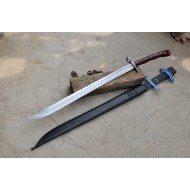
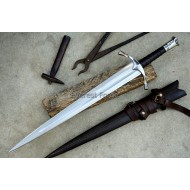
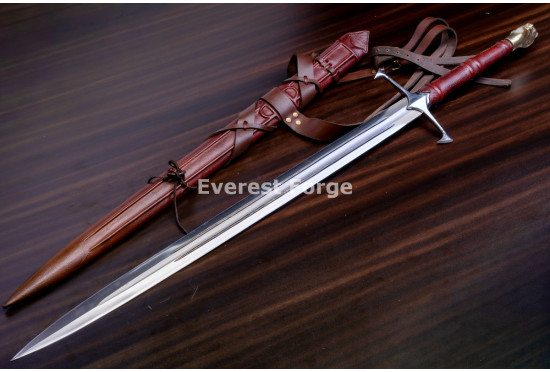
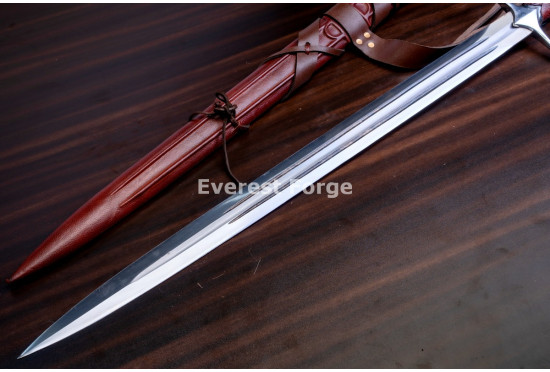
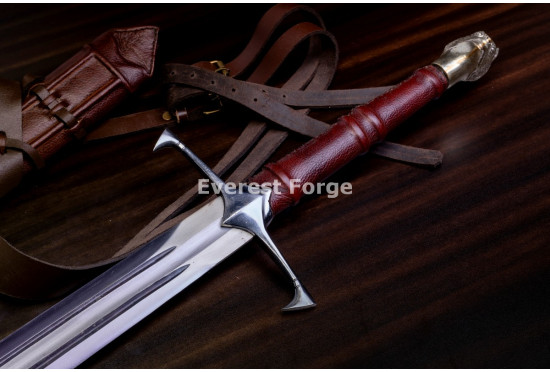
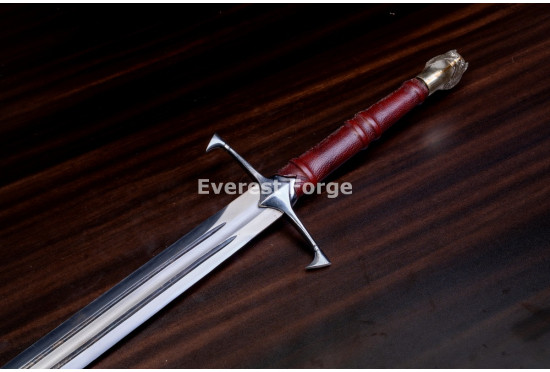
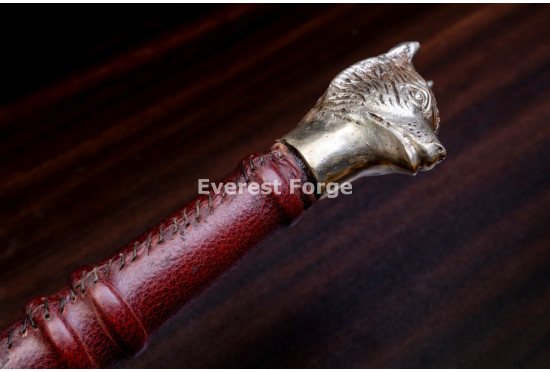
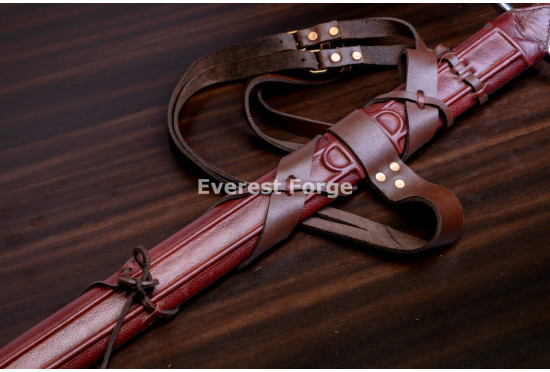
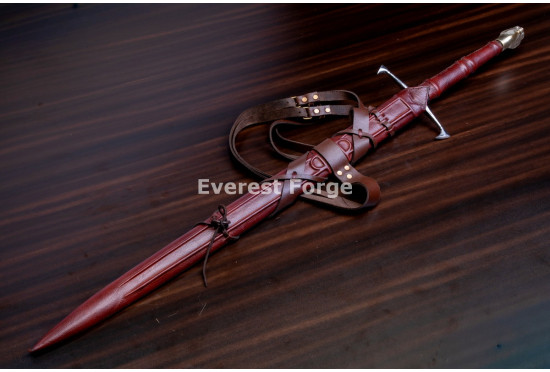
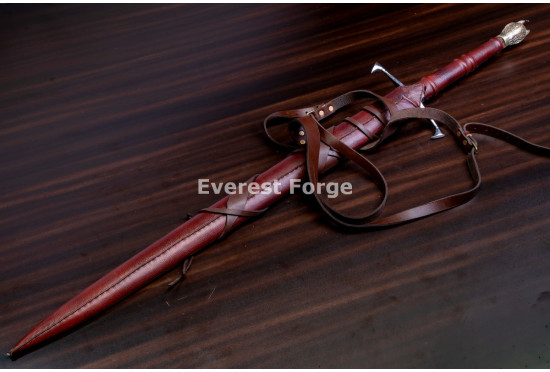
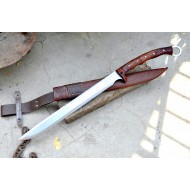
This is the largest sword in our range, hand-forged in Tokha-3, Kathmandu, Nepal from 5160 high-carbon steel, oil-quenched and tempered. The blade runs 36 inches, holding its width through the upper half with a narrow fuller before drawing into a long acute point, satin polished across the flats. The hilt is 12 inches with an 8.5 inch grip: swept quillons curving toward the blade and finishing in flared terminals, a wrapped and stitched oxblood leather grip over a shaped rosewood core, and a cast wolf-head pommel worked in the round. Overall it stands 48 inches. It ships sharpened, with a tooled brown leather scabbard on a full shoulder baldric.
An honest note. Two things worth being straight about. This is an original design from our workshop rather than a licensed replica of anything, and we build it as ours. Second, size: at 48 inches overall this is a true two-handed longsword and it is considerably larger than most swords sold for display. Measure your wall and your case before you order, because it will not fit where a 30 inch sword fits, and it cannot be drawn from a hip-hung scabbard by anyone of ordinary height — which is precisely why it comes on a baldric.
Have a Sword in Mind?
Our smiths build to a drawing, a photograph or a description — blade length and profile, quillon shape, grip wrap, and cast pommels worked to your own device. A different animal head, a crest or a monogram can all be modelled and cast. Send what you have and we will quote it.
Start a Custom Build →Why This Longsword Is Built the Way It Is
Full Specifications
How You Can Configure It
Is This the Right Sword for You?
Buy This If You Want
- A genuine two-handed longsword at full 48 inch scale
- A cast pommel worked in the round rather than a filed steel block
- Real forged 5160 with a proper heat treatment at a size where it matters
- A tooled scabbard on a full shoulder baldric, not a display sleeve
- A centrepiece rather than another sword in a rack
- A pommel device modelled to your own crest or animal on a custom build
Look Elsewhere If You Want
- A licensed replica — this is an original design from our workshop
- A sword that fits a standard display case or a short wall
- A single-hand sword; the 8.5 inch grip is built for two
- A light piece — 48 inches of forged steel weighs what it weighs
- A stainless blade that needs no oiling or care
- Identical units; every piece is forged and cast by hand and varies
How to Order
Who This Longsword Suits
- Collectors after a centrepiece rather than another mid-size sword — this is the one that anchors a wall.
- Cosplayers and stage users who need real scale on camera, with a blunted edge and baldric carry available.
- Test cutters with space who want to feel what two hands on a 36 inch blade actually does.
- Gift and commission buyers wanting a cast pommel modelled to a family crest, a regiment or a personal device.
- Fantasy and gaming collectors putting a character's sword into steel as an original rather than a licensed copy.
What Is Included
- One hand-forged longsword, sharpened and ready to use
- Tooled brown leather scabbard on a full shoulder baldric
- Care and oiling instructions
- Everest Forge manufacturer warranty against defects in forging and heat treatment
Other Hand-Forged Swords
Shipping, Returns and Care
Shipping. Standard builds dispatch in 2 to 3 business days. Custom builds take 4 to 6 weeks, and longer if a pommel is being modelled. At 48 inches this sword ships as an oversize consignment by DHL or FedEx, 7 to 14 business days, fully tracked. Sword laws vary by country and by state — please check what applies where you live before ordering, as we cannot deliver into a restricted address.
Returns. Standard builds can be returned unused and in the original scabbard within 30 days. Custom builds, altered dimensions, custom pommels and etched pieces are made to your specification and cannot be returned unless there is a fault in forging or heat treatment.
Care. The blade is high-carbon steel: wipe it dry after handling and keep a thin film of oil on it in storage, running a cloth corner down the fuller rather than across it. The cast pommel has recesses — around the ears, the eye and the muzzle — that a cloth cannot reach; use a soft brush and keep polish away, since polish packs into cast detail and dries white in every hollow. The leather grip wrap and the tooled scabbard should be kept out of direct sunlight and conditioned once or twice a year. Do not store the sword sheathed for long periods.
Frequently Asked Questions
Why is the pommel cast rather than forged?
Because you cannot forge a wolf's head. Forging and filing move steel in broad strokes and are ideal for a wheel, a disc, a brazil-nut or a scent-stopper pommel — the geometric forms that dominate historical swords, all of which are essentially solids of revolution. The moment a pommel has to carry fur texture, an ear, an eye socket and a muzzle undercut beneath the jaw, you need a mould: the piece is modelled first in wax or clay, a mould is taken, and the metal is poured. That is how every sculpted animal pommel from antiquity onward has been made, and it is why cast pommels appear on decorated and presentation swords rather than on issue ones. What to look for in a good casting: crisp detail that has not been softened by a worn mould, no porosity or pinholes in the flat areas, and a clean seam where the mould halves met. What to watch for on a cheap one is a pommel that is hollow and light — a pommel has a structural job as a counterweight, and a hollow casting cannot do it.
How do you carry or draw a 48 inch sword?
Not from a belt, and this is the practical constraint that shapes every large sword. To draw a sword you have to clear the point of the scabbard, so the maximum blade you can draw from a hip-hung scabbard is roughly the length of your arm plus the distance from your hand to the scabbard mouth — for most people that caps out somewhere around 32 to 34 inches of blade. Beyond that the point simply will not clear before your arm runs out of travel. Historically this is why longswords and greatswords moved to shoulder or back carry, or were drawn with an assist by rotating the scabbard forward, or in the largest cases were not sheathed at all but shouldered like a polearm. This sword ships on a shoulder baldric for exactly that reason. If it is going on a wall rather than a belt, the point is academic — but it is worth knowing why the rig looks the way it does rather than assuming it is decoration.
Is this a replica of a sword from a film or a book?
No. It is an original design made in our own workshop. We do build inspired-by pieces through the custom forge where the rights position allows, and we are equally willing to tell you when it does not — some properties have active licensing programmes and we will not put those names on our work. If there is a specific sword you are after, send us the reference and we will tell you honestly whether it is something we can build, something we can build in spirit, or something we should not touch. What we will not do is sell you an original piece under someone else's name.
What steel is it and how is it heat treated?
5160 high-carbon spring steel, oil-quenched and then tempered back. On a 36 inch blade the heat treatment matters more than on anything else we make: a long blade flexes considerably under its own leverage, and a blade that has been hardened without proper tempering will take a permanent set or crack rather than returning straight. 5160 tempered correctly bends and comes back. It is also the steel family Nepali smiths have traditionally drawn from vehicle leaf spring, so our forge reads it by colour and by sound at the anvil.
Does it arrive sharp?
Yes. It ships with a working edge on both sides, sharpened by hand and ready out of the scabbard. It is not a blunt wall-hanger with a sword-shaped profile ground into it. If the sword is going into a display case, a costume or a stage production — and at this size it very often is — ask for it blunted in the order note before we ship and we will finish it that way at no extra cost.
Is the tang full length?
Yes, and at this size it is not a detail to gloss over. The tang runs the full length of the hilt with the quillons, grip and pommel fitted to it, so the assembly is held by steel rather than by adhesive. A 36 inch blade generates far more leverage against the hilt than a 24 inch one, and two hands on a long grip multiply the torque again. A short or partial tang under that combination is the single most likely thing to fail on a large sword, and it announces itself as a rattle at the cross long before anything breaks.
Will it fit in a normal display case?
Almost certainly not, and we would rather you knew before ordering than after. At 48 inches overall this needs a run of four feet plus mounting clearance, so measure the wall or the cabinet first. Most wall brackets sold for swords are spaced for a 30 to 36 inch piece and will need repositioning. It hangs well diagonally, which is often the answer in a room with a shorter wall, and the baldric gives you a second mounting option through the strap. If you want it shorter, blade length is selectable — a 30 inch blade on the same hilt gives you a hand-and-a-half sword that fits a standard case.
Can I have a different pommel device?
Yes, and it is the most rewarding custom option on this sword. A cast pommel starts as a model, so any device can be made: a different animal, a family crest, a regimental badge, a monogram, a mythological figure, or a plain geometric form if you would rather the sword were quiet. Send a drawing, a photograph or even a clear description and our workshop will model it, take a mould and cast it. Allow extra lead time beyond the usual custom window, since modelling and mould-making happen before any forging starts. Nepal has a deep tradition of lost-wax casting in copper alloy, which is why this is work we can do in-house rather than buying in a stock pommel.
Is the scabbard and baldric included?
Yes. A tooled brown leather scabbard with cross-lacing comes with the sword, on a full shoulder baldric with buckle adjustment, cut around this specific blade profile. On a sword this size the baldric is not an accessory — it is the only practical way to wear the piece, as covered above. A wall mount, a floor stand or a belt rig for a shortened custom build can be supplied instead on request.
How do I look after the blade, the casting and the leather?
Three materials, three routines. The blade is high-carbon steel: wipe it dry after handling, since fingerprints will etch a satin finish within days, and keep a thin film of camellia, mineral or light gun oil on it, running a cloth corner down the fuller. The cast pommel is the part people get wrong — it has recesses around the ears, the eye and under the muzzle that a cloth simply bridges over, so use a soft brush, and keep metal polish away entirely, because polish packs into cast detail and dries to a white residue in every hollow that is close to impossible to remove. The leather grip wrap and the tooled scabbard want conditioning once or twice a year and no direct sunlight.
Will every sword look exactly like the photograph?
No, and on this piece two parts vary visibly. The blade is drawn out under a hammer, so width and the exact line of the fuller differ slightly from piece to piece. The pommel is cast and then hand-finished, so the crispness of the fur texture and the exact expression of the face differ on every one — collectors generally regard this as the point rather than the problem. The leather is dyed and stitched by hand, so wrap and tooling vary. Weights and dimensions vary by a few percent. What is consistent is the steel, the heat treatment, the construction and the edge.
Where is it made and by whom?
Hand-forged in Tokha-3, Kathmandu, Nepal, by our own smiths. Everest Forge is a working forge rather than a reseller putting a name on imported blanks — the steel is cut, drawn, quenched, tempered and ground, the quillons shaped, the pommel modelled and cast, the grip cored and wrapped, and the scabbard tooled and stitched, all under one roof. The casting in particular is worth mentioning: Nepal has centuries of lost-wax metal casting behind it, which is why a sculpted pommel is something we make rather than something we order in.
| Specification | |
| Blade: | 36 inches. Hand forged from 5160 carbon steel |
| Total Length: | 48 inches |
| Handle: | 12 inches total with an 8.5 inch grip, full tang, shaped rosewood core wrapped in stitched leather, swept quillons and cast wolf-head pommel |
| Weight: | 2420 grams approx, as shipped with the scabbard and baldric |
| Note: | handmade variation in weight, dimensions and finish may occur; keep blade lightly oiled when not in use |