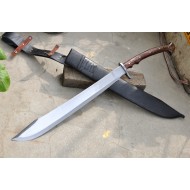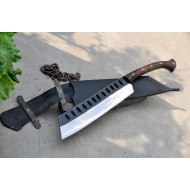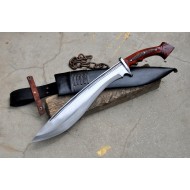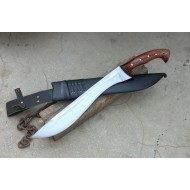


- Model: SINGLE EDGED SWORD
- Product Code: LONGSEAX0022
- Location: Kathmandu, Nepal
Available Options
A Hand-Forged Long Seax With a Broken-Back Blade and Full-Tang Rosewood Hilt
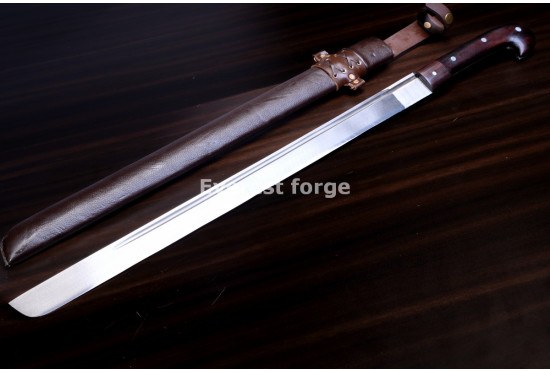
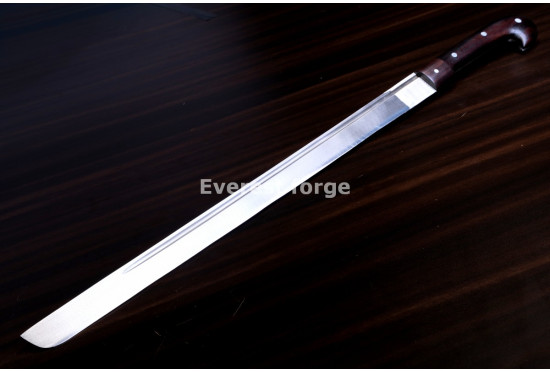
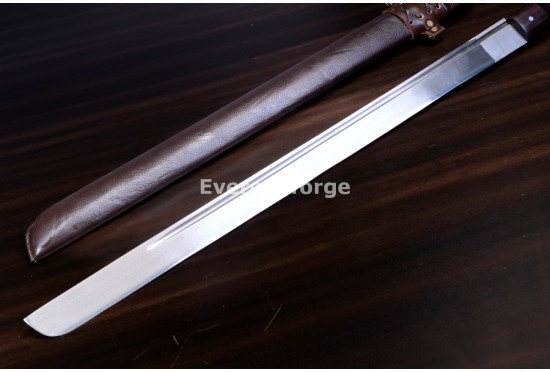
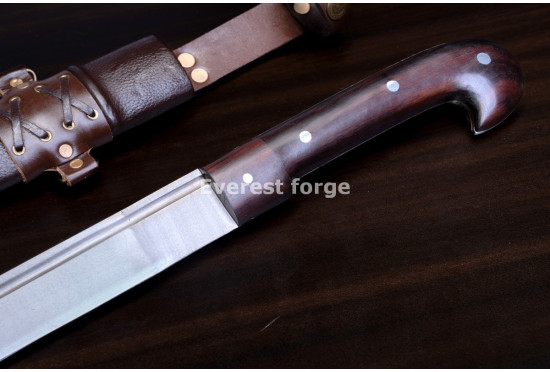
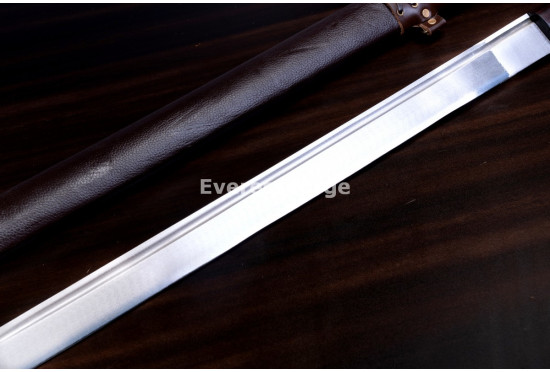
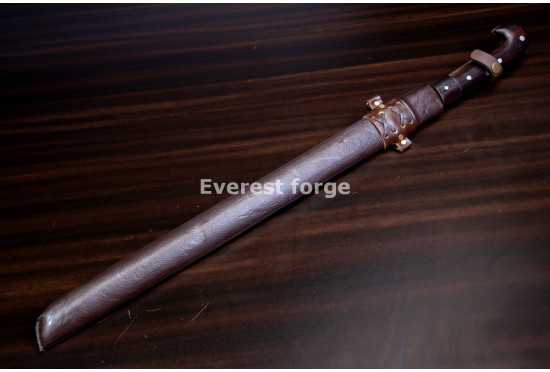
This is a 22 inch hand-forged long seax: a straight single-edged blade with no guard, ground as one broad bevel from a shoulder high near the spine down to the edge, with a narrow groove running the length beside the spine. The back runs dead straight and then angles down to meet the edge, so the point finishes on the line of the cutting edge rather than the spine — the broken-back geometry that gives the type its name. The hilt is rosewood, full tang with four pins through it, with a shaped hook at the butt. Overall length is 29.5 inches and it weighs approximately 590 grams, which is remarkably light for a sword-length blade and is exactly what a seax should be. Forged from 5160 high-carbon steel in Tokha-3, Kathmandu, and supplied in a brown leather scabbard with a laced throat.
An honest note. The blade is a broken-back seax in geometry but not in proportion. On surviving Anglo-Saxon examples the angled section of the back runs roughly the last quarter to third of the blade, giving a long shallow slope down to the point. On this one the break happens in about the final tenth, at a much steeper angle. It is the same idea, abbreviated, and it is how nearly every modern long seax is made. If you want the historical proportion, our smiths will forge it and it is the first option below. The hilt is the other departure: the hooked butt is a modern fitting and no period seax carries one, as they end plain or with a simple cap. We would rather set both of those out here than let a page that talks about the British Museum imply the whole piece is a reconstruction.
Have This Seax Forged Your Way
Blade length, the angle and length of the break, hilt form and scabbard are all decided at the forge. Send a description or a photograph of a museum piece and our smiths will quote it.
Start a Custom Forge Order →Why This Seax Is Built the Way It Is
Specifications
Build Options
Is This the Right Blade for You?
Buy This If You Want
- A sword-length blade that weighs 590 grams and handles like something far shorter
- The correct seax section, a single broad bevel rather than a sword grind with a seax outline
- A full tang, which is stronger than the originals and honestly described as such
- A blade that reads instantly as early medieval in a photograph or on a wall
- The starting point for a fully historical commission, with the break and hilt corrected
Look Elsewhere If You Want
- An accurate museum reconstruction out of the box — the break proportion and the hooked butt are both modern here
- A chopper for firewood; a thin single-bevel blade is the wrong tool and a kukri is the right one
- A thrusting weapon, since a point on the edge line with no guard is built for the cut
- A stainless blade needing no care, since 5160 is carbon steel and will rust if left wet
- A sparring or HEMA trainer, which needs rolled edges and a rebated point
Reconstructions Built to a Museum Piece
Send us photographs, measurements or a catalogue entry for a surviving seax and our smiths will forge to it. Period proportions, period hilt, wire inlay in the grooves.
Talk to the Forge →How to Order
Who This Seax Is For
- Re-enactors and living history groups covering the Viking age and Anglo-Saxon England
- Collectors of early medieval arms who want the section and the geometry right
- Film, stage and photography armourers needing a blade that reads early medieval instantly
- Anyone planning a full reconstruction, for whom this is the base the smiths work from
What Is Included
- One hand-forged long seax, sharpened and ready
- Fitted brown leather scabbard with laced throat and belt rig
- Certificate of hand-forging from the workshop
- Everest Forge manufacturer warranty against defects in forging and heat treatment
Explore the Collection
Shipping, Returns and Care
Stock pieces are dispatched within two to three business days. Custom builds take four to six weeks at the forge before they ship. Everything travels tracked with DHL or FedEx and typically arrives in seven to fourteen business days. Every piece carries the Everest Forge manufacturer warranty against defects in forging and heat treatment.
Long blades are restricted in some countries and in some states and provinces within them. It is your responsibility to check that this seax may lawfully be imported and possessed where you live before ordering, because a parcel seized by customs cannot be returned to us and cannot be refunded. Ask us before you buy if you are unsure and we will tell you what we know about your destination.
5160 is a high-carbon steel and it will rust if left wet or stored damp. Wipe the blade dry, keep a light film of oil on it, and pay attention to the groove beside the spine, which holds moisture that a cloth passes straight over. Do not store the seax in the scabbard for long periods. The rosewood grip takes an occasional coat of oil. A single-bevel blade is the easiest thing in the world to sharpen: lay the whole bevel flat on the stone and work it, with no angle to guess at.
Frequently Asked Questions
What is a broken-back seax?
It is the form where the back of the blade runs straight for most of its length and then angles sharply downward to meet the edge, so the point ends up level with the cutting edge rather than up on the line of the spine. The name is a modern description of what the profile looks like — as though the back has been snapped and bent down. It is strongly associated with Anglo-Saxon England in the ninth and tenth centuries and it is the single most recognisable blade shape of the period. The most famous survivor is the seax found in the Thames in the nineteenth century and now in the British Museum, which carries the name Beagnoth and the only complete Anglo-Saxon runic futhorc known, inlaid in wire along the blade. Two things follow from the geometry. The point is where the cut ends, so it is optimised for slicing and drawing rather than thrusting. And the long straight back leaves a great deal of flat surface, which is exactly where the decoration went.
Is the break on this blade historically proportioned?
No, and it is the first thing we would change if you asked. On surviving examples the angled section is long — commonly the last quarter to third of the blade — and the angle is shallow, so the back slopes gradually down toward the point over many inches. On this blade the break happens in roughly the final tenth of the length at a much steeper angle, closer to forty-five degrees. That gives a more abrupt, more dramatic silhouette and it is how the overwhelming majority of modern long seaxes are built, ours included, because it photographs well and because it is quicker to grind. It handles perfectly well. It is simply not what the originals look like, and since this page cites the British Museum we are not going to let that slide past. Ask for the historical break and our smiths will forge it at no great cost.
Why does a seax have no guard?
Because of how it was worn and what it was for. A seax hung horizontally across the front of the body, edge upward, suspended from the belt by loops, and it was drawn sideways across the stomach in one motion. A cross guard fouls that draw and pushes the whole thing away from the body when you sit, ride or work. The seax was also as much a tool and a status object as a weapon — a man wore one to eat with, to work with and to show what he could afford — and a guard is a fighting fitting that gets in the way of everything else. When the same culture wanted a dedicated fighting sword, it built one with a guard and a pommel and carried it differently. That is the real distinction between a seax and a sword in this period: not size, since the largest seaxes are longer than some swords, but carry and purpose.
Why is it ground as a single bevel?
Because it is the simplest way to get a strong, deep-cutting edge out of a bar of steel, and because it does something a conventional sword grind does not. On this blade the bevel starts high, close to the spine, and runs in one continuous flat plane to the cutting edge, so the whole blade is essentially a long thin wedge with the thick part at the back. That has three consequences. It cuts deep, because there is no shoulder partway down to stop the blade in the material. It is extraordinarily light for its size, which is why this piece is 590 grams at 29.5 inches when a double-edged sword of that length would be half as heavy again. And it is the easiest geometry in the world to sharpen, because you lay the entire bevel flat on a stone and there is no angle to judge. The cost is stiffness: a wedge this thin has less resistance to bending than a diamond-sectioned sword blade, which is one more reason the seax was a cutting weapon rather than a thrusting one.
Is the hilt authentic?
No, and we would rather say so plainly. Two things depart from the originals. The hooked butt is a modern fitting: period seax grips end plainly, or with a simple cap or ferrule, and nothing in the archaeological record looks like this hook. And the construction is a full tang with four pins, where period seaxes almost always ran a narrower tang into a solid one-piece grip of wood, horn or antler. The full tang is genuinely stronger than the original arrangement and we fit it deliberately, but stronger is not the same as authentic and a page that mentions the British Museum should not blur the two. If you want the period hilt, we will fit a plain grip with no hook, and we can run a narrow tang into a solid handle if you want that too, though we will tell you honestly it is the weaker build.
Where does the word seax come from?
From Old English, where it simply meant knife, and it appears in cognate forms across the Germanic languages. The connection people usually want is the one to the Saxons, and it is real but the direction of it is debated: the tribal name and the weapon name share a root, and writers from the early medieval period onward took it to mean the Saxons were named for the blade they carried. Whether that was the actual etymology or a later rationalisation is not settled. What is not in doubt is that the seax was central enough to identity for the association to be made at all. The word also survives in the county arms of Essex and Middlesex, which carry seaxes to this day. Scramasax, a term some sellers use, comes from a single mention in a sixth-century Frankish source and is used inconsistently in modern writing; we use seax, and long seax for the sword-length ones.
What is the groove beside the spine?
On this blade it is a decorative channel, ground along the back of the blade parallel to the spine. It is a correct feature: surviving seaxes very often carry one or several such grooves running the length of the back, and on the finest examples they are not empty but filled with wire of a contrasting metal — brass, copper, silver, or twisted combinations of them — hammered into the channel to sit flush with the surface. That is how the Beagnoth seax carries its runes and its geometric decoration. It is not a fuller in the structural sense; on a blade this thin there is no meaningful weight to remove. If you want the grooves inlaid with wire, tell us and we will do it, and it is the single change that most transforms how one of these looks in the hand.
How is a seax different from a sword or a messer?
By construction and by carry rather than by size. Against a sword: a seax is single-edged, has no guard and no pommel, is ground as one broad bevel instead of a symmetrical section, and hangs horizontally rather than at the hip. Against a messer, which comes several centuries later: a messer has a cross and usually a Nagel, a riveted slab hilt and a blade that is often curved, and it belongs to late medieval Germany rather than the early medieval north. The confusing case is size. A long seax at twenty-two or twenty-six inches is longer than plenty of things people call swords, and it was used two-handed on occasion. The type is defined by the shape and the fittings, not the length, which is why a four inch eating knife and a twenty-six inch blade both carry the name.
What steel is it, and how is it heat treated?
5160 high-carbon spring steel, brought to temperature in the forge, quenched in oil and tempered back so the edge is hard while the body stays springy. A period seax would have been pattern-welded or made from bloomery iron with a steel edge forge-welded on, because consistent steel was not available; a modern homogeneous alloy is stronger and more predictable than either. If you want pattern welding for its own sake, as decoration and as a nod to how these were actually made, that is a custom order and it changes the price considerably. It is not stainless, deliberately: on a thin single-bevel blade, toughness matters far more than rust resistance.
How sharp does it arrive?
Sharp and ready, with the edge put on a stone by hand at the forge. A single-bevel blade takes an edge quickly and holds it well. If you would prefer it shipped blunt — for display, for re-enactment where a live edge is not permitted, for a gift, or because of the rules where you live — say so in the order comments and we will send it unsharpened at no extra cost, and rebate the point too if you need it for group combat.
Can you build it to a specific museum piece?
Yes, and it is the work our smiths most enjoy. Send photographs, measurements, a catalogue entry or a museum accession record and we will forge to it: the right break proportion, the right blade width and taper, a period hilt, and wire inlay in the grooves if the original carries it. What we will tell you honestly is where a request cannot be met and why — we do not make bloomery iron and we will not pretend a modern alloy blade is period metallurgy. Everything about the shape, the section, the fittings and the decoration is achievable. Send the reference before you order rather than after, because it changes the forging from the first heat rather than at the finishing stage.
Where is this made, and by whom?
In our own workshop in Tokha-3 on the northern edge of Kathmandu, Nepal, by around ten smiths, most from families that have forged blades for generations. Everest Forge has operated since 2010. An early medieval North European blade made in Nepal deserves the same word we give the bowie: this is not our own tradition, and this page tells you what is documented and what is not precisely because we are working from the record rather than from inheritance. What our smiths bring is forging, and the seax is about as pure a test of forging as a blade gets — a long thin single-bevel wedge that has to come out of the quench straight.
| Specification | |
| Blade: | 22 inches. Hand forged from 5160 carbon steel |
| Total Length: | 29.5 inches |
| Handle: | 7.5 inches. Full tang with rosewood scales pinned through, no guard |
| Weight: | approx 590g seax, 850g with scabbard |
| Note: | Some variation in weight, dimensions and finish may occur as each piece is hand forged. Keep the blade lightly oiled when not in use |