Menu
Your Cart

Hand-Forged Long Messer Sword, Fullered Blade

Hand-Forged Long Messer Sword, Fullered Blade
$324.99
Ex Tax: $324.99
  • Model: SINGLE EDGED SWORD
  • Product Code: Singleedge027
  • Location: Kathmandu,Nepal

Available Options

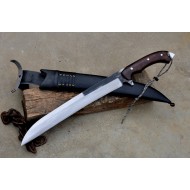
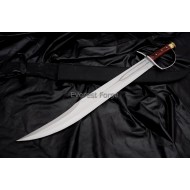
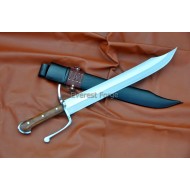
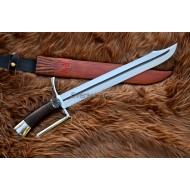
Hand-Forged Long Messer Sword — Fullered Blade with Rosewood Grip

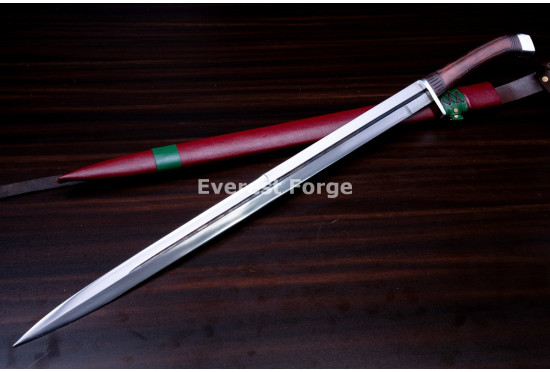
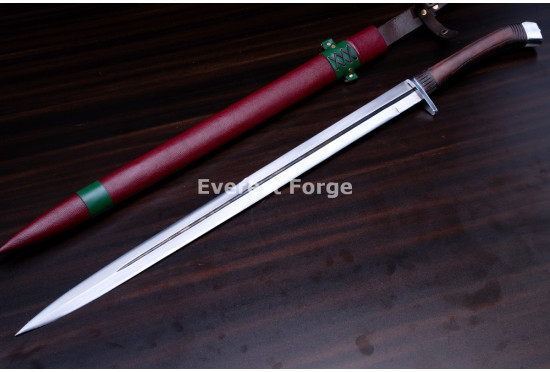
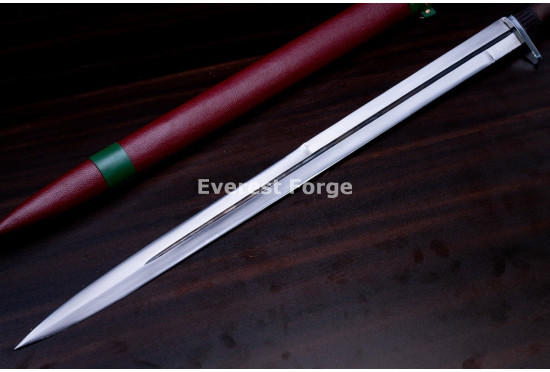
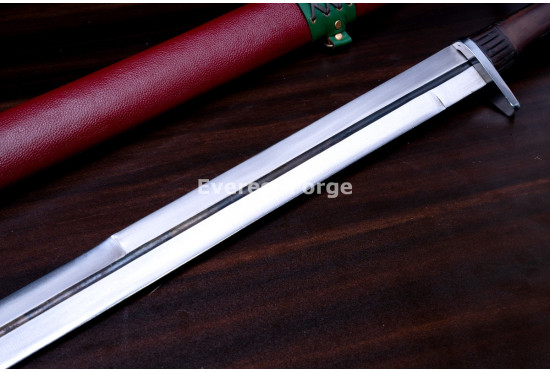
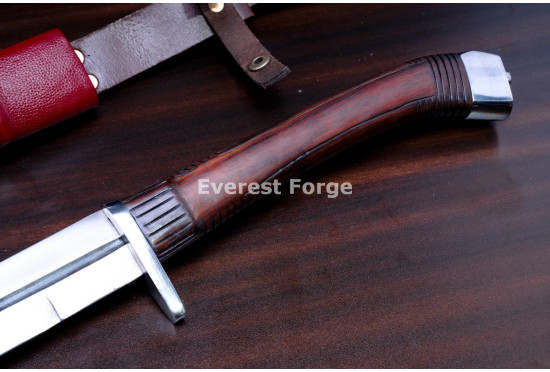
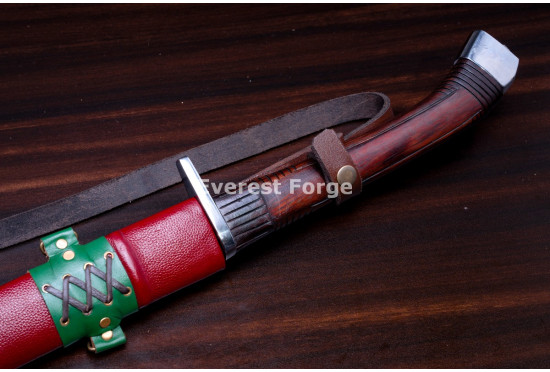
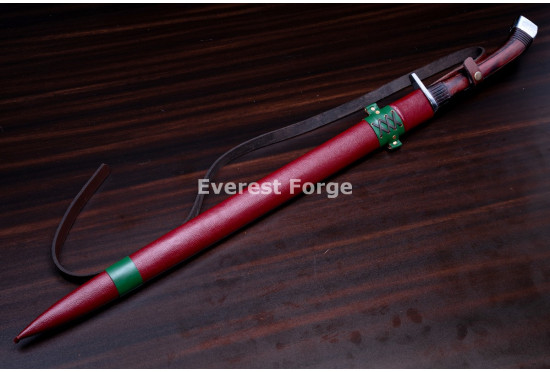
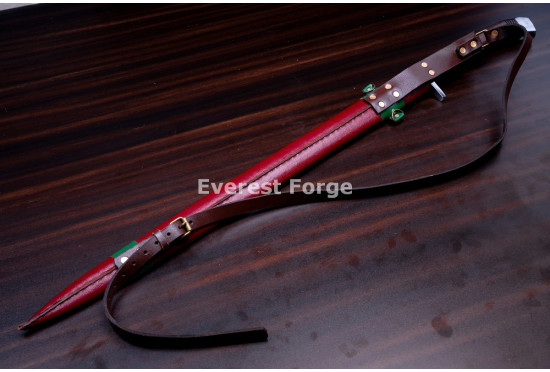
This is a hand-forged, fully functional long messer — the langes messer of late medieval Germany, a single-edged sword built long enough to fence with two hands, forged in Nepal from 5160 high-carbon spring steel, oil-tempered, full tang, and sharpened to a true edge. A single fuller runs along the blade, darkened against the clean finish. The hilt is a shaped rosewood grip with a swept butt and a steel cap, behind a plain steel guard. It ships with a red leather scabbard with green accent detail. Every sword is made to order in your chosen length, finish, and engraving.

The standard blade is 27 inches on a 10-inch handle, for an overall length around 37 inches at about 1.4 kg. That weight is the thing to notice on a sword this size — it is light for its length, and the fuller is a large part of why. A langes messer was meant to be fenced with rather than swung, and this one handles accordingly: quick to the point, quick to recover, and long enough in the grip to take a second hand when you want the leverage.

An honest note. The same point of precision we make on all our messers, because it is the thing sellers get wrong. A true historical messer is defined by its hilt construction, not its blade — a flat slab tang with scales riveted through either side, like an oversized kitchen knife, usually with a Nagel projecting from the guard to shield the hand. This sword uses conventional sword construction: a shaped grip over a full tang, with a steel guard and cap. The blade is right for the family and the proportions are right for a langes messer, so the name is fair, but it is a modern interpretation rather than a reproduction. If you want a historically constructed messer with a slab tang, riveted scales and a proper Nagel, we will build one through Custom Forge.

Bespoke Service

Forge a Messer to Your Own Design

Want a historically constructed slab-tang hilt with a Nagel, a shorter bauernwehr blade, a different fuller, or your own engraving? Our Custom Forge service builds swords to your spec, by hand in Kathmandu.

Request a Custom Forge →

What Is a Long Messer?

Messer is simply German for knife, and it names a family of single-edged European swords carried from roughly the 14th to the 16th century. The family runs by size. At the small end is the bauernwehr, a large belt knife worn by townsfolk and farmers. In the middle sits the langes messer — the long messer — a sword-length single-edged blade with a grip long enough to take a second hand, which is what this one is. At the top are the grosse messer and kriegsmesser, the great and war messers, heavier blades built for the battlefield. What ties them together is the hilt: a flat tang with riveted scales rather than a tang running through a pommel. The langes messer is the form that appears most in the German fencing manuals, and it had a full technical system of its own rather than borrowing longsword technique.

Real Forged BladeHand-forged 5160 spring steel, full tang, oil-tempered and sharpened.
Light for Its LengthAround 1.4 kg on a 37-inch sword — built to fence with, not to swing.
Single FullerFuller ground along the blade and darkened against the clean finish.
5160 Spring SteelTruck leaf-spring steel — tough, shock-resistant, holds an edge.
Shaped Rosewood GripContoured rosewood with a swept butt and steel cap — no wrap to wear through.
Red Leather ScabbardRed leather with green accent detail — this sword's signature.

Specifications

TypeHand-forged long messer (langes messer), single-edged
Blade Length27 inches standard (custom lengths to order)
Handle Length10 inches, long enough for a second hand
Overall LengthApprox 37 inches at standard blade size
WeightApprox 1400 g total, 1000 g blade
Blade Steel5160 high-carbon spring steel (truck leaf spring)
Heat TreatmentOil-tempered — hard edge, flexible spine
Blade StyleSingle-edged, long taper to the point, single fuller, sharpened
Blade FinishClean finish with darkened fuller detail
TangFull tang, peened at the cap
HandleShaped rosewood with swept butt
FittingsPolished steel guard and butt cap
ScabbardRed leather with green accent detail, included
OriginHand-forged in Tokha-3, Kathmandu, Nepal

Customize Your Messer

Every sword is forged to order. Set your options before you add to cart:

Blade LengthStandard 27 inches, or a shorter bauernwehr blade, or longer to your spec.
Blade WeightStandard light section, or a heavier grosse messer build.
Hilt ConstructionConventional full tang as standard, or a historical slab tang with riveted scales.
GuardPlain steel guard as standard, or a historical Nagel.
FullerSingle darkened fuller as standard, left bright, or omitted.
Grip MaterialRosewood as standard, or walnut, buffalo horn, or a leather wrap.

Hand-Forged, Not a Wall-Hanger

This Messer

  • Hand-forged 5160 high-carbon spring steel
  • Oil-tempered, hard edge and flexible spine
  • Full tang, peened at the cap
  • Fuller ground in with a real distal taper behind it
  • Sharpened, balanced, made to your spec

A Wall-Hanger

  • Cast stainless, brittle under load
  • No real heat treatment
  • Rat-tail tang that snaps at the guard
  • Groove pressed in cold, no taper, dead in the hand
  • Blunt, display-only

How It Is Made

You set the spec — length, section weight, hilt construction, guard, fuller and grip material.
A smith forges the single-edged blade from a 5160 leaf-spring billet and draws the taper to the point.
The fuller is ground and darkened, the blade oil-tempered, finished clean and hand-sharpened.
We fit the guard, shape the rosewood grip, peen the tang at the cap, build the scabbard, and ship worldwide tracked.

Who It Is For

  • Collectors of German and Central European swords who want the messer family represented properly
  • Historical fencing enthusiasts interested in the messer as a documented system rather than a curiosity
  • Buyers who want a long single-edged sword that is quick rather than heavy
  • Reenactors portraying late medieval townsfolk and common soldiers, who should order the display-blunt option
  • Gift buyers personalizing a blade with a name, date, or engraving
  • Not for anyone wanting a heavy chopper — our fantasy messer is considerably heavier and hits harder

What Is Included

  • One hand-forged long messer, built to your chosen spec
  • Red leather scabbard with green accent detail
  • Shaped rosewood grip with polished steel guard and butt cap
  • Any personalization or engraving you ordered
  • A fullered, sharpened blade with a clean finish
  • Everest Forge manufacturer warranty

Explore More Hand-Forged Swords

Shipping, Returns & Care

Shipping

In-stock specs dispatch within 2 to 3 business days; fully custom builds take roughly 4 to 6 weeks to forge before dispatch. We ship worldwide by DHL or FedEx in 7 to 14 business days, tracked. Import and blade laws vary by country, so please check your local rules before ordering.

Returns & Warranty

Every blade is backed by the Everest Forge warranty against forging and material defects. If something is wrong with your order, we will repair, replace, or refund it. Personalized and custom-engraved blades are made to order, so please confirm your spec carefully before purchase.

Care

Wipe the blade clean and dry after handling, and apply a light coat of oil before storage to protect the high-carbon steel from moisture. Pay attention to the fuller, which holds moisture more readily than a flat surface. Give the rosewood an occasional wipe with oil, keep the dyed leather scabbard out of prolonged direct sun so the red does not fade, and do not store the sword inside the scabbard for long periods.

From The Forge

Build a Messer That Is Yours Alone

Beyond the options here, our Custom Forge service will build a historically constructed messer with a slab tang, riveted scales and a Nagel, or shape this pattern to your own length, weight and fittings. Roughly 4 to 6 weeks from order.

Start a Custom Forge →

Frequently Asked Questions

What is a long messer, and how does it differ from other messers?

Messer is German for knife, and it names a family of single-edged European swords carried from roughly the 14th to the 16th century. The family is sorted by size. The bauernwehr is the small end — a large belt knife rather than a sword, worn by townsfolk and farmers. The langes messer, or long messer, is the sword-length form with a grip long enough to take a second hand, which is what this is. The grosse messer and kriegsmesser are the great and war messers, heavier blades meant for the battlefield. What ties the family together is not blade shape but hilt construction: a flat tang with scales riveted through either side, rather than a narrow tang passing through a pommel.

Was there an actual fighting system for the messer?

Yes, and it is one of the best-documented systems in medieval European martial arts, which surprises people who assume the messer was a peasant's improvised weapon. The priest Johannes Lecküchner wrote a treatise on the langes messer in the 1470s that runs to hundreds of illustrated plates — by some measures the largest single work on any one weapon to survive from the medieval period, larger than most longsword treatises. It presents a complete technical system with its own named guards and techniques, built on the same principles as the German longsword tradition but adapted for a single edge and a one-handed grip. Messer material also appears in the Codex Wallerstein and in several other fencing books of the period. The messer was not a fallback for people who could not afford a sword; it was a weapon with its own literature and its own body of teaching.

Is this a historically accurate messer?

Not in construction. A true historical messer is defined by its hilt: a flat slab tang with scales riveted through either side, like an oversized kitchen knife, and usually a Nagel — a stud projecting sideways from the guard to shield the hand. This sword uses conventional sword construction instead, with a shaped grip over a full tang and a steel guard and cap. The blade and the proportions are right for a langes messer, which is why the name is fair, but it is a modern interpretation. If you want a historically constructed messer with a slab tang, riveted scales and a proper Nagel, we build them through Custom Forge — send us the length and we will quote it.

How does this differ from your Fantasy Messer?

They are built to opposite briefs, and the weights tell the story. This one is a 27-inch blade at about 1.4 kg all up — longer, lighter, fullered, and made to be fenced with. The fantasy messer has a 24-inch blade at roughly 1.85 kg: three inches shorter and 450 g heavier, with no fuller, built as a heavy cutter. They also look nothing alike. This has a plain steel guard, a shaped rosewood grip and a red scabbard with green detail; the fantasy messer has a scalloped winged guard, a black leather-wrapped grip and a laced black scabbard. Buy this one if you want a quick, historically proportioned long messer; buy the fantasy messer if you want mass behind the edge and a more dramatic hilt.

Is it one-handed or two-handed?

Hand-and-a-half, which is what the langes messer was. The 10-inch handle works properly in one hand — that is how the fencing manuals show it being used, with the off hand free — but there is room to add a second hand behind the first for a heavier cut or better control on a bind. At 1.4 kg it is genuinely comfortable one-handed for extended use, which is not true of every sword this long.

Is this a real, functional sword?

Yes. It is hand-forged from 5160 high-carbon spring steel, full tang, oil-tempered, and sharpened to a true cutting edge before it ships. The guard and butt cap are solid steel and the tang is peened at the cap rather than glued or threaded. It handles tatami mats, water bottles and light green targets well. Do not use it on bone, metal, seasoned hardwood, or anything you would not put a good knife through.

What steel is it, and is it oil-tempered?

The blade is forged from 5160 high-carbon spring steel, the same alloy used in heavy-duty truck leaf springs, prized for toughness and edge retention. It is oil-tempered for a hard cutting edge backed by a flexible, shock-absorbent spine. On a long, relatively light single-edged blade that flex is essential — a thin blade of this length in a hard, brittle steel would be a liability rather than a sword.

Is it full tang?

Yes. The tang runs the full length of the hilt and is peened at the butt cap, so the guard and grip are mechanically captured on the tang itself. There is no rat-tail, no weld, and no glued-in stub to fail. Note that this is sword construction rather than the slab-and-scale build of a historical messer — see the accuracy question above, which explains the difference and what we can build instead.

What are the grip, fittings and scabbard made of?

The grip is shaped rosewood with a swept butt, left bare rather than wrapped, which means there is no leather to stretch or come loose over time and the wood grain shows. The guard and butt cap are polished steel — solid, not cast alloy or plated pot metal. The scabbard is red leather with a green accent band and green detail at the throat, made by hand to fit the blade size you order. Because rosewood and dyed leather are natural materials, grain and colour vary slightly between pieces.

Does it arrive sharpened?

Yes, sharpened as standard along the full edge, finished by hand. If you need it blunt for historical fencing, reenactment, stage use, display, or to satisfy import rules where you live, choose the display-blunt option or tell us in your order notes. There is no extra charge either way — and if you are ordering for fencing practice, tell us, because a blunt intended for contact wants a thicker edge and rolled tip than a display blunt.

Can I order a historical hilt, a different length, or a heavier blade?

Yes to all three, and the hilt is the interesting one. We will build this blade with a proper slab tang, riveted scales and a Nagel, which gives you a historically constructed messer rather than an interpretation of one. Blade length runs from a short bauernwehr up to a grosse messer, and we can forge the section heavier if you want a cutter rather than a fencing sword. Tell us how you want it to handle rather than only what dimensions you want, and we will tell you honestly what the trade-offs are before we forge it.

Do you ship worldwide, and how long does it take?

Yes. We ship worldwide from Nepal by DHL or FedEx in 7 to 14 business days with tracking. In-stock specs dispatch within 2 to 3 business days; fully custom builds take roughly 4 to 6 weeks to forge first. Import and blade laws vary by country, so please check your local rules before ordering.

Specification
Blade: 27 inches. Hand forged from 5160 carbon steel
Total Length: 37 inches
Handle: 10 inches, long enough for a second hand. Full tang peened at the cap, shaped rosewood with swept butt, polished steel guard and butt cap
Weight: Approx 1400 grams total (blade approx 1000 grams)
Note: As every piece is forged by hand, slight variation in weight, dimensions and finish may occur. Rosewood grain and dyed leather colour vary between pieces. Keep the blade lightly oiled when not in use.

Write a review

Note: HTML is not translated!
Bad Good
Captcha