- Model: HUNTING SPEAR
- Product Code: SPEAR0015
- Location: Kathmandu, Nepal
Available Options
A Hand-Forged Ceremonial Spear With a Lion-Head Finial
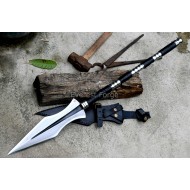
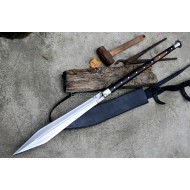
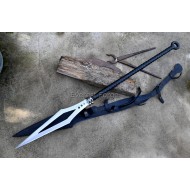
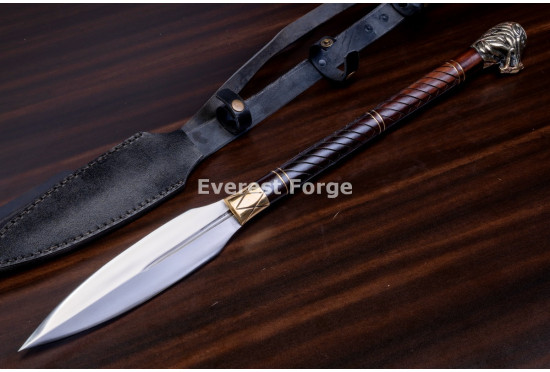
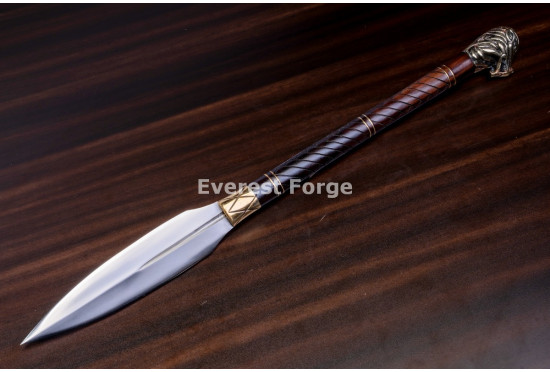
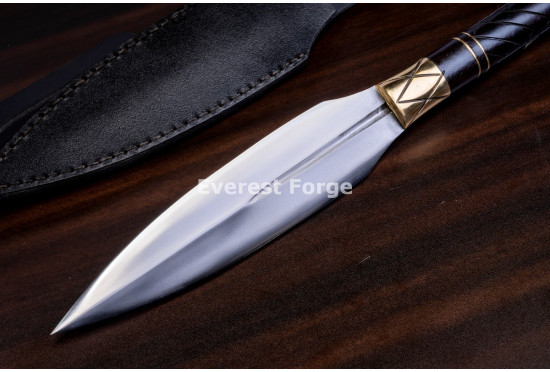
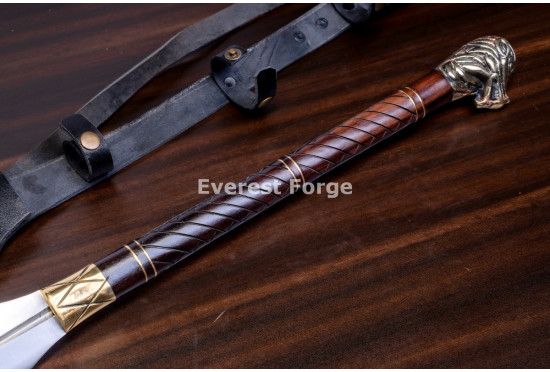
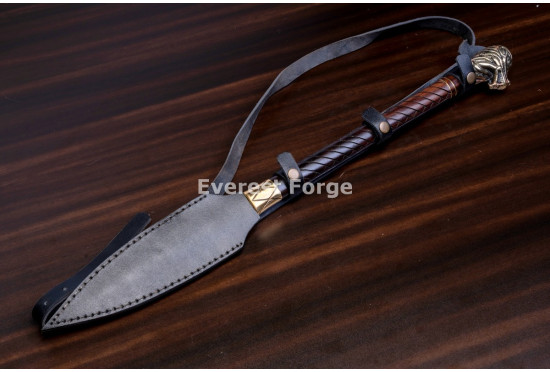
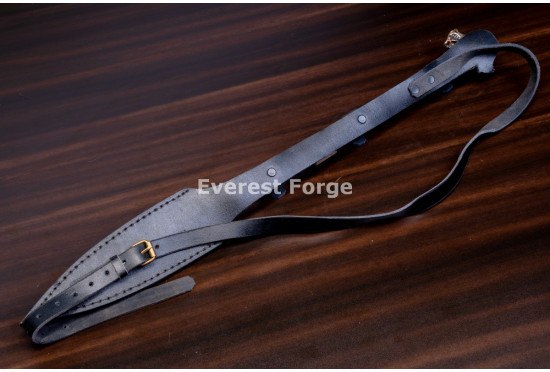
This is a short ceremonial spear, hand-forged in Tokha-3, Kathmandu, Nepal, built as a piece to be carried, presented and displayed rather than fought with. The head is a 10 inch leaf blade in 5160 high-carbon steel, oil-quenched and tempered, with a raised medial ridge running to a fine point and a satin finish on the flats. It seats into an engraved brass-toned ferrule on a turned hardwood haft, banded with fitted rings and finished at the butt with a cast lion-head finial. It ships sharpened, with a fitted black leather scabbard for the head.
An honest note. This is a ceremonial spear and not a fighting polearm. A war spear is a two-handed weapon of five to seven feet, where the whole point is reach; this piece stands around 27 inches, which is short-form. That is normal for a ceremonial or presentation spear — guard spears, parade arms and staff-of-office pieces have been made short and heavily decorated for as long as spears have existed, because they are carried in a hall and not thrown across a field. But we would rather say so plainly than let the word "spear" set an expectation the piece will not meet. If you want a full-length haft on this same head, our smiths will make one.
Want This Head on a Full-Length Haft?
Our smiths will build this leaf blade onto a war-length shaft, or make the piece taller for a standing display, or cut a different finial — a different animal head, a plain butt cap, or a spiked ferrule. Send a sketch or a reference photo and we will quote it.
Start a Custom Build →Why This Spear Is Built the Way It Is
Full Specifications
How You Can Configure It
Is This the Right Piece for You?
Buy This If You Want
- A presentation or ceremonial piece with real forged steel in it
- A short-form spear you can display indoors without a seven-foot wall
- Fittings and a finial that are cut and cast rather than stamped
- Something to mark a promotion, a retirement or an anniversary, engraved
- A head that can later be rehafted to full length if you change your mind
- A piece a smith will proportion to your dimensions before it ships
Look Elsewhere If You Want
- A war spear — at 27 inches this is short-form, not a fighting polearm
- A throwing spear or a hunting spear; the finial and fittings are not built for it
- A historical reconstruction of a specific culture's spear pattern
- Solid brass fittings — ours are brass-toned; ask us before ordering if this matters
- A stainless head that needs no oiling or care
- Identical units; every piece is forged and fitted by hand and varies slightly
How to Order
Who This Spear Suits
- Presentation and award buyers marking a retirement, a promotion or a milestone with something engraved that will not end up in a drawer.
- Collectors of hafted arms who want a decorated short-form piece alongside full-length polearms.
- Interior and display buyers who want the look of a spear in a room that cannot take a seven-foot shaft.
- Cosplay and stage users needing a hafted prop with genuine forged weight and a blunted option.
- Clubs, lodges and ceremonial bodies commissioning matched pieces with a device or an inscription.
What Is Included
- One hand-forged ceremonial spear, sharpened and ready to display
- Fitted black leather scabbard for the head
- Care and oiling instructions
- Everest Forge manufacturer warranty against defects in forging and heat treatment
Other Hand-Forged Blades
Shipping, Returns and Care
Shipping. Standard builds dispatch in 2 to 3 business days. Custom builds take 4 to 6 weeks. We ship worldwide by DHL or FedEx, 7 to 14 business days, fully tracked. Bladed and hafted arms are restricted in some countries and states — please check what applies where you live before ordering, as we cannot deliver into a restricted address. A full-length haft ships as an oversize consignment and carries a higher freight cost, which we will quote before we start.
Returns. Standard builds can be returned unused and in the original scabbard within 30 days. Custom builds, altered dimensions and engraved pieces are made to your specification and cannot be returned unless there is a fault in forging or heat treatment.
Care. 5160 is a high-carbon steel and it will rust if you neglect it. Wipe the head dry after handling and keep a thin film of oil on it in storage. The ferrule and finial are brass-toned and will dull over time; a soft cloth restores them, and metal polish will strip the finish, so avoid it. Wipe the hardwood haft with a barely damp cloth and treat it once or twice a year with a hard wax or a furniture oil. If the spear is wall-mounted, keep it out of direct sun, which fades wood and dries the leather scabbard.
Frequently Asked Questions
Is this a full-length spear?
No. This is a ceremonial short-form spear of roughly 27 inches overall. A fighting spear runs five to seven feet, because reach is the entire reason a spear exists as a weapon — it lets you strike a man before he can strike you. This piece is built for presentation, display and carry rather than for fighting, which is why the haft is short and the fittings are decorated. That is a real historical category, not a shortcut: ceremonial and guard spears have always been made shorter and more ornate than the ones issued for war. If you want this same head on a war-length shaft, our smiths will build it to order.
How is a spear head attached to its shaft, and which method is stronger?
There are two ways, and the difference decides whether a hafted weapon survives use. A SOCKETED head is forged with a hollow cone at its base that the shaft slides into, so the wood is wrapped in steel and the load is spread around the full circumference of the joint. This is what most European, Greek and African war spears used, and it is the stronger method. A TANGED head has a spike at its base that is driven into a bored or split shaft and then bound or riveted, which is simpler to make but concentrates every impact on a small area of wood that eventually splits. A third approach, used on many decorative and ceremonial pieces, seats the head into a fitted metal ferrule that carries the joint. The ferrule method sits between the two for strength and looks far better, which is why ceremonial arms use it. If you are commissioning a full-length working haft from us, ask for a socketed build and say what you intend to do with it.
Why are ceremonial weapons shorter than fighting ones?
Because the two are solving different problems. A fighting weapon is proportioned entirely around what it has to do at the moment of use, and for a spear that means reach. A ceremonial weapon is proportioned around being carried in formation, held at attention for long periods, presented across a table, and displayed indoors for decades — and a seven-foot shaft is a liability in every one of those situations. The same logic shortened court swords against war swords and turned the halberd into a sergeant's spontoon. Decoration follows the same pressure: a piece that will be looked at closely for a lifetime gets the engraving, the cast finial and the fitted bands, whereas a war piece gets a plain shaft because it is going to be replaced.
What steel is the head and how is it heat treated?
5160 high-carbon spring steel, oil-quenched and then tempered back. We heat treat ceremonial pieces the same way we heat treat working ones. An untreated decorative blade looks identical when it is new and then takes a permanent bend the first time it is knocked against something, and on a piece that is going to be handled at every ceremony that happens sooner than you would think.
Does the head arrive sharp?
Yes. It ships with a working edge on both sides of the leaf, sharpened by hand and ready out of the scabbard. If the spear is going into a display case, a stage production, a costume or a setting where a sharp edge is a liability, tell us in the order note and we will finish it blunted at no extra cost. For ceremonial and presentation use we would generally suggest blunted, since the piece is going to be handled by people who are not expecting an edge.
Are the fittings solid brass?
They are brass-toned rather than certified solid brass, and we would rather be exact about that than let the photographs imply otherwise. The ferrule, the bands and the lion-head finial are cast and finished to a brass appearance. In practice this affects two things: the weight is slightly lower than solid brass would give, and the surface should be cleaned with a soft cloth rather than metal polish, which will cut through the finish. If solid brass matters to you — for a presentation piece with a long life ahead of it, it might — ask us before ordering and we will tell you what the custom forge can do.
Can I have a full-length haft made?
Yes, and it is one of the more common custom requests on a piece like this. Our smiths will build the same head onto a war-length or standing-display shaft, re-proportioning the ferrule and the finial so the spear does not look like a short piece that has been stretched. Bear in mind two practical points: a long shaft changes the balance completely, so tell us whether the spear will be carried, mounted or stood upright, and a full-length haft ships as an oversize consignment at a higher freight cost, which we will quote before starting.
Is the scabbard included?
Yes. A fitted black leather scabbard for the head comes with the spear, cut around this specific blade profile. It protects the edge in transit and in storage, and it makes the piece safe to hand to someone at a ceremony. If you change the head dimensions on a custom build, the scabbard is made to the new size automatically.
Can it be wall-mounted or stood in a display?
Both. At 27 inches it hangs comfortably on a wall bracket without needing the ceiling height a full polearm demands, and it will lie in a display case. If you want it to stand upright in a corner or a stand, ask for a spiked or flat-based ferrule instead of the lion-head finial, or for a full-length haft with a weighted butt — the standard short-form piece is not stable standing on its own. We can supply it with a simple wall bracket on request.
How do I look after the steel, the wood and the fittings?
Three different materials, three different routines. The head is high-carbon steel: wipe it dry after handling, since fingerprints will etch a satin finish within days, and keep a thin film of camellia, mineral or light gun oil on it in storage. The haft is hardwood: wipe it with a barely damp cloth and give it a hard wax or a furniture oil once or twice a year to stop the grain drying and lifting. The fittings are brass-toned: a soft dry cloth is all they need, and metal polish will strip the finish, so keep it away. Keep the whole piece out of direct sunlight, which fades wood and dries leather.
Will every piece look exactly like the photograph?
No, and that is inherent to hand forging and hand fitting. Every head is drawn out under a hammer, so the width of the leaf and the line of the medial ridge carry small differences from piece to piece. The haft is turned from natural timber, so grain and colour vary. The finial is cast and then hand-finished, so the detail on the lion's face differs slightly on every one. Weights and dimensions vary by a few percent. What is consistent is the steel, the heat treatment, the fitting and the edge.
Where is it made and by whom?
Hand-forged in Tokha-3, Kathmandu, Nepal, by our own smiths. Everest Forge is a working forge rather than a reseller putting a name on imported parts — the steel is cut, drawn, quenched, tempered and ground, and the haft is turned, banded and fitted, under one roof. That is why we can change the head size, the haft length and the finial on a custom order: there is a smith at the anvil and a fitter at the bench rather than a catalogue of finished stock.
| Specification | |
| Blade: | 10 inches. Hand forged from 5160 carbon steel |
| Total Length: | 27 inches |
| Handle: | 17 inch turned hardwood haft, banded with fitted rings, engraved brass-toned ferrule and cast lion-head finial |
| Weight: | 1240 grams approx, as shipped with the scabbard |
| Note: | handmade variation in weight, dimensions and finish may occur; keep blade lightly oiled when not in use |