Menu
Your Cart

Hand-Forged Kukri Knife, Ringed Hilt

Hand-Forged Kukri Knife, Ringed Hilt
$144.99
Ex Tax: $144.99
  • Model: Historical Khukuri
  • Product Code: HISTORIC0012
  • Location: Kathmandu, Nepal

Available Options

A Traditional Nepali Kukri With a Ringed Rosewood Hilt and Cho Notch

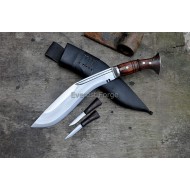
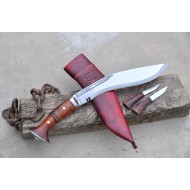
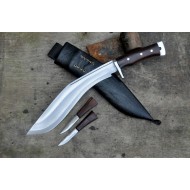
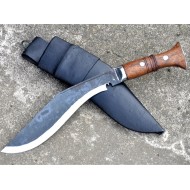
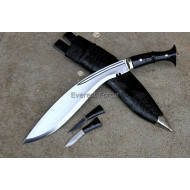
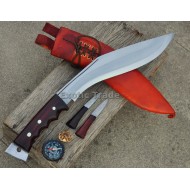
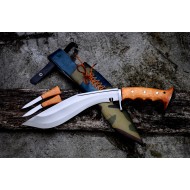
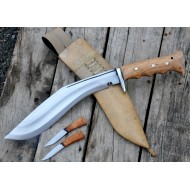
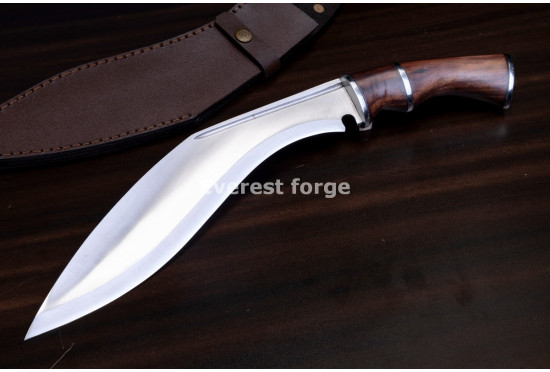
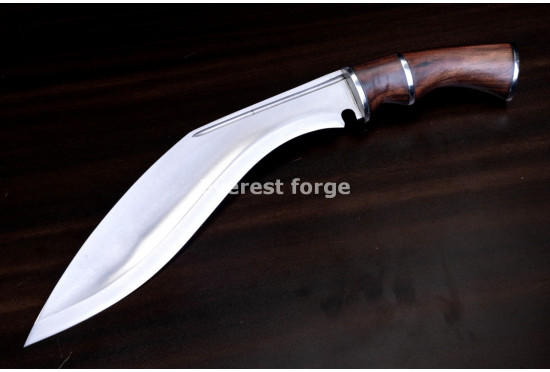
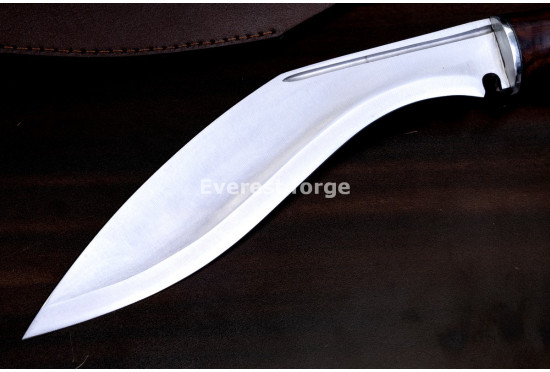
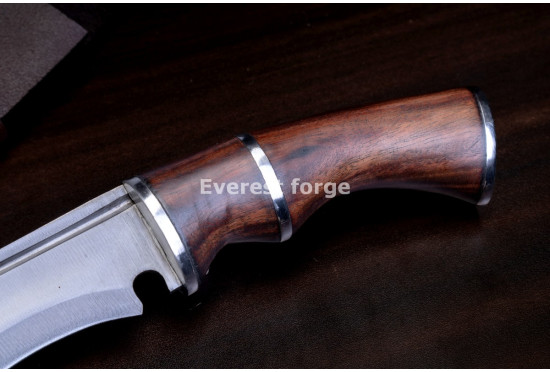
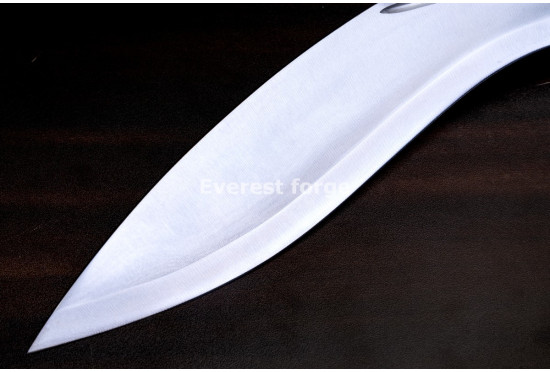
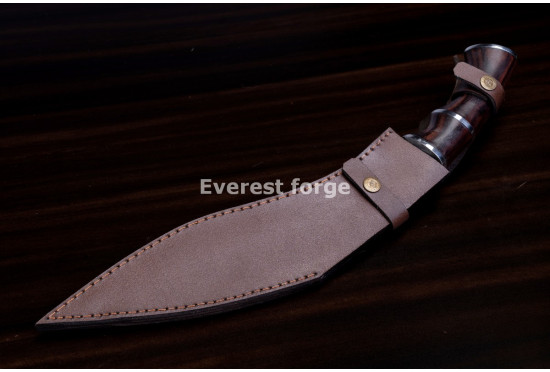
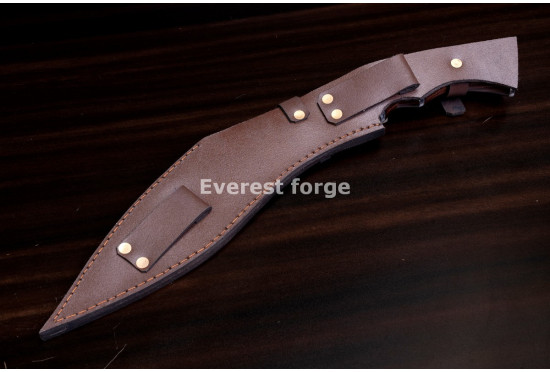
This is a 12 inch hand-forged kukri knife built to Nepali service proportions: a forward-curved blade with the classic drop and broad belly, a narrow chirra running inside the spine, and the cho notch cut at the base of the edge. The hilt is turned rosewood in the traditional form, waisted through the middle with a raised ring band and a flared butt, fitted between a steel bolster and a steel butt cap. Overall length is 18 inches and the knife weighs approximately 650 grams. The blade is forged from 5160 high-carbon steel by our own kami in Kathmandu, and it ships in a brown leather belt sheath.

An honest note. The hilt on this kukri is traditional; the sheath is not. A traditional Nepali kukri rides in a dap — a wooden-cored scabbard covered in leather, with two pockets behind the blade holding the karda, a small utility knife, and the chakmak, a blunt steel burnisher for straightening and touching up the edge. This one ships in a modern flat leather belt sheath, with no karda and no chakmak. That is a perfectly good way to carry a kukri and many buyers prefer it, but we are not going to call the piece fully traditional when half of what makes it traditional is the scabbard. If you want the dap with both companions, it is the first option below and our smiths make them every week.

Made to your specification

Have This Kukri Forged Your Way

Blade length, pattern, hilt construction and scabbard are all decided at the forge. Tell us what you want it for and our kami will tell you which pattern to order.

Start a Custom Forge Order →

Why This Kukri Is Built the Way It Is

Service Size, Not Display SizeAt 12 inches of blade this sits close to the size a Nepali soldier or hill farmer actually carries. Most kukris sold abroad are 15 to 17 inches because size photographs well, but the working size is smaller and handier.
A Hilt That Locks Into the HandThe grip is waisted through the middle, ringed with a raised band and flared at the butt. A kukri is swung hard and released slightly at the wrist; that shape is what keeps it from travelling forward or flying out.
The Cho Is Cut, Not StampedThe notch at the base of the edge is filed in by hand. It is the mark that tells you a kukri came from a Nepali forge rather than a factory copying the silhouette.

Specifications

Blade Length12 inches
Handle Length6 inches
Overall Length18 inches
Blade Steel5160 high-carbon spring steel, oil-quenched and tempered
Blade ProfileForward-curved with the traditional drop and broad belly, edge on the inner curve
Blade DetailSingle chirra running inside the spine, cho notch at the base of the edge
HiltTurned rosewood in the traditional form, waisted with a raised ring band and flared butt
FittingsSteel bolster, steel ring band and steel butt cap
Standard BuildPolished blade, rosewood hilt — size, finish and grip material are selectable above
SheathBrown leather belt sheath with press-stud retaining strap
CompanionsNone as standard; karda and chakmak available with a dap scabbard
WeightApproximately 650 grams for the kukri, 920 grams with the sheath
OriginHand-forged in Tokha-3, Kathmandu, Nepal

Build Options

Dap Scabbard With Karda and ChakmakThe traditional wooden-cored scabbard with both companion tools in their pockets behind the blade. This is what turns the piece into a complete traditional kukri and it is the change we would suggest first.
Blade LengthTen to eleven inches for a true service kukri, twelve as shown, or fifteen to seventeen if you want a chopper. The hilt scales with the blade.
PatternSirupate for a long slender fast blade, budhume for a broad heavy belly, bhojpure for a thick working chopper. Tell us the job and we will tell you the pattern.
Hilt ConstructionThe turned hilt shown, or panawal — rosewood scales riveted through a full-width tang, which is the stronger build for heavy chopping.
Hilt MaterialRosewood as standard. Water buffalo horn is the other traditional choice and is what a village kukri most often carries.
Blade FinishPolished as shown, satin, or the semi-polished working finish a kami leaves when the knife is going out to be used rather than looked at.

Is This the Right Kukri for You?

Buy This If You Want

  • A kukri at the size Nepalis actually carry rather than the size that sells in photographs
  • The traditional turned and ringed hilt rather than a modern slab handle
  • A hand-cut cho and a hand-filed chirra from a forge that is genuinely in Nepal
  • Something you can wear on a belt without it dominating the whole rig
  • A first kukri, because this size teaches you what the tool actually does

Look Elsewhere If You Want

  • A complete traditional kit out of the box — this ships without the dap, karda and chakmak unless you ask
  • A heavy chopper for firewood and standing timber; order fifteen inches or more, or a bhojpure pattern
  • The strongest possible hilt for hard daily chopping, which is panawal construction, not this one
  • A stainless blade needing no care, since 5160 is carbon steel and will rust if left wet
  • A clearing blade for green growth, where a machete does the job faster
Our own craft, not someone else's

Ask Our Kami Which Kukri to Order

Swords we research. Khukuri we make, and have made since 2010. Describe what you need one for and the smiths will tell you the pattern, the length and the hilt to ask for.

Talk to the Forge →

How to Order

Choose your blade length, finish and hilt material from the options above the description.
Say in the order comments whether you want the dap scabbard with karda and chakmak.
We confirm the build by email and start forging. Custom work takes four to six weeks.
Your kukri ships tracked by DHL or FedEx and arrives in seven to fourteen business days.

Who This Kukri Is For

  • First-time kukri buyers who want the real proportions before deciding whether they want something bigger
  • Campers and hill walkers who need one blade that will process wood and still do camp work
  • Collectors of Nepali arms looking for a traditional hilt from a working Nepali forge
  • Anyone with a Nepali connection — family, service, trekking — for whom the right size matters more than the impressive one

What Is Included

  • One hand-forged kukri knife, sharpened and ready to use
  • Fitted brown leather belt sheath with press-stud strap
  • Certificate of hand-forging from the workshop
  • Everest Forge manufacturer warranty against defects in forging and heat treatment

Explore the Collection

Bush Machete, Brass-Fitted HiltFor green growth rather than wood →
Bowie Knife, Crossguard HiltA heavy single-edged camp knife →
Hunting Knife, Bolstered Full TangA 9 inch field knife →

Shipping, Returns and Care

Stock pieces are dispatched within two to three business days. Custom builds take four to six weeks at the forge before they ship. Everything travels tracked with DHL or FedEx and typically arrives in seven to fourteen business days. Every piece carries the Everest Forge manufacturer warranty against defects in forging and heat treatment.

Large fixed blades are restricted in some countries and in some states and provinces within them. It is your responsibility to check that this kukri may lawfully be imported and possessed where you live before ordering, because a parcel seized by customs cannot be returned to us and cannot be refunded. Ask us before you buy if you are unsure and we will tell you what we know about your destination.

5160 is a high-carbon steel and it will rust if left wet or stored damp. Wipe the blade dry after use, keep a light film of oil on it, and do not store the kukri in the leather for long periods. The rosewood hilt takes an occasional coat of oil. The edge comes back with a stone, or with a chakmak if you order one, which is what it is for.

Frequently Asked Questions

What size kukri should I actually buy?

Smaller than you think, in most cases. The kukri carried by Nepali soldiers and used daily by hill farmers runs around ten to twelve inches of blade, which is what this one is. The fifteen to seventeen inch kukris that dominate export listings exist because a big blade photographs better and feels like more knife for the money, but they are heavy on a belt, awkward in close work and tiring over a day. Blade length is only half of it, though — pattern matters as much. A sirupate is long, slender and fast, good for vegetation and light work. A budhume has a broad deep belly and puts mass forward, which suits chopping. A bhojpure is thick and heavy through the spine and is the pattern for serious wood. If you are buying your first kukri, buy something close to service size in a general pattern, use it for a season, and then order the second one knowing exactly what you want changed.

What is the notch near the handle?

That is the cho, sometimes called the kaudi. It is cut into the edge just in front of the bolster and it is the single feature that tells you a blade is a genuine kukri rather than a shape copied from a photograph. It has practical value — it stops a crack running back from the edge into the tang, and it catches and holds fluid away from the grip — but its meaning in Nepal is symbolic as much as functional, read variously as a trident, a cow's hoof or a representation of the divine. Ours are cut by hand with a file, one at a time. If you are looking at a kukri anywhere and there is no cho, or the cho is a neat identical stamping on every example, you are not looking at a Nepali-made blade.

What are the karda and chakmak, and why does this not have them?

They are the two companion tools that ride in pockets behind the blade in a traditional dap scabbard. The karda is a small utility knife, three or four inches, for the fine work a twelve inch kukri cannot do — cutting cord, food, whittling. The chakmak is not a knife at all: it is a blunt burnisher of hardened steel used to straighten a rolled edge and bring the kukri back without removing metal, in the same way a butcher uses a steel. Traditionally its spine also struck a flint, which is where the name comes from. This kukri ships in a modern belt sheath, which has no pockets and therefore carries neither. We would rather offer you the dap than fit a karda into a sheath not designed for it. Ask for the dap version and you get the scabbard, both companions and the arrangement the tool was designed around.

How is a kukri edge hardened?

Traditionally, and here, only along the edge. The kami brings the blade to heat and then pours water along the cutting edge alone, from a jug, working down the length while the spine stays hot. What that produces is a differentially hardened blade: hard where it cuts and soft and springy through the spine and the belly. A kukri is used to hit things, and a blade hardened all the way through would crack under that; one hardened only at the edge holds the cut and absorbs the impact everywhere else. It is the same principle behind a differentially hardened Japanese blade, arrived at independently and executed with a jug of water rather than a clay coat. You can sometimes see the transition as a faint line above the edge on a semi-polished blade. On a mirror-polished one like this it is usually invisible, which is one small argument for ordering the working finish instead.

Why is the handle shaped like that?

Because of how a kukri is swung. It is not held in a fixed clamp like a chef's knife; the grip is relaxed slightly at the moment of impact so the blade can rotate a little and the shock does not go straight into the wrist. That means the hand must be stopped from travelling in two directions. The steel bolster stops it going forward onto the blade. The raised ring band in the middle and the flare at the butt stop it coming off the back, which is the direction a heavy forward-weighted blade actually wants to leave your hand. The waist between them is where the palm sits. It looks decorative and it is not — it is one of the oldest solved problems in hand tools, and it is why every traditional kukri hilt has broadly this profile regardless of which valley it was made in.

Is the hilt panawal construction?

No. This is the turned traditional build: the tang runs into a solid rosewood grip and is secured at the butt cap. Panawal is the other traditional Nepali construction, where the tang is full width and rosewood or horn scales are riveted through it, and it is the stronger of the two for hard sustained chopping. Both are genuine and both are made here. We say plainly which one you are getting because the distinction matters and most sellers do not mention it. If this kukri is going to be a working tool that sees a lot of wood, order panawal. If it is going to be carried, used moderately and looked at, the turned hilt is the more traditional-looking of the two and is what most Nepali service and village kukris carry. What you should avoid, from any seller, is a narrow tang simply glued into a drilled handle, which is the standard failure point on cheap kukris.

What steel is it, and where does it come from?

5160 high-carbon spring steel. In Nepal the traditional stock for a kukri is a vehicle leaf spring, and 5160 is exactly the alloy family those springs are made from, so this is not a substitution for tradition but a continuation of it. It is tough, it takes and holds a working edge, and it responds well to the differential hardening described above. It is not stainless, deliberately: stainless grades that genuinely resist rust give up toughness, and on a blade designed to be swung into wood, toughness is the property that matters.

How is this different from your other kukris?

Size and hilt, mainly. This is the shortest kukri we list at twelve inches of blade and the only one built at genuine service proportions, and it carries the traditional turned and ringed hilt rather than a modern slab handle or a two-hand grip. Our double-edged kukri is longer at fourteen and a half inches and has a working edge ground on the back of the blade as well as the front, which is a trade rather than an upgrade. Our larger kukris run fifteen to seventeen inches and are choppers. If you want one kukri that behaves the way a kukri is supposed to behave, this is the one to start with. If you already own one and want a second for heavier work, go longer and go panawal.

What is the groove along the spine?

That is a chirra, the Nepali term for the fuller ground into a kukri blade. It runs inside the spine through the upper part of the blade. Kukris are described by how many they carry — a single chirra like this one, or two, three or five on more elaborate patterns — and beyond a certain point they become decorative rather than structural. On a working blade a chirra is ground for the same reason as any fuller: it removes metal from where it contributes least. On a kukri, which is deliberately forward-heavy, taking weight out of the section nearest the hand sharpens that forward bias rather than balancing it, which is the intended effect.

How sharp does it arrive?

Sharp and ready to work. Every kukri is finished on a stone by hand before it leaves. We put a working edge on rather than a razor polish, because a kukri meets wood, grit and bone and a fine edge simply does not survive that. If you would prefer it shipped blunt — for display, for a gift, or because of the rules where you live — say so in the order comments and we will send it unsharpened at no extra cost.

Can I use it as a general camp knife?

For wood, yes, and it is very good at it: splitting kindling, limbing, notching, batoning through a small log with a stick on the spine. That thick unsharpened spine is a working surface and you should use it as one. For fine work, no — twelve inches of forward-weighted blade will not carve a peg, prepare food comfortably or do anything requiring the point. That is precisely the gap the karda exists to fill, and it is the strongest argument for ordering the dap version with both companions. A kukri and a karda together cover more ground than any single knife of either size.

Who makes these?

Our own kami, in our own workshop in Tokha-3 on the northern edge of Kathmandu. Kami is the Nepali word for smith, and most of ours came from families who have forged blades for generations. Everest Forge has operated since 2010. This matters more on a kukri page than on a sword page, and we will say why plainly: with a gladius or a falcata we are researching someone else's tradition carefully and reproducing it. The khukuri is not someone else's tradition. It is made here, used here, and the men forging it grew up with one in the house. There is very little sold abroad as a Nepali kukri that is actually forged in Nepal, and that is the difference we are selling.

Specification
Blade: 12 inches. Hand forged from 5160 carbon steel
Total Length: 18 inches
Handle: 6 inches. Turned rosewood hilt with raised ring band and flared butt, steel bolster and butt cap
Weight: approx 650g kukri, 920g with sheath
Note: Some variation in weight, dimensions and finish may occur as each piece is hand forged. Keep the blade lightly oiled when not in use

Write a review

Note: HTML is not translated!
Bad Good
Captcha