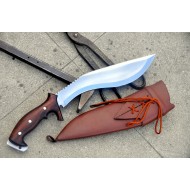
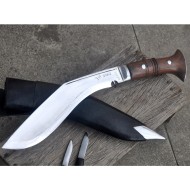
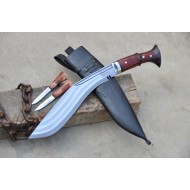
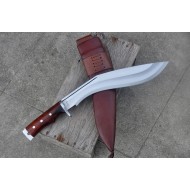
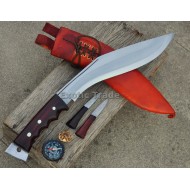
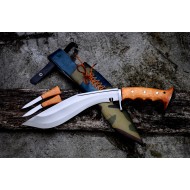
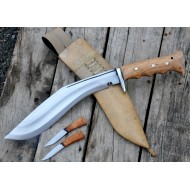
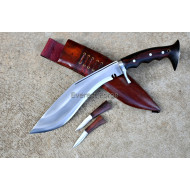
- Model: Modern Kukuri
- Product Code: CHHUKURI12
- Location: Kathmandu, Nepal
Available Options
A Hand-Forged Kukri Khukuri With a Double Edge
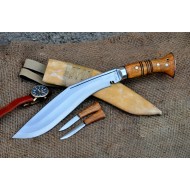
This is a hand-forged fantasy kukri, or khukuri — both spellings are correct and we use both — with a deeply recurved 12 inch blade sharpened on both the belly and the back, a panelled polished steel bolster, a timber grip and a steel pommel. It is 18.5 inches overall and comes with a leather sheath cut to the curve. Forged from 5160 high-carbon spring steel in our workshop in Tokha-3, Kathmandu, after your order arrives — so the edge arrangement, the dimensions, the grip and the sheath are all yours to set at no extra cost.
The recurve is the reason to own it. The blade waists in through the middle and bellies out again before sweeping up to a fine point, which is the most dramatic profile we grind and reads from across a room. It is a fantasy interpretation of the Nepali blade our smiths have spent generations making, and the page below is clear about the difference rather than blurring it.
We sell 276 traditional kukris and khukuris. This is not one of them, and the most important thing on this page is the honest account of what a sharpened back edge costs you on a blade whose spine is normally the part doing the work.
An honest note. Three things. A double-edged kukri is not traditional, and the thick unsharpened spine on a real khukuri is not an omission — it is mass and stiffness where a chopping blade needs it, it is where your thumb goes for control, and it is what you strike with a stick to baton through wood. Grinding a back edge removes all three at once. The single-edged build is free and it is what we would make for anyone who means to use the knife. Second, it is heavy: 1,170 grams against 600 to 900 for a traditional khukuri of this blade length, and heavier per inch of blade than anything else we make. Third, the sheath is not crocodile — it is cowhide with the pattern embossed into it, and there is a way to tell on anybody's photographs in the questions below.
Why It Is Built This Way
Full Specifications
Figures are taken from the knife shown and describe the standard build. Hand-forged work varies a little from piece to piece, so read these as close rather than exact. If a dimension matters, tell us before we start and we will build to it and measure the finished knife for you.
Build It Your Way
None of this costs extra, because none of it is made before you ask for it. Work down these six and put what you want in the order note.
If you are going to use it, order it single-edged
The same blade, the same recurve, the same bolster and grip — with the spine left thick and unsharpened, the way a khukuri has been made for two centuries. You get back the mass over the cut, somewhere to put your thumb, and a spine you can strike with a stick to drive the blade through wood. You lose the second edge and nothing else. It costs nothing, it adds no time, and we would rather build you the knife that works than the one that photographs.
Talk to the Forge →What It Does Well, and What It Does Not
What it does well
- A silhouette nothing in the traditional range comes close to. The recurve is the most dramatic profile we grind and it is the reason to own this piece.
- A substantial forged steel bolster doing real structural work at the joint where a working knife is most heavily stressed.
- Both edges properly finished rather than one sharpened and the other left as a ground bevel.
- A sheath genuinely cut to a recurved outline, which a generic sheath cannot manage.
- The single-edged build is free, and we will tell you when it is the better choice rather than upselling the other way.
- Everything configurable at no extra cost, including horn scales if you want the traditional material on an untraditional knife.
What it does not do
- A double-edged kukri or khukuri is not traditional. The thick unsharpened spine is the reason the blade works, and grinding it away costs you mass, thumb placement and the ability to baton.
- It is very heavy. 1,170 grams is 30 to 95 per cent above a traditional khukuri of this blade length, and heavier per inch than anything else we make.
- The balance sits further back than a working kukri's, because of the steel in the hilt. It will not chop the way a traditional one does.
- The sheath is not crocodile. It is embossed cowhide and we say so rather than letting the photographs imply otherwise.
- A second sharpened edge changes how a blade is classified in some jurisdictions regardless of length. Check before ordering.
- It is not stainless. 5160 rusts if left damp and wants an occasional wipe of oil.
How to Order
Who It Is For
- Collectors who already own traditional kukris and khukuris and want something from the same forge that is deliberately not one.
- Fantasy and game-inspired buyers who want a recurved blade made by people who grind recurves for a living.
- Buyers who want the silhouette and would rather be told plainly that it is not the traditional article.
- Anyone who intends to actually use it — with the strong recommendation that you order the single-edged build.
- Stage combat and theatrical armourers, who can order this rebated and round-tipped at no extra cost.
- Anyone who would rather hear that a sheath is embossed cowhide than find out when it arrives.
What Is Included
- The knife, hand-forged in Tokha-3, Kathmandu, Nepal.
- A leather sheath cut to the recurve, with an embossed crocodile pattern, contrast stitching, a studded retaining strap and a steel tip ring.
- A protective coat of oil on the blade for transit, wiped off before handling.
- Care instructions, and the Everest Forge manufacturer warranty against defects in materials and workmanship.
We make 276 of the real thing
Bhojpure, Sirupate, Angkhola, Panawal, the wartime service patterns and the historical replicas. If what you actually want is a kukri or khukuri that a Nepali smith would recognise — single edge, thick spine, horn or hardwood, a sheath with a karda and chakmak — that is the range to look at, and it is what this forge was built to make.
See the Traditional Range →Related Blades and Reading
Shipping, Returns and Care
Dispatch and transit. Standard builds leave the workshop in 2 to 3 business days. Genuinely custom work — a single edge, a different length or stock, horn scales — runs 4 to 6 weeks depending on the queue. We ship by DHL or FedEx with tracking, typically 7 to 14 business days from Kathmandu, sheathed and braced in a rigid carton.
Duties, import and knife law. Import duty and local taxes are the buyer's responsibility and vary by country. Note specifically that a second sharpened edge changes how a blade is classified in a number of jurisdictions regardless of its length, so this build may be treated differently from an otherwise identical single-edged knife. Please check what applies where you live before ordering. An unsharpened build is free, and so is the single-edged build, and either may make the difference.
Returns and warranty. Because every blade is forged after the order, a custom build cannot be restocked, so please make sure the specification is right before you confirm. Anything damaged in transit, or showing a defect in materials or workmanship, is covered by the Everest Forge manufacturer warranty and we will repair or replace it. Photograph the packaging as well as the knife if something has gone wrong on the way.
Care. 5160 is a high-carbon steel and it is not stainless. Wipe the transit oil off before handling and put a light film back on before the knife goes away. Fingerprints are acidic and will etch a polished blade if left for weeks. On a recurved blade the inside of the waist is the surface a cloth drawn straight along the blade skips entirely, and it is where rust will start — use a folded corner of cloth and follow the curve. Do not store the knife in the sheath for long periods, since leather holds moisture against steel.
Questions About This Kukri Khukuri
Is a double-edged kukri traditional?
No. A kukri — khukuri, in the other common spelling, and we use both because both are correct — is single-edged by definition, and its thick unsharpened spine is not an omission. It is the reason the blade works. This one carries a ground back edge, which makes it a fantasy interpretation rather than a traditional Nepali blade, and we would rather open with that than let 276 traditional kukris and khukuris on this site imply otherwise.
What it is: a deeply recurved 12 inch blade with a sharpened back, a substantial polished steel bolster, a timber grip and a steel pommel, on an 18.5 inch knife. It is a striking object and it is not the blade our smiths have been making for generations. If the traditional article is what you want, start at our traditional kukris and khukuris.
What does the back edge actually cost you?
Three things, and they are the reason no traditional kukri or khukuri has one. First, MASS AND STIFFNESS: a kukri's spine is thick precisely because that is where the metal does the most good on a chopping blade, and grinding it away takes steel out of the part that resists bending under a hard stroke.
Second, THE THUMB. On a working khukuri you put a thumb or the heel of your hand on the spine for control on fine cuts, and to guide the blade when you choke up on it. You cannot do that on an edge. Third, BATONING AND PALMING: a thick spine is something you can strike with a stick to drive the blade through wood, and something you can push on with a flat palm. A back edge removes all three uses at once. None of that matters on a wall piece. All of it matters on a knife you work with, and it is why the single-edged build is free on request.
Can I have it single-edged instead?
Yes, at no extra cost, and if you intend to use the knife rather than display it, that is the build we would make you. The same blade profile with an unsharpened spine gives you back the mass, the thumb placement and the ability to baton, and it loses you nothing except the look.
Say so in the order note. While you are there, it is worth deciding whether you want the spine left thick and square in the traditional manner or given a rounded finish — both are free, and the square spine is the one you can actually strike.
Is the sheath real crocodile?
No. It is cowhide with a crocodile pattern embossed into the grain, and we say so on every page where the texture appears rather than letting photographs imply otherwise. The leather underneath is ordinary good-quality cowhide and the pattern is pressed into it under heat.
The quick test on anyone's photographs: genuine crocodile scales vary across a hide and never repeat, while an embossed pattern repeats on a regular pitch because it comes off a plate. There is also a practical advantage nobody mentions — genuine crocodile and alligator are CITES-listed and need permits to cross borders, while embossed cowhide ships anywhere. We do not supply the real thing, for that reason among others.
How heavy is it?
1,170 grams, and this is the figure to know before you order. A traditional kukri or khukuri with a 12 inch blade runs somewhere between 600 and 900 grams. This is 30 to 95 per cent above that depending which end you measure against, and it is heavier per inch of blade than anything else we make — including our own heavy choppers.
Part of that is the hilt: a substantial steel bolster and a steel pommel on a 6.5 inch handle is a lot of metal behind your hand, and it pulls the balance back in a way a traditional horn-and-wood khukuri does not. Part of it is simply thick stock. If you want something closer to a working weight, ask for thinner stock and we will tell you honestly what it costs in robustness. On this design it costs very little, because the blade is not being asked to do a chopper's job.
What size is it, and can I change it?
The standard build carries a 12 inch blade and a 6.5 inch handle, 18.5 inches overall. That is a default rather than a fixed specification — everything we make is forged after the order, so the dimensions are yours to set.
Twelve inches is a sensible size for this shape: long enough for the recurve to read properly, short enough to handle in one hand without the weight punishing you. Longer exaggerates both the look and the weight. Shorter, around 9 or 10 inches, makes a considerably handier knife and is worth considering if you actually want to carry it.
What are the handle and bolster made of?
A timber grip with a polished steel bolster at the blade and a steel pommel cap. The bolster is the substantial part: a panelled block with an inset frame, flaring into a hooked quillon below and a smaller one above, which is where most of the visual weight of the hilt sits.
Grip material and colour are both selectable at no extra cost — horn is the traditional material on a khukuri and is available, as are rosewood, bone, micarta and leather over timber. We will match the sheath to whatever you choose.
Does it arrive sharp?
Yes, both the main edge and the back edge sharpened and ready to use, unless you tell us otherwise. On a recurved blade the belly does most of the cutting and that is where the main edge is finished most carefully.
Unsharpened builds are free, for display or for an awkward import, and on a piece bought for its silhouette an unsharpened build loses you very little. A stage combat build — rebated edge, rounded tip — is also available at the same price. Note that a second sharpened edge changes how a blade is classified in some jurisdictions regardless of length, which is worth checking before you order.
What steel is it, and how is it heat treated?
5160 high-carbon spring steel, which we use across the whole range. The blade is forged to shape, quenched, and then tempered back by hand as a separate operation afterwards. Those two steps are distinct and the second is what matters: quenching alone leaves a blade hard and brittle, and tempering trades a little hardness for toughness.
It matters more than usual on a recurved blade with a ground back, because the blade is narrowest through the waist of the recurve and that is where the load concentrates on a hard stroke. 5160 is not stainless, rusts if left damp, and takes and keeps an edge far better than any stainless we could sensibly forge. We do not make pattern-welded or laminated blades at all, by choice.
Where does it balance?
Closer to the hand than a traditional khukuri of the same blade length, because of the steel in the hilt. A working kukri puts nearly all its mass forward into the belly, which is what makes it chop above its weight. This one does not, quite, and the difference is noticeable if you have handled both.
We do not publish a single point-of-balance figure, because hand-forged work varies and a number an inch out is worse than none. Ask before dispatch and we will measure the actual knife we are sending you, from the bolster, and send you the figure.
What does the sheath include?
A leather sheath cut to the curve of the blade, with a crocodile pattern embossed into the face, contrast stitching, a brass-studded retaining strap over the bolster and a steel ring at the tip. Cowhide, embossed — see the fourth question above.
It is built to this outline rather than to a pattern, which matters on a recurved blade: a sheath cut for a straight or single-curved knife will not take one that waists in the middle and bellies out again. Colour, stitching and carry arrangement are all yours to specify.
How long does it take, and how is it shipped?
Nothing is held in stock. Every blade is forged after the order arrives, which is why the edge arrangement, the dimensions, the grip material and the sheath are all free to change — there is no standard version already made. Standard builds dispatch in 2 to 3 business days; genuinely custom work runs 4 to 6 weeks depending on the queue.
It ships sheathed and braced in a rigid carton, by DHL or FedEx with tracking, typically 7 to 14 business days from Kathmandu. Import duty and local taxes are the buyer's responsibility and vary by country.
| Specification | |
| Blade: | 12 inches. Hand forged from 5160 carbon steel |
| Total Length: | 18.5 inches |
| Handle: | 6.5 inches. Full tang, timber grip, panelled steel bolster and pommel cap |
| Weight: | 1170 grams the knife, 1490 grams with the sheath |
| Note: | Handmade variation in weight, dimensions and finish may occur. Keep blade lightly oiled when not in use. |