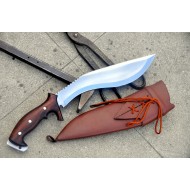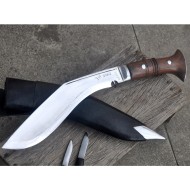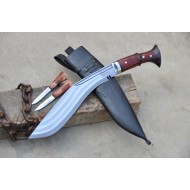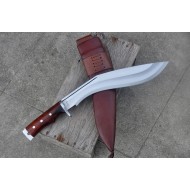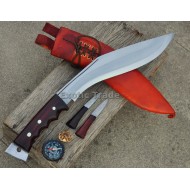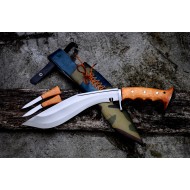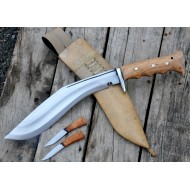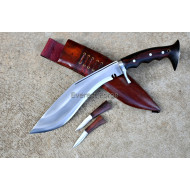


- Model: Traditional khukuri
- Product Code: TRADITIONALKUK013
- Location: Kathmandu, Nepal
Available Options
A Kukri With a Carved Brass Pommel
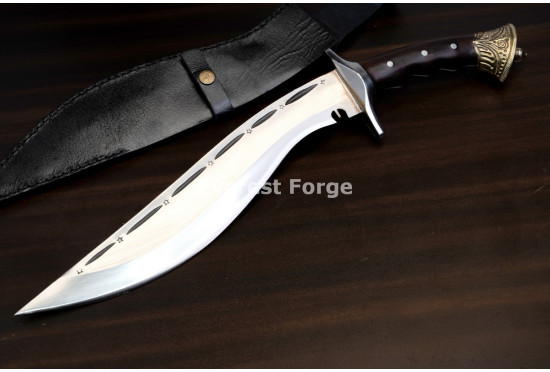
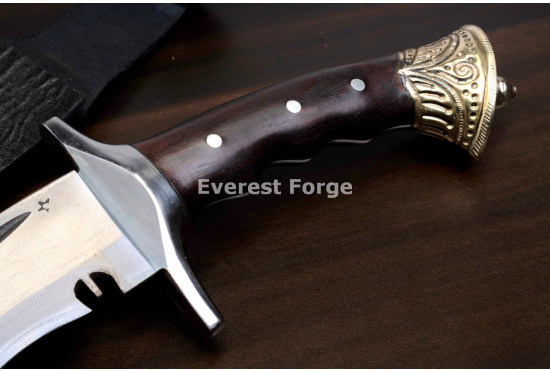
The pommel is why this piece exists. It is solid brass, carved by hand rather than cast, worked in deep scrolling foliate relief and finished with a turned finial at the crown. Nothing else in our range carries one, and it is the part of this kukri that will get picked up and turned over.
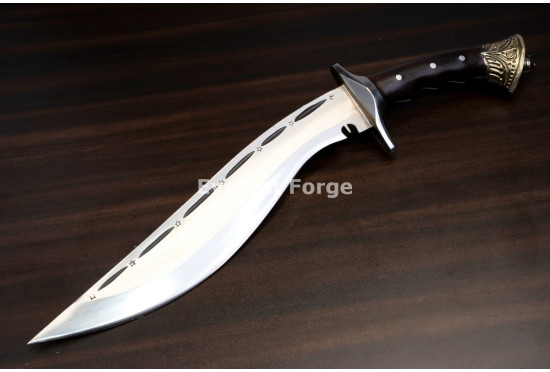
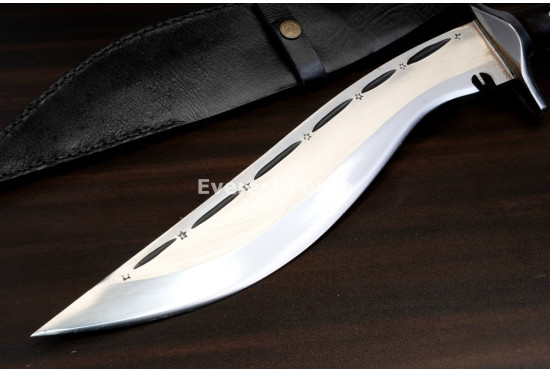
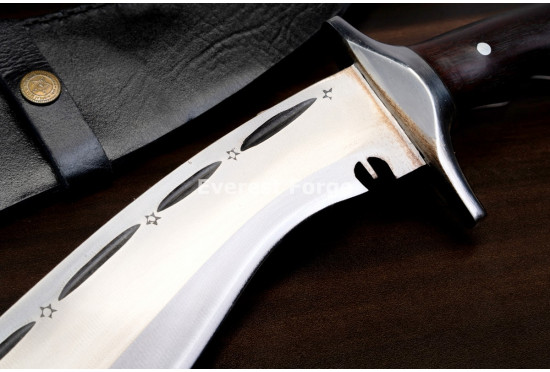
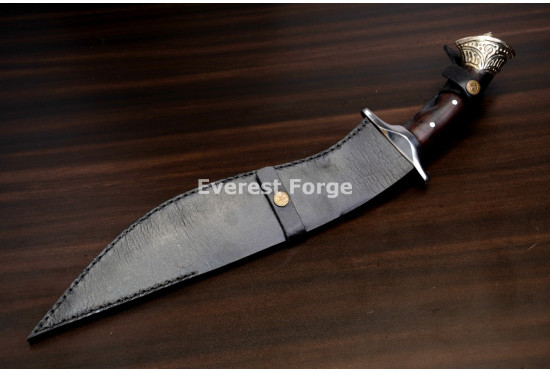
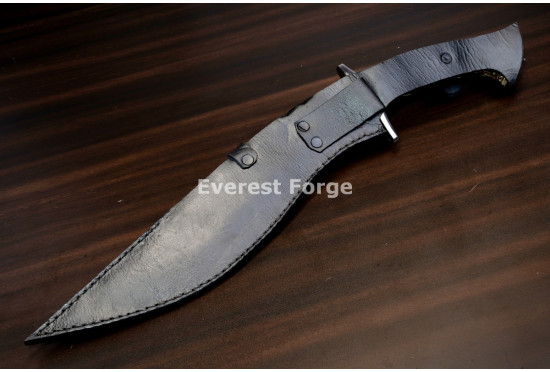
The blade is 13 inches, hand-forged from 5160 high-carbon steel, oil-quenched and tempered, forward-curved with a deep belly and a fine acute point. It carries a row of eight lens-shaped cuts running the length of the flat, each separated by a small star, dark against the polish. The hilt measures 6.5 inches overall with 4 inches of that being grip: contoured rosewood scales on three pins between a steel crossguard at the front and the brass pommel at the back. It ships in a plain black leather sheath, stitched, with a studded retaining strap.
An honest note. This kukri sits closer to the decorative end of our range than the working end, and we would rather say so than have you find out. The blade is real, forged from the same steel as our working pieces and sharpened, but the carved brass pommel is soft metal that marks, the blade decoration is ornament with no function, and the whole piece is finished to be looked at. There is a Nepali tradition of decorative kukris and it is a genuine one, most associated with Dhankuta, where makers embellished with brass while everyone else used plain leather and steel. The hilt here belongs to that family. The blade decoration does not: cutting shapes into the flat of a blade is not part of the Nepali decorative vocabulary, which puts its ornament in engraving on the steel and carving on the scabbard. This is a decorative hilt in a recognisably Nepali idiom on a blade treated in a modern way.
Want This Built Your Way?
A plain blade with no decoration, a different pommel pattern, a steel pommel instead of brass, another length, or your own drawing entirely. Our smiths in Kathmandu forge to specification and quote before any work begins.
Start a Custom BuildWhat You Are Looking At
Standard Build and Specifications
Blade length, blade finish, grip material, pommel pattern and blade decoration are all selectable, so the figures above describe the standard build rather than every version. Because the pommel is carved by hand, the relief pattern varies between pieces — yours will not be identical to the one photographed, and that is the nature of hand work rather than a defect. Individual blade and fitting weights can be measured on your actual piece before dispatch on request.
Build Options
Is This the Right Kukri for You?
Choose This One If
- You want a piece with real hand craftsmanship in the fittings, not just the blade
- You are buying for display, for a gift or for a collection
- You like the brass and want the component that took the longest to make
- You want a blade that is genuinely forged rather than a cast reproduction
- You want something no one else in your circle will have, since each pommel is carved individually
Look Elsewhere If
- You are buying a tool — brass marks, the decoration serves nothing, and our bhojpure or deep-fullered 13 inch will do the work better
- You want a fully traditional kukri — the hilt nods to Dhankuta, the blade treatment does not
- You want low maintenance — brass wants occasional polishing to stay bright
- You want the full traditional kit — no karda, no chakmak, no wooden dap as supplied
- You want a long grip — 4 inches is a firmly one-handed hilt
How to Order
Who This Kukri Is For
- Collectors who want a piece where the fittings are as considered as the blade
- Gift buyers looking for something with presence and visible hand work rather than a mass-produced ornament
- Buyers drawn to the Nepali decorative tradition — the brass work descends from a real one
- Anyone furnishing a wall or a cabinet who would rather hang a forged blade than a cast display piece
- People who like metalwork as much as they like knives
What Is Included
- One hand-forged kukri with hand-carved brass pommel, sharpened
- Black leather sheath with studded retaining strap
- Everest Forge manufacturer warranty
- Care instructions
No karda and no chakmak are supplied with this kukri, and the sheath has no pockets for them. If you want the traditional arrangement we make it — the wooden-cored dap with both companions fitted — and one of our kukris ships with a karda as standard if that is what you are after.
More From the Everest Forge Collection
Shipping, Returns and Care
Stock builds dispatch from our workshop within 2-3 business days. Custom and carved builds take 4-6 weeks from confirmation, and we photograph the finished piece before it leaves us. We ship worldwide with DHL and FedEx, fully tracked, typically 7-14 business days in transit. Every blade carries the Everest Forge manufacturer warranty against defects in forging and construction.
Blade laws vary by country, state and province and it is the buyer's responsibility to check local restrictions before ordering. We cannot advise on your jurisdiction and we cannot refund a blade seized in transit.
5160 is a high-carbon steel and it will rust if you let it. Wipe the blade dry after handling, keep it lightly oiled, and do not store it in the sheath for long periods in a damp climate. The brass needs different care from the steel: it will not rust but it will tarnish to a darker gold, and how bright you keep it is a matter of taste. Use a soft cloth and a brass polish sparingly, and keep polish off the steel and out of the carved recesses, where residue dries white and is difficult to remove. Sharpen with a stone or a file rather than a powered grinder.
Forged by Hand, Not Assembled
Every blade we sell is forged, ground, heat-treated, fitted and carved by our own smiths in Kathmandu. If you want something we do not list, we will make it.
Talk to Our SmithsFrequently Asked Questions
Is the pommel carved or cast, and how can I tell?
Carved. It is worked with gravers by hand, cutting the pattern into solid brass, rather than poured into a mould. The distinction matters because casting is how almost every decorated fitting on the market is made, and it costs a fraction as much. Here is how to tell them apart on any piece, ours included. Carved relief has crisp edges and undercuts that catch a hard shadow, because a graver leaves a clean wall. Cast relief is softer and slightly rounded everywhere, because molten metal will not hold a sharp internal corner and the mould has to release. Look for a faint seam line running around a cast piece where the mould halves met, often polished but rarely gone. And look at two examples of the same product: castings are identical, carvings are not. If you buy this, yours will differ from the photographs in small ways, and that difference is the evidence.
Why brass rather than steel?
Three reasons, and the first is the real one. Brass is the traditional decorative metal in Nepali kukri work: the makers of Dhankuta, who built their reputation on ornament while other villages built theirs on working blades, used brass binding and mounts to mark a piece out as something more than a tool. Choosing brass puts this hilt in that lineage rather than in a Western one. The second reason is practical: brass is softer than steel and works cold, so a carver can cut deep relief into it with hand tools in a way that would take far longer in hardened steel. The third is simply how it looks against dark rosewood. The trade-off is that brass is soft. It marks if you knock it, and it tarnishes. Both are reversible and both are part of owning brass.
The handle is 6.5 inches but the grip is 4. What does that mean?
It means you have 4 inches of usable hand space, and that is the number to compare against your own hand rather than the 6.5. On a hilt like this the crossguard occupies space at the front and the brass pommel occupies space at the back, and neither is grip. Four inches is a firmly one-handed hilt: comfortable for most adult hands in a standard grip, snug for large hands, and not enough to shift your hold along the handle the way you might on a long working kukri. We publish both numbers because handle length on its own is misleading on any knife with substantial fittings, and it is one of the more common causes of a knife arriving smaller in the hand than someone expected. If you have large hands and want more room, say so and we will lengthen the grip.
What is the decoration on the blade?
A row of eight lens-shaped cuts running the length of the flat, each separated by a small star, standing dark against the polished steel. It is ornament and nothing else: it does not lighten the blade meaningfully, it does not affect how it cuts, and it has no traditional significance we can point to. We would rather tell you that than invent a story about it. The one thing worth knowing practically is that any cut surface on carbon steel is a place moisture can sit where a cloth drawn along the flat will not reach, so the decoration wants a moment's attention when you oil the blade. If you want the piece without it, a plain blade costs nothing extra — and if the kukri is going to be used rather than displayed, plain is the sensible choice.
Is this a working kukri or a display piece?
It leans display, and we are not going to pretend otherwise to make a sale. The blade is genuine: same 5160 steel, same forging, same heat treatment as our working pieces, and it arrives sharpened. So it will cut, and it is not a wall-hanger with soft steel and a cast handle. But everything around the blade is arranged for looking rather than working. Brass is soft and will mark. The decoration serves no function. The polish will scuff the first time you use it properly. If you want a 13 inch kukri to actually work with, our deep-fullered 13 inch is lighter and built for exactly that, and our bhojpure hits harder for its size. Buy this one because you want the object.
Is this a traditional Nepali kukri?
Partly, and it is worth separating the parts. There is a genuine Nepali tradition of decorative kukris, centred on Dhankuta, where makers put their effort into ornament and brass while other villages concentrated on working steel. The carved brass pommel here belongs to that family, and the material choice is a Nepali one rather than something borrowed. The blade is a different matter. Nepali decorative work goes into engraving on the steel and carving on the scabbard; cutting decorative shapes into the flat of a blade is not part of that vocabulary, and you will not find it on antique or village pieces. The crossguard is not traditional either — kukris do not carry guards. So: a decorative hilt in a real Nepali idiom, on a blade treated in a modern way.
What is the notch at the base of the blade?
That is the cho, sometimes written kaudi, and it is the diagnostic mark of a genuine kukri. It terminates the edge in a rounded cut rather than letting the edge run straight into the fittings, so a crack starting at the edge has somewhere to stop instead of running back toward the tang. It also carries religious meaning that different communities in Nepal read in different ways, and some villages cut a closed form rather than an open one for that reason. Ours are cut by hand on every blade, which is why no two are exactly alike. We apply the test in both directions: a curved knife with no cho did not come from this tradition whatever a listing calls it, and we have declined to call our own pieces kukris on that basis.
What steel is the blade?
5160 high-carbon spring steel, oil-quenched and tempered, the same as every blade we forge. It is the family of steel used for vehicle leaf springs, which is where the Nepali practice of forging kukris from springs comes from, and it is chosen for toughness rather than for maximum hardness. It is worth stressing on a decorative piece: plenty of ornamental kukris on the market use soft, unhardened steel because nobody expects them to cut, and that is not what this is. The blade under the ornament is the same blade we sell to people who chop with it. It is not stainless and it will rust if neglected, which on a display piece means wiping it after handling, since fingerprints are acidic.
How do I look after the brass?
Decide first how you want it to look, because there is no wrong answer. Left alone, brass tarnishes from bright gold toward a deeper, browner tone, and on a carved piece that darkening settles into the recesses and makes the relief read more strongly. Many collectors prefer it. If you want it bright, use a soft cloth and a small amount of brass polish, worked gently and not too often, since polish is mildly abrasive and repeated over years will soften fine detail. Two cautions specific to a carved pommel: keep polish out of the deep cuts, where residue dries to a white crust that is awkward to remove, and keep it off the steel entirely. Wipe the pommel after handling for the same reason you wipe the blade.
How does this compare to your other 13 inch kukris?
It is the ornamental one. Our traditional chirra is the classic article with a broad fuller, horn hilt and laced sheath. Our deep-fullered 13 inch is the lightest blade we make and built for long working sessions. Our guarded kukri is the fighting-derived design with an acute point and a swept quillon, and it explains the reasoning behind guards on kukris in detail. This one shares the guard idea but exists for a different reason entirely: it is the piece where the fittings are the point. If you are choosing between them, ask what you want the kukri to do. Three of them answer that question with cutting. This one answers it with looking.
Is it sharp when it arrives?
Yes. Every blade leaves us sharpened, including the decorative ones, because a kukri that will not cut is not a kukri. Kukri edges are ground with a convex bevel, which is stronger at the edge and better suited to impact, so sharpen with a stone worked in small circles or with a file rather than dragging it through a fixed-angle pull-through sharpener, which grinds a flat bevel into a convex edge. If this piece is going on a wall, the practical note is the opposite of the usual one: an unused blade still rusts, so oil it before it goes up and check it a couple of times a year, particularly if the wall is an outside one.
Can I have a different size or a different pommel?
Both. Pommel carving is done to order and the standard foliate pattern is only a starting point: geometric work, religious motifs, initials or a design of your own can all be cut, and we quote carving by the hour because that is honestly how it is costed. A plain polished brass cap is the cheapest option and a steel pommel is the hardest-wearing. On size, we forge this profile from belt-sized blades up to two-handed pieces, with one proportional caution: a large carved pommel needs a blade with enough presence to balance it visually, and below about 10 inches the fitting starts to look like it belongs to a different knife. We will tell you that before quoting rather than after.
| Specification | |
| Blade: | 13 inches. Hand forged from 5160 carbon steel. Forward-curved with a deep belly, acute point and decorated flat |
| Total Length: | 19 inches |
| Handle: | 6.5 inches overall, 4 inches of grip between guard and pommel. Rosewood scales on three pins, steel crossguard, solid hand-carved brass pommel with turned finial |
| Weight: | Approx. 1290 g total |
| Note: | The pommel is carved by hand, so the relief pattern varies between pieces and yours will not be identical to the one photographed. Brass tarnishes naturally; polish sparingly and keep polish out of the carved recesses. |