Menu
Your Cart

Hand-Forged Kindjal Short Sword

Hand-Forged Kindjal Short Sword
$224.99
Ex Tax: $224.99
  • Model: Historical sword
  • Product Code: Kindajal020
  • Location: Kathmandu, Nepal

Available Options

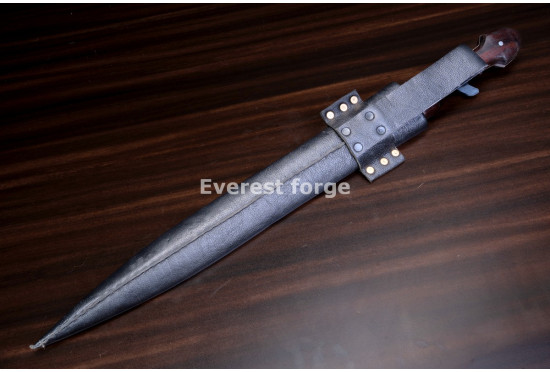
A Hand-Forged Kindjal Short Sword With Asymmetric Fullers and a Guardless Hilt

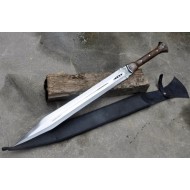
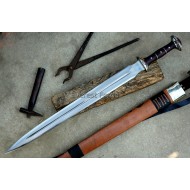
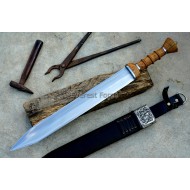
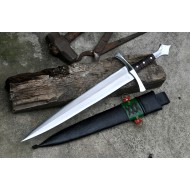
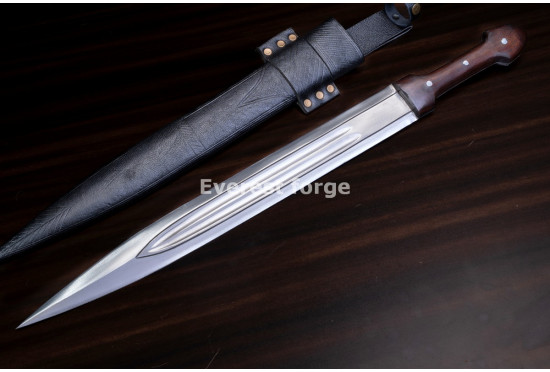
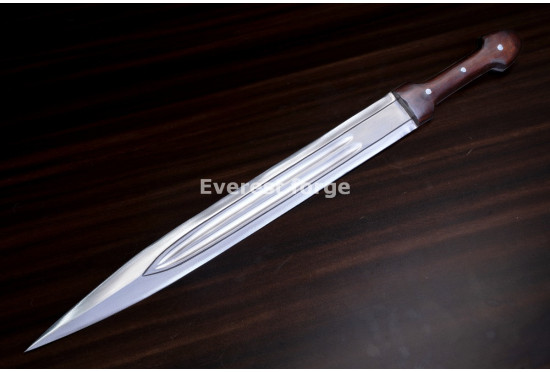
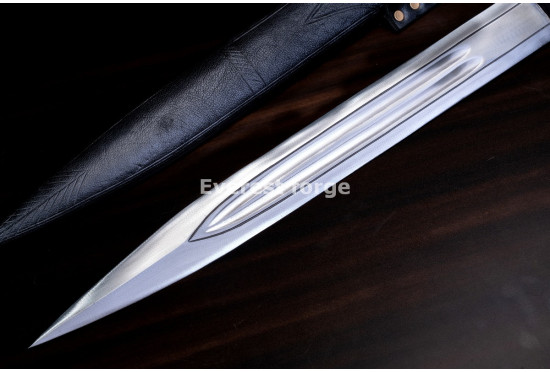
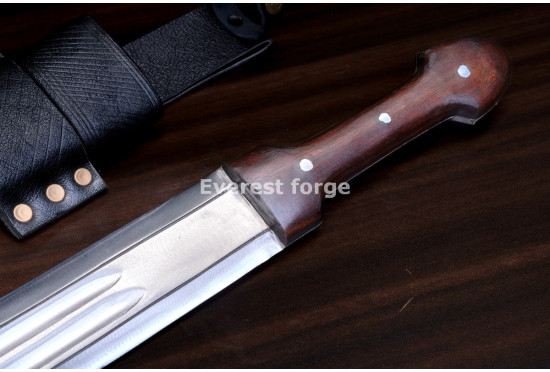
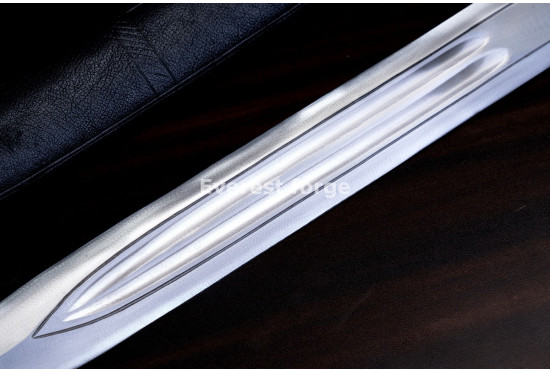
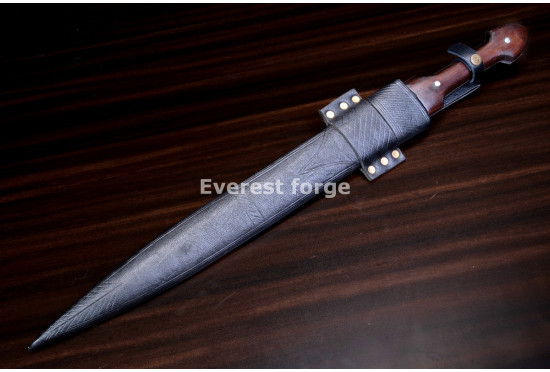
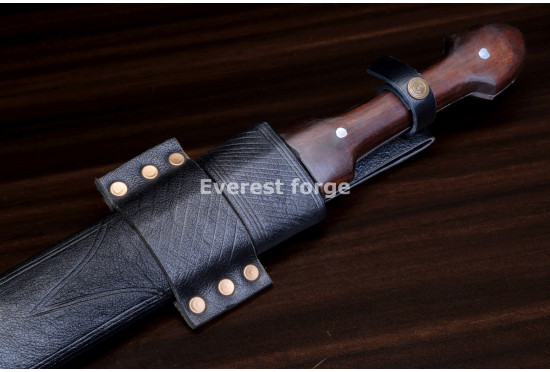
This is a 20 inch hand-forged kindjal, the broad straight sword-dagger of the Caucasus. The blade is double-edged and wide at the shoulder, tapering in a long even line to a very acute point, and carries the type's characteristic asymmetric fullering: channels of different lengths and depths ground at different heights on the face rather than mirrored across the centre line. The hilt is guardless in the Caucasian manner, a waisted rosewood grip flaring at both ends, pinned through a full tang and fitted to a stepped steel collar. Overall length is 27.5 inches and it weighs approximately 1000 grams. Forged from 5160 high-carbon steel in Tokha-3, Kathmandu, and supplied in a deep black leather scabbard, tooled and riveted on a belt rig.

An honest note. Two things. This is a kindjal in blade, hilt architecture and proportion, but not in dress: surviving Caucasian kindjals of any quality carry silver mounts worked with niello, and the scabbard is usually silver-faced rather than plain leather. That decoration is not an extra on this type, it is what the type looked like, and a plain kindjal is a working example rather than a representative one. We offer the silver-mounted build and it is the first option below. Second, at 20 inches of blade this is at the top of the kindjal range and firmly a short sword rather than a dagger, whatever the type is usually called. Ours is listed as a sword to stay consistent with the rest of the catalogue, and the answer below explains why the word dagger follows this weapon anyway.

Made to your specification

Have This Kindjal Forged Your Way

Blade length, fuller arrangement, hilt material and mounts are all decided at the forge. Send a description or a photograph of a museum piece and our smiths will quote it.

Start a Custom Forge Order →

Why This Sword Is Built the Way It Is

Fullers That Do Not MatchThe channels sit at different heights and run different lengths on the face rather than mirroring across the centre. It looks like an error and it is not; it is one of the marks of a Caucasian blade.
No Guard, Because There Never Was OneA kindjal hilt has no cross. The blade meets the grip directly, and the flare at each end of the waisted grip does the work a guard would otherwise do.
A Point Built to Go ThroughWide at the shoulder, straight, and drawn out in one long line to a very acute tip. It is a thrusting geometry first, and the width is what keeps it stiff while doing it.

Specifications

Blade Length20 inches
Handle Length7.5 inches
Overall Length27.5 inches
Blade Steel5160 high-carbon spring steel, oil-quenched and tempered
Blade ProfileStraight double-edged, broad at the shoulder, tapering evenly to a very acute point
FullersAsymmetric — channels of differing length and depth set at different heights on the face
GuardNone, as the type requires
HiltWaisted rosewood grip flaring at both ends, pinned through a full tang
FittingsStepped steel collar at the shoulder
Standard BuildSatin blade, rosewood grip — size, finish and grip material are selectable above
ScabbardBlack leather, tooled and riveted, on a belt rig
WeightApproximately 1000 grams for the sword, 1330 grams with the scabbard
OriginHand-forged in Tokha-3, Kathmandu, Nepal

Build Options

Silver Mounts and NielloGrip mounts, collar and scabbard fittings in silver, blackened with niello in the Caucasian manner. This is what the type actually looked like and it is the change that turns a working kindjal into a representative one.
Blade LengthTwelve to twenty inches. The type genuinely runs that whole span, from a large belt dagger to the short sword shown, and all of it is historical.
Fuller ArrangementThe asymmetric arrangement shown, a single central fuller, or multiple narrow channels. Asymmetric is the more characteristic and the more work.
Grip MaterialRosewood as standard. Water buffalo horn is the traditional material and gives the deep black grip most surviving examples carry.
Blade FinishSatin as standard. Mirror polish shows the fullers better on a display piece; a dark forge finish suits a working look.
Matching ShashkaThe Caucasian sabre worn alongside the kindjal, dressed to match. The pair is how these were worn and almost nobody offers it.

Is This the Right Blade for You?

Buy This If You Want

  • The Caucasian sword-dagger with the fullering done the way the originals do it
  • A guardless hilt, which is the defining architecture of the type rather than a simplification
  • A broad straight blade stiff enough to thrust properly at this length
  • A base for a silver and niello commission, which is what the type deserves
  • A form with a real history that almost nobody in the export market forges

Look Elsewhere If You Want

  • A representative Caucasian piece out of the box — that means silver mounts, and it is a custom build
  • A dagger you can wear discreetly; at 27.5 inches overall this is a visible sidearm
  • A cutting or camp blade, since a broad straight double-edged sword is the wrong tool for working wood
  • A stainless blade needing no care, since 5160 is carbon steel and will rust if left wet
  • A sparring or HEMA trainer, which needs rolled edges and a rebated point from the first heat
Fifteen years at the anvil

Silver, Niello and a Matching Shashka

The kindjal was worn with the shashka and both were dressed alike. We build the pair, mounted in silver and blackened with niello. Tell us what you want on them.

Talk to the Forge →

How to Order

Choose your blade length, finish and grip material from the options above the description.
Note any silver mounts, niello work or a matching shashka in the order comments.
We confirm the build by email and start forging. Preparation takes seven to ten days.
Your kindjal ships tracked and arrives a further seven to ten days later.

Who This Kindjal Is For

  • Collectors of Caucasian and Russian arms who want the blade geometry and fullering right
  • Anyone with Circassian, Georgian, Chechen, Dagestani or Cossack connection for whom this is the blade of the region
  • Re-enactors and living history groups covering the Caucasus and the Russian imperial period
  • Buyers commissioning a silver piece, for whom this is the base the mounts go onto

What Is Included

  • One hand-forged kindjal, sharpened and ready
  • Fitted black leather scabbard on a belt rig
  • Certificate of hand-forging from the workshop
  • Everest Forge manufacturer warranty against defects in forging and heat treatment

Explore the Collection

Shipping, Returns and Care

Every piece is prepared at the forge in seven to ten days, and shipping adds a further seven to ten days. Orders to the USA and Canada travel with FedEx; everywhere else ships on a DDP service, which means duties and taxes are settled before the parcel moves so there is nothing to pay on delivery. Every piece carries the Everest Forge manufacturer warranty against defects in forging and heat treatment.

Long double-edged blades are restricted in some countries and in some states and provinces within them, and the rules for a double-edged weapon are often stricter than for a single-edged blade of the same length. It is your responsibility to check that this piece may lawfully be imported and possessed where you live before ordering, because a parcel seized by customs cannot be returned to us and cannot be refunded. Ask us before you buy if you are unsure and we will tell you what we know about your destination.

5160 is a high-carbon steel and it will rust if left wet or stored damp. Wipe the blade dry, keep a light film of oil on it, and pay attention to the fullers, which are deep and hold moisture a cloth passes straight over. Do not store the sword in the scabbard for long periods. The rosewood grip takes an occasional coat of oil. If you order silver mounts with niello, clean them with a soft cloth only — abrasive silver polish will lift niello out of the engraving and it cannot be put back.

Frequently Asked Questions

Why are the fullers not symmetrical?

Because that is how kindjals are made, and it is one of the surest ways to tell a Caucasian blade from a broad dagger shaped to look like one. On most European blades the fullers mirror each other across the centre line, and a blade where they did not would be read as badly ground. On a kindjal the channels are deliberately set at different heights on the face, run to different lengths and are often of different depths, and the two faces of the same blade frequently do not match one another either. Several explanations get offered — that it stiffens the blade against bending in one plane, that it is a maker's signature, that it is simply the regional aesthetic — and the honest answer is that no single one is settled. What is not in doubt is that it is characteristic and intentional, appearing across centuries of Caucasian work from many different workshops. Ours are ground that way on purpose. If you would prefer a conventional matched arrangement we will do it, and the blade will be less obviously a kindjal for it.

What is a kindjal?

The broad straight double-edged sword-dagger of the Caucasus, carried across the region by Circassians, Georgians, Chechens, Dagestanis and others, and adopted wholesale by Cossack regiments of the Russian empire, who called it the kama. It is worn at the front of the belt, hanging vertically, hilt to hand, and it was the everyday sidearm of an entire region for centuries — a weapon, a tool, a mark of adulthood and a statement of what you could afford, all at once. The form is remarkably consistent: broad at the shoulder, straight, tapering in one long line to a very acute point, no guard at all, and a waisted grip flaring at both ends. What varies is size and decoration, and both vary enormously. The great centres were in Dagestan, Kubachi above all, whose silversmiths supplied the whole region and are still working.

Is it a sword or a dagger?

Both words are used and neither is wrong, which is why we say sword-dagger in the lead. The kindjal genuinely spans the range: examples run from around twelve inches of blade, which nobody would call anything but a dagger, up to around twenty, which is a short sword by any measure. This one is at the top of the range at 20 inches of blade and 27.5 overall. Our own rule across the catalogue is that past roughly sixteen to eighteen inches a piece stops being a dagger in any useful sense, so we list it as a short sword, and the hilt is proportioned to match at 7.5 inches. The word dagger follows the type anyway because most kindjals sold are shorter and because the Russian and Caucasian terms do not map neatly onto the English distinction. If you want the dagger end of the range, order twelve to fourteen inches and we will shorten the hilt with it.

Why is there no guard?

Because the type does not have one and never did, and the hilt solves the problem differently. A kindjal grip is waisted through the middle and flares at both ends, so the flare at the blade end stops the hand travelling forward and the flare at the butt stops it coming off the back. That is enough on a weapon used the way this one was: drawn from a vertical scabbard at the front of the belt and used at very close range, where a cross guard would foul the draw and catch on clothing constantly. It is the same reasoning that leaves a seax guardless, arrived at independently. It does mean you should treat the point with respect, because there is nothing between your hand and the blade but the flare, and a wet grip on a hard thrust is exactly the situation a guard exists for. That is a real trade the type accepted, not an oversight.

What are silver mounts and niello?

They are what a kindjal actually looks like, and it is the main thing separating ours from a representative example. Caucasian kindjals of any standing are mounted in silver — grip plates, collar, scabbard face and chape — engraved and then filled with niello, a black metallic compound of silver, copper, lead and sulphur that is melted into the engraved lines and polished flush. The result is a deep black pattern locked into bright silver, and it does not wear off the way a surface finish does. Dagestani work, particularly from Kubachi, is among the finest of its kind anywhere. On this type the decoration is not an upgrade in the way it is on most weapons: an undecorated kindjal is a working blade, and a mounted one is the object as it was understood in the Caucasus. We do this work in our own shop. One care note: never use abrasive silver polish on niello, because it lifts the black out of the lines and it cannot be replaced.

How was it worn?

At the front of the belt, hanging vertically with the hilt at hand and the point down, usually centred or slightly to one side over the stomach. That is unusual — most sidearms hang at the hip or behind — and it follows from how the weapon is used and what it meant. Hung at the front it is visible, which matters on an object that announced status, and it can be drawn with either hand across the body at very close quarters. It also sits comfortably on a man on horseback, which the hip does not. The scabbard is typically narrow and closely fitted with a small ball or knob at the chape, and the whole rig hangs from a single narrow strap or a loop rather than a frog. Ours hangs on a belt rig that will carry either way; tell us if you want the vertical front arrangement and we will build the straps for it.

What is a shashka, and should I have both?

The shashka is the Caucasian sabre: single-edged, guardless like the kindjal, with a hilt that has no pommel but a cleft or eared cap, carried edge-up in a scabbard that swallows most of the hilt. Kindjal and shashka were the standard pair across the Caucasus and later throughout the Cossack regiments, and a man of means had both dressed alike — same silver, same niello patterns, same hand. That matching is the thing almost nobody offers now, and it is the single most striking commission we take in this family. If you are buying one piece, buy the kindjal, because it is the more distinctive object and the more useful at close range. If you are building a set, tell us at the start rather than after the first piece is made, because matching mounts to an existing blade is harder than making them together.

Why is the blade so wide for a thrusting weapon?

Because width is what makes a long straight blade stiff enough to thrust with. A point driven into resistance loads the blade along its length, and a narrow blade of this size would flex and lose the line. Broad stock resists that, and the fullers then take weight back out of the middle of the face where it contributes least, which is why a kindjal is not the heavy object its outline suggests. The width also gives you real cutting edge, so the weapon is not purely a thruster the way an armour-piercing dagger is, though the taper and the point tell you where its priorities lie. It is a good example of a form where the shape is doing several jobs at once rather than one, and it is why the same broad-straight-tapered outline turns up independently in the Roman gladius and the Italian cinquedea.

What steel is it, and how is it heat treated?

5160 high-carbon spring steel, brought to temperature in the forge, quenched in oil and tempered back so the edges are hard while the body of the blade stays springy. On a long broad double-edged blade the tempering matters particularly, because the weapon is designed to be driven and a blade tempered too hard would take a set or crack under point load rather than flexing and returning. Fine Caucasian blades were often made from crucible steel with a visible pattern, and wootz blades from the region are among the most sought-after in collecting; a modern homogeneous alloy is stronger and far more predictable, and we would rather say that than imply a metallurgy we are not using. It is not stainless, deliberately.

Is it full tang?

Yes, and it follows the record. Kindjal hilts are characteristically built with a full-width flat tang and grip plates riveted through it, usually horn, sometimes wood, and on decorated pieces covered with silver mounts pinned over the top. That is exactly how ours is made, with rosewood scales pinned through and the line of steel showing along the outline of the grip. It is a straightforward, strong arrangement and one of the reasons the type survives so well in collections. If you order silver mounts, they are fitted over this same construction rather than replacing it.

How sharp does it arrive?

Sharp and ready, with both edges put on a stone by hand at the forge. If you would prefer it shipped unsharpened — for display, for a gift, for a group where a live edge is not permitted, or because of the rules where you live — say so in the order comments and we will do it at no extra cost, and rebate the point as well if you need it. On a guardless hilt with a very acute point, a blunt build is worth considering for anything that will be handled by visitors rather than kept on a wall.

Where is this made, and by whom?

In our own workshop in Tokha-3 on the northern edge of Kathmandu, Nepal, by around ten smiths, most from families that have forged blades for generations. Everest Forge has operated since 2010, and we forge, grind, heat treat, fit the hilts and cut the leather in the same building. A Caucasian weapon made in Nepal deserves the same word we give our bowie, our seax, our kopis and our cinquedea: this is not our own tradition and we do not pretend it is. It is worked from the record, which is why this page tells you plainly that a plain-mounted kindjal is a working example rather than a representative one.

Specification
Blade: 20 inches. Hand forged from 5160 carbon steel
Total Length: 27.5 inches
Handle: 7.5 inches. Guardless waisted rosewood grip flaring at both ends, full tang with pinned scales, stepped steel collar
Weight: Approx 1000g sword, 1330g with scabbard
Note: Some variation in weight, dimensions and finish may occur as each piece is hand forged. Keep the blade lightly oiled when not in use

Write a review

Note: HTML is not translated!
Bad Good
Captcha