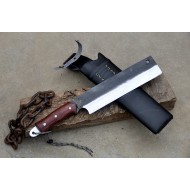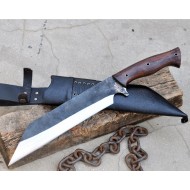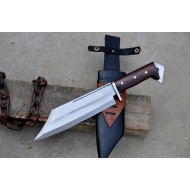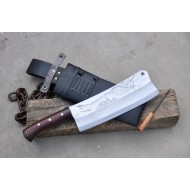
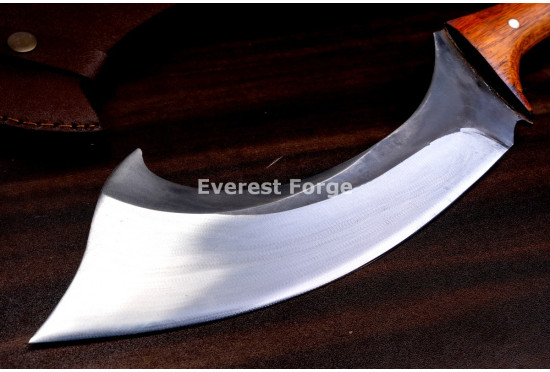
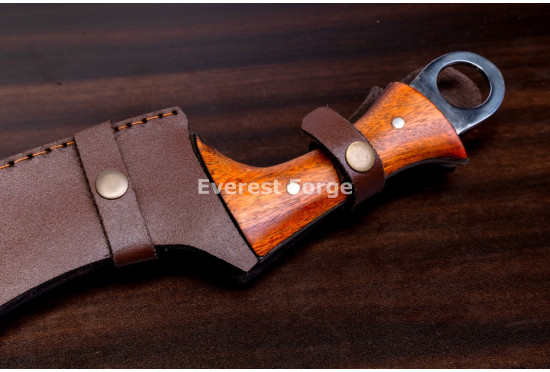
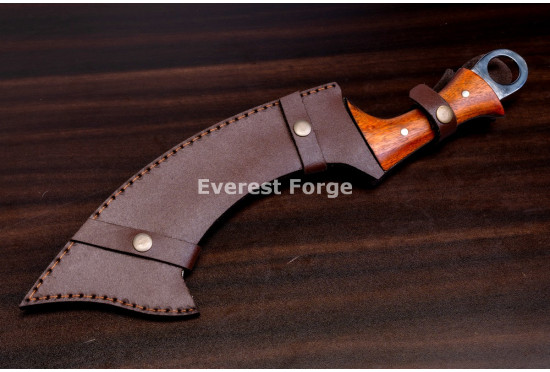
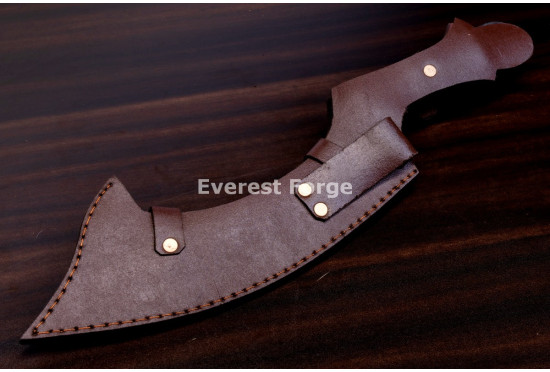
- Model: KHOPESH
- Product Code: Khopeshchopper010
- Location: Kathmandu,Nepal
Available Options
A Hand-Forged Khopesh-Style Chopper With a Steel Ring Pommel
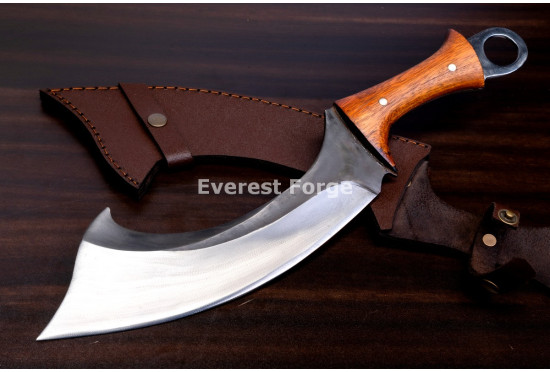
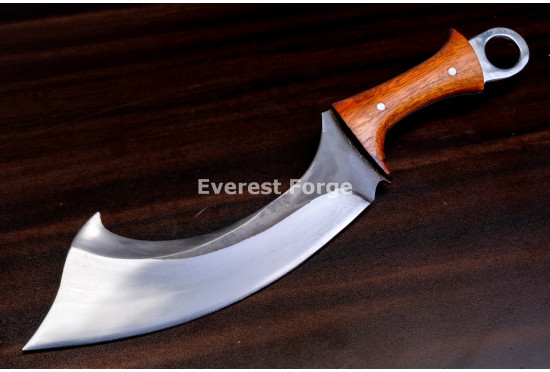
This is a short, forward-weighted chopper built around the sickle-sword silhouette of the ancient Egyptian khopesh — a deep recurve behind the ricasso, a broad convex belly carrying most of the cutting edge, and an upswept point. It is hand-forged in Tokha-3, Kathmandu, Nepal from 5160 high-carbon steel, oil-quenched and tempered, and it arrives sharpened and ready to work. At 10.5 inches of blade and 16.5 inches overall it is a one-hand chopper, not a display sword: the mass sits ahead of the grip where it does the cutting, and the integral steel ring pommel counterweights it and gives you a positive anchor point in the hand.
An honest note. This is a khopesh-style chopper, not a reproduction of an ancient one. A true khopesh was a Bronze Age weapon of roughly 20 to 24 inches with a long straight section before the hook, cast or forged in bronze, and no ring pommel. What this blade shares with it is the crescent profile and the sharpened outer curve. Everything else — the length, the steel, the riveted wooden grip, the ring pommel, the belt sheath — is modern working-blade construction. We would rather tell you that than let the name do the talking. If you want a full-length historical khopesh, we forge those to order.
Want a Full-Length Historical Khopesh Instead?
Our smiths forge to your drawing or reference photo — longer blade, straight proximal section, period fittings, different grip material, or a heavier chopping profile. Send a sketch or a photo and we will quote it.
Start a Custom Build →Why This Chopper Is Built the Way It Is
Full Specifications
How You Can Configure It
Is This the Right Blade for You?
Buy This If You Want
- A short chopper that hits harder than its length suggests
- The khopesh silhouette in a size you can actually carry on a belt
- Real forged high-carbon steel rather than stock-removal stainless
- A full-tang blade you can put real force into
- A working piece that still looks striking on a wall or a shelf
- Something a smith will alter to your dimensions before it ships
Look Elsewhere If You Want
- A museum-accurate Bronze Age khopesh — this is a modern interpretation
- A full-length sword; at 16.5 inches this sits with large knives and choppers
- A stainless blade that needs no oiling or care
- A thrusting weapon — the geometry is built to cut, not to stab
- A lightweight blade; the forward mass is the point of the design
- Identical units — every piece is forged by hand and varies slightly
How to Order
Who This Chopper Suits
- Bushcraft and camp users who want one blade that clears brush, splits kindling and processes camp wood without carrying an axe.
- Collectors of unusual blade geometry who already own straight knives and want a recurve in the rack.
- Cosplay and prop builders who need a real forged blade with presence rather than a cast replica.
- Gift buyers looking for something with a story behind the shape, etched with a name or a date.
- Smallholders and gardeners clearing vines, canes and light scrub where a machete is too whippy.
What Is Included
- One hand-forged khopesh-style chopper, sharpened and ready to use
- Fitted brown leather belt sheath with press-stud retention strap
- Care and oiling instructions
- Everest Forge manufacturer warranty against defects in forging and heat treatment
Other Curved and Heavy Working Blades
Shipping, Returns and Care
Shipping. Standard builds dispatch in 2 to 3 business days. Custom builds take 4 to 6 weeks. We ship worldwide by DHL or FedEx, 7 to 14 business days, fully tracked. Blade laws vary by country and by state — please check what applies where you live before ordering, as we cannot deliver into a restricted address.
Returns. Standard builds can be returned unused and in the original sheath within 30 days. Custom builds, altered dimensions and etched pieces are made to your specification and cannot be returned unless there is a fault in forging or heat treatment.
Care. 5160 is a high-carbon steel and it will rust if you neglect it. Wipe the blade dry after use, keep it lightly oiled when it is stored, and never leave it sheathed wet — leather holds moisture against steel. Strop or steel the edge regularly rather than grinding it back once a year. Store the sheath and the blade separately for long periods.
Frequently Asked Questions
Is this an authentic khopesh?
No, and we will not pretend otherwise. A historical khopesh was a Bronze Age Egyptian and Canaanite sickle-sword of roughly 20 to 24 inches, with a straight section of blade before the hook, made in bronze and later iron, with no ring pommel and no riveted scales. This piece borrows the crescent silhouette and the sharpened outer curve, then builds them into a modern 10.5 inch chopper in 5160 steel. It is a khopesh-style blade, which is why the name says so. If you want a full-length historical reconstruction, our smiths will forge one to a reference you supply.
Why is the edge on the outer curve instead of the inner one?
This is the detail that separates the sickle-sword family from the forward-curved knife family, and almost nobody explains it. On a kukri, a kopis or a falcata the edge sits on the inner, concave side of the forward bend, so the blade folds around the target. On a khopesh the edge runs along the outer, convex side of the crescent, so the blade sweeps past the target on an arc and the cut travels along the edge rather than landing all at once. In practice the outer-edge geometry gives you a longer effective cutting stroke and a natural draw cut, which is why it works so well on rope, hide, vine and green wood. The trade-off is that it hooks less aggressively than a kukri on a heavy chop into seasoned timber.
What is the ring pommel actually for?
Three things. It counterweights a blade that carries most of its mass forward, which brings the balance point back toward the hand and makes the chopper feel controllable rather than top-heavy. It indexes the grip — your little finger finds the ring and tells you which way the edge is pointing without looking. And it takes a lanyard, which matters on a blade you swing hard, because a wet grip and a forward-weighted blade is exactly how a chopper gets away from someone. It is forged as part of the tang rather than pinned on afterwards, so it is structural, not decoration.
What steel is it and how is it heat treated?
5160 high-carbon spring steel, oil-quenched and then tempered back. 5160 is the standard choice for blades that take impact — it holds a working edge and it bends under abuse rather than snapping, which is what you want in a chopper. It is also the steel family Nepali smiths have traditionally drawn from vehicle leaf spring, so our forge has generations of experience reading it by colour and by sound rather than by pyrometer alone.
Does it arrive sharp?
Yes. It ships with a working edge, sharpened by hand on the convex belly and ready to cut out of the sheath. This is not a wall-hanger with a blunt profile ground into it. If you want it taken finer for slicing work, or left with a stouter shoulder for splitting and hard chopping, say so in the order note before we ship and we will grind it that way.
Is the tang full length?
Yes — full tang, running the whole length and width of the handle, with the scales riveted through it and the ring pommel forged as part of the same piece of steel. There is no stick tang glued or pinned into a solid handle block. That construction is the single most common failure point on inexpensive choppers: the joint takes all the shock of every impact, and it eventually works loose. A full tang puts the steel behind the whole grip.
How does this compare to a kukri?
They solve the same problem from opposite directions. A kukri bends forward with the edge on the inside of the angle, so the impact concentrates at the sweet spot in the belly and it splits and chops deep into seasoned wood. This chopper curves the other way, with the edge on the outer arc, so it slices along a longer stroke and excels on rope, green growth, vine, hide and light brush. A kukri is the better splitter; this is the better slasher. If you mostly process firewood, take the kukri. If you mostly clear growth and want something visually striking, take this.
Can I have it made longer or shorter?
Yes. Blade length is selectable, and beyond the listed options our smiths will forge to a dimension you specify. Bear in mind that the recurve has to be re-proportioned when the length changes or the balance goes wrong — stretching a 10.5 inch profile to 16 inches without redrawing the curve gives you a blade that feels dead in the hand. That redrawing is included in a custom build; just tell us the length and how you intend to use it.
Is the sheath included?
Yes. It comes with a fitted brown leather belt sheath with a press-stud retention strap, cut to the shape of this specific blade profile. A hooked chopper is awkward to sheath safely, so it is not a generic pouch — it is made around the piece. Dangler carry, left-hand carry and a full leather scabbard with a belt frog are available on request.
Will every piece look exactly like the photograph?
No, and that is inherent to hand forging. Every blade is drawn out under a hammer by a smith, so the curve, the width at the belly and the finish carry small differences from piece to piece. Wood grain differs on every handle. Weights and dimensions vary by a few percent either way. What is consistent is the steel, the heat treatment, the construction and the edge. If you need a piece to match the photograph closely, note it on your order and we will pick the nearest one in the rack.
How do I keep the finish from rusting?
Treat it like any high-carbon blade. Wipe it dry after every use, especially after cutting anything green or acidic, and put a thin film of oil on it before it goes away. Camellia oil, mineral oil or a light gun oil all work; kitchen oils go sticky over time. Never store it sheathed for long periods, because leather traps moisture against steel and will mark the finish. A small amount of patina developing over the years is normal and is not a defect — it is a protective layer.
Where is it made and by whom?
Hand-forged in Tokha-3, Kathmandu, Nepal, by our own smiths. Everest Forge is a working forge, not a reseller putting a name on imported blanks — the steel is cut, drawn, quenched, tempered, ground, fitted and sheathed under one roof. That is also why we can change dimensions on a custom order: there is a smith at the anvil rather than a catalogue of finished stock.
| Specification | |
| Blade: | 10.5 inches. Hand forged from 5160 carbon steel |
| Total Length: | 16.5 inches |
| Handle: | 6 inches total with a 4 inch grip, full tang, wood scales riveted through with steel bolster and integral forged ring pommel |
| Weight: | 820 grams approx |
| Note: | handmade variation in weight, dimensions and finish may occur; keep blade lightly oiled when not in use |