Menu
Your Cart

Hand-Forged Hunting Knife, Bolstered Full Tang

Hand-Forged Hunting Knife, Bolstered Full Tang
$139.99
Ex Tax: $139.99
  • Model: Hunting and survival knife
  • Product Code: HUNTING0040
  • Location: Kathmandu,Nepal

Available Options

A Hand-Forged Hunting Knife With a Bolstered Full Tang

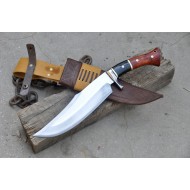
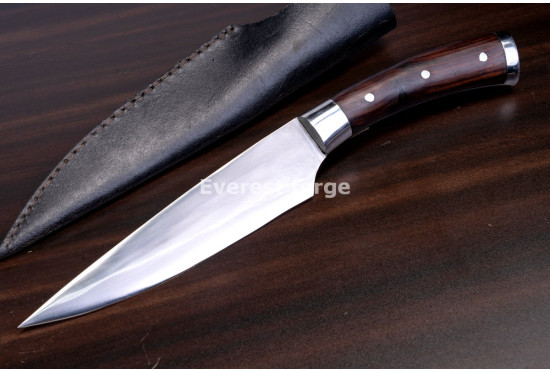
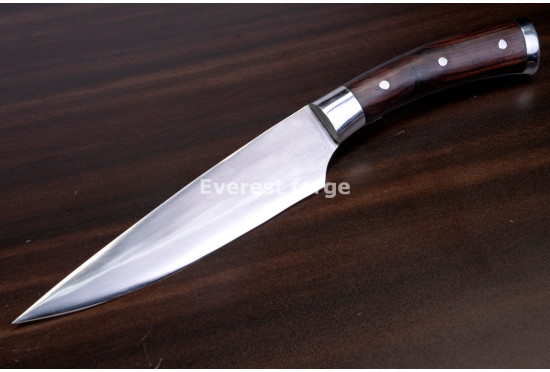
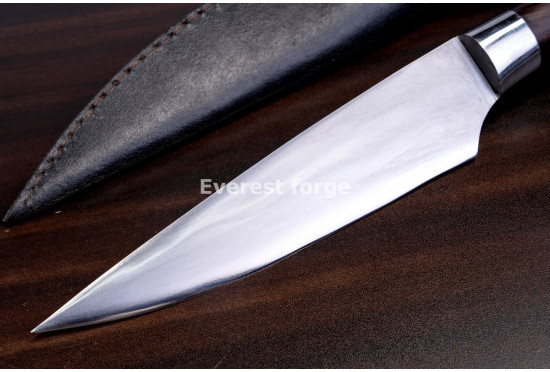
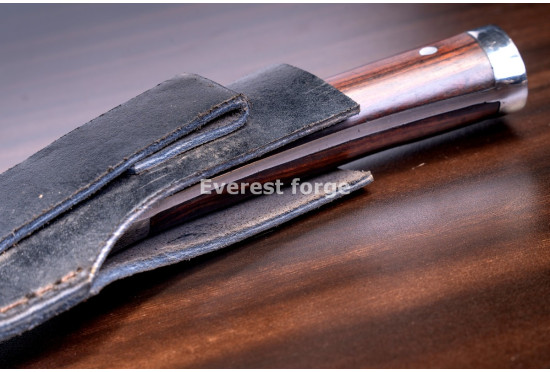
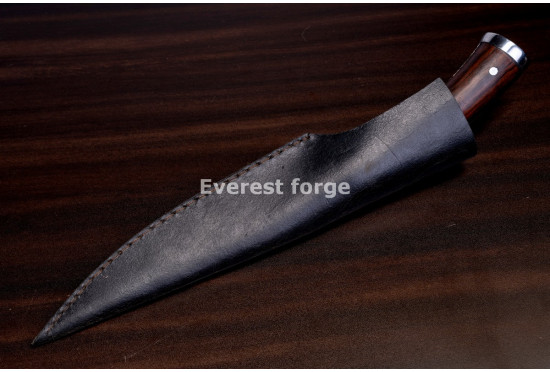
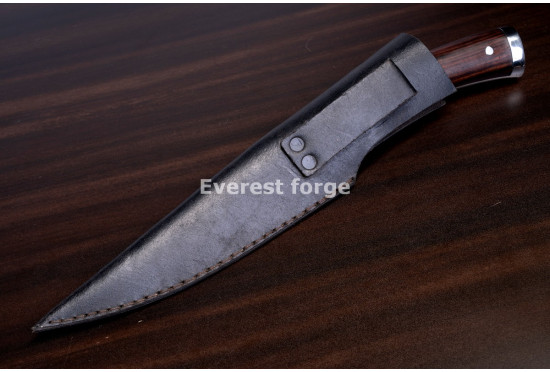
This is a large fixed-blade hunting and field knife, hand-forged in Tokha-3, Kathmandu, Nepal from 5160 high-carbon steel, oil-quenched and tempered. The blade runs 9 inches, widening slightly from the ricasso before drawing in a long even taper to a fine point, with a satin polish across the flats. Behind it sits a polished steel bolster, rosewood scales riveted through a full-width tang, and a steel cap closing the butt. Overall it stands 15 inches. It ships sharpened, in a fitted black leather sheath.

An honest note. Nine inches is long for a hunting knife, and it is worth saying so before you order. Most knives sold for hunting run three and a half to five inches, because the work is detail work — skinning, caping, opening a carcass without puncturing anything you did not intend to. A 9 inch blade is a camp and field knife: it clears brush, splits kindling, processes larger game and handles the heavy end of bushcraft, and it is genuinely better than a short knife at all of that. What it is not is a precision skinner. If that is what you need, we forge shorter blades on the same hilt, and you would be better served by one.

Custom Forge

Want This Knife at Skinning Length?

The same bolstered full-tang hilt on a 4 or 5 inch drop-point blade makes a proper hunting knife, and our smiths build it to order. We will also cut a different scale material, add a finger choil, or build a matched pair — one long, one short. Tell us what you hunt and we will proportion it.

Start a Custom Build →

Why This Knife Is Built the Way It Is

Steel BolsterThe collar between blade and scales does three jobs: it stops the hand sliding forward onto the edge, it moves weight back toward the grip, and it seals the joint where scales meet tang against moisture and blood.
Full-Width TangThe tang runs the whole length and width of the handle with the scales riveted through it. No glue line, no narrow section, and the load path from edge to hand is continuous steel.
Long Even TaperThe blade narrows steadily rather than running parallel and stopping, which keeps the balance near the hand on a blade this long and lets the point do fine work despite the size.
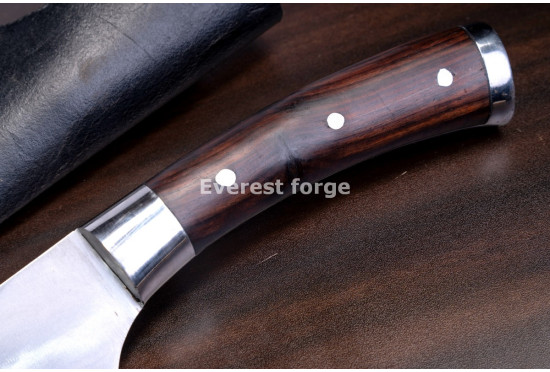
Shaped Rosewood ScalesContoured rather than left as flat slabs, so the hand finds the same position every time. A shaped, non-round grip is also what tells you where the edge is pointing without looking.
Steel Butt CapCloses the end grain of the scales, where a wooden handle takes damage first, and adds a little counterweight behind the hand.
5160 High-Carbon SteelSpring steel, oil-quenched and tempered. It takes a keen edge and bends rather than chipping under impact — the same family Nepali smiths have drawn from leaf spring for generations.

Full Specifications

Blade Length9 inches
Handle Length6 inches
Overall Length15 inches
Blade Steel5160 high-carbon spring steel, oil-quenched and tempered
Blade ProfileLong even taper to a fine point, straight spine
EdgeSingle edge, sharpened and ready to use
ConstructionFull-width tang with scales riveted through, steel bolster and butt cap
HandleShaped rosewood scales, three rivets
Weight770 grams approx, as shipped with the sheath
SheathFitted black leather sheath
OriginHand-forged in Tokha-3, Kathmandu, Nepal
Standard Build9 inch blade, satin finish, rosewood scales. Blade length, blade finish and scale material are selectable above — the photographed piece shows the standard build.

How You Can Configure It

Blade LengthNine inches as photographed for camp and field work, or 4 to 5 inches for a proper skinning and hunting blade. Tell us the task and we will proportion it.
Scale MaterialRosewood as standard, or hardwood, horn, bone or micarta. Micarta is the one to take if the knife will be wet often; wood and horn look better and need more care.
Blade FinishA bright satin as photographed, or a darker finish that hides use marks and slows surface rust on a working blade.
Finger ChoilA cut-out ahead of the bolster lets you choke up on the blade for close, controlled work. Worth having on a long blade you also want to use for fine tasks.
Edge GeometryA thinner edge for slicing and game preparation, or a stouter shoulder for splitting and camp use. Say what you will cut.
MarkingsInitials, a name or a date etched on the flat or the ricasso. Send the text with your order note.

Is This the Right Knife for You?

Buy This If You Want

  • A large field knife that handles camp work a short blade cannot
  • Bolstered full-tang construction with nothing glued and nothing to work loose
  • Real forged 5160 with a proper heat treatment
  • A shaped grip that indexes the edge without looking
  • A knife forged in Nepal by a workshop that has made blades for generations
  • The option of a shorter skinning blade on the same hilt

Look Elsewhere If You Want

  • A precision skinner — at 9 inches this is a field knife, and we build shorter
  • A pocket or folding knife; this is a fixed blade with a belt sheath
  • A stainless blade that needs no oiling or care
  • A lightweight knife; a full tang in this size carries real mass
  • A finger choil as standard; it is a build option
  • Identical units; every piece is forged by hand and varies slightly

How to Order

Choose Your BuildSet blade length, scale material, finish and edge geometry from the options above, then add to cart.
Add Any NotesA finger choil, a shorter skinning blade, a matched pair or etching text go in the order note.
We Forge and FitStandard builds dispatch in 2 to 3 business days. Custom builds take 4 to 6 weeks from confirmation.
Tracked DeliveryDHL or FedEx, 7 to 14 business days worldwide, tracked door to door and covered by our manufacturer warranty.

Who This Knife Suits

  • Camp and bushcraft users who want one blade that clears, splits and prepares rather than three that each do one job.
  • Hunters after a heavy field knife to carry alongside a short skinner, not instead of one.
  • Smallholders and outdoor workers cutting cord, canes, vines and light scrub.
  • Knife collectors who value visible construction — bolster, rivets, exposed tang — over branded stainless.
  • Gift buyers wanting a practical piece with an etched name that will actually be used.

What Is Included

  • One hand-forged hunting knife, sharpened and ready to use
  • Fitted black leather sheath
  • Care and oiling instructions
  • Everest Forge manufacturer warranty against defects in forging and heat treatment

Other Hand-Forged Blades

Shipping, Returns and Care

Shipping. Standard builds dispatch in 2 to 3 business days. Custom builds take 4 to 6 weeks. We ship worldwide by DHL or FedEx, 7 to 14 business days, fully tracked. Blade laws vary by country and by state — please check what applies where you live before ordering, as we cannot deliver into a restricted address.

Returns. Standard builds can be returned unused and in the original sheath within 30 days. Custom builds, altered dimensions and etched pieces are made to your specification and cannot be returned unless there is a fault in forging or heat treatment.

Care. 5160 is a high-carbon steel and it will rust if you neglect it. Wipe the blade dry after every use, especially after cutting game, fruit or anything acidic, and keep a thin film of oil on it in storage. Pay attention to the join where the scales meet the bolster and to the rivet heads, which are the two places moisture sits on a scaled handle. Never put it in a dishwasher and never leave it sheathed wet, since leather holds damp against steel. Rosewood scales want a light coat of hard wax or furniture oil once or twice a year. Strop the edge regularly rather than grinding it back once a season.

Frequently Asked Questions

What blade length should a hunting knife actually be?

Shorter than most people buy, and the reason is that a hunting knife is a precision tool rather than a chopper. For skinning and field dressing you want 3.5 to 4.5 inches: enough edge to work a hide, short enough to control with your fingers close to the tip, and short enough that you do not puncture the stomach or bladder when you are working blind inside a carcass. Four to six inches covers general hunting and camp use and is the most common all-round choice. Six to nine inches, where this knife sits, is a field and camp blade — it splits kindling, clears brush, quarters larger game and does the heavy work, but it is clumsy for detail. Past nine inches you are into machete and kukri territory, where chopping is the whole point. The honest answer for most hunters is two knives: a short one for the animal and a long one for the camp. We build both, and we will make them as a matched pair with the same hilt and scales if you want them to look like a set.

What does a bolster actually do?

Three things, and only one of them is obvious. The obvious one is that it stops your hand sliding forward onto the edge under a hard cut, which on a knife with no guard is the only thing standing between you and a cut hand. The second is balance: a solid steel collar sits right at the pivot point of the knife and pulls the balance back toward the grip, which makes a long blade feel considerably livelier than its weight suggests. The third is the one nobody mentions — a bolster seals the joint where the scales meet the tang at the front of the handle, which is exactly where blood, water and fat get in. On a knife without one, that joint is an open seam that traps moisture against the tang, and it is where a scaled handle starts to lift and corrode first. Field-dressing knives earn a bolster more than most.

Why does a knife handle need to be shaped rather than round?

Because you need to know where the edge is pointing without looking at it, and a round handle cannot tell you. When your hand closes on a shaped grip — flat sides, a contoured belly, an oval section — the geometry itself puts the blade in the same orientation every time. That is edge indexing, and it matters most when you cannot see what you are doing: inside a carcass, in poor light, or with cold hands. A round grip gives you no reference at all, so the blade can rotate in your hand and you only find out when the cut goes somewhere you did not intend. This knife has flat rosewood scales with a contoured profile and a bolster your forefinger registers against, which gives you three separate reference points. It is a small design detail with a large practical effect, and it is one of the clearest tells of whether a knife was designed to be used or to be looked at.

What steel is it and how is it heat treated?

5160 high-carbon spring steel, oil-quenched and then tempered back. 5160 takes a keen edge and bends under abuse rather than chipping, which is the right trade for a field knife that will meet bone, grit and knots. It is also the steel family Nepali smiths have traditionally drawn from vehicle leaf spring, so our forge has generations of experience reading it by colour and by sound at the anvil. Every blade is inspected before it is packed, and if a piece reaches you with a fault in the forging or the heat treatment we will replace it or refund you.

Does it arrive sharp?

Yes. It ships with a working edge, sharpened by hand and ready out of the sheath. It is not a display piece with an edge suggested rather than ground. If you want it taken finer for game preparation and slicing, or left with a stouter shoulder for splitting and camp work, say so in the order note before we ship and we will grind it that way.

Is the tang full length?

Yes, and full width. The tang is a flat continuation of the blade running the whole length and width of the handle, with the rosewood scales riveted straight through it — you can see the three rivet heads in the photographs, which is the visible sign of the construction. There is no narrow hidden tang and no glued handle block. On a knife that will be used hard this is the single most important structural feature: a partial tang concentrates every impact at the joint where it ends, and that joint is what eventually works loose or snaps. A full-width tang has no such point.

Can I have a shorter blade?

Yes, and for most hunting we would suggest it. The same bolstered full-tang hilt takes a 4 or 5 inch drop-point blade and becomes a proper skinning and field-dressing knife. Our smiths will also build the two as a matched pair with the same scales and fittings, which is a popular commission and a good gift — a long camp blade and a short skinner that clearly belong together. Tell us what you hunt and how you work and we will proportion both.

What is a finger choil and should I add one?

A finger choil is a cut-out in the edge immediately ahead of the bolster, sized so you can slip your index finger into it and grip the blade itself rather than the handle. Choking up like that shortens your effective blade to two or three inches and gives you the control of a small knife on a large one — useful for detail work, caping, or anything needing the point rather than the belly. On a 9 inch blade it is genuinely worth considering, because it lets one knife cover both ends of the job. The trade is that it removes a little edge at the base and, if it is cut too shallow, it can be uncomfortable under sustained pressure. We cut ours generously. It is a build option rather than standard on this piece.

Which scale material should I choose?

It depends almost entirely on how wet the knife will get. Rosewood, as fitted here, is dense, attractive and stable enough for normal use, and it wants a wax or oil once or twice a year. Horn and bone are traditional and handsome but are natural materials that can dry, shrink or crack if the knife lives somewhere very dry or very hot. Micarta is layered fabric in resin: it is the least beautiful of the four and by a distance the most reliable, because it does not absorb water, does not move with humidity and grips better wet than dry. If this is a working knife that will be used on game, in rain, or on a boat, take micarta. If it is going to be looked after, take the wood.

Is the sheath included?

Yes. A fitted black leather sheath comes with the knife, cut around this specific blade profile with a belt loop. If you change the blade length on a custom build the sheath is made to the new dimensions. A dangler loop, a cross-draw carry or a firesteel loop can be added on request — say so with your order.

How do I look after the blade and the scales?

The blade is high-carbon steel, so wipe it dry after every use and keep a thin film of camellia, mineral or light food-safe oil on it in storage — food-safe if the knife will touch anything you intend to eat. Two spots need attention rather than a general wipe: the seam where the scales meet the bolster, and around the rivet heads, both of which trap moisture on a scaled handle. Never put it through a dishwasher, which will ruin the edge, the finish and the scales in one cycle. Never store it sheathed wet. The rosewood wants a hard wax or furniture oil once or twice a year to stop the grain drying and lifting at the rivets.

Where is it made and by whom?

Hand-forged in Tokha-3, Kathmandu, Nepal, by our own smiths. Everest Forge is a working forge rather than a reseller putting a name on imported blanks — the steel is cut, drawn over the anvil, quenched, tempered, ground, the bolster fitted, the scales shaped and riveted, and the sheath cut and stitched, all under one roof. Fixed-blade knives are the closest thing to the workshop's original trade: our smiths learned on working blades before they made anything else, and this is the kind of knife that background shows in.

Specification
Blade: 9 inches. Hand forged from 5160 carbon steel
Total Length: 15 inches
Handle: 6 inches, full-width tang with scales riveted through, polished steel bolster and butt cap
Weight: 770 grams approx, as shipped with the sheath
Note: handmade variation in weight, dimensions and finish may occur; keep blade lightly oiled when not in use

Write a review

Note: HTML is not translated!
Bad Good
Captcha