- Model: Hybrid Kukri
- Product Code: FATMAN0012
- Location: Kathmandu, Nepal
Available Options
Hand-Forged Fatman Kukri Knife — Wide Belly Blade with Etched Fuller
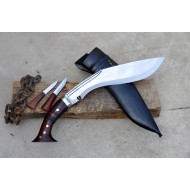
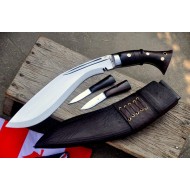
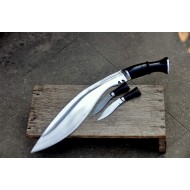
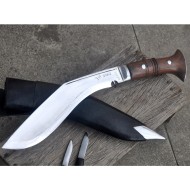
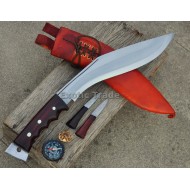
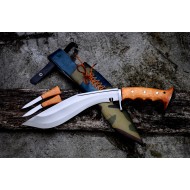
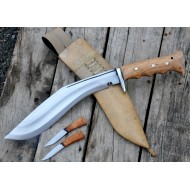
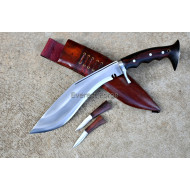
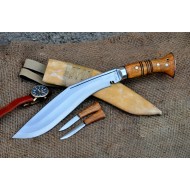
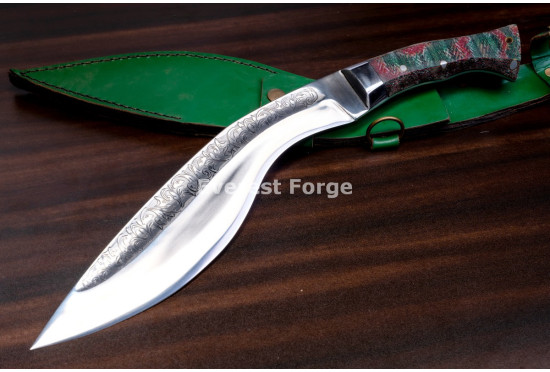
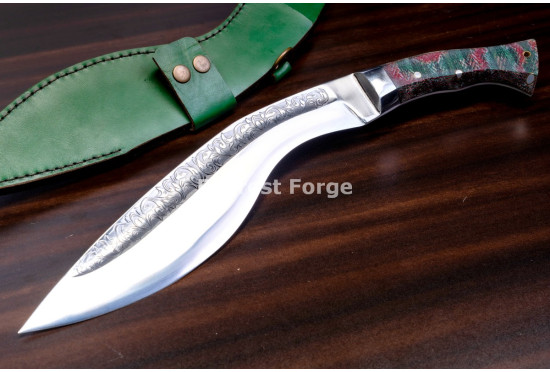
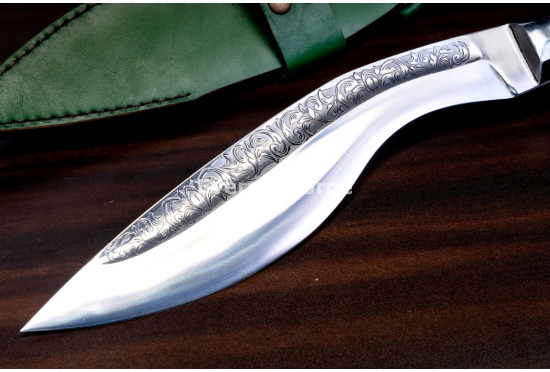
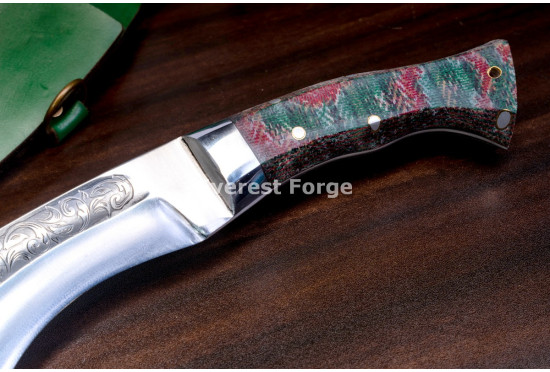
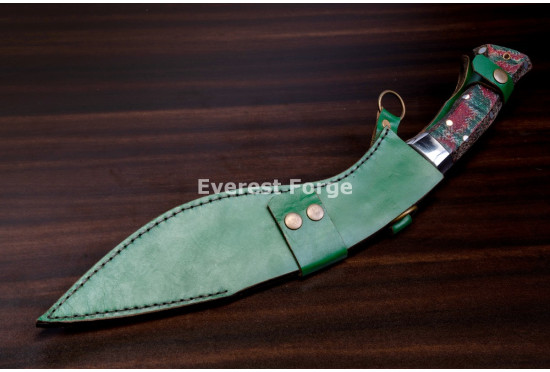
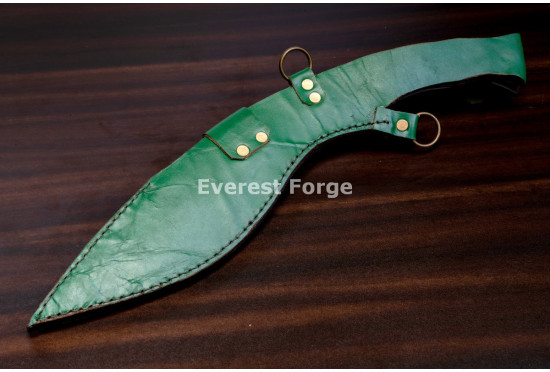
This is a hand-forged, fully functional kukri built around an exceptionally wide belly — the forward-curved Nepali blade taken deliberately broad, forged at our workshop in Kathmandu from 5160 high-carbon spring steel, oil-tempered, full tang, and sharpened to a true edge. The blade carries the traditional cho notch at its root and a fuller running along the spine, etched with a flowing floral pattern. The handle is contoured micarta pinned through the tang, behind a polished steel bolster. It ships with a green leather sheath with brass studs.
The standard build gives a 12-inch blade on a 6-inch handle, around 18 inches overall, at about 1.1 kg with 820 g of that in the blade. Those are compact proportions carrying a lot of blade width, which is the whole idea — this is a short kukri that cuts like a longer one because of how much steel sits in the belly rather than how much sits in the length.
An honest note. "Fatman" is a trade nickname for the wide-bellied shape, not a Nepali pattern name. Bhojpure, Sirupate, Chainpure and Ang Khola are real terms tied to districts and construction methods; this is not one of them, and we would rather say so than let it sit alongside them as though it were. What the name does describe accurately is the blade: it is genuinely much wider through the belly than a standard kukri, and that changes how it cuts. The blade itself is a proper kukri with a real cho. The micarta handle is modern rather than traditional, and deliberately so — see the questions below for why we think that is a good choice on a working knife.
Bespoke Service
Forge a Kukri to Your Own Design
Want a natural handle instead of micarta, a plain blade without the etching, or a traditional pattern? Our Custom Forge service builds to your spec, by hand in Kathmandu.
Request a Custom Forge →What the Wide Belly Does
Most heavy kukris get their authority from mass — a thick spine and a long blade, so there is simply more steel moving. This one gets it from width instead. Taking the belly wider does something a heavier blade does not: it moves the centre of percussion further from the hand without lengthening the knife, so a short blade lands with the leverage of a longer one. It also gives you more edge in contact through the arc of a cut, which matters on green wood and brush where the blade is slicing as much as splitting. And it puts more steel behind the edge at the widest point, which is where a chopping blade takes the most punishment. The trade-off is that a wide blade wedges rather than passes through, so it will bind in a deep cut sooner than a narrow one. On a 12-inch blade meant for limbing and clearing rather than felling, that is the right compromise.
Specifications
The figures above are the standard build. Blade size, blade finish and handle material are all selectable options — set them before you add to cart and the spec you receive will match what you choose.
Customize Your Kukri
Hand-Forged, Not a Souvenir Kukri
This Kukri
- Hand-forged 5160 high-carbon spring steel
- Oil-tempered, hard edge and flexible spine
- Full tang with scales pinned through it
- Cho cut properly, fuller ground and etched by hand
- Sharpened, balanced, forged in Nepal by Nepali smiths
A Souvenir Kukri
- Unhardened mild steel or stainless
- No real heat treatment, edge rolls on first use
- Stick tang glued into a hollow handle
- Pattern printed on, cho decorative or missing
- Blunt, made for a shelf
How It Is Made
Who It Is For
- Outdoor users who want maximum chopping power in a blade short enough to carry
- Buyers who want a synthetic handle that needs no maintenance and will not crack
- Anyone working in wet conditions, where micarta outperforms horn, bone and wood
- Collectors who want a decorated blade without a traditional dress kukri's fragility
- Gift buyers personalizing the etching with a name or motif
- Not for traditional Nepali collecting — see our Bhojpure, Chainpure and Ang Khola
What Is Included
- One hand-forged wide-belly kukri, built to your chosen spec
- Green leather sheath with brass studs and belt strap
- Contoured handle pinned through a full tang, with polished steel bolster
- Any personalization or engraving you ordered
- A sharpened blade with a traditional cho and an etched fuller
- Everest Forge manufacturer warranty
Explore More Hand-Forged Blades
Shipping, Returns & Care
Shipping
In-stock specs dispatch within 2 to 3 business days; fully custom builds take roughly 4 to 6 weeks to forge before dispatch. We ship worldwide by DHL or FedEx in 7 to 14 business days, tracked. Import and blade laws vary by country, so please check your local rules before ordering.
Returns & Warranty
Every blade is backed by the Everest Forge warranty against forging and material defects. If something is wrong with your order, we will repair, replace, or refund it. Personalized and custom-engraved blades are made to order, so please confirm your spec carefully before purchase.
Care
Wipe the blade clean and dry after use and keep a light film of oil on it — 5160 is carbon steel and sap from green wood is acidic enough to mark it overnight. Pay attention to the fuller and the etched pattern, which hold moisture and debris more readily than a flat surface. The handle needs nothing: micarta is unaffected by water, and it does not want oil or conditioner the way horn, bone and wood do. Do not store the kukri inside its sheath for long periods.
From The Forge
Build a Kukri That Is Yours Alone
Beyond the options here, our Custom Forge service will build a natural handle, a plain undecorated blade, a traditional regional pattern, or the full karda and chakmak set. Roughly 4 to 6 weeks from order.
Start a Custom Forge →Frequently Asked Questions
Is Fatman a real Nepali kukri pattern?
No, and we would rather be straight about it. Fatman is a trade nickname for the wide-bellied shape, used by sellers rather than by Nepali smiths. The genuine pattern names are tied to districts and construction methods — Bhojpure from Bhojpur, Chainpure from Chainpur, Sirupate named for the siru grass leaf, Ang Khola meaning body-hollowed — and those terms mean something specific to anyone who knows kukris. Fatman does not belong in that list. What the nickname does describe accurately is the blade: it is genuinely much wider through the belly than a standard kukri, and that is a real design difference rather than a marketing one. We use the name because it is what people search for and because it describes the shape honestly, not because it is traditional.
What does a wide belly do that a heavier blade does not?
They are different levers on the same problem. Adding weight to a blade increases the energy in a swing, which is what our battle kukri does with a very thick spine. Adding width moves the centre of percussion — the point that delivers the cleanest strike — further out from your hand without making the knife longer. That means a 12-inch blade can land with the leverage you would normally need a 15-inch blade to get, while still being short enough to carry and control. Width also gives you more edge in contact through the arc of the cut, which matters on green wood and brush where the blade is slicing as much as splitting, and it puts more steel behind the edge exactly where the blade takes the most punishment. The honest trade-off is that a wide blade wedges rather than passes through, so it binds in a deep cut sooner than a narrow one. For limbing, clearing and camp work that is the right compromise; for felling anything substantial it is not.
What is micarta?
Micarta is a laminate — layers of canvas, linen or paper soaked in resin and cured under heat and pressure into a solid block, which is then shaped like wood. It has been made since the early twentieth century, originally as an electrical insulator, and it became a knife-handle material because it turned out to do that job extremely well. It is dimensionally stable, so it will not shrink, swell, warp or crack as humidity changes. It is unaffected by water, oils, blood and most solvents. It is tough enough to take impact without chipping. And its texture is slightly grippy rather than slick, which means it actually holds better in a wet hand than a polished natural material does. The canvas weave shows through the surface, which is where the pattern on this handle comes from — that is the material itself, not a print.
How does micarta compare with horn, bone and wood?
It wins on durability and loses on tradition, and which matters depends entirely on what you want. Buffalo horn, bone and rosewood are all natural materials, which means they respond to their environment: they dry out, they can crack if stored near a radiator or left in direct sun, and they want a wipe of oil every few months to stay healthy. They are also what a kukri has been made with for centuries, and they are beautiful in a way a synthetic is not — no two are the same. Micarta does none of that. It needs no maintenance at all, it does not care about humidity, and a hundred of them look identical. If this knife is going to live in a damp shed, go out in the rain, or be used hard and stored badly, micarta is the better material by a distance. If it is going on a wall or into a collection, a natural handle will suit it better and we build all three.
What is the pattern etched into the fuller?
A flowing floral design, etched into the recessed fuller running along the spine rather than onto the flat of the blade. Putting it in the fuller is a deliberate choice: the recess protects the pattern from the wear a flat surface takes in use and in the sheath, so it stays crisp far longer than surface decoration would. It also creates a natural frame, so the pattern reads as part of the blade rather than applied to it. Because it is etched into the steel rather than printed, it will not wear off with handling, though it will soften if the blade is ever heavily re-polished. Other motifs, a name, or a plain undecorated fuller are all available to order.
How does this differ from your other kukris?
Width and handle. This is the only kukri we make built deliberately wide through the belly, and the only one with a synthetic handle. Our battle kukri is the heavy one — it gets its power from a very thick spine rather than width, and it is considerably heavier overall. Our bushcraft kukri is the practical modern carry knife with a contoured wooden grip. Our D-guard kukri is the protected one, with a full knuckle bow. And our Bhojpure, Chainpure and Ang Khola are the three traditional patterns, all with natural handles and proper daps. Buy this one if you want maximum cutting power in a short blade and a handle you never have to think about.
Is this a real, functional kukri?
Yes. It is hand-forged from 5160 high-carbon spring steel, oil-tempered, sharpened, and built on a full tang with the scales pinned straight through it. It will chop green wood, clear brush and take the abuse a working blade is meant to take, and the wide belly means it does that harder than its length suggests. Do not use it on stone, metal, nails hidden in old timber, or seasoned hardwood knots, and check the pins and the edge after heavy use.
What steel is it, and is it oil-tempered?
The blade is forged from 5160 high-carbon spring steel, the same alloy used in heavy-duty truck leaf springs, prized for toughness and edge retention. It is oil-tempered for a hard cutting edge backed by a flexible, shock-absorbent spine. Nepali smiths have forged kukris from vehicle leaf spring for generations, long before anyone in Nepal was quoting an alloy number — it became the traditional material because it was available and because a chopping blade needs to absorb shock without chipping far more than it needs extreme hardness.
Is it full tang?
Yes, full tang with the micarta scales pinned straight through it, so the handle is mechanically fastened to the steel rather than held by adhesive. This pairing is particularly sound: micarta does not move with humidity, so the pins stay tight in a way they can loosen slightly over years with a natural material that expands and contracts. On a wide-bellied chopper the case for a full tang is strong anyway — a broad blade generates more twisting force against the handle on an off-centre strike than a narrow one does.
What is the scabbard like?
A green leather sheath with brass studs and a belt strap, cut and stitched by hand to fit the blade size you order. It is a modern sheath rather than a traditional dap — no wooden core and no companion pockets, since this kukri ships without a karda and chakmak. Store the kukri outside it for the long term rather than in it: leather is tanned with acids and holds damp against carbon steel. Dyed leather also fades in prolonged direct sunlight, so keep a display piece out of a south-facing window.
Does it arrive sharpened, and what can I change?
Yes, sharpened to a working edge along the belly, finished by hand; the area near the cho is traditionally left unsharpened, which is normal and not an oversight. Choose the display-blunt option if you need it unsharpened for display or import rules, at no extra charge. As for changes — blade size, blade width, etching, handle material and finish are all selectable, and the figures on this page describe the standard build. The interesting choice is handle material: micarta for a knife you will use hard, or a natural material if it is going into a collection.
Do you ship worldwide, and how long does it take?
Yes. We ship worldwide from Nepal by DHL or FedEx in 7 to 14 business days with tracking. In-stock specs dispatch within 2 to 3 business days; fully custom builds take roughly 4 to 6 weeks to forge first. Import and blade laws vary by country, so please check your local rules before ordering.
| Specification | |
| Blade: | Hand forged from 5160 carbon steel, forward-curved with exceptionally wide belly, cho notch and etched spine fuller |
| Total Length: | 12 inch blade, 6 inch handle, approx 18 inches overall |
| Handle: | Full tang with contoured micarta scales pinned through it, polished steel bolster |
| Weight: | Approx. 1100 grams total at standard build (blade approx 820 grams) |
| Note: | As every piece is forged by hand, slight variation in weight, dimensions and finish may occur. Blade size, blade finish and handle material are all selectable options - the figures above describe the standard build. Micarta needs no oiling or conditioning. Keep the blade lightly oiled when not in use. |