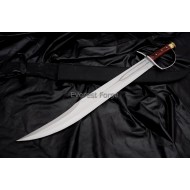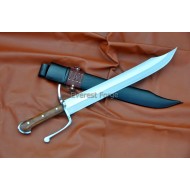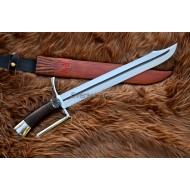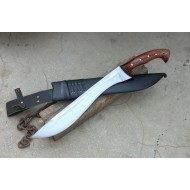
- Model: SINGLE EDGED SWORD
- Product Code: KHOPESH0027
- Location: Kathmandu,Nepal
Available Options
A Hand-Forged Fantasy Khopesh With a Sculpted Guard and Deep Curved Blade
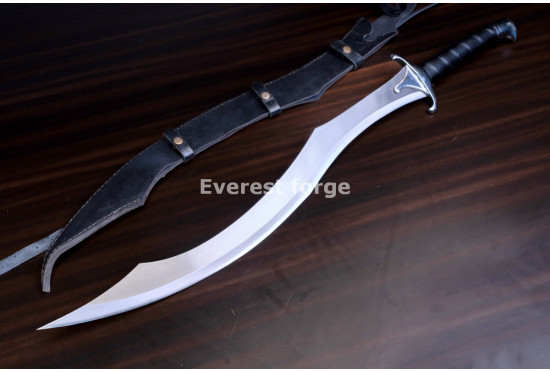
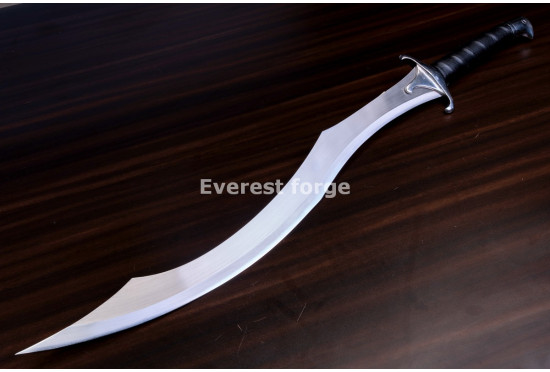
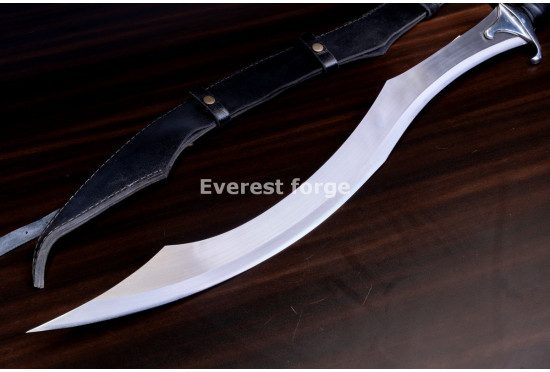
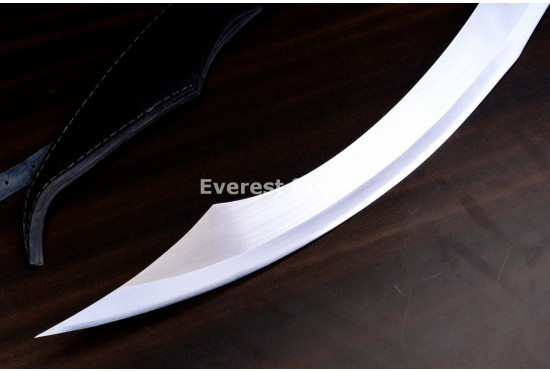
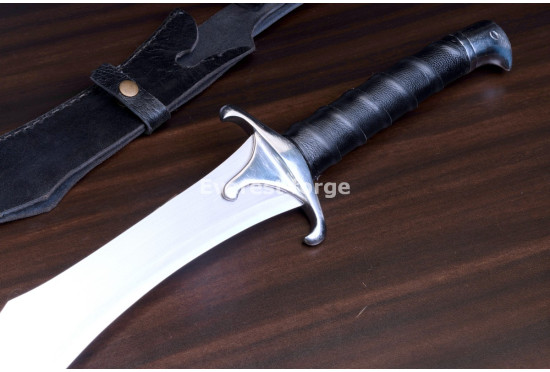
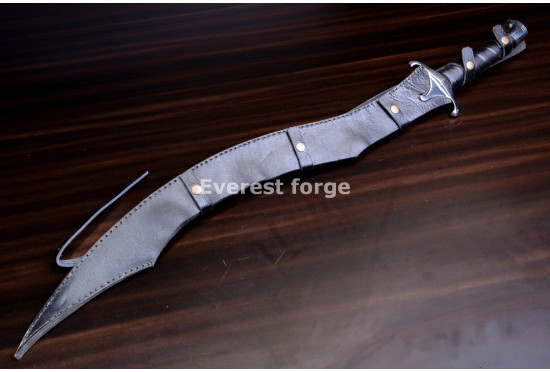
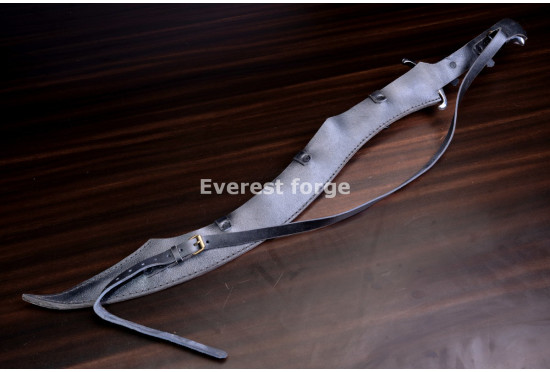
This is a 27 inch hand-forged fantasy khopesh: a single-edged blade sweeping in one deep continuous curve from an angular ricasso shoulder to a fine upswept point, broad through the forward third where the cut lands. The guard is sculpted steel, swept and pierced with an open aperture, curving down over the blade on one side and back over the hand on the other. The grip is black leather wrapped over a shaped core, 7 inches of it on a 9 inch hilt, finishing in a shaped dark pommel. Overall length is 36 inches and it weighs approximately 1390 grams. Forged from 5160 high-carbon steel in Tokha-3, Kathmandu, and supplied in a black leather scabbard shaped to the curve, on a full shoulder baldric.
An honest note. The word fantasy is in the name because this is not the historical weapon. A real khopesh runs straight from the hilt for a distance and then breaks into a distinct crescent or hook, with the edge on the outer convex curve — that crescent is the type, and it is what separates the sickle-sword family from everything else. This blade is one smooth sabre curve with no crescent at all. It is a designer's khopesh rather than an Egyptian one, and it is a very good-looking sword. We forge three historical khopesh patterns as well, and if what you want is the Bronze Age weapon rather than the modern idea of it, those pages are where to go and the answer below explains what changed and why.
Have This Sword Forged Your Way
Blade length, the depth of the curve, guard form and grip are all decided at the forge. Send a drawing, a render or a description and our smiths will quote it.
Start a Custom Forge Order →Why This Sword Is Built the Way It Is
Specifications
Build Options
Is This the Right Sword for You?
Buy This If You Want
- The look people picture when they think of an Egyptian fantasy sword
- A sculpted guard shaped individually rather than cut from flat bar
- A long grip, so the second hand can come on for a heavy cut
- A scabbard genuinely built to the curve rather than a straight sheath that half fits
- A piece from a range with a consistent design hand across four weapons
Look Elsewhere If You Want
- A historical khopesh — that is the crescent-bladed Bronze Age weapon and we forge three
- A thrusting sword, since a curve this deep puts the point well off the line of the hand
- A light sword to wear all day; at 1390 grams and 36 inches this is a substantial piece
- A stainless blade needing no care, since 5160 is carbon steel and will rust if left wet
- A sparring or HEMA trainer, which needs rolled edges and a rebated point from the first heat
Send Us the Drawing
Sculpted guards are where our smiths invent rather than reproduce. Send a render, a screenshot or a sketch and we will tell you honestly what will work and what will only look good.
Talk to the Forge →How to Order
Who This Sword Is For
- Collectors of fantasy swords who want forged steel rather than a cast stainless wall-hanger
- Costume, cosplay and prop work where the silhouette has to carry a whole character
- Film, stage and photography armourers needing a curved blade that photographs dramatically
- Anyone building a matched set from the sculpted range across glaive, dao, sword and scimitar
What Is Included
- One hand-forged fantasy khopesh, sharpened and ready
- Fitted black leather scabbard shaped to the curve, on a full shoulder baldric
- Certificate of hand-forging from the workshop
- Everest Forge manufacturer warranty against defects in forging and heat treatment
Explore the Collection
Shipping, Returns and Care
Every piece is prepared at the forge in seven to ten days, and shipping adds a further seven to ten days. Orders to the USA and Canada travel with FedEx; everywhere else ships on a DDP service, which means duties and taxes are settled before the parcel moves so there is nothing to pay on delivery. Every piece carries the Everest Forge manufacturer warranty against defects in forging and heat treatment.
Long blades are restricted in some countries and in some states and provinces within them. It is your responsibility to check that this sword may lawfully be imported and possessed where you live before ordering, because a parcel seized by customs cannot be returned to us and cannot be refunded. Ask us before you buy if you are unsure and we will tell you what we know about your destination.
5160 is a high-carbon steel and it will rust if left wet or stored damp. Wipe the blade dry, keep a light film of oil on it, and pay attention to the pierced aperture in the guard and the angles where the guard meets the blade, which are the two places a cloth will not reach. Do not store the sword in the scabbard for long periods. The leather grip and baldric take an occasional conditioning.
Frequently Asked Questions
Why does this not look like a real khopesh?
Because a real khopesh has a crescent and this has a curve, and the difference is the whole type. A genuine khopesh runs straight from the hilt for a distance and then breaks sharply into a hook or crescent, with the cutting edge on the outer convex side of that hook. It descends from the axe rather than the sword and you can see the axe in it: the working part is out at the end, set at an angle to the handle. This blade instead sweeps in one smooth continuous curve from ricasso to point, which is sabre geometry — the family that includes the shamshir and the kilij, and nothing to do with sickle-swords. Fantasy designers make that change consistently, and the reason is that a true crescent reads as agricultural to a modern eye, close to a billhook or a sickle, while a smooth sweeping curve reads as exotic and dangerous. It is a design decision about how a shape is understood rather than a mistake, and it is why we put fantasy in the name rather than arguing about it in the small print.
Is this the sword from The Mummy?
No. This is an independent piece made by Everest Forge, it is not an official or licensed product, and we are not affiliated with, endorsed by or connected to Universal or any rights holder. We mention the film because it is what people are usually thinking of when they ask, and because it is largely responsible for the visual vocabulary this sword sits in — a curved Egyptian-flavoured blade with sculpted fittings, which was not really a look before 1999 and has been a staple of games, novels and film since. What we have made is our own design in that vocabulary. If you want a screen-accurate replica of a specific prop, we are not the right workshop and any seller who tells you otherwise is selling you something they should not be.
Is this part of a range?
Yes, though we have not been selling it that way and probably should. Four pieces in the catalogue carry guards shaped by the same hand: this scimitar-curved khopesh, our fantasy glaive with its swept curled guard at the root of the blade, our fantasy sword with the large pierced skeleton guard, and our fantasy dao with its swept S-guard. They were designed and forged by the same smiths working in the same idiom, and put together they read as one designer's work across four different weapons rather than four unrelated products. If you are building a display or a costume set, ordering two or more from that group gets you pieces that genuinely belong together, and we will match finish and grip treatment across them so they look like a set rather than a coincidence. Tell us at the start rather than after the first one is made.
Why is the grip so long on a curved sword?
Because a curved blade cuts by pulling, and a second hand adds pull far more usefully than it adds push. Seven inches of grip on a nine inch hilt is hand and a half: your main hand sits forward against the guard and your other hand can come onto the rear of the grip and the pommel when you want a heavy draw cut, then come off again when you want the reach and speed of one hand. Most curved swords give you four or five inches and one hand only, because they were built around a horseman who needed the other hand for reins. This is not a historical sword and has no such constraint, so the longer grip is a genuine gain rather than an affectation. What it costs is a little balance: nine inches of hilt puts more weight behind the hand than a short grip would, which softens the forward bias slightly. On a blade this long that is a fair trade.
How is a curved scabbard made?
Not the way a straight one is, which is the short answer to why so many curved swords are sold with sheaths that half fit. A straight scabbard can be cut from a flat pattern and folded around the blade. A curve cannot: leather stretches around the outside of a bend and compresses on the inside, so a pattern that works flat will pull, gape or twist once it is formed. The scabbard here is cut to a shaped pattern developed for this blade, wetted and formed over the sword itself so it takes the curve while the leather is soft, then stitched and riveted along the spine once it has dried to shape. That is also why a curved scabbard is not interchangeable between two swords of nominally the same size — a small difference in the depth of the curve makes a scabbard that binds at the throat or lets the blade rattle. If you order a different curve depth, the scabbard is made new rather than adjusted.
What does the pierced guard do?
Here, mostly it is form, and we would rather say so. The aperture takes a small amount of weight out of a fitting that sits right at the balance point, which is worth marginally more than it sounds because weight at the hilt affects handling out of proportion to its size. But the guard would work as well solid, and the piercing is there because it makes the shape read as sculpted rather than cut. Our fantasy sword with the skeleton guard goes into the engineering of pierced fittings properly — stress at the edges of an opening, why round beats square, and the difference between filing a piercing and casting one. On this piece the honest summary is that it is a shaped guard with a hole in it because that is the design, and the design is good. It is forged and filed rather than cast, which is why the surfaces flow into one another instead of meeting at a mould line.
Where do the three historical khopesh patterns differ?
They differ from this one in having an actual crescent, and from each other in size and detail. Our Hooked Point khopesh is an 18 inch sickle blade with a barb on the back edge and a plain hilt. Our Single Fuller khopesh is a 21 inch blade with a stepped spine shoulder and a fuller running inside it, on a worked hilt with a disc guard and checkered grip. We also make a short khopesh-style chopper as a working tool rather than a weapon. All of them put the edge on the OUTER convex curve, which is the diagnostic that separates the sickle-sword family from the kukri, kopis and falcata family, where the edge is on the inner concave side. If you are buying for the history rather than the look, start with the Hooked Point, which sits inside the length range of surviving Egyptian and Canaanite examples where most khopesh sold abroad are cut far too short.
Does the deep curve affect how it cuts?
Yes, and it is the reason curved swords exist. A curve means the edge meets the target at an angle rather than square on, so the blade slides along the cut as it goes in and slices rather than chopping. That takes less force for a given depth of cut in soft material, which is why cutting swords across most of the world drift toward curvature. The costs are two. A curved blade thrusts poorly, because the point sits off the line of your hand and arm, so a hard thrust wants to twist the sword rather than drive it. And a deep curve makes the sword awkward to draw from a scabbard without a long clean pull, which is why deeply curved swords are usually worn edge-up or on a baldric with room to swing. Our fantasy dao page covers the cutting geometry more fully. On this piece the curve is deeper than most historical sabres, which is a design choice for silhouette as much as for cutting.
What steel is it, and how is it heat treated?
5160 high-carbon spring steel, brought to temperature in the forge, quenched in oil and tempered back so the edge is hard while the body of the blade stays springy. On a deeply curved blade the quench needs watching more than usual, because a curve wants to move as it hardens and a blade that comes out of the oil with the curve altered is scrap rather than something to be corrected. That is one of the quiet reasons deeply curved swords cost more to make well. It is not stainless, deliberately, because the stainless grades that genuinely resist rust give up the toughness a cutting sword depends on.
Is it full tang?
The tang runs the full length of the hilt with the pommel fitted over the end, which is through-tang construction. That is the correct build for a sculpted guard, a wrapped grip and a fitted pommel, all of which have to be assembled onto the tang and clamped between guard and pommel. Done properly it is strong in the direction a sword is loaded, which is along the plane of the blade. If you want a visible full-width tang with riveted scales, that means a different hilt without the sculpted guard, and we would design the sword around it from the start.
How sharp does it arrive?
Sharp and ready, with the edge put on a stone by hand at the forge. If you would prefer it shipped blunt — for display, for costume or convention use, for a gift, or because of the rules where you live — say so in the order comments and we will send it unsharpened at no extra cost and rebate the point as well. On a piece bought largely for its appearance that is a common request and it costs nothing. Many conventions require it.
Where is this made, and by whom?
In our own workshop in Tokha-3 on the northern edge of Kathmandu, Nepal, by around ten smiths, most from families that have forged blades for generations. Everest Forge has operated since 2010, and we forge, grind, heat treat, shape the guards, fit the hilts and cut the leather in the same building. Fantasy work sits oddly alongside our traditional blades and we are comfortable with that: the same hands forge both, the construction standard does not drop, and a smith who has made ten thousand working blades brings something to a sculpted design that a factory pressing shapes out of stainless bar does not.
| Specification | |
| Blade: | 27 inches. Hand forged from 5160 carbon steel |
| Total Length: | 36 inches |
| Handle: | 9 inches (7 inch grip). Black leather wrapped over a shaped core, shaped pommel |
| Weight: | Approx 1390g sword, 1840g with scabbard and baldric |
| Note: | Some variation in weight, dimensions and finish may occur as each piece is hand forged. Keep the blade lightly oiled when not in use |