Menu
Your Cart

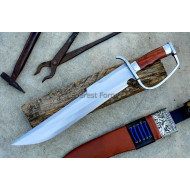
Hand-Forged Fantasy Bowie Knife, Horn and Bone Handle

Hand-Forged Fantasy Bowie Knife, Horn and Bone Handle
$189.99
Ex Tax: $189.99
  • Model: Bowie knives
  • Product Code: FantasyBowie13
  • Location: Kathmandu,Nepal

Available Options

Hand-Forged Fantasy Bowie Knife — Stacked Horn and Bone Handle

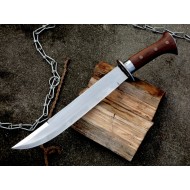
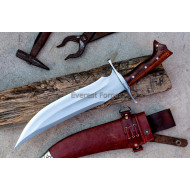
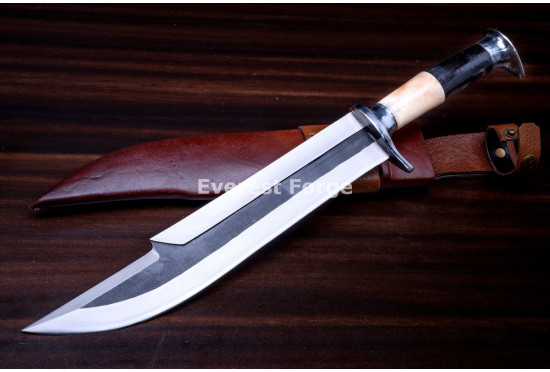
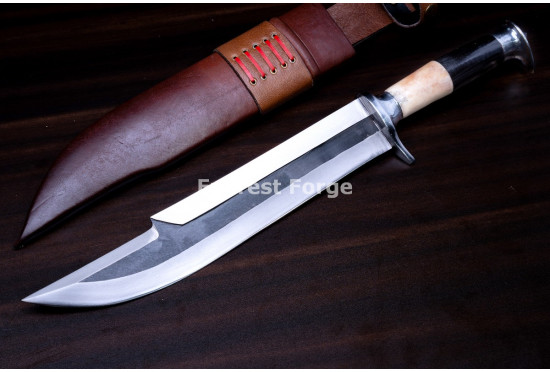
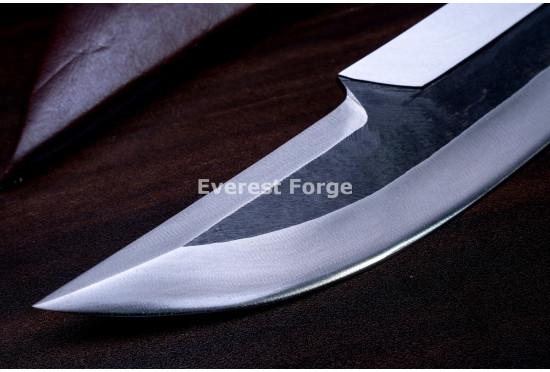
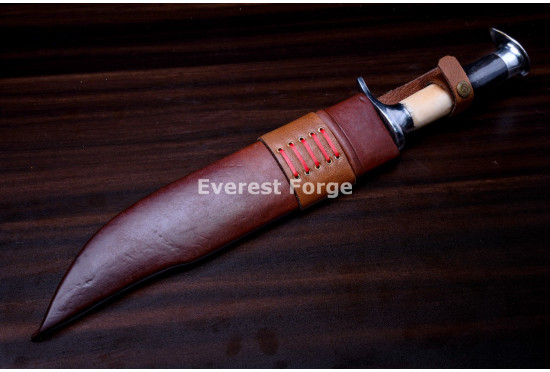
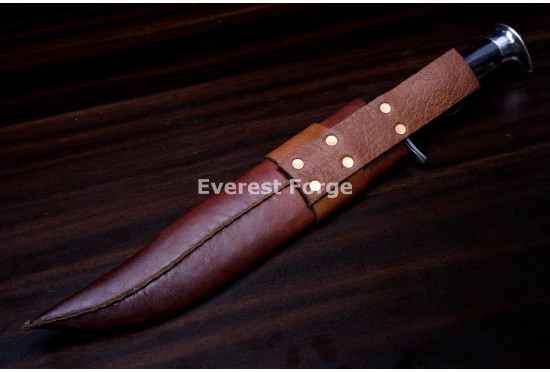
This is a hand-forged, fully functional fantasy bowie — a broad single-edged blade with a deep clipped point, forged in Nepal from 5160 high-carbon spring steel, oil-tempered and sharpened to a true edge. The blade carries a two-tone forge finish, with the dark flats left from the fire and the edge bevel and clip ground bright against them. The handle is stacked horn and bone sections between a steel crossguard and a flared steel pommel cap. It ships with a brown leather belt sheath. Every knife is made to order in your chosen size, finish, and engraving.

The standard blade is 13 inches on a 6-inch handle, for an overall length around 19 inches at about 1.04 kg. That is a big bowie — well past the working sizes most people carry, and squarely in the territory the pattern is famous for. The oil-tempered 5160 steel and peened through-tang construction make it a working blade rather than a display piece.

An honest note. Two things worth saying. First, this is a fantasy bowie, not a historical reproduction — the two-tone finish and the stacked horn and bone handle are our own styling, and no 19th century bowie looked quite like this. Second, and more important, this knife uses a through-tang rather than a full tang. That is the correct and traditional way to build a stacked handle, and a properly peened through-tang is strong, but it is not the same construction as a slab handle riveted to a full-width tang. We say so because plenty of sellers describe every knife as full tang regardless of what is inside the handle, and you deserve to know which one you are buying.

Bespoke Service

Forge a Bowie to Your Own Design

Want a working-size blade, a full-tang slab handle instead of the stack, a plain satin finish, or your own engraving? Our Custom Forge service builds knives to your spec, by hand in Kathmandu.

Request a Custom Forge →

What Is a Bowie Knife?

The bowie is the large American fighting and utility knife that takes its name from Jim Bowie, the frontiersman who died at the Alamo. His reputation with a big knife was made at the Sandbar Fight of 1827 near Natchez, and within a decade every cutler on both sides of the Atlantic was selling something called a bowie — Sheffield in particular built an entire export trade on it. Because the name spread through reputation rather than through any single pattern, there is no one canonical bowie shape. What the family shares is a large single-edged blade, a clipped point where the spine is cut away toward the tip, and usually a crossguard, which is unusual on a knife and tells you the pattern was meant for fighting as much as for work. This one takes that outline and gives it a modern fantasy treatment.

Real Forged BladeHand-forged 5160 spring steel, oil-tempered and sharpened.
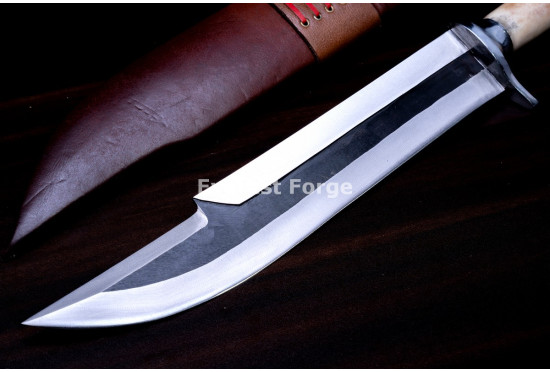
Two-Tone Forge FinishDark forge flats with the edge bevel and clip ground bright against them.
Deep Clipped PointLong clip cutting the spine away for a fine, controllable tip.
5160 Spring SteelTruck leaf-spring steel — tough, shock-resistant, holds an edge.
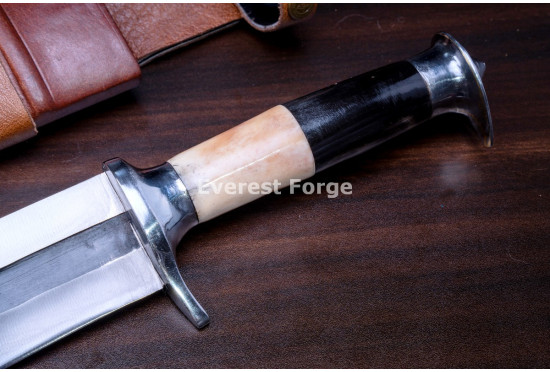
Stacked Horn and BoneAlternating horn and bone sections built up over the tang by hand.
Steel Guard and CapCrossguard at the blade and a flared pommel cap peened over the tang.

Specifications

TypeHand-forged fantasy bowie knife
Blade Length13 inches standard (custom sizes to order)
Handle Length6 inches
Overall LengthApprox 19 inches at standard blade size
WeightApprox 1040 g total, 810 g blade
Blade Steel5160 high-carbon spring steel (truck leaf spring)
Heat TreatmentOil-tempered — hard edge, flexible spine
Blade StyleSingle-edged, broad, deep clipped point, sharpened
Blade FinishTwo-tone forge finish with polished edge bevel and clip
TangThrough-tang, peened at the pommel cap
HandleStacked horn and bone sections
FittingsPolished steel crossguard and flared pommel cap
SheathBrown leather belt sheath, included
OriginHand-forged in Tokha-3, Kathmandu, Nepal

Customize Your Bowie

Every knife is forged to order. Set your options before you add to cart:

Blade LengthStandard 13 inches, or a working size of 7 to 9 inches, or your own spec.
Blade FinishTwo-tone forge finish as standard, or full satin, polished, or antiqued.
Handle ConstructionStacked horn and bone as standard, or a full-tang slab handle.
Handle MaterialHorn and bone as standard, or rosewood, walnut, or plain buffalo horn.
Clip EdgeClip left unsharpened as standard, or ground as a sharpened false edge.
EngravingAdd a name, date, or your own pattern to the blade or sheath.

Hand-Forged, Not a Display Knife

This Bowie

  • Hand-forged 5160 high-carbon spring steel
  • Oil-tempered, hard edge and flexible spine
  • Through-tang peened over the pommel cap
  • Forge finish left from the hammer, not sprayed on
  • Sharpened, balanced, made to your spec

A Display Knife

  • Unhardened or stainless bar stock
  • No real heat treatment, edge rolls on first use
  • Short tang glued into a hollow handle
  • Black paint or coating over a ground blade
  • Blunt, made for a shelf

How It Is Made

You set the spec — blade length, finish, handle construction and material, clip edge and engraving.
A smith forges the blade from a 5160 leaf-spring billet and cuts the deep clip at the point.
The blade is oil-tempered, the forge finish left on the flats, and the edge and clip ground bright and sharpened.
We fit the crossguard, stack and shape the horn and bone over the tang, peen the pommel cap, cut the sheath, and ship worldwide tracked.

Who It Is For

  • Collectors of large bowie and frontier-pattern knives
  • Buyers who want a dramatic display knife with genuine forged construction behind it
  • Anyone drawn to natural-material handles rather than wood or synthetic
  • Camp users who want a big chopper — though see the size note in the FAQs first
  • Gift buyers personalizing a blade with a name or date
  • Not for anyone who specifically wants full-tang slab construction — order that option instead

What Is Included

  • One hand-forged fantasy bowie knife, built to your chosen spec
  • Brown leather belt sheath
  • Stacked horn and bone handle with steel crossguard and flared pommel cap
  • Any personalization or engraving you ordered
  • A two-tone forge-finished, sharpened blade
  • Everest Forge manufacturer warranty

Explore More Hand-Forged Blades

Shipping, Returns & Care

Shipping

In-stock specs dispatch within 2 to 3 business days; fully custom builds take roughly 4 to 6 weeks to forge before dispatch. We ship worldwide by DHL or FedEx in 7 to 14 business days, tracked. Import and blade laws vary by country, so please check your local rules before ordering.

Returns & Warranty

Every blade is backed by the Everest Forge warranty against forging and material defects. If something is wrong with your order, we will repair, replace, or refund it. Personalized and custom-engraved blades are made to order, so please confirm your spec carefully before purchase.

Care

Oil the blade before storage and wipe it dry after handling — the forge finish resists corrosion a little better than bare polished steel, but the bright edge bevel has no protection at all and that strip is the part to watch. Do not polish the dark flats: the finish is forge scale from the fire and once it is buffed off it cannot be put back. The horn and bone handle wants a drop of mineral oil every few months and should be kept away from radiators and direct sun, since both materials dry and can crack.

From The Forge

Build a Bowie That Is Yours Alone

Beyond the options here, our Custom Forge service will build a working-size bowie, a full-tang slab handle, a different finish, or a knife to a pattern you send us. Roughly 4 to 6 weeks from order.

Start a Custom Forge →

Frequently Asked Questions

What is a bowie knife, and where does the name come from?

The bowie is the large American fighting and utility knife named after Jim Bowie, the frontiersman who died at the Alamo. His reputation with a big knife was made at the Sandbar Fight of 1827 near Natchez, and within about a decade cutlers on both sides of the Atlantic were selling knives under the name — Sheffield in particular built a substantial export trade on it. Because the name spread through reputation rather than from a single documented pattern, there is no one canonical bowie shape. What the family shares is a large single-edged blade, a clipped point, and usually a crossguard.

What makes this a fantasy bowie rather than a traditional one?

The styling. A 19th century bowie would carry a plain polished or satin blade, and a handle of wood, stag or bone in a single material. This one has a two-tone forge finish with the dark flats deliberately left from the fire against a bright ground edge, and a handle built from alternating horn and bone sections. Both are modern decorative choices rather than historical ones. The underlying shape — large single edge, deep clip, crossguard — is genuine bowie, so it is a fantasy treatment of a real pattern rather than an invented knife.

How is the stacked horn and bone handle made?

Each section is cut and drilled through the middle, then threaded onto the tang one at a time — horn, bone, horn — with the crossguard at the front and the pommel cap at the back. The stack is compressed tight as the tang is peened over the cap, so the whole handle is held under pressure between the two steel fittings rather than glued in place. Only then is the assembled handle shaped and finished as a single piece, which is why the sections meet cleanly and why the profile flows through the joints. It is slow work compared with fitting two slabs to a tang, and it is the traditional way stacked handles have been built for centuries, from leather-washer military knives to stag-and-brass hunting patterns. Because horn and bone are natural materials, the colour and grain of every section differ, so no two handles come out the same.

Is it full tang? How is the handle attached?

It is a through-tang, not a full tang, and the difference is worth understanding. A full tang is a flat plate of steel the full width and length of the handle with scales riveted to each side — you can see the steel running around the edge of the grip. A through-tang is narrower, runs down the centre of the handle, and is peened over a pommel cap at the butt, which compresses everything between the cap and the guard. A stacked handle can only be built this way, because the sections have to slide onto something. Neither is inherently better: full tang is stronger under extreme lateral load and is what we use on choppers, while a properly peened through-tang is what almost every traditional stacked-handle knife in history used and is entirely sound for normal use. What you should avoid is a rat-tail tang — a thin stub glued or spot-welded into a hollow handle, with nothing peened at the other end. That is the construction that fails, and it is not what this is. If you want a full-tang slab handle on this blade, it is available as a custom option.

Why does a bowie have a crossguard when most knives do not?

Because the pattern was meant for fighting as much as for work, and a guard does two jobs in that context. It stops your hand running forward onto the edge if the point stops suddenly against something hard, which is the injury that ends a fight for the man holding the knife. And it gives you something to catch or turn another blade against, which is why so many surviving bowies have a guard with one quillon turned forward. On a purely utilitarian knife a guard is a nuisance — it gets in the way when you choke up on the blade for fine work — which is exactly why most working knives have only a small bolster instead. The presence of a real crossguard is one of the clearest signals of what the bowie was designed to be.

How does this differ from your curved Hunting Knife?

Different shapes for different jobs. The curved hunting knife has a longer 15-inch blade with a sweeping belly and a fullered spine, and it is built around chopping — the curve carries mass out to where a chopping stroke lands. This bowie has a shorter, broader, straighter blade with a deep clip and a crossguard, so it is better balanced for cutting and thrusting and much better at fine work with the tip. The handles differ too: the hunting knife has a full-tang riveted rosewood grip, this has a stacked horn and bone through-tang. Buy the hunting knife for camp chopping; buy this for a classic bowie in the hand and on the wall.

Is this a real, functional knife?

Yes. It is hand-forged from 5160 high-carbon spring steel, oil-tempered, sharpened, and built on a peened through-tang with solid steel fittings. It cuts, it holds an edge and it will take normal hard use. It is not a chopper in the way a full-tang kukri or machete is, so avoid using it to split seasoned hardwood or to hack at anything that will load the handle sideways, and never use the point as a pry bar.

What steel is it, and is it oil-tempered?

The blade is forged from 5160 high-carbon spring steel, the same alloy used in heavy-duty truck leaf springs, prized for toughness and edge retention. It is oil-tempered for a hard cutting edge backed by a flexible, shock-absorbent spine. On a big knife with a fine clipped point, toughness matters most at the tip — that is the part under the greatest stress and the first to break on a brittle blade.

What is the two-tone finish, and how do I look after it?

The dark areas are forge scale, the black oxide that forms on steel in the fire, left on the flats rather than ground away. The edge bevel and the clip are then ground and polished bright, so you get a dark blade with clean bright lines following the working edges. It is produced by the forging itself rather than applied as a coating, which is why it varies from knife to knife. Care is specific: oil it like any carbon steel, pay particular attention to the bright bevel because it has no protection at all, and do not polish the dark flats — the scale cannot be put back once it is buffed off.

Does it arrive sharpened?

Yes, sharpened along the main edge as standard, finished by hand. The clip along the top of the point is left unsharpened; a sharpened false edge can be ground on request, though note that a double-edged point changes the legal position in some countries. If you need the knife blunt for display, or to satisfy import rules where you live, choose the display-blunt option or tell us in your order notes.

Can I order a smaller blade or a different handle?

Yes to both. A working-size bowie of seven to nine inches is far more practical for camp and outdoor use than this one, and most people who own several reach for the smaller blade. Handle construction is also a real choice rather than a cosmetic one: stacked horn and bone as standard, or a full-tang slab handle in rosewood or walnut if you want the stronger build. Tell us the job you want the knife to do and we will tell you honestly what suits it.

Do you ship worldwide, and how long does it take?

Yes. We ship worldwide from Nepal by DHL or FedEx in 7 to 14 business days with tracking. In-stock specs dispatch within 2 to 3 business days; fully custom builds take roughly 4 to 6 weeks to forge first. Import and blade laws vary by country, so please check your local rules before ordering.

Specification
Blade: 13 inches. Hand forged from 5160 carbon steel
Total Length: 19 inches long in total.
Handle: 6 inches. Through-tang peened at the pommel cap, stacked horn and bone sections with polished steel crossguard and flared cap
Weight: Approx 1040 grams total (blade approx 810 grams)
Note: As every piece is forged by hand, slight variation in weight, dimensions and finish may occur. Horn and bone are natural materials, so colour and grain differ in every section and no two handles are alike. Keep the blade lightly oiled when not in use.

Write a review

Note: HTML is not translated!
Bad Good
Captcha