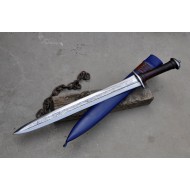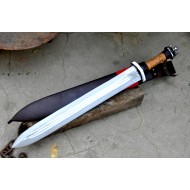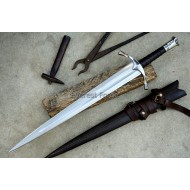
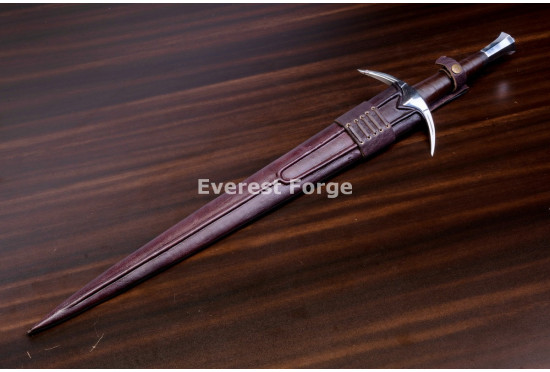
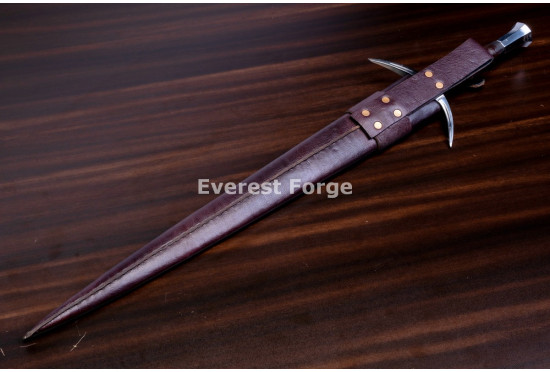
- Model: Arming Dagger
- Product Code: FANSTASYDAG0023
- Location: Kathmandu,Nepal
Available Options
A Hand-Forged Fantasy Arming Sword With Horned Quillons
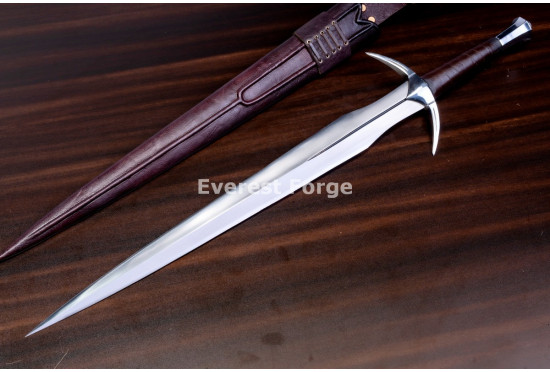
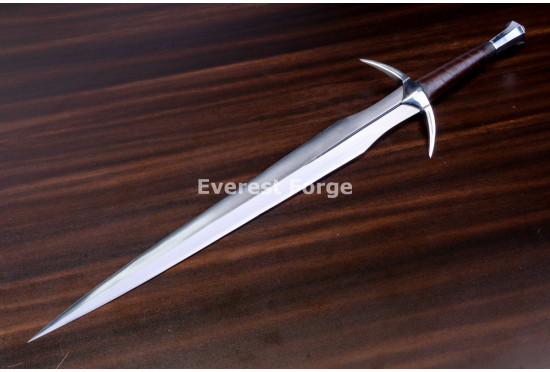
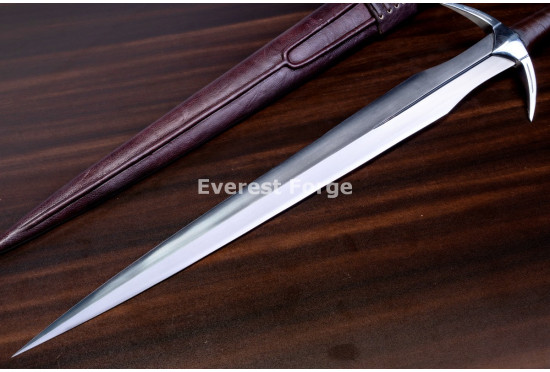
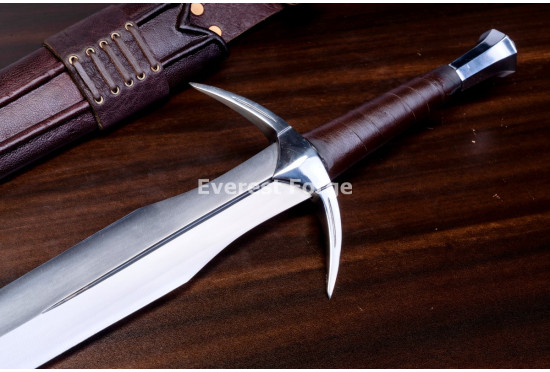
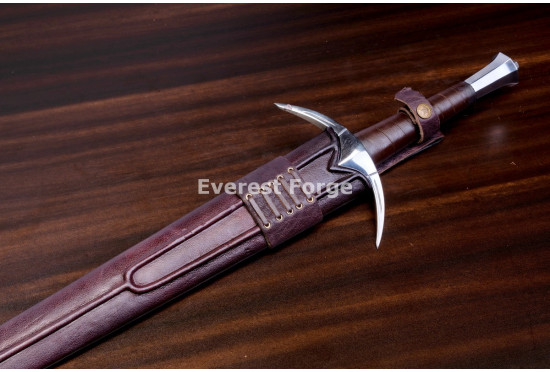
This is a single-hand fantasy sword with a 23 inch blade and a 30.5 inch overall length, hand-forged in Tokha-3, Kathmandu, Nepal from 5160 high-carbon steel, oil-quenched and tempered. The blade runs a long even taper from a broad forte to an acute point, with a narrow fuller worked into the upper section and a dark detail left in it against the satin flats. The hilt is the piece's signature: two polished quillons sweeping down and forward into horn tips, a leather-wrapped grip of 5 inches, and a fitted polished pommel. It ships sharpened, in a fitted brown leather sheath.
An honest note. This blade is often listed as a dagger, and it is not one. A dagger is a short double-edged sidearm, generally under a foot of blade, made to be carried on the belt and drawn in close. This has 23 inches of blade and stands 30.5 inches overall — those are arming sword proportions, a one-handed knightly sword. We call it what it is, because someone shopping for a dagger who receives a two and a half foot sword has been misled, and because the hilt is an original fantasy design rather than a reconstruction of any historical pattern. What is period-correct is the geometry: the taper, the fuller and the point are laid out the way a real thrusting sword is laid out.
Want This Hilt on a Different Blade?
Our smiths forge to your drawing or reference photo — a longer blade, a hand-and-a-half grip, a different quillon sweep, a historical Oakeshott profile, or a true dagger-length version of this same design. Send a sketch and we will quote it.
Start a Custom Build →Why This Sword Is Built the Way It Is
Full Specifications
How You Can Configure It
Is This the Right Sword for You?
Buy This If You Want
- A one-handed fantasy sword with a hilt that is not a copy of anything
- Real forged 5160 with a proper heat treatment, not decorative stainless
- A thrust-oriented blade with a genuinely acute point
- A sword that photographs well and still handles like a sword
- Something a smith will alter to your dimensions before it ships
- A fitted leather sheath made around the blade rather than a generic scabbard
Look Elsewhere If You Want
- A dagger — at 30.5 inches this is a sword, whatever the listing title says
- A historical reconstruction; the hilt is an original fantasy design
- A two-handed sword; the 5 inch grip is strictly single-hand
- A stainless blade that needs no oiling or care
- A light blade — this one carries real mass
- Identical units; every piece is forged by hand and varies slightly
How to Order
Who This Sword Suits
- Fantasy and prop collectors who want a forged blade with a distinctive hilt rather than another licensed replica everyone already owns.
- Cosplayers and LARP builders who need real presence on camera, with the option of a blunted display edge.
- Sword collectors filling a single-hand slot between an arming sword and a longsword.
- Gift buyers looking for a display piece that can be etched with a name or a date.
- Writers, gamers and worldbuilders who want the sword from the page or the table made in steel.
What Is Included
- One hand-forged fantasy arming sword, sharpened and ready to use
- Fitted brown leather sheath with laced throat detail
- Care and oiling instructions
- Everest Forge manufacturer warranty against defects in forging and heat treatment
Other Hand-Forged Swords and Blades
Shipping, Returns and Care
Shipping. Standard builds dispatch in 2 to 3 business days. Custom builds take 4 to 6 weeks. We ship worldwide by DHL or FedEx, 7 to 14 business days, fully tracked. Sword laws vary by country and by state — please check what applies where you live before ordering, as we cannot deliver into a restricted address.
Returns. Standard builds can be returned unused and in the original sheath within 30 days. Custom builds, altered dimensions and etched pieces are made to your specification and cannot be returned unless there is a fault in forging or heat treatment.
Care. 5160 is a high-carbon steel and it will rust if you neglect it. Wipe the blade dry after handling — fingerprints alone will mark it — and keep a thin film of oil on it in storage. Do not leave the sword sheathed for long periods, because leather holds moisture against steel. Pay attention to the fuller, which traps oil and dust more than the flats do. Wipe the leather wrap dry if it gets wet and let it dry away from direct heat.
Frequently Asked Questions
Is this a dagger or a sword?
It is a sword. You will see this style listed as a fantasy dagger, and we understand why — the narrow tapering blade and the compact hilt read as dagger-like in a photograph with nothing beside it for scale. But a dagger is a short double-edged sidearm, generally under twelve inches of blade, made for close work and belt carry. This has 23 inches of blade and stands 30.5 inches overall. Those are the proportions of a one-handed arming sword. We would rather set the expectation correctly than have a customer open a two and a half foot sword expecting a belt knife. If you want this exact hilt and blade profile at true dagger length, our smiths will forge one to order.
What is distal taper and why does it matter on a blade like this?
Distal taper is the reduction in blade thickness from the hilt to the point, as distinct from profile taper, which is the narrowing you see when you look down at the flat. Almost every serious sword has both, and it is the single most important thing separating a sword that handles from a heavy bar of steel that merely looks like one. Thickness near the guard gives the blade stiffness where the leverage on it is greatest. Thinning toward the point removes weight from the end of a long lever, which is where every gram costs you the most in control. The result is a sword you can stop and redirect rather than one that swings you. On this blade the distal taper is what allows a 23 inch blade with real mass in the forte to still finish in an acute point without feeling nose-heavy. It is also why simply scaling a blade longer without redrawing the taper produces a sword that feels dead, which is why our smiths re-proportion a custom length rather than just extending it.
What do the curved quillons actually do?
On a historical sword, quillons that sweep forward toward the blade are there to catch. An incoming edge sliding down your blade meets the curve and is turned outward, away from the hand, instead of running onto the fingers. Quillons angled the other way, back toward the wielder, favour binding and controlling an opponent's blade instead. Straight quillons split the difference and are the medieval default. This hilt uses a pronounced forward sweep finishing in horn-like points, which is a fantasy exaggeration of a real principle rather than a copy of a specific historical hilt — the geometry is functional, the styling is not period. Practically, for a display or costume piece, the forward sweep also does a good job of framing the blade in a photograph.
What steel is it and how is it heat treated?
5160 high-carbon spring steel, oil-quenched and then tempered back. 5160 is the standard working choice for long blades that need to survive impact — it holds a serviceable edge and it flexes and returns rather than snapping. It is also the steel family Nepali smiths have traditionally drawn from vehicle leaf spring, so our forge has generations of experience reading it by colour and by sound at the anvil rather than by instrument alone.
Does it arrive sharp?
Yes. It ships with a working edge on both sides, sharpened by hand and ready out of the sheath. It is not a blunt wall-hanger with a sword-shaped profile ground into it. If the sword is going into a costume, a display case or a LARP context and you would rather it arrived blunted, tell us in the order note before we ship and we will finish it that way at no extra cost.
Is the tang full length?
Yes. The tang runs the full length of the hilt with the guard and pommel fitted to it, so the whole assembly is held together by steel rather than by adhesive. This matters more on a sword than on a knife, because a 23 inch blade generates far more leverage against the hilt joint than a short blade ever will. A sword with a short or partial tang will eventually loosen at the guard, and that is the failure you feel as a rattle long before anything breaks.
Is it battle ready, and can I cut with it?
It is forged, hardened and tempered as a functional blade rather than cast or stamped as decoration, and the tang and fittings are built to take load. That said, we would not put an original fantasy hilt into contact sparring — not because the steel is not up to it, but because a hilt designed for silhouette has features that were never tested against another blade. For test cutting on soft targets such as water bottles, tatami or pool noodles, it is entirely suitable with the standard sharpened edge. For steel-on-steel work, commission a purpose-built blunt from our custom forge and tell us that is the intended use so the smiths can build the guard for it.
Can I have the blade made longer or shorter?
Yes. Blade length is selectable, and beyond the listed options our smiths will forge to a dimension you specify. As covered above, the taper gets redrawn when the length changes rather than simply stretched, so the sword still balances near the hand. Tell us the length you want and how you intend to use the sword — display, cutting, costume — and the smiths will proportion it accordingly. Going substantially longer will usually mean lengthening the grip too, which turns it into a hand-and-a-half sword; we will flag that before we start rather than surprise you with it.
Is the sheath included?
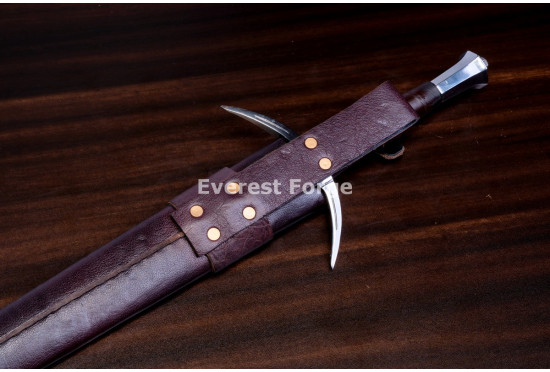
Yes. A fitted brown leather sheath with a laced throat detail comes with the sword, cut around this specific blade profile rather than being a generic scabbard the blade happens to fit. A belt frog, a baldric or a wall mount can be added on request. If you change the blade length on a custom build, the sheath is made to the new dimensions automatically.
How do I look after the finish and the leather?
Treat the blade as you would any high-carbon sword. Wipe it dry after handling, because fingerprints are acidic enough to etch a satin finish within days, and keep a thin film of camellia, mineral or light gun oil on it in storage. Pay particular attention to the fuller, which holds oil and dust more than the flats. Do not store the sword in the sheath for long periods; leather traps moisture against steel. For the grip wrap, wipe it dry if it gets wet, let it dry away from direct heat, and give it a light leather conditioner once or twice a year to stop it drying out and cracking.
Will every sword look exactly like the photograph?
No, and that is inherent to hand forging. Every blade is drawn out under a hammer by a smith, so the taper, the width at the forte and the exact line of the fuller carry small differences from piece to piece. The quillons are filed and polished by hand, so no two sweeps are identical. Weights and dimensions vary by a few percent either way. What is consistent is the steel, the heat treatment, the construction and the edge. If you need a piece to match the photograph closely, note it on your order.
Where is it made and by whom?
Hand-forged in Tokha-3, Kathmandu, Nepal, by our own smiths. Everest Forge is a working forge rather than a reseller putting a name on imported blanks — the steel is cut, drawn, quenched, tempered, ground, fitted and sheathed under one roof. That is also why we can change dimensions on a custom order: there is a smith at the anvil rather than a catalogue of finished stock.
| Specification | |
| Blade: | 23 inches. Hand forged from 5160 carbon steel |
| Total Length: | 30.5 inches |
| Handle: | 7.5 inches total with a 5 inch grip, full tang, leather-wrapped grip with polished steel guard and fitted pommel |
| Weight: | 1310 grams approx |
| Note: | handmade variation in weight, dimensions and finish may occur; keep blade lightly oiled when not in use |