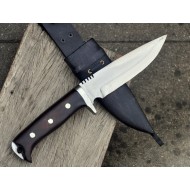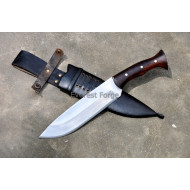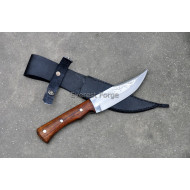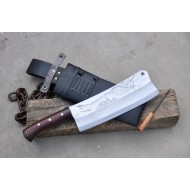


- Model: EDC Knives
- Product Code: KARAMBIT07
- Location: Kathmandu,Nepal
Available Options
What Is a Double Ring Karambit?
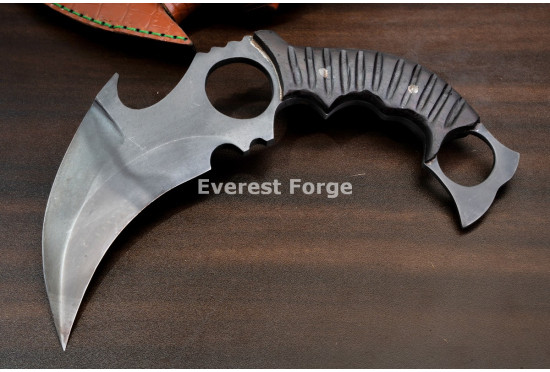
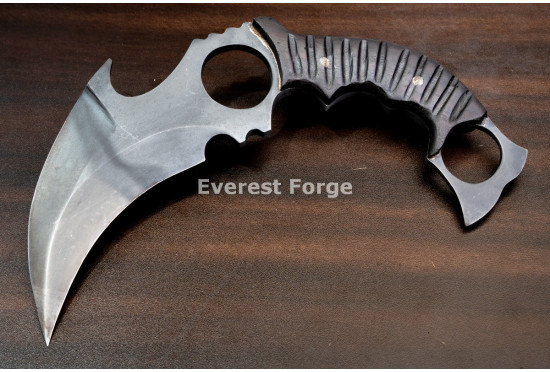
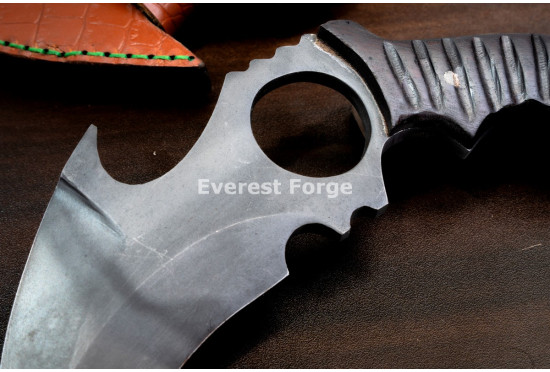
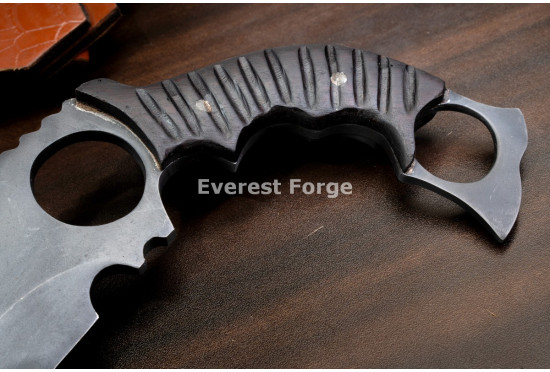
A double ring karambit is a hooked, inward-curving knife carried with a finger through a ring, built here with two rings instead of the usual one: a forefinger ring cut through a broad steel plate at the base of the blade, and a second steel ring forged at the butt of the handle. Two anchor points instead of one means the knife is locked to the hand in a way a single ring cannot manage, and it cannot be dropped, twisted out or stripped away in use. This one is hand-forged in Nepal from 5160 high-carbon spring steel, with a 7 inch hawkbill blade, a 6 inch carved grip and a 13 inch overall length, and it ships in a fitted leather sheath.
Almost every karambit on the market is a single-ring folder or a stamped stainless copy of one. This is a fixed blade, forged and ground by hand, with a full-width tang running the length of the grip and both rings integral to the steel rather than bolted on. It is a collector's piece and a working curiosity rather than an everyday pocket knife, and the page below says plainly what it does well and what it does badly.
An honest note. A second ring is a real trade-off, not a free upgrade. Two rings hold the hand in one orientation and one orientation only: you cannot shift your grip, choke up, reverse the knife or let go quickly, and getting out of it takes a deliberate movement with the other hand. That is exactly what some buyers want and exactly what makes it unsuitable for general utility work. There is also a legal dimension, set out below, that a single-ring karambit does not carry to the same degree. If you want the traditional single forefinger ring, or a plain handle with no ring at all, both are offered at no extra cost and we would rather build you the one you will actually use.
Please check your local law before ordering. A karambit is already among the most heavily regulated knife shapes in the world, because legislation in many countries names a curved or hooked fixed blade and a finger ring as separate restricted features, and this knife has both. A second ring can push it further still: where a statute describes a weapon held across two or more fingers by rings, wording written with knuckle knives in mind can be read to cover a two-ring karambit. Rules vary by country, and within countries by state, province and city. We ship worldwide but we cannot advise on your jurisdiction, and it is the buyer's responsibility to confirm that this knife is legal to own, carry and import where you live. Where it is not, we are happy to forge the same blade with a plain grip instead.
Want This Blade Built to Your Own Design?
Change the ring count, the blade length, the grip material or the sheath, or send us a drawing of something else entirely. Our smiths forge to order in Kathmandu and quote before any steel is cut.
Start a Custom Build →Why This Karambit Is Built the Way It Is
Full Specifications
Blade length, blade finish and grip material are selectable on this listing. The figures above describe the standard build as photographed; the specification you receive will match the options you choose at checkout. As with all hand-forged work, small variations in weight, dimension and finish are normal.
Build It Your Way
Every option below is forged to order in the same workshop. None of them is a bolt-on part fitted afterwards.
What This Knife Does Well, and What It Does Not
What It Is Good At
- Cutting cord, rope, webbing, strapping, netting and sacking, which is the work the shape was originally made for
- Pull cuts of every kind, where the material is drawn into the hook rather than pushed against a straight edge
- Retention. Two rings make this the most secure grip of any knife we forge, wet hands included
- Display and collecting. It is a striking, unusual object and the forge finish photographs well
- Opening boxes, sacks and bindings without driving a point through what is inside
What It Is Not Good At
- Food preparation. A hooked edge cannot be laid flat on a board and will not slice against one
- Chopping, batoning or prying. The blade is short, hooked and pierced at the forte, and none of that suits impact work
- Thrusting. The point returns toward your own hand, which is the opposite of a thrusting geometry
- Grip changes. Two rings hold one orientation, so you cannot choke up, reverse or release quickly
- Carry in restricted jurisdictions. Please read the legal note above before ordering
How to Order a Custom Karambit
Not Quite the Karambit You Had in Mind?
Send us a sketch, a photograph or a written description. We forge one-off commissions every week and will tell you honestly if what you are asking for will not work.
Talk to the Forge →Who This Karambit Is For
- Collectors of unusual knife forms who already own a conventional karambit and want the two-ring variant of it
- Buyers who value retention above all and want a knife that genuinely cannot be pulled out of the hand
- People who cut a lot of cord and strapping in a workshop, on a boat, in a warehouse or in a garden
- Students of Southeast Asian blade forms who want a hand-forged fixed blade rather than a production folder
- Display and prop buyers who want something with real presence on a wall or in a case
It is not for you if you want a general-purpose belt knife, a camp or kitchen tool, or something you can grip several different ways. Any of our straight-bladed hunting or bushcraft knives will serve you better, and we would rather sell you one of those.
What Is Included
- The hand-forged double ring karambit, sharpened and ready to use
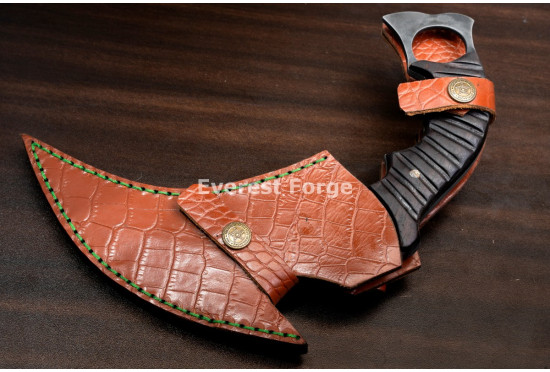
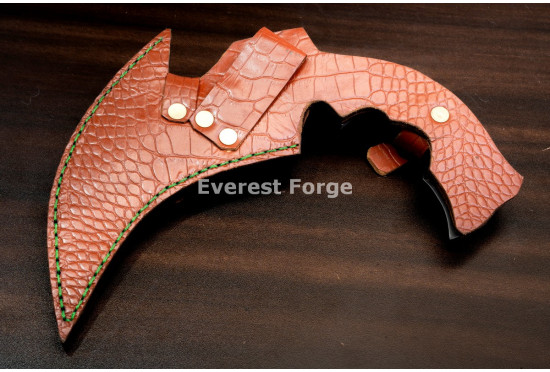
- A fitted leather sheath with a handle retaining strap, cut to the curve of the blade
- A certificate of authenticity from the workshop
- Care instructions for high-carbon steel
- Everest Forge manufacturer warranty against forging and material defects
Other Blades From the Everest Forge Workshop
Shipping, Returns and Care
Dispatch. Stock pieces leave the workshop within 2-3 business days. Custom builds take 4-6 weeks depending on the queue and the complexity of the work, and we will tell you the honest date rather than an optimistic one.
Shipping. Tracked worldwide by DHL or FedEx, typically 7-14 business days in transit from Kathmandu. Customs paperwork is completed accurately and in full. Some countries restrict the import of ringed or hooked blades; please check before ordering, because a parcel seized at your border cannot be recovered.
Returns and warranty. Covered by the Everest Forge manufacturer warranty against defects in forging and materials. Custom builds made to your own specification cannot be returned for a change of mind, which is why we confirm everything in writing first.
Care. This is high-carbon steel and it will rust if neglected. Wipe it dry after use, keep a light film of oil on the blade when it is stored, and pay particular attention to the inside walls of both rings and the jimping on the spine. Those are enclosed surfaces that a cloth drawn along the flat never touches, and they are exactly where moisture sits. Do not store the knife in the leather sheath for long periods; leather holds damp against steel.
Karambit Questions Answered
What is a double ring karambit?
A karambit is a knife with the edge ground along the inner face of a curved blade and a ring at the handle for a finger to pass through. It descends from an agricultural tool used across Indonesia, Malaysia and the Philippines, and its name in Indonesian points at the same idea our word "claw" does. A double ring karambit adds a second ring, so a finger of each hand position is anchored rather than just one. On this piece the forward ring is cut through a widened plate at the base of the blade and the rear ring is forged into the butt of the tang.
Which finger goes through which ring, and what does the second ring actually change?
Held blade-forward, the index finger goes through the forward ring at the ricasso and the little finger through the rear ring at the butt, with the carved grip filling the palm between them. What that changes is straightforward: a single-ring karambit pivots around one point, so the knife can rotate in the hand and be spun, re-indexed or reversed. Two rings remove that entirely. The knife becomes a fixed extension of the hand in one orientation, which is why retention is so much better and why it is the wrong tool for anything that needs a grip change. It is worth being blunt about the cost: you cannot let go of this knife quickly. Freeing your hand takes a deliberate movement, and if you drop something else while holding it you cannot simply open your fingers to catch it.
Why is the forward ring cut through the blade rather than the handle, and how do you tell a well-made one?
It sits at the ricasso, the short unsharpened section between the edge and the handle, because that is the only part of a blade a finger can pass through without sitting next to a cutting edge. The steel is widened into a plate there to give the ring a rim of material all the way round. Two things tell you whether it was made properly. First, the inside wall of the ring should be smooth, rounded over on both faces and polished, not left as a drilled or ground hole with a square edge, because a finger bears its whole weight on that rim. Second, look for bright bare metal, burring or discoloured rings around the opening, which would mean the hole was cut after heat treatment rather than before it. On the question of whether cutwork weakens a blade, our deep-fullered kukri page works through the structural argument properly rather than repeating a summary of it here.
Why does the point face backwards?
Because a hawkbill is a hook, and the whole edge lies along the inside of the curve, so the tip finishes pointing back toward the hand that holds it. Everything this blade does is therefore a pull. You place the hook over or behind what you want to cut and draw it toward you, and the material is trapped in the curve and fed into the belly of the edge instead of skidding off the way it does on a straight blade. That is why the shape survives in pruning hooks, linoleum knives, sickles and rope knives. It also explains the limits: a hook cannot be pushed, cannot be laid flat against a board, and cannot be thrust, because pushing it drives the point back at the user rather than into the work.
Can I use it as an everyday utility knife?
For some jobs, very well. Cord, rope, twine, webbing, strapping, sacking, netting, cable ties, packing tape and garden growth are all pull cuts, and this is a better tool for them than most straight knives. For most other jobs, badly. It will not slice food on a board, will not carve, will not baton, will not spread, will not drill and will not be used one-handed while your other hand holds the work steady, because both hands are needed to get into and out of the rings. If you were hoping for a knife to keep in a bag for general use, buy one of our straight fixed blades and buy this because you want a karambit.
How do I sharpen a hooked edge?
Not on a flat stone. A bench stone bridges a concave edge and touches only the two high points, so the hook flattens out over successive sharpenings and eventually stops being a hook. You want a round or tapered ceramic rod, a sharpening steel of small diameter, or a slip stone narrow enough to follow the curve, worked in short strokes along the arc and finished on the outside face to remove the burr. Our recurve knife page sets out the same problem in more detail, since it applies to any concave edge.
Is a double ring karambit legal where I live?
We cannot answer that for you and you should treat any seller who does with suspicion. What we can tell you is why this shape attracts more attention than most. Knife legislation often names features rather than types, and a karambit carries two named features at once: a curved or hooked fixed blade, and a finger ring. A second ring adds a third consideration, because wording drafted to cover knuckle knives sometimes describes a weapon held by rings across more than one finger, and that language can be read onto a two-ring karambit even though the design intent is completely different. Rules vary by country and, within countries, by state, province and city, and import rules differ again from carry rules. Check yours, and if the rings are the problem, ask us for the single-ring or plain-grip build at no extra cost. Our full tang karambit page covers how knife law treats blade shape in more general terms.
How does this compare with the other karambits in the range?
Three pieces, three different answers. The Karambit, Full Tang is the closest relative, with the same 7 inch blade and almost the same weight, but a single forefinger ring and an inch more length overall: pick it if you want a karambit you can re-grip, spin and release normally. The Claw Karambit is a shorter 6 inch blade with a deeper hook and a ring pommel, which makes it the most aggressive cutter of the three on cord and strapping. This double ring build is the one to choose if maximum retention is the point, or if you are collecting the form and want the two-ring variant. It is also the most restricted of the three, so read the legal note first.
What steel is it, and how is it heat treated?
5160 high-carbon spring steel, the same stock our smiths use for kukris and swords, forged down from leaf spring in the Nepali tradition. It is oil-quenched and then tempered back, which gives a blade that holds a hard working edge but stays tough rather than brittle. It is not stainless. It will take a patina with use and it will rust if you leave it wet, which is the trade every high-carbon blade asks you to make in exchange for an edge that sharpens easily and cuts well.
Is the handle full tang, and what holds the scales on?
Yes. The tang runs the full length of the grip at full width and continues into the rear ring, so the ring is part of the same piece of steel as the blade rather than a fitting attached to it. The rosewood scales are pinned through that tang with two pins, and the exposed steel along the spine of the grip is the tang itself. This matters more on a karambit than on most knives, because both rings pull against the handle in use and a stick tang glued into a slotted handle, which is how inexpensive karambits are usually made, has nothing holding it when that load goes on.
Will my knife look exactly like the photographs?
Close, but not identical, and that is the nature of forged work. The profile is shaped by eye against a pattern, the grinds are done by hand, the jimping is filed one groove at a time and rosewood varies board to board in colour and figure. What does not vary is the specification: length, steel, construction, heat treatment and sharpness are held to the same standard on every piece. Our kukri machete page explains in more detail what can and cannot differ between two blades from the same bench.
What is the sheath like to carry?
It is cut and stitched to the curve of the blade, because a hooked blade cannot be pushed into a straight sheath without the point catching on the welt. The standard build is crocodile-embossed leather, saddle-stitched in a contrasting thread with brass studs, and it carries a separate strap that closes over the handle so the knife is held at two points rather than by friction alone. Draw it by releasing the strap first and lifting the knife clear along the line of the curve; do not try to pull it straight out. Belt, horizontal and neck carry are all available if you tell us how you intend to wear it.
| Specification | |
| Blade: | 7 inches. Hand forged from 5160 carbon steel |
| Total Length: | 13 inches |
| Handle: | 6 inches, full-width tang with scales pinned through, carved rosewood grip, forefinger ring through the ricasso plate and a second steel ring forged at the butt |
| Weight: | 470 grams the knife, 640 grams with the sheath |
| Note: | handmade variation in weight, dimensions and finish may occur;keep blade lightly oiled when not in use |