Menu
Your Cart

Hand-Forged Dane Axe, Engraved Head

Hand-Forged Dane Axe, Engraved Head
$344.99
Ex Tax: $344.99
  • Model: Axe
  • Product Code: DaneAxe
  • Location: Kathmandu,Nepal

Available Options

A Hand-Forged Dane Axe With an Engraved Head

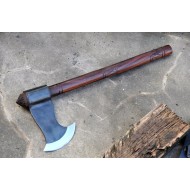
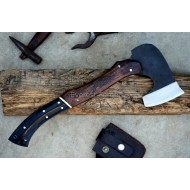
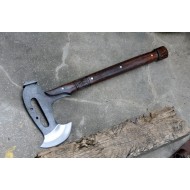
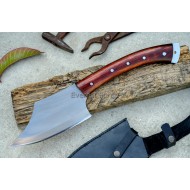
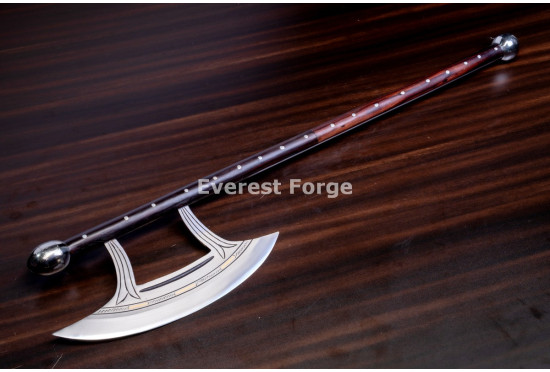
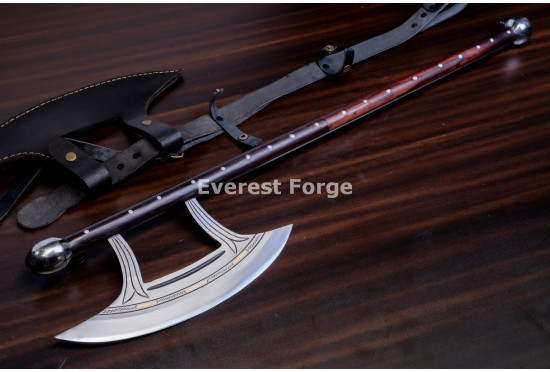
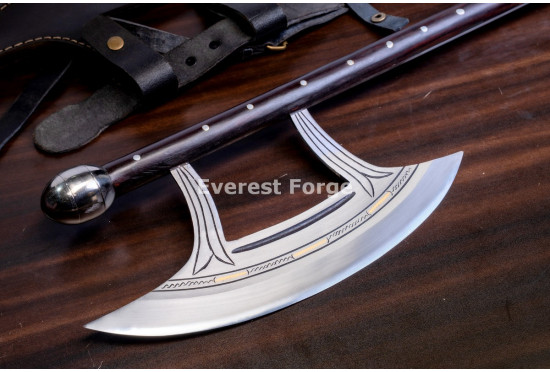
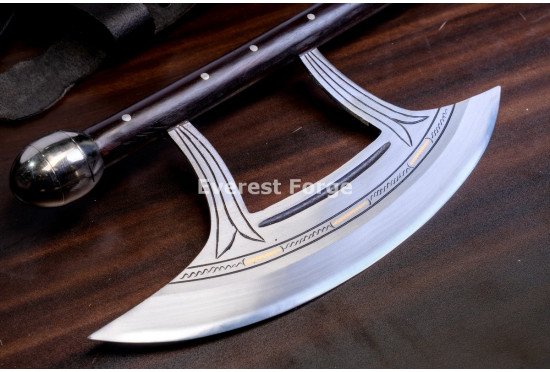
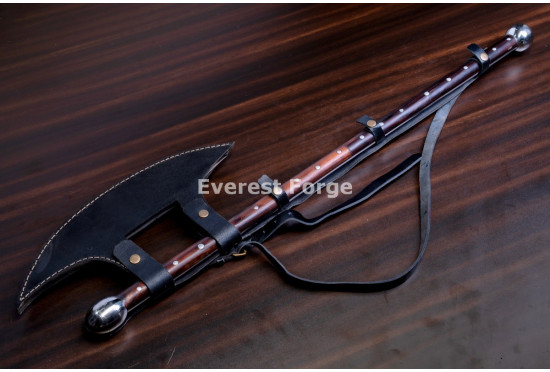
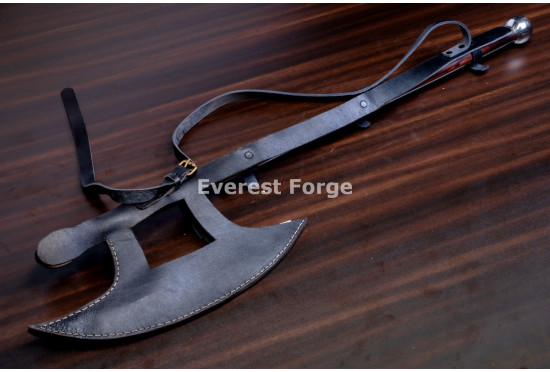
This is a Dane axe, hand-forged in Tokha-3, Kathmandu, Nepal from 5160 high-carbon steel, oil-quenched and tempered. The head carries a broad crescent edge of 14 inches, both horns sweeping forward from a narrow body, with engraved panels worked into the cheeks and inlaid line detail following the sweep of the edge. It is hung on a 36 inch rosewood haft studded the length of its run and capped at both ends with polished steel finials. It ships sharpened, with a fitted black leather head cover on belt straps.

An honest note. This is a decorated Dane axe rather than a strict archaeological reproduction, and the difference is mostly in the head. A genuine Viking-age Dane axe head was remarkably thin — often only two to five millimetres through the body, thickening only at the edge — and the whole head weighed between roughly one and two pounds. They were made that way deliberately, and it is the most surprising fact about the type. This head is thicker and heavier than that, which makes it stronger and more forgiving but less historically exact. The engraving and the studded, steel-capped haft are decorative additions with no period basis. If you want a thin, period-weight head on a plain haft, our smiths will forge one.

Custom Forge

Want a Period-Weight Dane Axe?

Our smiths will forge a thin, historically proportioned head at period weight on a plain ash or hickory haft, at any length from a short one-hand axe to a full five-foot Dane axe. Send a reference or a find drawing and we will quote it.

Start a Custom Build →

Why This Axe Is Built the Way It Is

Broad Crescent EdgeFourteen inches of edge on a head whose body is far narrower. That spread is what a Dane axe is for — it puts a long cutting edge on the end of a long lever without adding the weight a solid head would.
Forward-Swept HornsBoth the upper and lower horns reach forward from the eye. The horns are what let the axe cut with the corner as well as the belly, and they are what catch and hook.
Engraved CheeksPanels cut into both faces with inlaid line detail following the edge. Engraving on an axe is unusual because the head is a working surface; here it is the point of the piece.
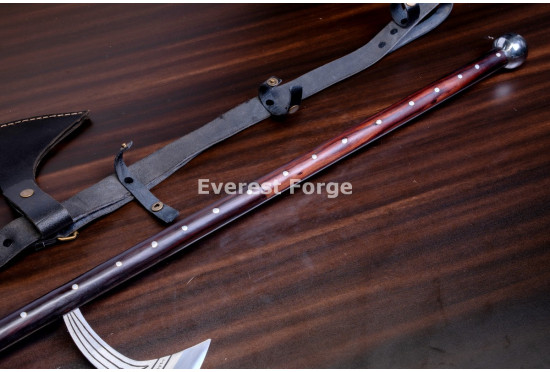
Studded Rosewood HaftStudded the full length rather than left plain, and capped at both ends with polished steel. Decorative rather than period, and the reason this reads as a presentation axe.
Long Two-Hand HaftThirty-six inches is a genuine two-hand length. An axe is a lever and the haft is the lever arm — length is where the force comes from, not head weight.
5160 High-Carbon SteelSpring steel, oil-quenched and tempered. On an axe the heat treatment matters at the edge above all, where impact and edge retention pull in opposite directions.

Full Specifications

Edge Length14 inches across the crescent
Haft Length36 inches
Overall Length36 inches
Head Steel5160 high-carbon spring steel, oil-quenched and tempered
Head ProfileBroad crescent with both horns swept forward from a narrow body
DecorationEngraved panels on both cheeks with inlaid line detail
EdgeSharpened and ready to use
HaftRosewood, studded the full length, polished steel caps at both ends
Weight2480 grams approx, as shipped with the head cover
SheathFitted black leather head cover on belt straps
OriginHand-forged in Tokha-3, Kathmandu, Nepal
Standard Build14 inch edge, 36 inch haft, satin finish, rosewood haft. Edge size, finish and haft material are selectable above; the engraved head is fixed on this piece and is what distinguishes it.

How You Can Configure It

Haft LengthShorter for a one-hand axe you can hang on a belt, or longer toward the four to five foot hafts the largest Dane axes carried. Tell us how it will be used.
Head SizeA narrower edge for a lighter, faster axe, or wider still. The body is re-proportioned rather than simply scaled so the balance stays right.
Head WeightAs built, or forged thin to historical Viking-age weight if you want the period feel rather than the robust one.
FinishA bright satin that shows the engraving, or a darker finish that reads as excavated and gives the engraving more contrast.
Haft MaterialRosewood as standard, or ash or hickory, which are the historically correct and mechanically better choices for an axe that will be swung.
MarkingsA name, a date, a rune row or a personal device engraved into the cheeks alongside the existing panels. Send the text with your order note.

Is This the Right Axe for You?

Buy This If You Want

  • A Dane axe with engraved cheeks rather than a plain working head
  • Fourteen inches of edge, which is genuine Dane axe scale
  • Real forged 5160 with a proper heat treatment at the edge
  • A decorated haft that finishes the piece as a display object
  • A fitted leather head cover rather than a bare edge
  • A smith who will forge a thin period-weight head if you prefer

Look Elsewhere If You Want

  • A strict archaeological reproduction — period heads were far thinner
  • A plain working axe; the engraving and studding are the point here
  • A felling or splitting axe; a Dane axe is a cutting weapon, not a wood tool
  • An ash or hickory haft as standard; rosewood is the display choice
  • A stainless head that needs no oiling or care
  • Identical units; every piece is forged and engraved by hand and varies

How to Order

Choose Your BuildSet haft length, head size, head weight, finish and haft material from the options above, then add to cart.
Add Any NotesAdditional engraving, a period-weight head or a longer haft go in the order note.
We Forge and HangStandard builds dispatch in 2 to 3 business days. Custom builds take 4 to 6 weeks from confirmation.
Tracked DeliveryDHL or FedEx, 7 to 14 business days worldwide, tracked door to door and covered by our manufacturer warranty.

Who This Axe Suits

  • Viking-age and early medieval collectors who want the decorated version alongside a plain working axe.
  • Display buyers after a wall piece where the head carries detail worth looking at closely.
  • Reenactors and living-history groups portraying a figure of standing, where a decorated axe is appropriate.
  • Cosplay and stage users needing real forged weight and a silhouette that reads instantly.
  • Gift buyers marking an occasion, with a name, a date or a rune row cut into the cheeks.

What Is Included

  • One hand-forged Dane axe, sharpened and ready to display
  • Fitted black leather head cover on belt straps
  • Care and oiling instructions
  • Everest Forge manufacturer warranty against defects in forging and heat treatment

Other Hand-Forged Blades

Shipping, Returns and Care

Shipping. Standard builds dispatch in 2 to 3 business days. Custom builds take 4 to 6 weeks. We ship worldwide by DHL or FedEx, 7 to 14 business days, fully tracked. A haft longer than the standard 36 inches ships as an oversize consignment, which we will quote before starting. Axes are restricted in some countries and states — please check what applies where you live before ordering, as we cannot deliver into a restricted address.

Returns. Standard builds can be returned unused and in the original head cover within 30 days. Custom builds, altered dimensions and engraved pieces are made to your specification and cannot be returned unless there is a fault in forging or heat treatment.

Care. The head is high-carbon steel: wipe it dry after handling and keep a thin film of oil on it in storage. The engraved panels are the part that needs attention rather than a general wipe — cut lines hold oil, dust and polish, so work along them with a corner of cloth or a soft brush and keep metal polish away entirely, since polish dries white in an engraved line and is very difficult to lift out. The rosewood haft wants a light coat of hard wax or furniture oil once or twice a year. Check the head for movement on the haft every few months, particularly if the axe has been somewhere dry — timber shrinks, and a loose head is both a safety problem and easily fixed early.

Frequently Asked Questions

How heavy was a real Dane axe?

Far lighter than almost anyone expects, and this is the single most misunderstood thing about the type. Surviving Viking-age Dane axe heads generally weigh between about one and two pounds — roughly 500 to 900 grams — and the body of the head is often only two to five millimetres thick, thickening only in the last stretch toward the edge. Some are so thin you can see daylight distortion in them. The reason is that an axe does its work through leverage and edge, not through mass: the haft is the lever, the speed at the head end is what generates force, and a heavy head simply slows the whole thing down while adding nothing to the cut. A thin head on a long haft is quick, recovers fast between blows, and still bites deep. The popular image of a massive slab of iron on a stick comes from film and fantasy art rather than from the archaeology. This head is thicker and heavier than a period one, which makes it more forgiving and more robust, and we would rather tell you that than let you believe otherwise. If you want the period feel, our smiths will forge a thin head to historical weight.

What is the difference between a Dane axe, a bearded axe and a broad axe?

They overlap and the terms get used loosely, so here is the working distinction. A DANE AXE, also called a Danish axe or breidox, is the big two-handed weapon: a wide thin crescent head, both horns swept forward, on a haft of three to five feet. A BEARDED AXE, or skeggox, is defined by asymmetry — the lower horn drops well below the eye into a hook, the beard, while the upper edge stays short, and it is usually a shorter one-handed axe. The beard lets you choke up and grip the haft right behind the head for fine work, and it hooks well. A BROAD AXE in the modern sense is a woodworking tool with a wide edge and a bevel on one side only, used for hewing timber flat, and it is not a weapon at all despite the name overlap. This head is a symmetrical forward-swept crescent on a two-hand haft, which places it in the Dane axe family rather than the bearded one, even though the lower horn does reach forward.

Is a Dane axe a weapon or a tool?

A weapon, and it does not make a good tool. The thin wide head that makes it fast against an unarmoured or lightly armoured target is exactly wrong for wood: a felling or splitting axe wants a thick wedge-shaped head that forces fibres apart, and a Dane axe head would bind or bend in a log rather than split it. That specialisation is the point. What the Dane axe does extremely well is reach, speed and hooking — the horns catch shield rims and pull them out of line, the long haft outreaches a sword, and the edge does not need mass behind it to cut through cloth and flesh. If you want an axe for actual woodwork, ask us for a working profile with a thick head and a shorter ash haft; it is a different object and we build it as one.

What steel is it and how is it heat treated?

5160 high-carbon spring steel, oil-quenched and then tempered back. On an axe the heat treatment matters most at the edge, where two requirements pull against each other: hard enough to hold an edge through impact, soft enough not to chip when the edge meets something it does not like. 5160 tempered correctly sits well in that band, and it is the steel family Nepali smiths have traditionally drawn from vehicle leaf spring, so our forge reads it by colour and by sound at the anvil.

Does it arrive sharp?

Yes. It ships with a working edge along the full 14 inch crescent, sharpened by hand and ready out of the cover. It is not a blunt wall-hanger with an axe-shaped profile ground into it. If it is going into a display case, a costume or a reenactment group whose rules require blunt kit, ask for it blunted in the order note before we ship and we will finish it that way at no extra cost. Note that a 14 inch edge is a lot of exposed steel to have loose in a room, which is why the head cover matters.

How is the head fixed to the haft, and will it come loose?

The head is hung on the haft through its eye and wedged, which is how axes have been hung for several thousand years and is entirely different from how a spear or a glaive head is fitted. The haft is shaped to pass through the eye, driven up until it is tight, and then a wedge is driven into the end grain from the top to spread the timber against the walls of the eye. It holds by friction and compression rather than by any fastening. What that means in practice is that an axe head can loosen as the timber moves — in a dry, heated room over a winter, wood shrinks, and a head that was tight in Kathmandu can develop a little play. Check it every few months by holding the haft and trying to rock the head. If there is movement, it is a routine fix rather than a fault, and we will talk you through re-wedging it.

Can I have a longer haft?

Yes. The largest Dane axes carried hafts of four to five feet, and our smiths will hang the same head at any length you specify. Be aware of two things. A longer haft changes the balance and the swing completely — it is not simply a bigger version of the same axe, it is a different weapon in the hand. And a haft beyond the standard 36 inches ships as an oversize consignment at a higher freight cost, which we will quote before starting. If the axe is for display, measure the wall first; a five-foot haft needs a genuinely large space.

Why rosewood rather than ash?

Because this is a display piece, and rosewood earns its place there. Historically an axe haft was ash or hickory, and for good mechanical reasons: both are ring-porous hardwoods with long straight fibres that flex under shock and absorb the vibration of a blow rather than transmitting it into the hand or splitting. Rosewood is denser, harder and far more beautiful, but it is comparatively brittle in shock and it is not what you would choose for an axe you intended to swing hard and often. On a decorated axe destined for a wall or a case, that trade favours the rosewood every time. If you are buying this to cut with, specify an ash or hickory haft when you order and we will hang it on one.

Is the head cover included?

Yes. A fitted black leather head cover on belt straps comes with the axe, cut around this specific head profile. On an axe this is not optional in any practical sense — a 14 inch exposed crescent edge is a hazard leaning against a wall, and the cover is what makes it safe to store, transport and hand to someone. If you change the head size on a custom build, the cover is made to the new dimensions.

How do I look after the engraving and the haft?

The engraving is the part people get wrong. Cut lines hold oil, dust and above all polish, and metal polish dries to a white residue inside an engraved line that is very difficult to lift out again — so keep polish away entirely and work along the lines with a corner of cloth or a soft brush instead. For the head generally, wipe dry after handling and keep a thin film of camellia, mineral or light gun oil on it. The rosewood haft wants a hard wax or furniture oil once or twice a year. And check the head for movement periodically, as covered above.

Will every axe look exactly like the photograph?

No, and on this piece the engraving is where you will see it. Each head is drawn out under a hammer, so the sweep of the crescent and the exact reach of the horns differ slightly. The panels are cut by hand, so line weight, spacing and the crispness of the detail vary from piece to piece — collectors generally regard this as the point rather than the problem. Rosewood is a natural timber, so grain and colour differ on every haft, and the stud spacing is set by hand. Weights and dimensions vary by a few percent. What is consistent is the steel, the heat treatment, the hanging and the edge.

Where is it made and by whom?

Hand-forged in Tokha-3, Kathmandu, Nepal, by our own smiths. Everest Forge is a working forge rather than a reseller putting a name on imported parts — the steel is cut, drawn, the eye drifted, the head quenched, tempered and ground, the panels engraved, the haft turned, studded and hung, and the leather cover cut and stitched, all under one roof. Engraving in particular is worth mentioning: Nepal has a deep tradition of decorative metalwork, which is why the panels on this head are cut in the same workshop as the axe rather than bought in.

Specification
Blade: 14 inch crescent edge. Hand forged from 5160 carbon steel
Handle: 36 inch rosewood haft, studded the full length with polished steel caps at both ends
Weight: 2480 grams approx, as shipped with the head cover
Note: handmade variation in weight, dimensions and finish may occur; keep blade lightly oiled when not in use

Write a review

Note: HTML is not translated!
Bad Good
Captcha