- Model: Hunting and survival knife
- Product Code: HUNTINGJAMBIA0015
- Location: Kathmandu,Nepal
Available Options
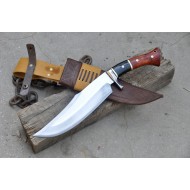
Hand-Forged Hunting Knife — Curved Fullered Blade with Rosewood Handle
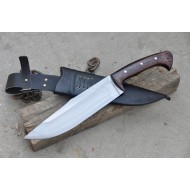
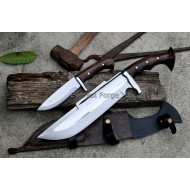
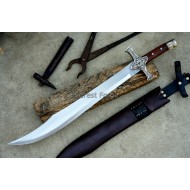
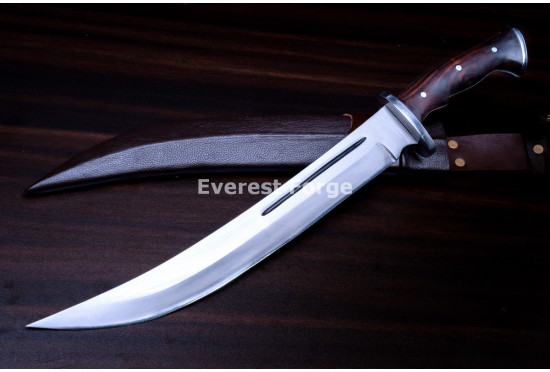
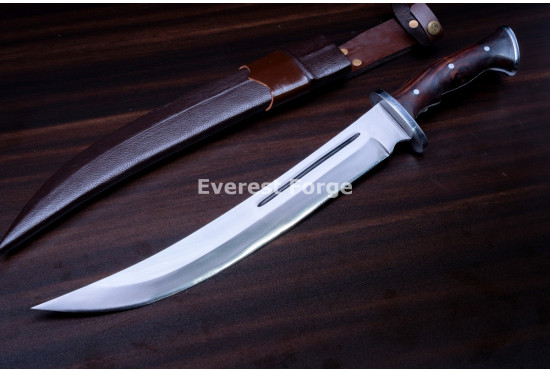
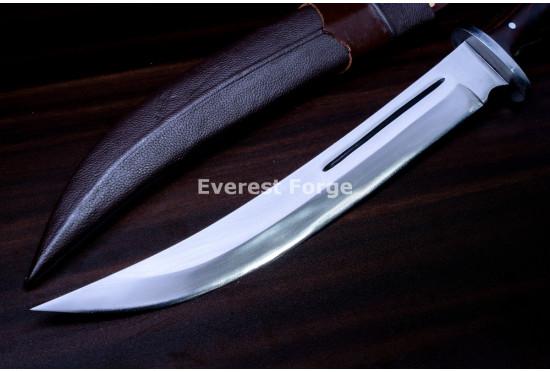
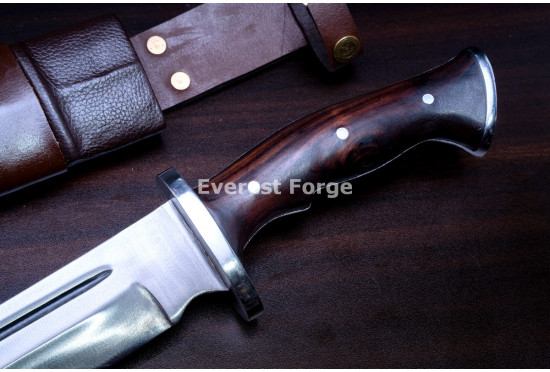
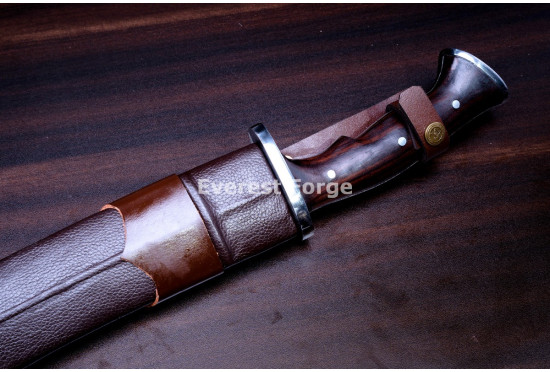
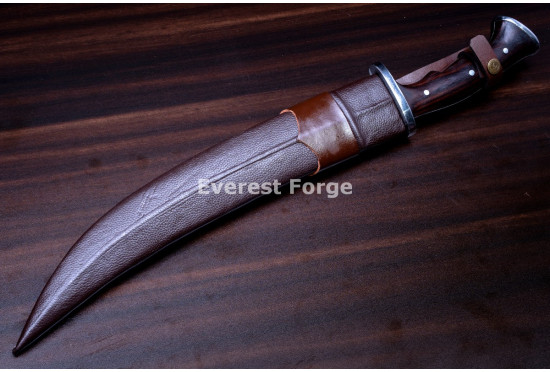
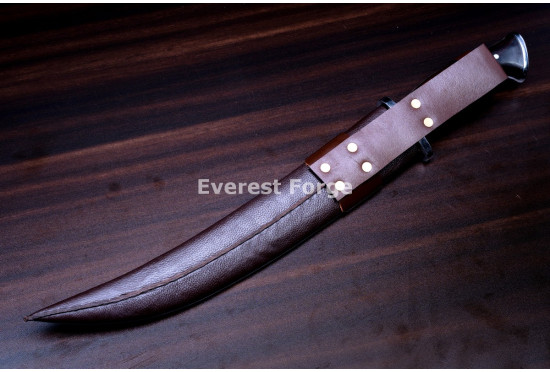
This is a hand-forged, fully functional hunting knife — a long curved single-edged blade sweeping up to a clipped point, forged in Nepal from 5160 high-carbon spring steel, oil-tempered, full tang, and sharpened to a true edge. A narrow fuller runs along the spine, darkened against the satin finish for contrast. The handle is rosewood, riveted through the tang, with a polished steel bolster and butt cap. It ships with a brown leather belt sheath. Every knife is made to order in your chosen size, finish, and engraving.
The standard blade is 15 inches on a 6.5-inch handle, for an overall length around 21.5 inches at about 1.13 kg. That is a large knife — closer in size to a short sword than to a belt knife — with the mass carried forward in the curve so it chops as well as it slices. The oil-tempered 5160 steel and riveted full tang make it a working blade, not a display piece.
An honest note. Read this before ordering, because the name can mislead. A knife made for actual hunting work — field dressing, skinning, breaking down a carcass — has a blade of four to six inches. Anything past about eight becomes clumsy for the job, and at fifteen inches this knife is no use for it at all. What it is good at is camp work: clearing brush, splitting kindling, heavy chopping, and the kind of jobs where you want reach and weight behind the edge. It is also a genuinely impressive piece to display. If you want a knife to take into the field after game, buy a shorter one — ask us and we will build it, and it will cost you less than this.
Bespoke Service
Forge a Knife to Your Own Design
Want a practical field-size blade, a straighter profile, buffalo horn instead of rosewood, or your own engraving? Our Custom Forge service builds knives to your spec, by hand in Kathmandu.
Request a Custom Forge →What Kind of Knife Is This?
It sits in the family of large single-edged camp and outdoor knives that runs from the bowie through the hunting sword to the machete — blades long enough to chop with but shaped and handled like a knife rather than a sword. The defining features here are the sweeping curve, which puts the widest part of the edge out where a chopping stroke lands, and the clipped point, where the spine is cut away near the tip to produce a finer, more controllable point than a simple sweep would give. Those two together make a blade that can take down a sapling and still do fine work with the tip. It is not a reproduction of a historical pattern; it is a modern working knife built in the tradition of big outdoor blades.
Specifications
Customize Your Knife
Every knife is forged to order. Set your options before you add to cart:
Hand-Forged, Not a Display Knife
This Knife
- Hand-forged 5160 high-carbon spring steel
- Oil-tempered, hard edge and flexible spine
- Full tang with scales riveted through it
- Fuller ground in, not stamped cold
- Sharpened, balanced, made to your spec
A Display Knife
- Unhardened or stainless bar stock
- No real heat treatment, edge rolls on first use
- Narrow tang glued into a hollow handle
- Groove pressed in for looks, no grinding behind it
- Blunt, made for a shelf
How It Is Made
Who It Is For
- Campers and bushcraft users who want a serious chopper for brush and kindling
- Collectors of large outdoor and bowie-pattern knives
- Buyers who want an impressive display knife with genuine working construction underneath
- Anyone replacing a big knife that failed at the handle
- Gift buyers personalizing a blade with a name or date
- Not for field dressing or skinning — see the honest note above and order a shorter blade instead
What Is Included
- One hand-forged curved knife, built to your chosen spec
- Brown leather belt sheath
- Rosewood handle with polished steel bolster and butt cap
- Any personalization or engraving you ordered
- A satin-finished, fullered, sharpened blade
- Everest Forge manufacturer warranty
Explore More Hand-Forged Blades
Shipping, Returns & Care
Shipping
In-stock specs dispatch within 2 to 3 business days; fully custom builds take roughly 4 to 6 weeks to forge before dispatch. We ship worldwide by DHL or FedEx in 7 to 14 business days, tracked. Import and blade laws vary by country, so please check your local rules before ordering.
Returns & Warranty
Every blade is backed by the Everest Forge warranty against forging and material defects. If something is wrong with your order, we will repair, replace, or refund it. Personalized and custom-engraved blades are made to order, so please confirm your spec carefully before purchase.
Care
Wipe the blade clean and dry after use and keep a light film of oil on it — 5160 is carbon steel and it will rust if neglected. Pay attention to the fuller, which holds moisture more readily than a flat surface, and to the joint where the blade meets the bolster. Sap from green wood is acidic enough to mark a blade overnight, so clean it the same day. Give the rosewood an occasional wipe with oil, and store the knife outside its sheath rather than in it.
From The Forge
Build a Knife That Is Yours Alone
Beyond the options here, our Custom Forge service will build a practical field-size knife, a different profile, or a matched pair — direct from our smiths in Kathmandu, roughly 4 to 6 weeks from order.
Start a Custom Forge →Frequently Asked Questions
What kind of knife is this?
It belongs to the family of large single-edged outdoor knives that runs from the bowie through the hunting sword to the machete — blades long enough to chop with, but shaped and handled like a knife rather than a sword. The sweeping curve puts the widest part of the edge out where a chopping stroke lands, and the clipped point gives you a finer tip than a plain sweep would. It is a modern working knife rather than a reproduction of a historical pattern.
Is a 15-inch blade practical for hunting?
No, and we would rather tell you now than have you find out. A knife for real hunting work — field dressing, skinning, breaking down a carcass — wants a blade of four to six inches. That length gives you control, lets you work close to the hand, and fits inside a body cavity without the tip getting in the way. Past about eight inches a knife becomes clumsy for that job, and at fifteen it is simply the wrong tool. What this blade is genuinely good at is camp work: clearing brush, limbing, splitting kindling, and anything where reach and weight behind the edge help. Plenty of people also buy it as a display piece, which is a perfectly good reason. If you want a knife to take after game, order a five to seven inch blade through Custom Forge and it will serve you far better and cost you less.
What is a clip point, and why is the blade shaped that way?
Look at the last few inches of the spine and you will see it drops away toward the tip instead of running straight to it — that removed section is the clip, and the shape is one of the most useful things you can do to a large blade. Cutting away the spine near the point does three things. It moves the tip down toward the centreline of the blade, so a thrust lines up with your wrist instead of angling upward. It makes the point narrower and more acute, which means it will pierce and do detail work that a broad sweeping tip cannot. And it takes weight off the very end, which slightly quickens the blade in the hand. The trade-off is strength: a clipped point has less steel behind it, so it is the part most likely to break if you pry with it. Do not use the tip as a lever. The clip on this knife is left unsharpened; a sharpened false edge can be ground on request.
Why is the fuller darkened?
It is a finish choice rather than a functional one. The fuller is ground into the blade along the spine, and instead of polishing the inside of the groove to match the satin flats we leave it dark, so the line reads clearly against the bright steel and gives the blade some visual depth. The groove itself is there to take weight out of the thickest part of the blade without losing stiffness. If you would rather have it bright, or no fuller at all, both are options — a blade with no fuller is very slightly stronger and slightly heavier, and on a knife this size you would struggle to feel the difference.
Is this a real, functional knife?
Yes. It is hand-forged from 5160 high-carbon spring steel, oil-tempered, sharpened, and built on a full tang with the rosewood scales riveted straight through it. It will chop green wood, clear brush and take the abuse a working knife is meant to take. Do not use it on stone, metal, nails hidden in old timber, or seasoned hardwood knots, and check the rivets and edge after heavy use.
What steel is it, and is it oil-tempered?
The blade is forged from 5160 high-carbon spring steel, the same alloy used in heavy-duty truck leaf springs, prized for toughness and edge retention. It is oil-tempered for a hard cutting edge backed by a flexible, shock-absorbent spine. On a chopping blade that toughness matters more than extreme hardness — a very hard edge chips when it meets a knot, where a tougher one rolls slightly and can be steeled back.
Is it full tang?
Yes. The tang runs the full length and width of the handle and the rosewood scales are riveted straight through it, so the handle is mechanically fastened to the steel rather than held by adhesive. There is no narrow tang hidden inside a hollow grip. On a chopper this is not a luxury — every impact sends shock back into the handle, and a glued or partial tang is the part that fails first.
What is the bolster for?
The bolster is the block of steel between the blade and the handle scales, and it does more than finish the joint. It stops your hand sliding forward onto the edge under a hard stroke, it adds weight at the balance point so the blade does not feel entirely nose-heavy, and it seals the front of the handle where moisture and debris would otherwise work their way in between the scales and the tang. On this knife it is polished steel, matched by a butt cap at the other end.
Does it arrive sharpened?
Yes, sharpened to a working edge along the full belly, finished by hand. If you need it blunt for display, or to satisfy import rules where you live, choose the display-blunt option or tell us in your order notes. There is no extra charge either way.
What is the sheath like?
A brown leather belt sheath, cut and stitched by hand to fit the blade you order — which is why a custom blade size always means a custom sheath and adds to the lead time. Store the knife outside it for the long term rather than in it: leather is tanned with acids and holds damp, and neither does carbon steel any favours over months in a cupboard.
Can I order a smaller blade or a different profile?
Yes, and it is worth thinking about properly rather than defaulting to the biggest option. Tell us the job you want the knife to do and we will tell you honestly what size and shape suits it — a five to seven inch blade for field work, something in the middle for general camp use, or this length if chopping and presence are what you are after. Blade profile, fuller, finish and handle material are all adjustable too.
Do you ship worldwide, and how long does it take?
Yes. We ship worldwide from Nepal by DHL or FedEx in 7 to 14 business days with tracking. In-stock specs dispatch within 2 to 3 business days; fully custom builds take roughly 4 to 6 weeks to forge first. Import and blade laws vary by country, so please check your local rules before ordering.
| Specification | |
| Blade: | 15 inches. Hand forged from 5160 carbon steel |
| Total Length: | 21.5 inches long in total |
| Handle: | 6.5 inches. Full tang with riveted rosewood scales, polished steel bolster and butt cap |
| Weight: | Approx 1130 grams total (blade approx 900 grams) |
| Note: | As every piece is forged by hand, slight variation in weight, dimensions and finish may occur. Rosewood grain varies between pieces. Keep the blade lightly oiled when not in use. |