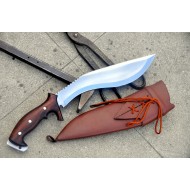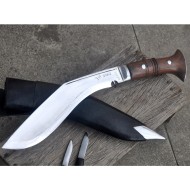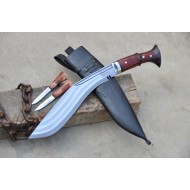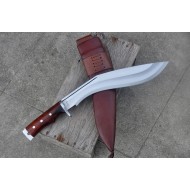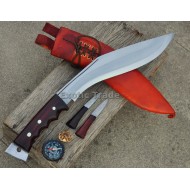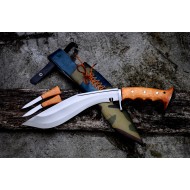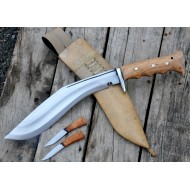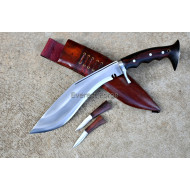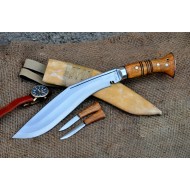


- Model: Modern Khukuri
- Product Code: Bushcraftkukri012
- Location: Kathmandu, Nepal
Available Options
A Kukri Built for Bushcraft
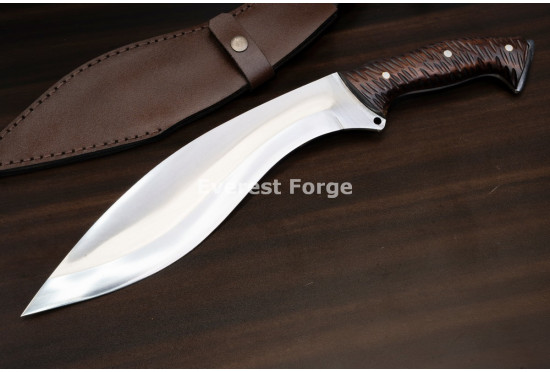
Most kukris are built to chop, and they are heavy because that is what chopping wants. This one is built for the other half of the work: the notching, splitting, feather-sticking, carving and cooking that fills the hours between the times you actually need to fell something. It is a 12 inch blade hand-forged from 5160 high-carbon steel, oil-quenched and tempered, weighing 600 grams. That is 50 grams per inch of blade, the lightest figure of any blade we make, and on a full day in the woods it is the difference you will notice most.
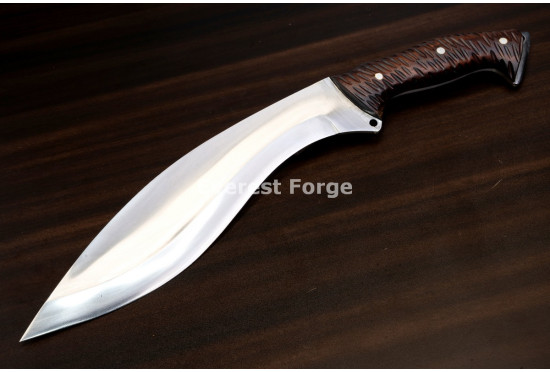
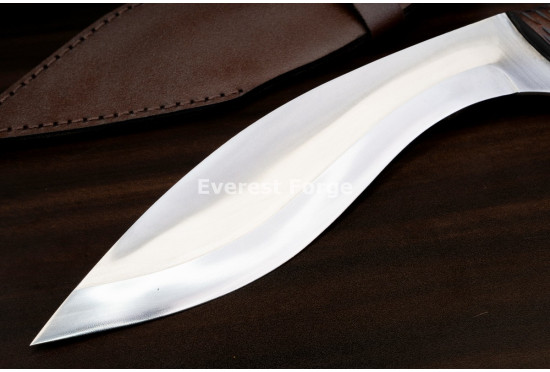
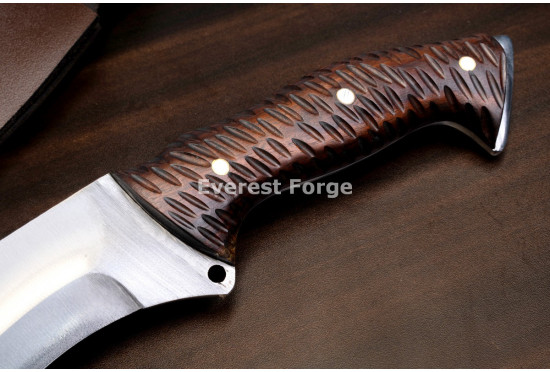
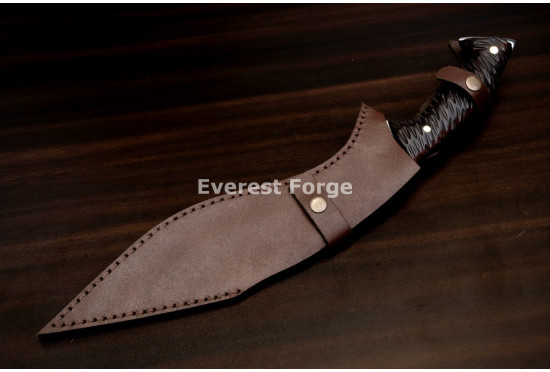
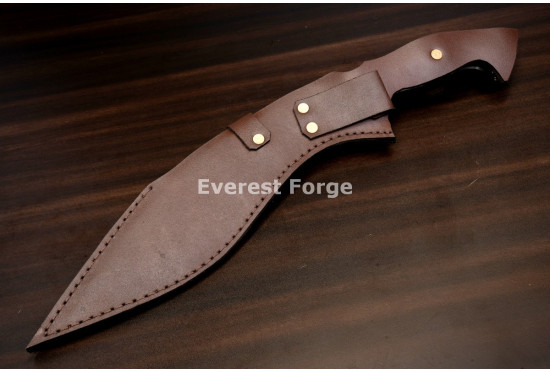
The blade is forward-curved with a deep belly, a broad flat grind and an acute point. The tang runs full length and is visible along the spine and across the butt, pinned with three rivets and drilled for a lanyard. The 6 inch grip is built in layers, with dark contoured sections at the bolster and the butt and a textured centre section chiselled deep for grip. It ships in a plain brown leather sheath, stitched, with a studded retaining strap.
An honest note. This is a modern design and we are not going to dress it up as anything else. The profile is Nepali and it is forged in Kathmandu by our own smiths, but the way it has been thought about — weight first, grip security second, carry third — comes from modern bushcraft practice rather than from village tradition. That has a real cost as well as a real benefit, and the cost is chopping power: a lighter blade does less work per stroke, and if what you want is a kukri that buries itself in seasoned hardwood, our bhojpure will serve you better than this will. Buy this one because you are carrying it a long way and using it constantly.
Want This Built Your Way?
Heavier stock, a different length, another grip material or texture pattern, a different sheath or carry system, or your own drawing entirely. Our smiths in Kathmandu forge to specification and quote before any work begins.
Start a Custom BuildWhat Makes It a Bushcraft Blade
Standard Build and Specifications
Blade length, blade finish and grip material are selectable, so the figures above describe the standard build rather than every version of this kukri. Because each piece is forged, ground and carved by hand, weights, dimensions and the exact texture pattern vary slightly between examples.
Build Options
Is This the Right Kukri for You?
Choose This One If
- You carry a blade all day and notice every hundred grams
- Your cutting is mostly carving, notching, splitting small stock and food prep
- You want grip security in wet or cold conditions
- You want a full tang you can see rather than one you have to trust
- You want a kukri that will do bushcraft work rather than a bushcraft knife that is trying to be a kukri
Look Elsewhere If
- You want maximum chopping power — a heavier blade does more per stroke, and our bhojpure is built for exactly that
- You want a traditional Nepali piece — the profile is, the design thinking is not
- You want a display piece — this is finished as a tool and nothing on it is ornamental
- You want the full traditional kit — no karda, no chakmak, no wooden dap
- You dislike textured handles — ask for the smooth contour instead
How to Order
Who This Kukri Is For
- Bushcrafters and campers who want one blade covering most tasks without the weight penalty of a dedicated chopper
- Hikers and packers carrying a blade for days rather than hours
- Anyone working in the wet — the textured grip is there for exactly those conditions
- Buyers who have owned a heavy kukri and found it stayed in the pack because it was too much to carry
- People who want to see the construction rather than take it on faith
What Is Included
- One hand-forged bushcraft kukri, sharpened and ready to use
- Brown leather sheath with studded retaining strap
- Everest Forge manufacturer warranty
- Care instructions
No karda and no chakmak are supplied with this kukri, and the sheath has no pockets for them. If you want a companion knife, one of our kukris ships with a karda as standard, and we build the traditional wooden-cored dap with fitted pockets to order.
More From the Everest Forge Collection
Shipping, Returns and Care
Stock builds dispatch from our workshop within 2-3 business days. Custom and made-to-order builds take 4-6 weeks from confirmation, and we photograph the finished piece before it leaves us. We ship worldwide with DHL and FedEx, fully tracked, typically 7-14 business days in transit. Every blade carries the Everest Forge manufacturer warranty against defects in forging and construction.
Blade laws vary by country, state and province and it is the buyer's responsibility to check local restrictions before ordering. We cannot advise on your jurisdiction and we cannot refund a blade seized in transit.
5160 is a high-carbon steel and it will rust if you let it, and a blade that lives outdoors gets more chances to than one that lives in a drawer. Wipe it dry after use, keep it lightly oiled, and do not leave it in the sheath overnight in a wet camp. Two places want particular attention on this piece: the seams where the handle sections meet, which hold water, and the cut lines of the texture, which a cloth drawn across the grip will bridge. Work oil into both with a cloth corner. Sharpen with a stone or a file rather than a powered grinder, which will draw the temper out of an edge faster than you expect.
Forged by Hand, Not Assembled
Every blade we sell is forged, ground, heat-treated and fitted by our own smiths in Kathmandu. If you want something we do not list, we will make it.
Talk to Our SmithsFrequently Asked Questions
What makes this a bushcraft kukri rather than a chopping one?
What it is optimised for. A chopping kukri is arranged around a single question: how much energy can this blade deliver into wood in one stroke. That leads to thick stock, mass carried forward and a robust convex edge. Bushcraft asks a different question, because most of the cutting is small: carving a pot hook, notching a stake, taking feather sticks off a dry stick, splitting kindling, preparing food, cutting cord. Those jobs reward a blade that is light enough to control precisely, thin enough behind the edge to slice, and comfortable to hold for a long time. This piece is ground for that. The kukri curve is still there and it will still chop when it needs to, but the design has been pointed at the other ninety percent of the work.
Why is this the lightest kukri you make?
Because of the grind, not because of anything removed from the blade. There are several ways to make a blade lighter. Some of our pieces use a fuller, a groove ground down the flat, and one carries a small cut panel. This one has neither: it is simply forged from lighter stock and given a broad flat grind taken high up the blade, so the whole cross-section is thinner than a chopper's. The result is 600 grams over 12 inches, or 50 grams per inch, against 55.4 for our deep-fullered 13 inch and 57.0 for our bhojpure. The trade-off is honest and unavoidable: a thinner section means less mass behind the edge in a chop, and it also means the edge is a little more vulnerable if you drive it into a knot at full swing.
Is it too light to chop?
No, but it chops like what it is. You will get through green limbs, brush and anything up to roughly wrist thickness without difficulty, which covers most of what a camp actually needs. Beyond that it takes noticeably more strokes than a heavy chopper would, because momentum is doing less of the work and you are doing more. The honest framing is that this blade trades peak chopping power for everything else: control, carrying comfort, and the fine work a heavy blade is clumsy at. If a typical outing has you processing large seasoned rounds, take our bhojpure and accept the weight. If it has you carving, splitting small stock and cutting one or two limbs a day, this is the better tool and it is not close.
What is the handle texture for?
Wet hands. A smooth polished grip is comfortable and looks good, and it becomes slippery the moment your hands are wet, cold, sweaty or gloved, which describes most hands doing outdoor work. Deep-cut texture solves that by giving the skin somewhere to key into rather than relying on friction against a smooth surface. It is the same reasoning behind checkering on a gun stock or a rasp texture on a tool handle: not decoration, though it looks well, but a grip that works in the conditions the tool is actually used in. The trade-off is that aggressive texture can be uncomfortable over long sessions with bare hands, and the deeper it is cut the truer that becomes. Ours is cut deep but with rounded tops rather than sharp points, which is the compromise most people find comfortable. If you want it shallower, say so.
What is the layered handle?
The grip is built up from sections rather than shaped from a single piece: darker contoured material at the front where it meets the blade and again at the butt, framing the textured centre section where your hand actually sits. It does two things. Visually it defines where the grip is, so the eye and the hand agree on where to hold it. Practically, the raised contoured sections at each end act as soft stops without carving finger grooves into the handle, so your hand is located but not locked into one position — which matters on a blade you might hold three or four different ways in an afternoon. Finger grooves solve the same problem more aggressively and suit fewer hands.
Can I baton with it?
Yes, and this is a piece where the construction supports it properly. Batoning means striking the spine of the blade with a wooden billet to drive it through a piece of wood, and the two things that fail when people do it badly are a partial tang and a thin blade struck near the tip. This blade has a full tang running the length of the grip and visible along the spine, so there is no hidden joint to work loose. Strike over the thicker section toward the middle of the blade rather than out near the point, use a wooden billet and never a steel hammer, and keep the splits reasonable in size — this is a lighter blade than our choppers and the section is thinner, so it is well within its capability on kindling and small rounds rather than on large seasoned logs.
What does the exposed butt give me?
A steel surface at the back of the knife you can use and inspect. Because the tang runs through and is exposed across the end of the grip rather than being capped in wood, you can tap with it: driving a tent peg, seating a wedge, cracking a nut, breaking ice on a water bottle. None of those is what the knife is for, but all of them come up, and doing them with a wooden butt cap is how butt caps split. It is also honest construction in the plainest sense — you can see the steel running from the edge to the end of the handle, and there is no way for a manufacturer to hide a short tang behind a fitting. Do not use it as a hammer on hard steel, which will eventually deform the end and start to loosen the pins.
What steel is it?
5160 high-carbon spring steel, oil-quenched and tempered. It is the family of steel used for vehicle leaf springs, which is the origin of the Nepali practice of forging kukris from them, and it is chosen for toughness rather than for maximum hardness. That is the right choice on a bushcraft blade for two reasons. Toughness is what survives batoning, prying and the occasional strike into something you did not see. And a steel that rolls rather than chips can be brought back with a stone in the field, where a chipped edge in a very hard steel needs a workshop. The cost is that it needs sharpening a little more often, and that it is not stainless, so it will rust if you leave it wet.
How does this compare to your other 12 inch kukris?
It is the light one. Our etched chirra at this length runs 61.7 grams per inch with a 7 millimetre spine and is built as a decorated working blade. Our bhojpure is shorter at 10 inches but heavier for its length at 57.0, with mass deliberately carried forward for chopping. This one sits at 50.0, the lowest figure in the range, with a thinner section and a high flat grind. If you are choosing between them, the question is what your day looks like. If it is mostly cutting wood down to size, take the heavier blade. If it is mostly making things out of wood, take this one.
How do I sharpen it?
More easily than most kukris, which is a genuine advantage of this grind. A broad flat grind gives you a wide, clearly defined bevel that you can lay flat on a stone and follow, where a convex chopping edge has no flat reference and has to be worked in small circles with a feel for the curve. Lay the bevel down, keep the angle constant and work along the length, following the curve of the belly as you go. A pocket diamond stone or a small ceramic rod is enough to maintain it in the field, which matters on a blade you are carrying for days. Avoid fixed-angle pull-through sharpeners, which are too coarse for a blade this size and will chew the edge rather than refine it.
How do I look after it outdoors?
A blade that lives outside gets more chances to rust than one in a drawer, so the routine matters more. Wipe it dry every evening, not just at the end of a trip, and carry a small cloth with a little oil on it for that purpose. Do not leave it sheathed overnight in a wet camp: leather holds moisture against steel, and a damp sheath will do more harm in three days than three months of normal use. Two places on this piece need a moment beyond the blade — the seams where the handle sections meet, and the cut lines of the texture, both of which a cloth drawn across the grip simply bridges. Work a little oil into both with the corner of a rag. If a patch of light surface rust does appear, it comes off with fine steel wool and oil.
Can I have it in a different size?
Yes. We forge this profile from belt-sized blades up to two-handed pieces, and the bushcraft thinking scales with it in both directions. Worth saying which way to go: shorter blades gain control and lose reach, and below about 9 inches the kukri curve starts to work against you for fine carving because the belly puts the edge at an angle to your line of sight. Longer blades chop better and carve worse. If you tell us how you actually use a knife rather than just the length you want, we will tell you what we would build, and we will say so if we think a different piece in the range suits you better. Grip material, texture, finish and sheath can all be specified at the same time.
| Specification | |
| Blade: | 12 inches. Hand forged from 5160 carbon steel. Forward-curved with a deep belly, acute point and a broad high flat grind |
| Total Length: | 18 inches |
| Handle: | 6 inches, full tang exposed along the spine and at the butt, three pins, layered rosewood with deep chiselled texture, lanyard hole |
| Weight: | Approx. 600 g blade, approx. 800 g total |
| Note: | As each piece is forged, ground and carved by hand, slight variation in weight, dimensions and texture pattern may occur. Wipe dry every evening in the field, not just at the end of a trip. |