- Model: Machete
- Product Code: LIGHTMACHETE
- Location: Kathmandu,Nepal
Available Options
A Hand-Forged Bush Machete With Brass-Toned Fittings and a Harness Sheath
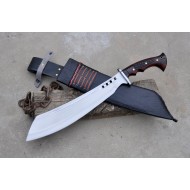
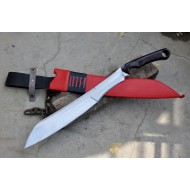
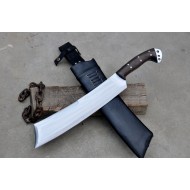
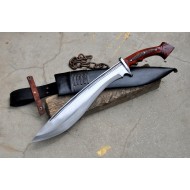
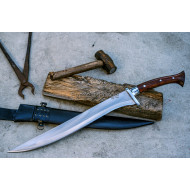
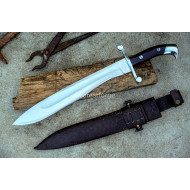
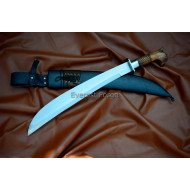
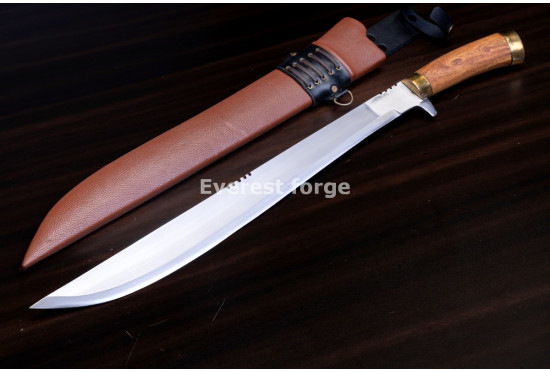
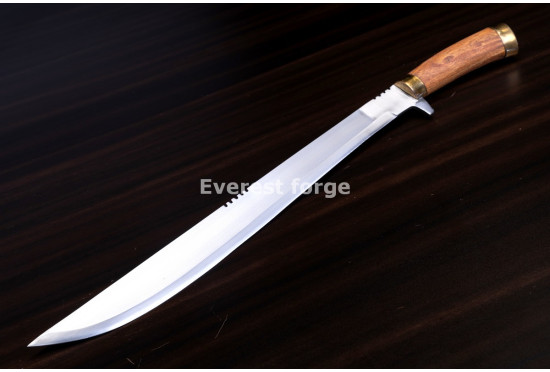
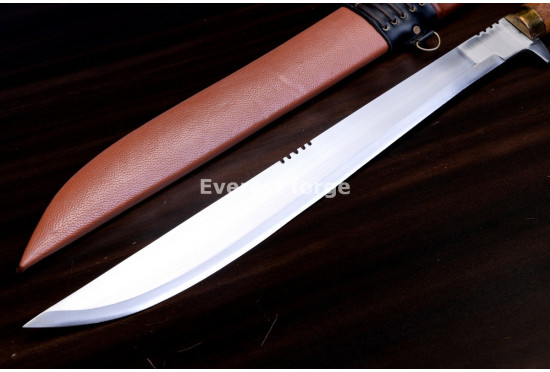
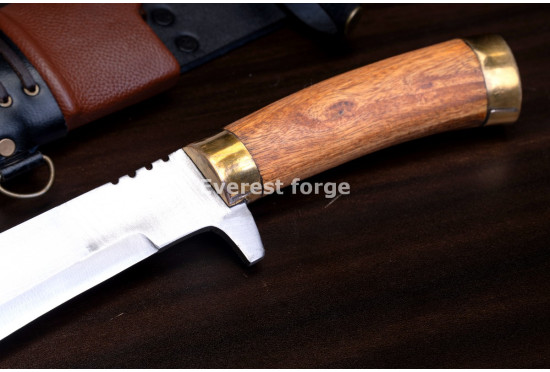
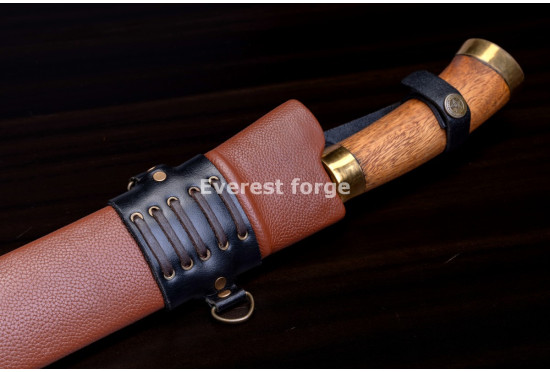
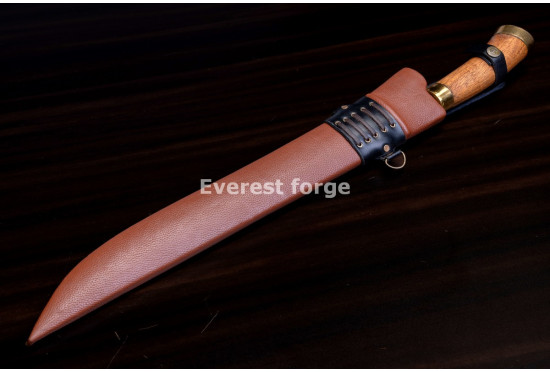
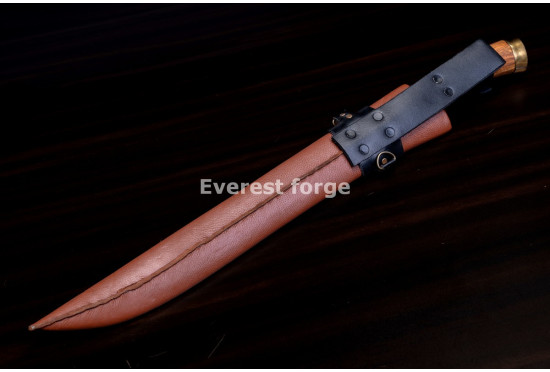
This is an 18 inch hand-forged bush machete: a long single-edged blade with a straight back dropping to a swept point and a deep belly through the cutting section, mounted on a shaped hardwood grip between a brass-toned ferrule and butt cap. Overall length is 24 inches and the whole thing weighs approximately 590 grams, which is deliberately light — a machete cuts with edge speed, not mass. The blade is forged from 5160 high-carbon steel, oil-quenched and tempered, with a ricasso lug ahead of the grip and filework along the spine. It ships in a brown leather sheath on a laced black harness with a hanging ring. Made to order in Tokha-3, Kathmandu, Nepal.
An honest note. Two things worth knowing before you buy. First, this is a machete and not a chopper: it is thin stock and it is built for green growth, cane, vines, saplings and undergrowth. Take it to seasoned hardwood or a thick standing limb and you will be there a long time, and you risk rolling the edge. For that work a kukri or an axe is the right tool and we make both. Second, this is a dressed machete — brass-toned fittings, filework on the spine and a fitted harness sheath — not a bare working blade with a plastic handle. It costs more than a hardware-store machete because it is a different kind of object, and it is worth being clear about that rather than implying otherwise.
Have This Machete Forged Your Way
Blade length, spine thickness, grip material and fittings are all decided at the forge before your piece is made. Send a sketch or a description and our smiths will quote it.
Start a Custom Forge Order →Why This Machete Is Built the Way It Is
Specifications
Build Options
Is This the Right Tool for You?
Buy This If You Want
- A long light blade for clearing green growth, cane, vines, brambles and saplings
- A forged carbon-steel machete rather than a stamped stainless one that will not hold an edge
- A guard lug and a properly shaped grip, which most machetes do not bother with
- A tool you can sharpen in the field with a mill file and nothing else
- Something that looks like a made object rather than a disposable one
Look Elsewhere If You Want
- A wood chopper for seasoned hardwood or standing limbs — a kukri or an axe does that job properly and this will not
- A batoning blade; thin stock and a hidden tang are the wrong build for hammering through logs
- A stainless blade needing no care, since 5160 is carbon steel and will rust if left wet
- The cheapest possible working machete, which is a real and sensible thing to buy but is not this
- A weapon; this is a clearing tool and the page treats it as one
Tell Us What You Are Cutting
Spine thickness, blade length and edge grind should follow the vegetation, not a catalogue. Describe your ground and our smiths will tell you what to order.
Talk to the Forge →How to Order
Who This Machete Is For
- Smallholders and land managers clearing tracks, boundaries and regrowth by hand
- Bushcrafters and expedition walkers who need one long blade for vegetation and are carrying something else for wood
- Gardeners with real acreage where a brush hook or a strimmer cannot reach
- Collectors of working blades who want a forged tool with proper fittings rather than a stamped one
What Is Included
- One hand-forged bush machete, sharpened and ready to work
- Fitted brown leather sheath on a laced harness with hanging ring
- Certificate of hand-forging from the workshop
- Everest Forge manufacturer warranty against defects in forging and heat treatment
Explore the Collection
Shipping, Returns and Care
Stock pieces are dispatched within two to three business days. Custom builds take four to six weeks at the forge before they ship. Everything travels tracked with DHL or FedEx and typically arrives in seven to fourteen business days. Every piece carries the Everest Forge manufacturer warranty against defects in forging and heat treatment.
Long fixed blades are restricted in some countries and in some states and provinces within them. It is your responsibility to check that this machete may lawfully be imported and possessed where you live before ordering, because a parcel seized by customs cannot be returned to us and cannot be refunded. Machetes are generally treated as agricultural tools rather than weapons, which usually helps, but the rules vary and we would rather you checked. Ask us before you buy and we will tell you what we know about your destination.
5160 is a high-carbon steel and it will rust, particularly if you are cutting green sap all day. Wipe the blade down at the end of the day, keep a light film of oil on it, and do not store it in the sheath for months at a time. The wooden grip takes an occasional coat of oil. The edge comes back with a mill file in a few minutes and does not need anything more sophisticated.
Frequently Asked Questions
Why is this machete so light?
Because that is what makes a machete work. It is the point most often misunderstood about the tool. A machete does not cut by being heavy, it cuts by being fast and thin: the edge arrives with speed, and the thin cross-section behind the edge passes through the stem instead of wedging in it. Add thickness and you add drag, both in the air and in the cut, and you tire out faster while getting less done. This is exactly the opposite of how an axe works, which is why an axe is thick and short-handled relative to its mass and a machete is thin and long. If a machete feels flimsy in the hand, that is usually the correct machete. Where thickness genuinely helps is if you intend to hit wood as well as vegetation, and that is a real trade you can specify — tell us and we will forge the spine heavier, accepting that it will be a slower blade in green growth.
What are the notches cut into the spine?
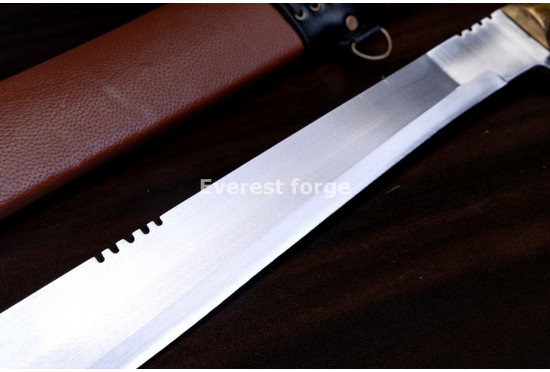
That is filework, also called jimping. On this blade there are two runs of it: one immediately ahead of the ricasso and a second further along the spine. The one at the ricasso does a real job — it is where your thumb goes when you choke up on the blade for close, controlled cutting rather than swinging, and the notches stop the thumb sliding on a wet spine. The second run further out is decorative. We would rather say that than claim a function it does not have. Filework is traditional decoration on forged blades in this part of the world and it is done with a file by hand, one cut at a time, which is why no two blades carry quite the same pattern. If you want a plain spine, that is a free change.
Are the fittings solid brass?
We describe them as brass-toned, and we would rather use that word than overclaim. The collars are fitted in our own workshop from stock we buy locally, and while it is a brass alloy we do not have certification of its exact composition and we are not going to state a grade we cannot evidence. What we can tell you is why it is there rather than steel: a copper alloy will not rust in a wet sheath, it is softer than the wood and steel it sits against so it will not chew them up as the tool works and flexes, and it takes a polish that stays presentable with almost no attention. That combination is why brass fittings turn up on working blades from Nepal to West Africa to the Caribbean. If you want fittings you can be certain about, we will build it with polished steel collars instead, or with no collars at all.
Machete, kukri or axe — which do I actually need?
They are three different tools and the difference is what you are cutting. A machete is for green, living, flexible material: cane, vines, brambles, grass, saplings, undergrowth. It is long and thin so it can be swung fast and reach past your own body. A kukri is for the middle ground and for wood: the forward weight and the drop in the blade put mass behind the cut, and it will limb a branch, split kindling and process firewood that a machete would only bruise. An axe is for standing timber and seasoned logs, where mass and a short controlled swing do everything. Most people clearing land want a machete and a kukri, not a machete and an axe, because the kukri covers the wood work and the camp work in one tool and packs far smaller. If you are only buying one blade and you are going into forest rather than scrub, buy the kukri.
How do I sharpen it in the field?
With a mill file, which is the traditional and still the best answer. A machete edge is long, it gets abused, and it is expected to be touched up constantly rather than restored occasionally, so it wants a coarse fast tool rather than a fine one. Clamp or brace the blade, run the file in one direction along the bevel with moderate pressure, work one side until you feel a burr along the full length, then turn it over and take the burr off with lighter strokes. Two or three minutes puts a working edge back on. Do not chase a razor polish: a slightly toothy edge cuts green stems better and survives contact with grit and soil far longer. A stone or a puck is fine for a finer finish if you want one, and a strop is unnecessary on a tool like this.
What steel is it, and how is it heat treated?
5160 high-carbon spring steel, brought to temperature in the forge, quenched in oil and tempered back. This is the leaf-spring steel that Nepali forges have worked for generations, and it is a particularly good fit for a machete: tough enough that a thin blade will flex and come back rather than snap, and soft enough at the temper we use that the edge deforms rather than chipping when it meets a stone in the grass. A rolled edge is straightened with a file in a minute; a chipped one is a repair. That is a deliberate choice for a tool that will hit things it did not intend to.
What is the lug on the ricasso for?
It is a stop for your hand. On a tool swung hard, repeatedly, often with wet or sappy hands, the risk is not that you lose the machete but that your grip creeps forward onto the blade. The lug projects below the line of the edge just ahead of the grip and gives your index finger something solid to run into before it reaches anything sharp. It also gives you a positive index point when you choke up for close work, so you know where your hand is without looking. Most machetes have nothing there at all, which is why most machete injuries are to the hand holding it.
How is this different from your Scimitar Machete?
Blade shape and dress. The scimitar machete has a pronounced curve through its length and a plainer hilt; this one has a straight back that drops only near the point, with a deep belly, brass-toned collars, filework and a harness sheath. In use, a curved machete puts more of the edge in contact through a draw cut and suits slashing at grass and cane; a straighter blade with a deep belly gives you a more predictable line and a heavier forward section for the occasional sapling. Neither is better and both cut green growth well. Choose the curved one if you are mostly slashing at soft standing growth, and this one if you want a slightly more general tool with better fittings.
Is it full tang?
The tang runs through the grip and is capped at the butt, which is a hidden or through tang rather than a full-width tang with riveted scales. That is the normal build for a fitted grip between two collars, and done properly it is strong in the direction a machete is loaded, which is a swing along the plane of the blade. Where a hidden tang is genuinely weaker is under hammering and prying, which is why the page tells you not to baton with it. If you want a full-width tang with visible riveted scales, say so and we will build the machete around that construction instead. It is a different-looking tool and slightly heavier, and for someone who will abuse it, it is the better order.
How sharp does it arrive?
Sharp and ready to work, with a convex working edge put on by hand at the forge. We do not send machetes out with a fine polished edge because it is the wrong edge for the job and it will be gone within an hour of real cutting. If you would prefer it shipped blunt — for display, for a gift, or because of the rules where you live — say so in the order comments and we will send it unsharpened at no extra cost.
Can I get a longer or shorter blade?
Yes, and it is worth thinking about rather than defaulting to what is shown. Fourteen to sixteen inches is easier to carry, easier to control in tight country and less likely to catch on things around you. Eighteen inches, as here, is a good general length. Twenty to twenty-two inches gives you reach and a faster tip for open cane and tall grass, at the cost of a slower swing and a tool that is awkward in dense growth. The grip stays the same across all of them and the sheath is cut to the blade you order.
Where is this made, and by whom?
In our own workshop in Tokha-3 on the northern edge of Kathmandu, Nepal, by around ten smiths, most from families that have forged blades for generations. Everest Forge has operated since 2010. Clearing blades are not a novelty here — they are made and used in the hills around the workshop — and the smiths who forge them have their own opinions about spine thickness and edge grind, which you are welcome to ask for. We forge, grind, heat treat, fit and do our own leatherwork in the same building.
| Specification | |
| Blade: | 18 inches. Hand forged from 5160 carbon steel |
| Total Length: | 24 inches long in total |
| Handle: | 6 inches. Through tang with shaped hardwood grip, brass-toned ferrule and butt cap |
| Weight: | approx. 590g machete, 850g with sheath |
| Note: | Some variation in weight, dimensions and finish may occur as each piece is hand forged. Keep the blade lightly oiled when not in use |