

- Model: Working Kukri
- Product Code: Workingkukri038
- Location: Kathmandu,Nepal
Available Options
What Is a Bhojpure Kukri?
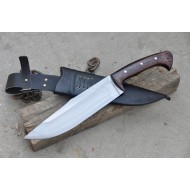
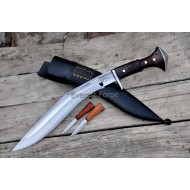
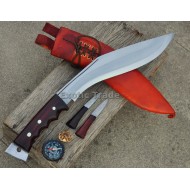
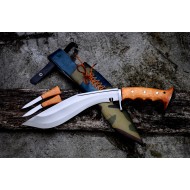
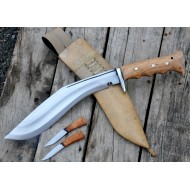
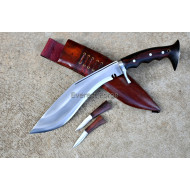
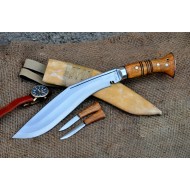
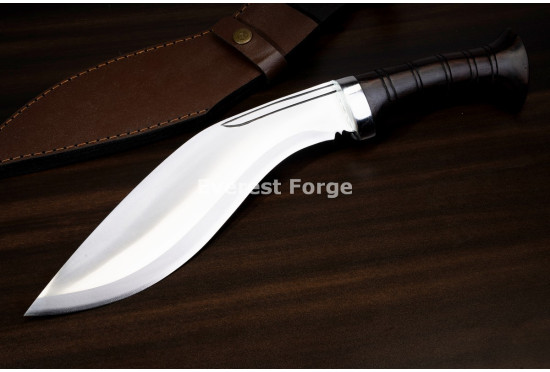
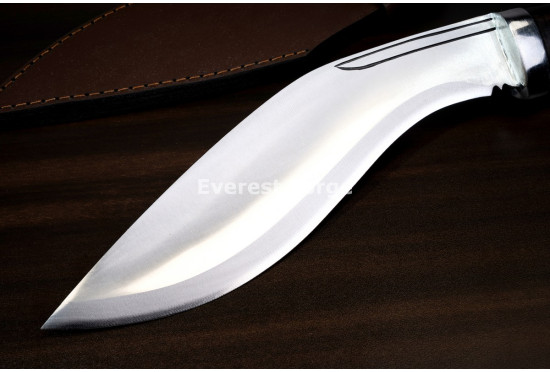
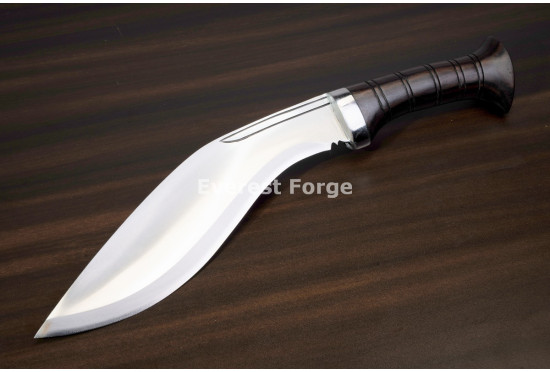
A bhojpure is a village pattern from eastern Nepal, and it is the pattern most people picture when they picture a kukri: a broad blade with the widest part of the belly carried well forward, a heavy forward curve, and thick stock through the spine. This one is a 10 inch blade hand-forged from 5160 high-carbon steel, oil-quenched and tempered, with a hand-cut cho at the base, a short fuller at the forte, a ringed rosewood grip pinned through a full tang, and a brown leather belt sheath. It is sharpened, it is not a wall-hanger, and it is built to be swung at wood.
What separates it from the rest of the range is mass rather than length. The blade alone weighs 570 grams over 10 inches. That is 57 grams per inch of blade — the same figure our 13 inch chirra kukri carries, and within the band our 12 inch choppers occupy. A shorter blade normally carries less mass per inch of length, because it is smaller in every dimension and not only in reach. When a 10 inch blade matches a 13 inch blade for density, the cross-section is genuinely stouter. That is the whole argument for this piece, and it is a measurement rather than an adjective.
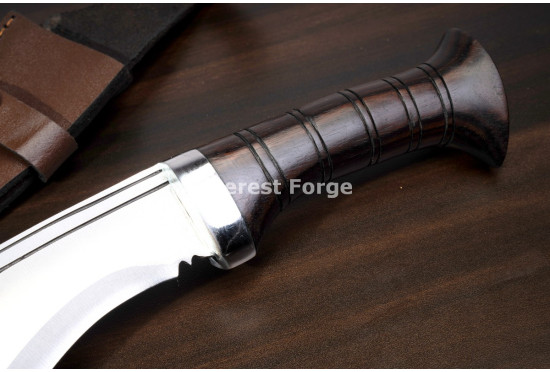
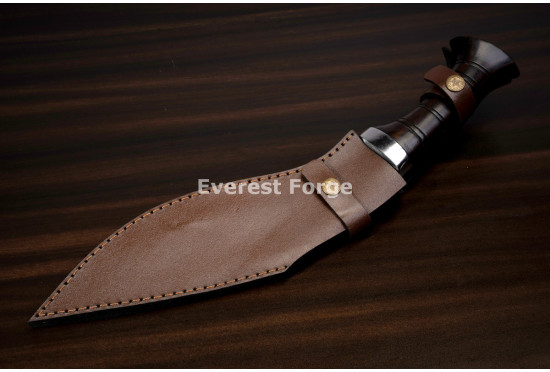
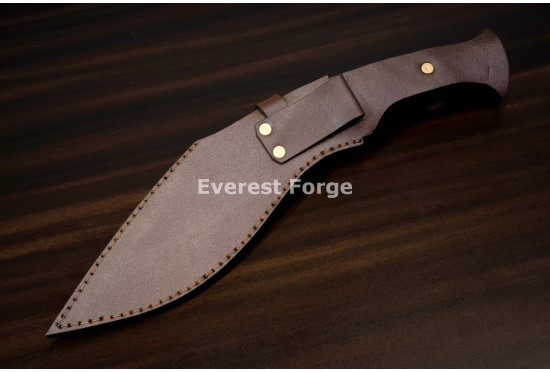
An honest note. This kukri is traditional in its blade and its hilt and modern in the way it is carried. The blade profile, the hand-cut cho, the short fuller and the ringed rosewood grip with its flared butt and fitted steel bolster are all village work, made the way they are made in Nepal. The sheath is not: it is a flat brown leather belt sheath with brass studs, machine-stitched, with no wooden-cored dap and no companion pockets. It carries no karda and no chakmak. We have not called this a fully traditional kukri for that reason, and if you want the traditional dap with karda and chakmak fitted, we will make one — ask before you order and we will quote it. We would rather tell you what this is than let a photograph do the arguing.
Want This Pattern Built to Your Own Dimensions?
Longer blade, thicker stock, a traditional dap with karda and chakmak, a different grip material or your own drawing entirely. Our smiths in Kathmandu forge to specification and quote before any work begins.
Start a Custom BuildWhy This Blade Chops Above Its Length
Standard Build and Specifications
Blade length, blade finish and grip material are selectable, so the figures above describe the standard build rather than every version of this kukri. Because each piece is forged and ground by hand, weights and dimensions vary slightly between examples. Spine thickness at the bolster and blade width at the widest point can be measured on your actual piece before dispatch if those numbers matter to you — ask and we will send them.
Build Options
Bhojpure or Sirupate: Which Pattern Suits You
Choose the Bhojpure If
- You want a kukri that chops — firewood, green limbs, brush, camp work
- You want mass ahead of your hand doing the work for you
- You want a shorter overall length that still hits hard
- You want the pattern most people mean when they say kukri
- You are comfortable carrying a heavier blade for its size
Look Elsewhere If
- You want a light blade for slicing and detail work — a sirupate is narrow and fast, and this is the opposite of that
- You want the full traditional kit as supplied — this ships without karda, chakmak or dap
- You want maximum reach — a 12 or 13 inch blade gives you more of it
- You want a display piece — this is finished as a tool
How to Order
Who This Kukri Is For
- Woodsmen and campers who want one blade that clears, splits kindling and processes firewood without carrying an axe
- Collectors of Nepali village patterns who want a bhojpure rather than a generic curved knife sold as one
- Smallholders and gardeners cutting back growth that a machete skips off and a saw is too slow for
- Buyers who have owned a light kukri and found it wanting when the wood got thick
- Anyone who wants a working tool from a forge in Nepal rather than a factory reproduction of one
What Is Included
- One hand-forged bhojpure kukri, sharpened and ready to use
- Brown leather belt sheath with retaining strap
- Everest Forge manufacturer warranty
- Care instructions
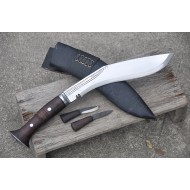
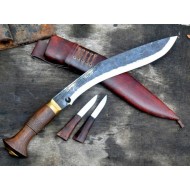
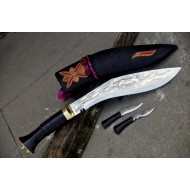
No karda and no chakmak are supplied with this kukri, and the sheath has no pockets for them. That is a deliberate choice rather than an omission: this is a working belt kukri and it is built as one. If you want the companions, we make the traditional dap to hold them — ask and we will quote.
More From the Everest Forge Collection
Shipping, Returns and Care
Stock builds dispatch from our workshop within 2-3 business days. Custom and made-to-order builds take 4-6 weeks from confirmation, and we photograph the finished piece before it leaves us. We ship worldwide with DHL and FedEx, fully tracked, typically 7-14 business days in transit. Every blade carries the Everest Forge manufacturer warranty against defects in forging and construction.
Blade laws vary by country, state and province and it is the buyer's responsibility to check local restrictions before ordering. We cannot advise on your jurisdiction and we cannot refund a blade seized in transit.
5160 is a high-carbon steel and it will rust if you let it. Wipe the blade dry after use, keep it lightly oiled when stored, and do not leave it in the sheath for long periods in a damp climate — leather holds moisture against steel. Sharpen with a stone or a file rather than a powered grinder, which will draw the temper out of an edge faster than you expect.
Forged by Hand, Not Assembled
Every blade we sell is forged, ground, heat-treated and fitted by our own smiths in Kathmandu. If you want something we do not list, we will make it.
Talk to Our SmithsFrequently Asked Questions
What actually makes a kukri a bhojpure?
Bhojpur is a district in eastern Nepal, and the pattern carries its name because that is where it was made and traded. The diagnostic features are geometric rather than decorative: a broad blade, the widest point of the belly carried well forward, a pronounced forward curve, and thick stock through the spine. Set it beside a sirupate — the slim, narrow pattern named after a blade of grass — and the difference is obvious at a glance. A bhojpure is built to move mass through wood. A sirupate is built to move quickly. Both are traditional, both are Nepali, and they are not interchangeable. Most sellers outside Nepal never name the pattern at all and simply call everything a kukri, which is a bit like selling every European sword as a sword.
How can a 10 inch blade weigh as much as a longer one?
By being thicker and broader in section. Blade weight divided by blade length is the most honest single number for a chopper, and it is a number almost no seller publishes. This blade is 570 grams over 10 inches, which is 57 grams per inch. Our 13 inch chirra kukri is 740 grams over 13 inches, which is 56.9 grams per inch. Those are effectively identical, and that is the point: a shorter blade should normally be less dense per inch, because it is smaller in every dimension rather than only shorter. Matching a blade three inches longer for density means this one carries genuinely heavier stock. In the hand it feels like a bigger kukri that somebody cut three inches off, which is a fair description of what it is.
Why does this one have no karda and chakmak?
Because it is a belt kukri rather than a full traditional kit. The karda is the small utility knife and the chakmak is the blunt burnisher used to straighten and true an edge; both ride in fitted pockets on the dap, the wooden-cored traditional scabbard. This kukri ships in a flat leather belt sheath with no pockets, so there is nowhere for them to sit and nothing missing from a set that was never assembled as one. If you want the traditional arrangement we make it — the dap, the karda and the chakmak, quoted with the kukri. Ask before you order rather than after, because fitting a dap to a finished blade means measuring it twice.
Is this a traditional kukri or a modern one?
Traditional in the blade and hilt, modern in the carry. On a kukri, the question of tradition is settled by the handle and the sheath rather than by the blade, because almost every kukri blade shape in production is a traditional one. This piece has a traditional grip: ringed rosewood with a flared butt and a fitted steel bolster, turned the way village smiths turn them. The sheath is where it departs — flat brown leather, stitched, brass-studded, with a belt loop, rather than a wooden-cored dap with companion pockets. We think that is the right compromise for someone who wants to carry and use it, but we are not going to describe it as a fully traditional kukri when half of it is not.
What is the notch at the base of the blade for?
That is the cho, sometimes written kaudi. It is the diagnostic mark of a genuine kukri and it carries both a practical and a cultural role. Practically, it terminates the edge in a rounded cut rather than letting the edge run straight into the bolster, so a crack starting at the edge has somewhere to stop instead of running back into the tang. Culturally it carries religious meaning that different communities in Nepal read differently. Ours are cut individually by hand, which is why no two are quite identical. If a curved knife has no cho, it did not come from this tradition, whatever the listing calls it — and we apply that test in both directions rather than only when it suits us.
How does this compare to your 13 inch chirra kukri?
Different jobs. The chirra kukri is longer at 13 inches, carries a single broad chirra ground down the length of the blade, has the forward section of its spine sharpened, and wears a black horn hilt on a laced sheath with a shoulder harness. It reaches further and it will thrust, and the back edge brings legal considerations with it in some jurisdictions. This bhojpure is shorter, plainer and denser, with a plain spine, a belt sheath and a rosewood grip. If you want reach and a working point, take the chirra. If you want the shortest blade that still chops properly and the simplest legal position, take this one.
Will it split firewood?
Yes, within reason. The forward mass and the thick section make it a genuine splitter for kindling and for rounds up to roughly wrist thickness, which is most of what a camp fire needs. Beyond that you want an axe, and no kukri of any length changes that. Baton it if you need to — strike the spine with a wooden billet, not a steel hammer, and strike over the thick section near the middle of the blade rather than out near the point. The spine here is plain and flat along its whole length, so there is nothing on it to damage a baton or your hand.
What is the groove near the handle?
A short fuller ground into the flat at the forte, with a scribed line above it. It sits in the part of the blade closest to your hand, which is the section doing the least cutting, and removing a little material there shifts the balance very slightly forward without touching the working belly. On a blade of this weight the effect is small and largely traditional — village smiths have ground grooves at the forte for generations. It is not a blood groove; there is no such thing, and any seller who tells you a groove breaks suction is repeating a myth that has never had a factual basis.
What steel is it, and how hard?
5160 high-carbon spring steel, oil-quenched and tempered. It is the same family of steel that leaf springs are made from, which is where the Nepali tradition of forging kukris from vehicle springs comes from, and it is chosen for toughness rather than for the highest possible hardness. A chopper that is too hard chips at the edge when it meets a knot; 5160 at a working temper rolls slightly instead, and a rolled edge can be steeled or stoned back. The trade-off is that it needs sharpening a little more often than a harder, more brittle steel would — which is the right trade for a tool you swing.
How do the rings on the grip help?
They are an index and a stop rather than decoration. A kukri should be held loosely, because gripping a chopper tightly transmits shock into your hand and wrist and tires you quickly. A loose grip needs something to stop the hand travelling forward on a hard downstroke, and that job is done by the flared butt behind the hand and the turned rings under it. Together they let you hold the kukri lightly and still keep it where it belongs. It is a solution village smiths arrived at long before anyone was designing ergonomic handles, and it works better than most of what has replaced it.
Is it sharp when it arrives?
Yes. It leaves us sharpened and ready to work. Kukri edges are ground with a convex bevel rather than a flat one, which is stronger at the edge and better suited to impact, and it also means you should sharpen it with a stone worked in small circles or with a file rather than dragging it through a fixed-angle pull-through sharpener, which will grind a flat bevel into a convex edge and undo it. Keep the edge oiled, keep it out of the sheath for long storage, and it will hold up for years.
Can I have this pattern in a different size?
Yes. The bhojpure profile scales well and we forge it from small belt sizes up to two-handed choppers. Tell us the blade length you want and we will tell you honestly whether the pattern holds at that size before we quote — a bhojpure ground too thin for its length stops being a bhojpure and becomes a heavy machete, and we will say so rather than take the order. Grip material, finish, engraving and the traditional dap with karda and chakmak can all be specified at the same time.
| Specification | |
| Blade: | 10 inches. Hand forged from 5160 carbon steel |
| Total Length: | 15.5 inches |
| Handle: | 5.5 inches, full tang, ringed rosewood with flared butt and fitted steel bolster |
| Weight: | Approx. 570 g blade, approx. 800 g total |
| Note: | As each piece is hand forged, slight variation in weight, dimensions and finish may occur. Keep the blade lightly oiled when not in use. |