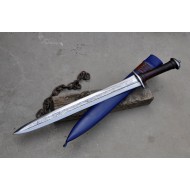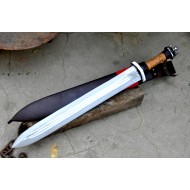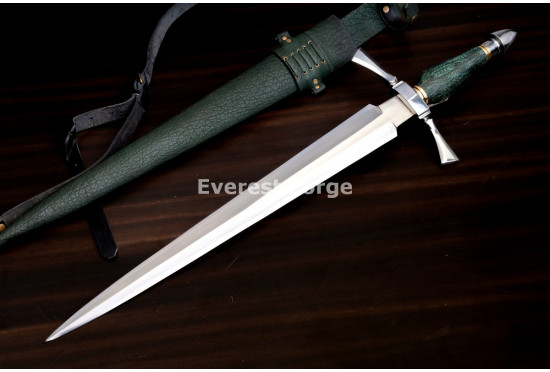
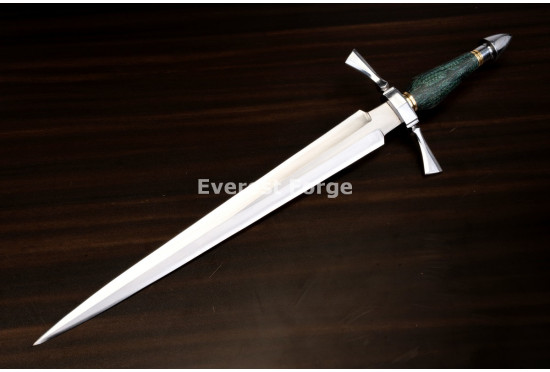
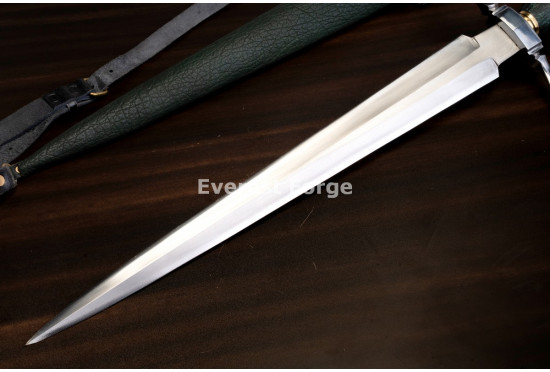
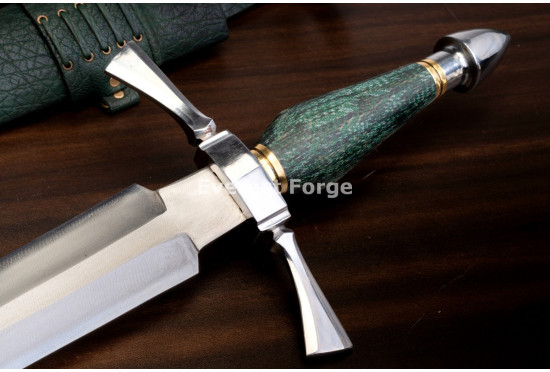


- Model: Viking sword
- Product Code: ARMINGM002
- Location: Kathmandu,Nepal
Available Options
A Hand-Forged Arming Sword With Trumpet Quillons
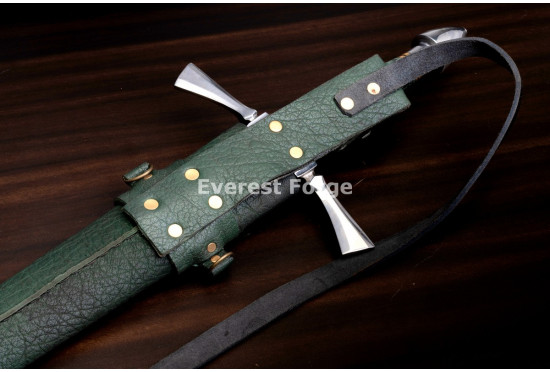
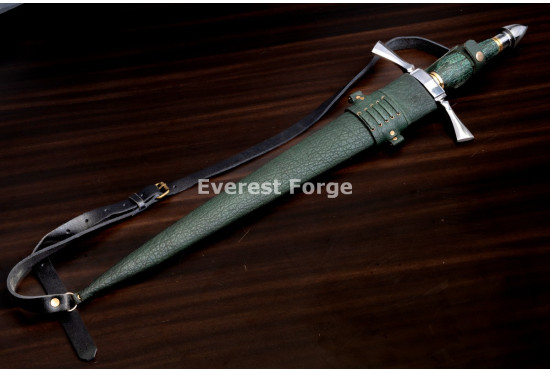
This is a hand-forged arming sword with a broad double-edged blade, a cross carrying flared trumpet-shaped quillon terminals, a green micarta grip and a polished steel cone pommel, forged from 5160 high-carbon spring steel in our workshop in Tokha-3, Kathmandu. It comes with a leather scabbard dyed to match the grip, on a leather belt. Nothing is held in stock and nothing here is fixed: the sword is forged after your order arrives, so the dimensions, the stock thickness, the grip material and the furniture are all yours to set at no extra cost. The figures in the specifications are the standard build.
The blade is the serious part. It runs in a long straight taper from a broad base to a very acute point, with the section kept thick behind the tip rather than thinned away for looks, and a squared unsharpened ricasso sits above the cross. That profile is close to what Oakeshott classed as a Type XV, the stiff straight-tapering blade that appeared when armour got good enough that cutting at it stopped working and the answer became driving a point into the gaps.
The hilt is where the design departs from history and does so deliberately. Trumpet-flared quillon terminals, a faceted steel block above the blade, brass collars and a cone pommel are a modern arrangement rather than a medieval one, and the green micarta grip is a material no medieval smith had. It is an original sword in a late medieval idiom, and the page below is careful about which parts are which.
An honest note. The important one first: this sword is heavy. The standard build is 1,540 grams over a 22 inch blade, which is 70 grams per inch of blade. For context, that is the figure we see on our heavy kukris, which are thick-stock chopping tools, and a historical single-handed sword of this blade length would run around 700 to 900 grams. You are holding roughly twice the mass on a 5 inch grip. It is superbly robust and it is tiring to use. We will build it from thinner stock with more distal taper at no extra cost, and for anyone who means to swing it rather than hang it, that is the build we would recommend. Two smaller things: the ricasso is a later feature than the arming sword proper, and this is not a reproduction of any documented sword.
Why It Is Built This Way
Full Specifications
Figures are taken from the sword shown and describe the standard build. Hand-forged work varies a little from piece to piece, so read these as close rather than exact. If a dimension matters, tell us before we start and we will build to it and measure the finished sword for you.
Build It Your Way
None of this costs extra, because none of it is made before you ask for it. Work down these six and put what you want in the order note.
Ask for the lighter build
The standard blade is cut from thick stock, which is why it weighs what it does. Thinner stock with increased distal taper takes a great deal of that weight out, brings the balance in toward the hand, and makes the sword handle like the historical article rather than merely outlast it. It costs nothing and adds no time. If you intend to use this sword rather than display it, say so and we will build it that way.
Talk to the Forge →What It Does Well, and What It Does Not
What it does well
- A thrusting point built properly: straight taper, thick section behind the tip, and none of the early thinning that ruins cheap swords of this shape.
- Forged hilt furniture rather than castings, on a design where the quillon terminals are the first thing anyone looks at.
- A ricasso that gives you somewhere safe to put a finger, which genuinely improves control on a point-oriented blade.
- A grip material that ignores humidity entirely, on a sword that will otherwise spend its life on a wall in whatever climate you have.
- Extremely robust. At this stock thickness it will survive treatment that would end a historical original.
- Everything configurable at no extra cost, including the thinner, lighter build we would actually recommend for use.
What it does not do
- It is heavy. 70 grams per inch of blade is a kukri chopper figure, not a sword figure, and the standard build is roughly twice the mass of a historical single-hander of the same blade length.
- That weight sits on a 5 inch single-hand grip. Fine to hold and display; tiring quickly if you do anything sustained with it.
- It is not a reproduction. The blade profile is close to an Oakeshott Type XV but the proportions, the ricasso and the hilt furniture are modern design.
- The ricasso is not a medieval arming sword feature. It belongs to later swords, and a purist will notice.
- Micarta is a synthetic. Excellent material, but if you want an all-natural historical-idiom sword, order timber or horn instead.
- It is not stainless. 5160 rusts if left wet and wants an occasional wipe of oil.
How to Order
Who It Is For
- Collectors who want a striking cruciform sword with forged furniture and would rather be told what is historical and what is design.
- Fantasy and film-inspired buyers after something with real presence that is nonetheless made from proper steel by people who make weapons for a living.
- Buyers who want a matched set — grip and scabbard in the same colour — which is harder to find than it should be.
- Stage combat and theatrical armourers, who can order this design rebated and round-tipped at no extra cost.
- Anyone who has been put off by wall-hanger swords with folding points and cast fittings.
- Anyone who intends to actually use it — with the strong recommendation that you order the thinner, lighter build.
What Is Included
- The sword, hand-forged in Tokha-3, Kathmandu, Nepal.
- A leather scabbard dyed to match the grip, with a riveted throat and brass rivets.
- A leather belt.
- A protective coat of oil on the blade for transit, wiped off before handling.
- Care instructions, and the Everest Forge manufacturer warranty against defects in materials and workmanship.
Want a documented sword instead?
A true Oakeshott Type XV built from a museum reference, a Type XII with a wheel pommel, an arming sword at proper 30 inch proportions with period mass, or something out of your own drawing. We work from your reference and quote before anything goes on the fire.
Start a Custom Forge Request →Related Blades and Reading
Shipping, Returns and Care
Dispatch and transit. Standard builds leave the workshop in 2 to 3 business days. Genuinely custom work — thinner stock, a longer blade, different furniture — runs 4 to 6 weeks depending on the queue. We ship by DHL or FedEx with tracking, typically 7 to 14 business days from Kathmandu, sheathed and braced with the belt packed separately so nothing bears on the blade.
Duties, import and edge law. Import duty and local taxes are the buyer's responsibility and vary by country. Swords are regulated differently in different places and are treated more strictly than knives almost everywhere. Please check what applies where you live before ordering. If an unsharpened build would make the difference, we will supply one at no extra cost.
Returns and warranty. Because every sword is forged after the order, a custom build cannot be restocked, so please make sure the specification is right before you confirm. Anything damaged in transit, or showing a defect in materials or workmanship, is covered by the Everest Forge manufacturer warranty and we will repair or replace it. Photograph the packaging as well as the sword if something has gone wrong on the way.
Care. 5160 is a high-carbon steel and it is not stainless. Wipe the transit oil off before handling and put a light film back on before the sword goes away. Fingerprints are acidic and will etch a polished blade if left for weeks. Pay attention to the angles of the ricasso and the inside faces of the quillon terminals, which a cloth drawn along the flat never properly reaches. Do not store the sword in the scabbard for long periods: leather holds moisture against steel. Light surface rust comes off with oil and fine steel wool; nothing abrasive on a polished finish. The micarta grip needs nothing at all beyond a wipe, which is rather the point of it.
Questions About This Sword
What is this sword?
A fantasy arming sword in a late medieval idiom. Broad double-edged blade running in a long straight taper to an acute point, a squared unsharpened ricasso at the base, a cross with flared trumpet-shaped quillon terminals, a faceted block above the blade, a brass collar and a polished cone pommel. It comes with a matching leather scabbard on a belt.
It is not a reproduction of a documented type and we will not pretend otherwise. The blade profile is close to what Oakeshott classed as a Type XV — broad at the base, straight-tapering, built around the thrust rather than the cut — but the proportions, the ricasso and the hilt furniture are a modern design. An original sword in a historical idiom, which is a perfectly good thing to be provided nobody sells it as older than it is.
Why does it weigh 1,540 grams, and can you build it lighter?
Because the blade is cut from thick stock, and this is the single most important thing to know before you order. The standard build is 1,540 grams over a 22 inch blade, which works out at 70 grams for every inch of blade. A historical single-handed sword of the same blade length would run somewhere around 700 to 900 grams. We are at roughly twice that.
For scale, 70 grams per inch is the figure we see on our heavy kukris — thick-stock chopping tools, not swords. So this is a very robust sword that will shrug off abuse no historical original would survive, and it is a genuinely heavy thing to hold on the end of a 5 inch grip. YES, WE CAN BUILD IT LIGHTER, at no extra cost: ask for thinner stock and increased distal taper and we will take a large amount of that weight out. If you want a sword that handles like a historical arming sword rather than one that outlasts one, order it that way and say so in the order note.
Is it one-handed or two-handed?
One-handed by design — the grip is 5 inches, which is a single-hand grip and will not comfortably take two. But you should know that 1,540 grams is a lot to carry on one hand. Historical single-handers sit near 1,100 to 1,300 grams with blades a third longer than this one, and they feel light because the mass is spread over more length and less thickness.
In practice: fine to pick up, handle and hold for photographs and display; tiring quickly if you are doing anything sustained with it. If you intend to swing it seriously, either order the lighter build described above or ask us to lengthen the grip so you can crowd the pommel with the off hand. Both are free.
What is the unsharpened section at the base of the blade for?
That is a ricasso, and it exists so there is somewhere safe to put a finger or a hand. Hooking the index finger over the quillon gives far better point control on a thrusting blade, and a ricasso means you are doing that against blunt steel rather than an edge. On longer swords the same idea extends to gripping the blade outright to shorten the weapon in a bind.
Worth saying that it is not an arming sword feature historically. Ricassos belong to later swords — the cinquedea, bastard swords, rapiers — and a true medieval arming sword is sharpened right up to the cross. It is here because it suits the design, and it is genuinely useful. Our Swiss sabre page covers the other half of that problem, which is protecting the finger you have just put outside the guard.
Is the point built for thrusting?
Yes, and it is the clearest thing about the blade. The taper runs in a straight line from a broad base to a very acute point rather than curving in near the tip, and the section stays thick behind the point instead of thinning early. That is the geometry of a sword meant to be driven into something, and it is why the profile reads as a Type XV.
The practical consequence is a point that will not fold on contact, which is exactly what you want on a thrusting sword and exactly what cheap swords of this shape get wrong. The edges cut too, but the point is the argument.
What is the grip made of?
Green micarta as standard, with a brass collar at each end, a faceted steel block below and a polished cone pommel above. Micarta is a resin laminate: dimensionally stable, completely indifferent to humidity, and it grips better wet than dry, which is more than can be said for polished timber.
It is a synthetic, and some collectors want only natural materials on a historical-idiom sword. If that is you, rosewood, horn, bone and leather over timber are all available at no extra cost. Micarta comes in other colours too, and the scabbard is dyed to match whichever you choose.
What size is it, and can I change it?
The standard build carries a 22 inch blade, a 9 inch hilt with a 5 inch grip, 31 inches overall. That is a default rather than a fixed specification — every blade we make is forged after the order, so the dimensions are yours to set.
The two changes worth considering on this design are a longer blade, which pushes it toward full arming sword proportions of 28 to 32 inches, and a longer grip, which lets the off hand crowd the pommel and makes the weight far more manageable. Neither costs extra. Put the numbers in the order note.
Does it arrive sharp?
Yes, both edges sharpened and the point finished, unless you tell us otherwise. The ricasso is left blunt by design, which is the whole point of it.
Unsharpened builds are free, for display or for an awkward import. So is a stage combat build — rebated edge, rounded tip — balanced for the work. Add that exact wording to your order note if it is what you want.
What steel is it, and how is it heat treated?
5160 high-carbon spring steel, which we use across the whole range. The blade is forged to shape, quenched, and then tempered back by hand as a separate operation afterwards. Those two steps are distinct, and the second is what matters: quenching alone leaves a blade hard and brittle, and tempering trades a little hardness for the toughness that keeps an acute point in one piece.
5160 is not stainless and is not meant to be. It rusts if left damp, and in exchange it takes and keeps an edge far better than any stainless we could sensibly forge. We do not make pattern-welded or laminated blades at all, by choice.
Where does it balance?
Further back than the weight might suggest. A short thick blade with a substantial steel block at the base and a solid cone pommel behind it puts a lot of mass close to the hand, which is the one mercy of a build this heavy — it is not a sword that hangs out in front of you.
We do not publish a single point-of-balance figure, because hand-forged blades vary and a number two inches out is worse than none. Ask before dispatch and we will measure the actual sword we are sending you, from the cross, and send you the figure. Our sword guide explains what the measurement means and why it is worth asking any seller for.
What comes with it, and can the scabbard be a different colour?
A leather scabbard dyed to match the grip, with a riveted throat section and a leather belt. The rivets are brass and set in a pattern rather than just where the stitching needed help.
Colour is yours. The standard build pairs a green grip with a green scabbard, and we will match whatever grip material and colour you choose. If you want a contrasting scabbard, a different belt arrangement, or a wall mount cut to this blade's profile, those are custom forge items and we will quote them.
How long does it take, and how is it shipped?
Nothing is held in stock. Every blade is forged after the order arrives, which is why the dimensions, the stock thickness, the grip material and the edge specification are all free to change — there is no standard version already made. Standard builds dispatch in 2 to 3 business days; genuinely custom work runs 4 to 6 weeks depending on the queue.
The sword ships sheathed and braced in a rigid carton with the belt packed separately so nothing bears on the blade, by DHL or FedEx with tracking, typically 7 to 14 business days from Kathmandu. Import duty and local taxes are the buyer's responsibility and vary by country.
| Specification | |
| Blade: | 22 inches. Hand forged from 5160 carbon steel |
| Total Length: | 31 inches |
| Handle: | 9 inches. Full tang, 5 inch green micarta grip, steel cross and cone pommel |
| Weight: | 1540 grams the sword, 1920 grams with the scabbard |
| Note: | Handmade variation in weight, dimensions and finish may occur. Keep blade lightly oiled when not in use. |