Pick up a spear and you're holding the oldest purpose-built weapon in human history. Before the sword, before the axe, before the bow — there was the spear. But not all spears are the same. And the difference that matters most isn't the length of the shaft or the shape of the head. It's the intent behind the design.
The Core Distinction: Control vs Release
At the most basic level, the difference comes down to one moment in combat: do you hold on or do you let go?
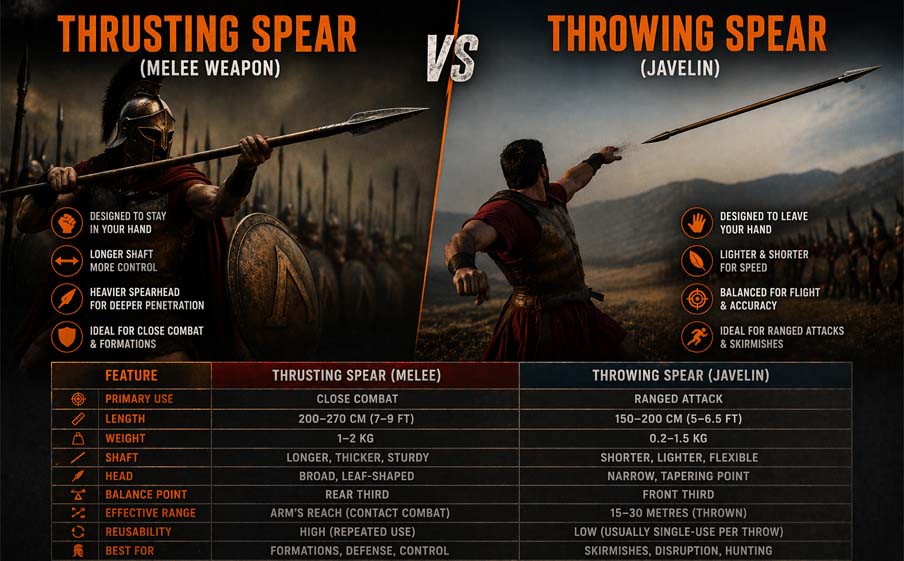
A thrusting spear — sometimes called a melee spear or a pole weapon — is designed to stay in your hands. You use it to jab, push, control distance, and keep your enemy at range. The shaft is long and substantial, built to absorb the shock of repeated thrusts and blocks. The head is broad enough to cause serious damage, but doesn't need to be aerodynamic, because it's never going to fly through the air.
A throwing spear — commonly called a javelin — is designed to leave your hand. Its entire construction is optimised for one moment: the release. After that moment, the weapon belongs to physics. The shaft needs to be light enough to travel, the balance point precise enough to keep the tip forward, and the head sharp enough to penetrate on impact even as velocity bleeds away over distance.
These two requirements — sustained melee performance vs ballistic efficiency — pull weapon design in completely opposite directions. That's why, despite looking similar at a glance, a war spear and a javelin are as different in construction as a crowbar and an arrow.
Design Differences: What the Weapon Is Built For
Length and Shaft Weight
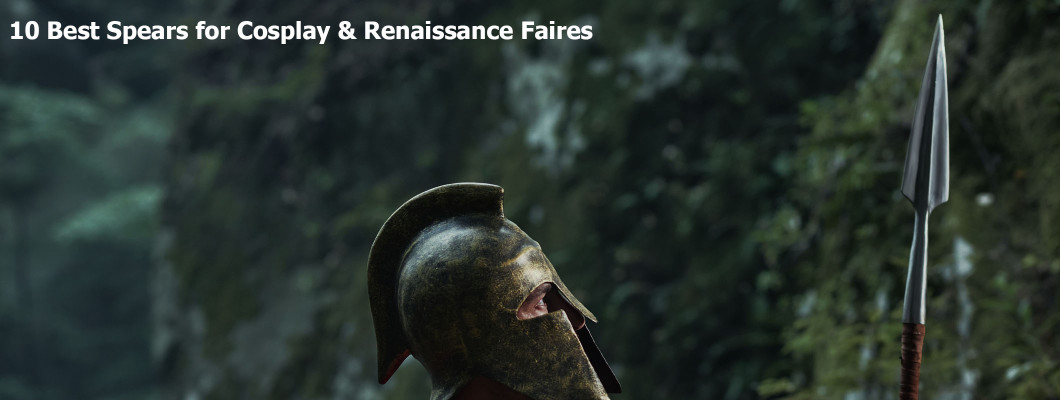
Thrusting spears were built long and stiff. The Greek dory — the standard infantry spear of the hoplite phalanx — ran between 210 and 270 centimetres (roughly 7 to 9 feet). The shaft was made of cornel wood, chosen for its density and resistance to splitting under impact. The weight was distributed to give the user leverage and control in close quarters, where the spear is essentially a lever being driven into another person.
Javelins were shorter and significantly lighter. A typical Greek javelin weighed around 200 to 400 grams — less than half the weight of a war spear. That reduction wasn't about saving material. It was about giving the thrower the ability to generate speed. The faster the release, the more kinetic energy the javelin carries. Every gram removed from the shaft translates directly into additional range and penetrating power on impact.
The Spearhead
Thrusting spear heads are typically broad and leaf-shaped, designed to create a wide wound channel on a driven thrust. When you're driving a weapon into a body with the full force of your torso behind it, a wider head does more damage. The head doesn't need to be perfectly balanced — it just needs to be sharp and strong.
Javelin heads tell a different story. They are usually smaller and narrower, designed to maintain a stable flight path and concentrate force at a single point on impact. A broad head creates drag. A narrow, tapering point cuts through the air cleanly and hits with focused, penetrating force. The Roman pilum — arguably the most engineered throwing spear ever produced — used a long iron shank with a small pyramidal tip specifically designed to punch through shields and armour at throwing range.
Balance Point
In a thrusting spear, the balance point sits closer to the rear third of the weapon. This gives the wielder control and leverage — you can redirect the tip quickly, recover from a missed thrust, and use the butt of the spear as a secondary weapon.
In a javelin, the balance point sits closer to the front — sometimes as far forward as the front third of the shaft. This front-weighted design causes the tip to naturally rotate downward in flight, keeping it on a collision course with the target. Throwing a javelin with the balance point in the wrong place is like throwing a dart backwards — it tumbles and arrives sideways instead of point-first.
Side-by-Side Comparison
| Feature | Thrusting Spear (Melee) | Throwing Spear (Javelin) |
|---|---|---|
| Primary use | Melee combat — held and driven | Ranged attack — thrown and released |
| Typical length | 200–270 cm (7–9 ft) | 150–200 cm (5–6.5 ft) |
| Typical weight | 1–2 kg | 0.2–1.5 kg |
| Shaft material | Dense hardwood (cornel, ash) | Lightweight wood or hollow shaft |
| Head shape | Broad, leaf-shaped | Narrow, tapering point |
| Balance point | Rear third of shaft | Forward third of shaft |
| Effective range | Arm's reach (contact combat) | 15–30 metres when thrown |
| Shield-breaking? | Penetrates on driven thrust | Purpose-designed (pilum bends on impact) |
| Historical examples | Greek dory, Zulu iklwa | Roman pilum, Greek akontia |
History: How Each Type Shaped Warfare
The Thrusting Spear and the Phalanx
The most famous use of the thrusting spear in history was the Greek phalanx — a formation of overlapping shields and extended spears that transformed warfare in the ancient Mediterranean. Greek hoplites carried the dory in their right hand, pushing it over the rim of the shield beside them. In formation, each man's spear projected past the shields of the soldiers in front, creating a wall of points that was nearly impossible to charge into directly.
The key to the phalanx was that nobody dropped their spear. The thrusting spear was a permanent presence in the fighter's hand — controlling distance, preventing enemy advances, and delivering killing thrusts when gaps appeared. Letting go of it would have broken the formation and left the soldier defenceless at close range.
The Javelin and the Roman Legion
The Romans took a completely different approach. Their standard legionary infantry — the hastati and principes — were built around the pilum: a heavy throwing javelin with a long iron shank and a small pyramidal tip.
The Roman battle sequence was deliberate and devastating. As two armies closed to around 15–30 metres apart, the front ranks hurled their pila in a massed volley. The pyramidal tip punched through wooden shields, and the long iron shank was intentionally left unhardened — so it would bend on impact. A pilum wedged in a shield couldn't be pulled out cleanly. Soldiers either had to fight on carrying the dead weight of a bent spear in their shield, or throw the shield aside entirely.
Then the gladius came out. With enemy shields compromised or discarded, the Romans had already won the opening exchange before swords had even been drawn. The pilum wasn't just a throwing spear — it was a shield-destroying device that set up the killing blow.
Cultures That Used Both
Many warrior cultures understood that the two types were complementary rather than competing. Greek soldiers often carried both — the dory for melee and lighter javelins (akontia) for throwing. Zulu warriors similarly carried multiple light throwing spears (izijula) for ranging, before closing with the short, heavy iklwa thrusting spear. Shaka kaSenzangakhona reportedly insisted on the iklwa over javelins precisely because it forced decisive, lethal close-quarters combat rather than ranged skirmishing.
Why the Design Can't Be Reversed
Here's the practical reality ancient smiths understood and modern collectors sometimes miss: you cannot use a thrusting spear effectively as a javelin, and you cannot use a javelin effectively as a thrusting spear.
Throw a war spear and you'll find it's too heavy to reach useful range, too rear-weighted to fly accurately, and too valuable to surrender mid-battle. Use a javelin for close-quarters thrusting and you'll find it lacks the structural rigidity to absorb repeated impact, the shaft weight to generate leverage, and often the blade width to cause meaningful wounds on a driven thrust.
The weapons look alike. Their physics are almost entirely opposed.
What This Means for Collectors and Craftsmen Today
If you're building a collection, commissioning a custom spear, or simply trying to understand what you're looking at — the thrusting vs throwing distinction is the first question to answer.
A hunting spear built for real field use should be designed around thrusting principles: a robust shaft, a broad blade, and a balance point that gives you control at close range.
A replica javelin — such as a recreation of a Roman pilum — should reflect throwing design: lighter shaft, narrower tip, forward balance. It will feel wrong in your hand if you try to use it like a war spear, because it was never meant to work that way.
A spear built for historical reenactment depends on which role you're filling. A hoplite carries a dory. A Roman velites-style light infantryman carries javelins. Getting the weapon wrong means getting the history wrong.
Hand-Forged Spears by Everest Forge
Every spear we make is built with a specific purpose in mind — hunting, historical replica, or a fully custom design forged to your specifications. Our Kami blacksmiths in Kathmandu hand-forge each piece from 5160 high-carbon steel.
Final Word
The spear is the oldest weapon on earth. It has outlasted empires, reinvented itself across a thousand cultures, and still exists today in the form of the bayonet fixed to a rifle barrel. That longevity doesn't come from simplicity — it comes from how well its designers understood the physics of violence and the geometry of combat.
The thrusting spear and the throwing spear are not two versions of the same idea. They are two different answers to the same question: how do I put a point into something from as safe a distance as possible? One answer is reach. The other is release. Both are correct. Both are profound.
And both, when forged by hand from real steel, are still among the most satisfying objects a person can hold.