Looking for a hand-forged LOTR blade? Everest Forge forges Barrow-blades, Boromir's sword and dagger, and Tauriel's dagger from 5160 spring steel in Kathmandu, Nepal. Browse the full Middle-earth collection or request a custom forge.
The Lord of the Rings saga is a timeless masterpiece of myth, heroism, and destiny. Set in the vast world of Middle-earth, it tells stories of ordinary beings rising to extraordinary challenges. Among the symbols that define this world, none are as iconic as its swords. These blades — from the humble Barrow-blades wielded by hobbits to the grand sword of Boromir — represent the heart of Tolkien's imagination. They are more than forged metal; they are living symbols of courage, sacrifice, and identity.
In Tolkien's vision, a sword is not just a tool of war but a sacred relic of heritage. Each weapon carries with it a history that binds past to present — a reminder of the ancient battles fought for peace and honour. The Lord of the Rings swords embody the essence of heroism, linking their wielders to the larger destiny of the world. For fans and historians alike, these weapons reveal the craftsmanship, culture, and symbolism that make The Lord of the Rings a living legend.
The Symbolism of Swords in Middle-earth
In Middle-earth, swords are more than instruments of defence. They are conduits of power, legacy, and morality. The reforging of Narsil into Andúril, "Flame of the West," marks not just the restoration of a blade but the rebirth of a king's courage. When Aragorn wields it, he carries the weight of his ancestors and the hope of the free peoples. Likewise, when the hobbits receive their ancient blades in the Barrow-downs, it signifies their transformation from travellers to heroes. Through their swords, they inherit not only strength but responsibility.
Tolkien's understanding of myth and medieval lore deeply influenced his approach to weapon symbolism. In ancient Anglo-Saxon and Norse cultures, a sword was believed to have a soul. It bore a name, an identity, and often, a fate intertwined with its master. This concept flows through Tolkien's storytelling. A sword's power comes not from its sharpness but from the heart of the one who wields it. When Frodo, Sam, Merry, and Pippin receive their blades, they are being entrusted with the legacy of Westernesse — the forgotten kingdom that once battled the shadows of Angmar.
In The Lord of the Rings, every major sword mirrors its owner's journey. The Barrow-blades reflect the awakening courage of the hobbits. Andúril represents the restoration of true kingship. Boromir's sword, proud and unyielding, symbolizes the strength and tragedy of mankind. Each of these weapons tells a part of Tolkien's grand theme — that true power lies not in domination, but in duty and honour.
The Barrow-Blades — Swords of the Hobbits
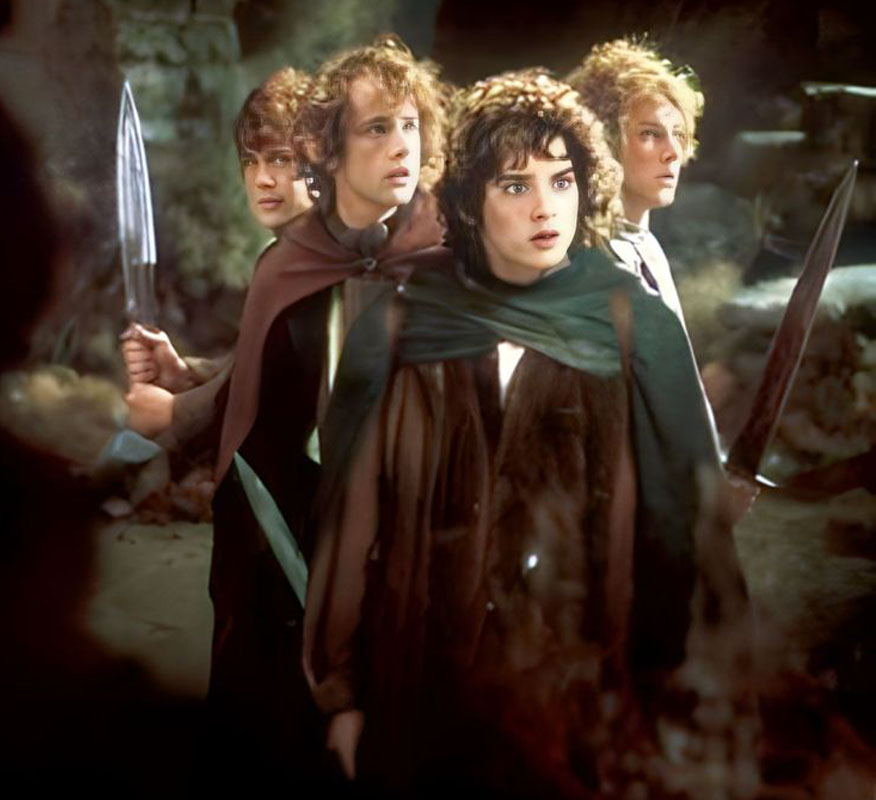
The story of the Barrow-blades begins in the eerie mists of the Barrow-downs. Captured by a Barrow-wight, the hobbits find themselves trapped among the relics of an ancient age. When Tom Bombadil rescues them, he gives each a blade taken from the barrow's treasure — swords forged by the men of Westernesse in their wars against the Witch-king of Angmar. These blades, though small, are of noble make and enchanted to pierce dark magic. Their craftsmanship and purpose far surpass the stature of their new owners, yet in Tolkien's world, greatness often finds its home in humility.
The Barrow-blades mark a turning point in the hobbits' lives. No longer are they simply wanderers from the Shire; they become part of the long struggle against evil. The blades are physical and symbolic gifts — reminders that courage can be found even in the smallest hearts. Though not as famous as Andúril or Glamdring, these swords carry deep historical and emotional significance. They connect the hobbits to the ancient warriors of Westernesse, linking the past age's valour with the present struggle against Sauron.
Sam's Barrow-Blade
Samwise Gamgee embodies loyalty and steadfast love. His Barrow-blade mirrors his character: simple, honest, and resilient. Sam's sword was originally crafted to combat the dark forces of Angmar, making it particularly deadly against creatures of shadow. When Sam uses it to wound Shelob, the monstrous spider of Mordor, it becomes an act of destiny — proof that even the smallest of beings can stand against the greatest darkness. The blade becomes an extension of Sam's unwavering heart, representing the power of devotion over fear.
In craftsmanship, the sword would have been narrow and light, suited for both precision and speed. The men of Westernesse, known for their advanced metallurgy, forged such blades to balance strength with grace. Tolkien's description implies both beauty and practicality, reflecting the artistry of a civilisation that fought evil with elegance and endurance.
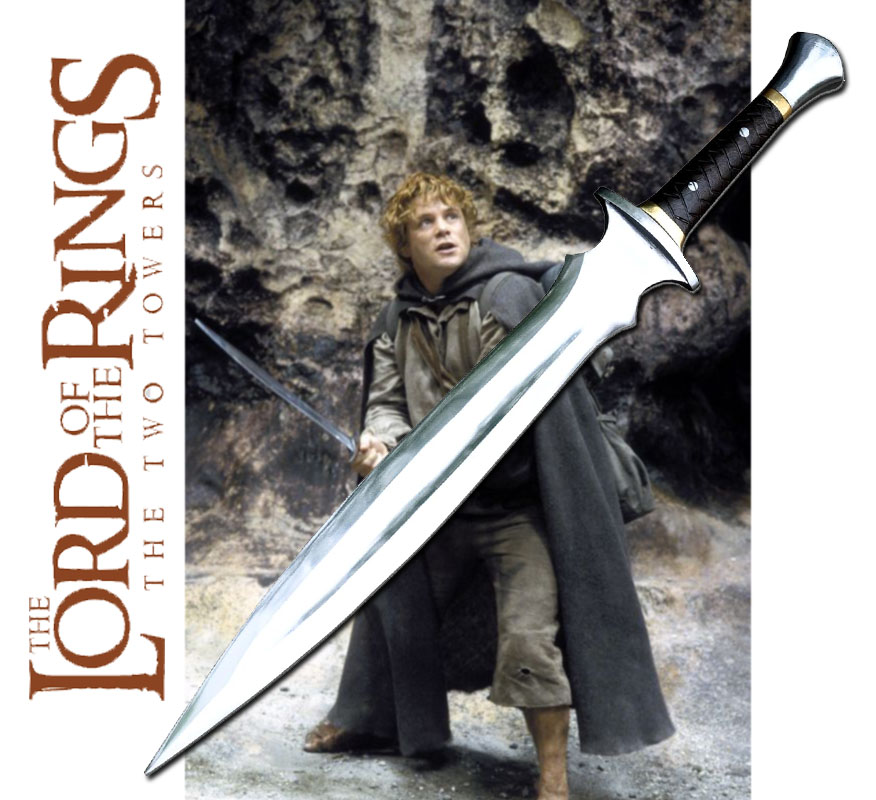
Sam Sword — Barrow-Blade Replica
Hand-forged from 5160 high-carbon spring steel. Full-tang, water-tempered, customisable blade length. Made in Kathmandu, Nepal.
View Sam SwordMerry's Barrow-Blade
Meriadoc Brandybuck carries one of the most historically significant weapons in the saga. During the Battle of Pelennor Fields, Merry uses his sword to strike the Witch-king of Angmar — an act that fulfils the prophecy that "no living man" could kill him. The enchantment placed upon the Barrow-blade allows it to break the dark spell protecting the Witch-king. This moment is one of Tolkien's finest illustrations of fate, courage, and poetic justice. Merry's small blade, forged in an age long past, becomes the key to the fall of a nearly immortal foe.
Merry's sword, in its design, likely carried runic inscriptions and a double fuller — features that balance lightness with power. It was a weapon of history, but in Merry's hands, it became a weapon of destiny. The victory at Pelennor Fields is not merely a triumph of arms but a triumph of courage — the courage of a hobbit who refused to yield.
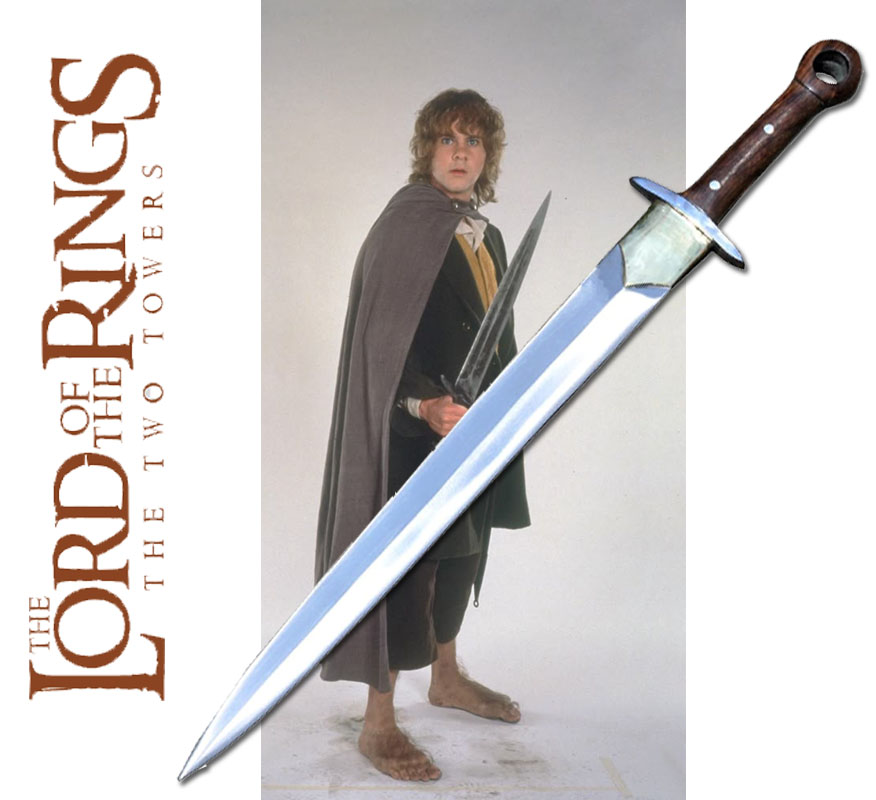
Merry Sword — Barrow-Blade Replica
Hand-forged from 5160 high-carbon spring steel. Full-tang, water-tempered, 16-inch blade. Made in Kathmandu, Nepal.
View Merry SwordPippin's Barrow-Blade
Peregrin Took, or Pippin, begins his journey as a playful and impulsive soul, yet his Barrow-blade accompanies his transformation into a soldier of Gondor. By the end of the story, he stands as a knight of the city, his courage tempered by loss and duty. His sword, small but finely made, becomes a symbol of youthful bravery matured through experience. When Pippin fights to save Faramir, he wields his blade not as a token of fantasy, but as a real instrument of valour and responsibility.
Tolkien uses Pippin's growth to show how courage evolves. The same hobbit who once joked and stumbled through the early chapters of the quest becomes a hero in the service of a kingdom. The sword he carries — a relic from forgotten wars — is a reminder that history lives on through those who choose to act with honour.

Pippin Sword — Barrow-Blade Replica
Hand-forged from 5160 high-carbon spring steel. Full-tang, water-tempered, 15-inch blade. Made in Kathmandu, Nepal.
View Pippin SwordThe Sword of Boromir — Pride of Gondor
Few characters embody both strength and tragedy as deeply as Boromir of Gondor. His sword reflects his dual nature — noble and proud, yet burdened by the weight of expectation. As the son of Denethor and heir to the Stewardship of Gondor, Boromir wields a blade fit for a warrior of men. Its design features a leaf-shaped double-edged blade, balanced for both slashing and thrusting. The crossguard curves slightly toward the blade, giving it both elegance and aggression — a perfect metaphor for Boromir himself.
In battle, Boromir's sword is an extension of his honour. When he fights to defend Merry and Pippin from the Uruk-hai at Amon Hen, he does so with unrelenting courage. Though he falls, pierced by arrows, his final act transforms his pride into redemption. His sword becomes a symbol of sacrifice — proof that even flawed men can achieve greatness through selflessness.
Historically, Boromir's sword draws from the arming swords of medieval Europe, particularly those used in the 12th and 13th centuries — blades that emphasised balance, symmetry, and grace, serving as both practical weapons and emblems of knighthood.
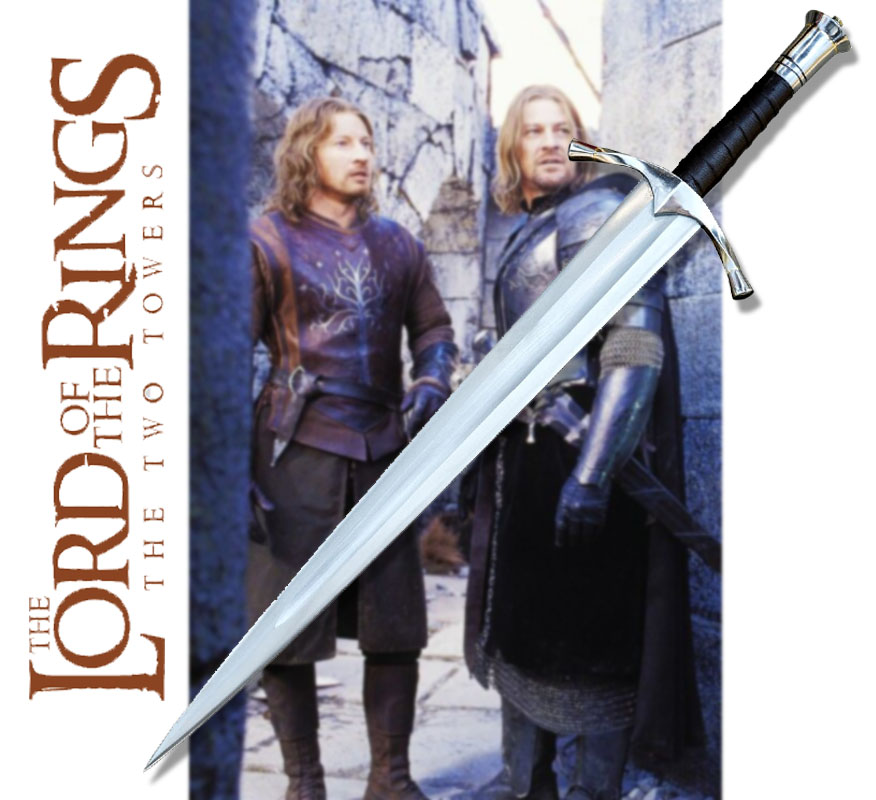
Sword of Boromir — LOTR Replica
Hand-forged from 5160 high-carbon spring steel. Full-tang, water-tempered, customisable blade length. Made in Kathmandu, Nepal.
View Sword of BoromirThe Dagger of Boromir
Less celebrated than his longsword but equally significant, Boromir's companion dagger is the shorter blade he carries at his side throughout the Fellowship's journey. Where the sword speaks to Boromir's role as a warrior of Gondor, the dagger speaks to his humanity — the personal, close-quarter blade of a man who has fought many battles and trusts the feel of steel in hand.
In design, a Gondorian companion dagger of Boromir's era would follow the same aesthetic language as the longsword: leaf-shaped profile, slight taper, crossguard that echoes the sword's form. It is a matching set — the kind a Gondorian captain would commission from the same smith. Everest Forge's Dagger of Boromir is hand-forged from 5160 spring steel to the same standard as the longsword.
Tauriel's Dagger — A Blade from The Hobbit
Beyond the Fellowship, Tolkien's wider Middle-earth introduced further iconic blades through Peter Jackson's The Hobbit trilogy. Tauriel, the Mirkwood elven captain played by Evangeline Lilly, carries a curved elven dagger that reflects the woodland elves' aesthetic: lighter than Gondorian steel, with a flowing geometry that speaks to elven craftsmanship traditions rather than the martial solidity of mannish blades.
The dagger sits within the broader elven design language of Middle-earth — blades that are as much expressions of culture as tools of war. For fans of The Hobbit and the wider Tolkien world, it is one of the most sought-after of the lesser-known Middle-earth blades. Everest Forge's Tauriel Dagger is hand-forged with a curved crossguard and leather-wrapped grip.
Forging Middle-earth: Craftsmanship and Legacy
The swords of The Lord of the Rings are more than movie props or literary symbols — they represent the artistry of forging itself. In the real world, each replica requires the same patience and precision that ancient swordsmiths practised. The process begins with raw steel, often high-carbon varieties like 5160 spring steel. The steel is heated, hammered, and tempered repeatedly to achieve the perfect balance of strength and flexibility. The blade must hold a sharp edge while resisting breakage — a quality that separates true craftsmanship from mere imitation.
In Tolkien's lore, this same devotion to craft defines civilisations. The elves forged weapons of grace and power, the dwarves of endurance and might, and the men of Westernesse of balance and wisdom. The forging process becomes a metaphor for the shaping of character — through pressure, heat, and perseverance. Just as steel is strengthened by fire, so too are heroes forged by trial.
For collectors, these swords are tangible connections to that spirit. A hand-forged replica carries more than weight and polish; it carries the soul of tradition. The art of blacksmithing — from shaping the tang to grinding the edge — turns raw metal into a story that can be held, displayed, and cherished. Whether inspired by the humble hobbits or the proud warriors of Gondor, each blade tells two tales: one of fantasy, and one of real human craftsmanship.
The Meaning of Forged Legends
The swords of The Lord of the Rings endure because they speak to universal truths. Sam's blade represents devotion and love. Merry's sword symbolises courage in the face of the impossible. Pippin's weapon reflects growth and loyalty, while Boromir's sword embodies sacrifice and redemption. Together, they form a tapestry of what it means to be human — to struggle, to fall, and to rise again with purpose renewed.
These blades remind us that heroism is not defined by size or status but by heart. When Tolkien wrote of small hands shaping the course of the world, he meant that true power lies in humility and hope. The swords of Middle-earth are physical manifestations of that idea — they channel the will of their bearers, turning belief into strength.
In every forged sword, whether in story or reality, there is a moment of transformation: when fire meets steel, and potential becomes purpose. The replicas crafted today by skilled artisans continue this ancient lineage, ensuring that the light of courage — first kindled in Tolkien's imagination — burns on in the real world. These are not merely weapons; they are symbols of resilience, artistry, and the eternal bond between myth and mankind.
Frequently Asked Questions
What are the Barrow-blades in Lord of the Rings?
The Barrow-blades are ancient swords forged by the men of Westernesse for their wars against the Witch-king of Angmar. Tom Bombadil gives one each to Sam, Merry, and Pippin after rescuing them from the Barrow-downs. The blades are enchanted to pierce dark magic — which is why Merry's blade is able to break the protective spell on the Witch-king at the Battle of Pelennor Fields.
What sword does Merry use to defeat the Witch-king?
Merry uses his Barrow-blade — one of the ancient swords given to the hobbits by Tom Bombadil in the Barrow-downs. The blade was forged specifically to combat the forces of Angmar, and its enchantment allows it to break the dark spell that protected the Witch-king from mortal wounds. After the strike, the blade dissolves — consumed by the energy released.
What type of sword does Boromir carry in Lord of the Rings?
Boromir carries a leaf-shaped, double-edged arming sword with a crossguard that curves slightly toward the blade. The design draws from European arming swords of the 12th and 13th centuries — balanced, symmetrical, and practical. It is built for both slashing and thrusting, reflecting Boromir's training as a Gondorian captain and warrior.
Are the Lord of the Rings swords based on real historical weapons?
Yes. Tolkien was a medieval scholar and drew heavily from real historical weapon traditions. The Barrow-blades reflect Anglo-Saxon seax and short sword designs. Boromir's sword draws from 12th–13th century European arming swords. The elven blades reflect Celtic and Norse aesthetic influences. Even the names Tolkien gave to the swords — Andúril, Narsil, Glamdring — follow Old Norse and Anglo-Saxon linguistic patterns.
What is the Dagger of Boromir?
The Dagger of Boromir is the shorter companion blade Boromir carries alongside his longsword throughout the Fellowship's journey. It follows the same Gondorian design language — leaf-shaped profile, slight taper, crossguard echoing the longsword's form. Everest Forge produces a hand-forged replica of the Dagger of Boromir in 5160 high-carbon spring steel.
Own a Piece of Middle-earth
Every Everest Forge LOTR blade is hand-forged from 5160 spring steel in Kathmandu, Nepal — Sam, Merry, Pippin, Boromir, Tauriel. Browse the full collection or commission a custom Middle-earth blade.
Browse Middle-earth Blades Request a Custom ForgeIP & Trademark Disclaimer: This article discusses bladed weapons appearing in the Lord of the Rings and The Hobbit film trilogies for educational and informational purposes. Everest Forge produces hand-forged interpretations inspired by these designs for collectors, cosplayers, and enthusiasts. We are not affiliated with, endorsed by, or licensed by Warner Bros. Discovery, New Line Cinema, MGM, the Saul Zaentz Company, or the Tolkien Estate. All character names, film titles, and franchise references are used for descriptive identification only. All trademarks are the property of their respective owners.