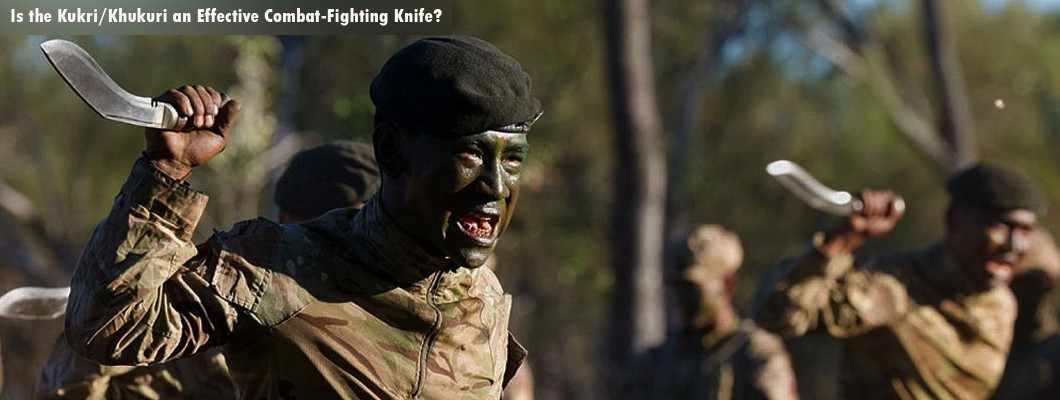
An Educational Analysis of the Kukri’s Combat Role and Fighting Use
The kukri (also spelled khukuri or khukri) is one of the most recognizable blades in the world. Its forward-curved profile, thick spine, and powerful cutting edge have earned it a fearsome reputation—often amplified by movies, folklore, and popular media.
This leads to a common and important question: Is the kukri/khukuri truly an effective combat-fighting knife, or is its reputation largely symbolic?
To answer this honestly, the kukri must be understood in proper context—as a tool first, a cultural artifact second, and a blade that was adapted for combat rather than designed exclusively for it.
Origins: A Tool Before a Weapon
The kukri originated in Nepal as an all-purpose working blade. For centuries, it was used daily for cutting wood, clearing vegetation, agricultural and household work, and general utility tasks.
Its combat association emerged not because it was designed as a weapon, but because it was always present. When conflict arose, people fought with the tool they already knew intimately.
Some historians suggest the kukri’s form may have evolved from sickles or ancient curved blades such as the Greek kopis. Regardless of origin, its defining forward curve created a mechanical advantage that shaped both its utility and combat potential.
Design Characteristics That Influence Combat Use
Several physical features help explain why the kukri could function effectively in close-range combat situations:
- Forward-weighted blade – concentrates mass toward the cutting edge, increasing impact force.
- Curved cutting edge – favors slicing and chopping rather than fine thrusting.
- Thick spine – adds durability under heavy stress.
- Compact overall length – suitable for close-range encounters.
Traditional kukris are often carried with two companion tools :
- Karda – a small utility knife for fine cutting tasks.
- Chakmak – a blunt honing and striking tool.
This reinforces that the kukri was conceived as a multi-tool system, not a dedicated fighting knife.
Historical Combat Role
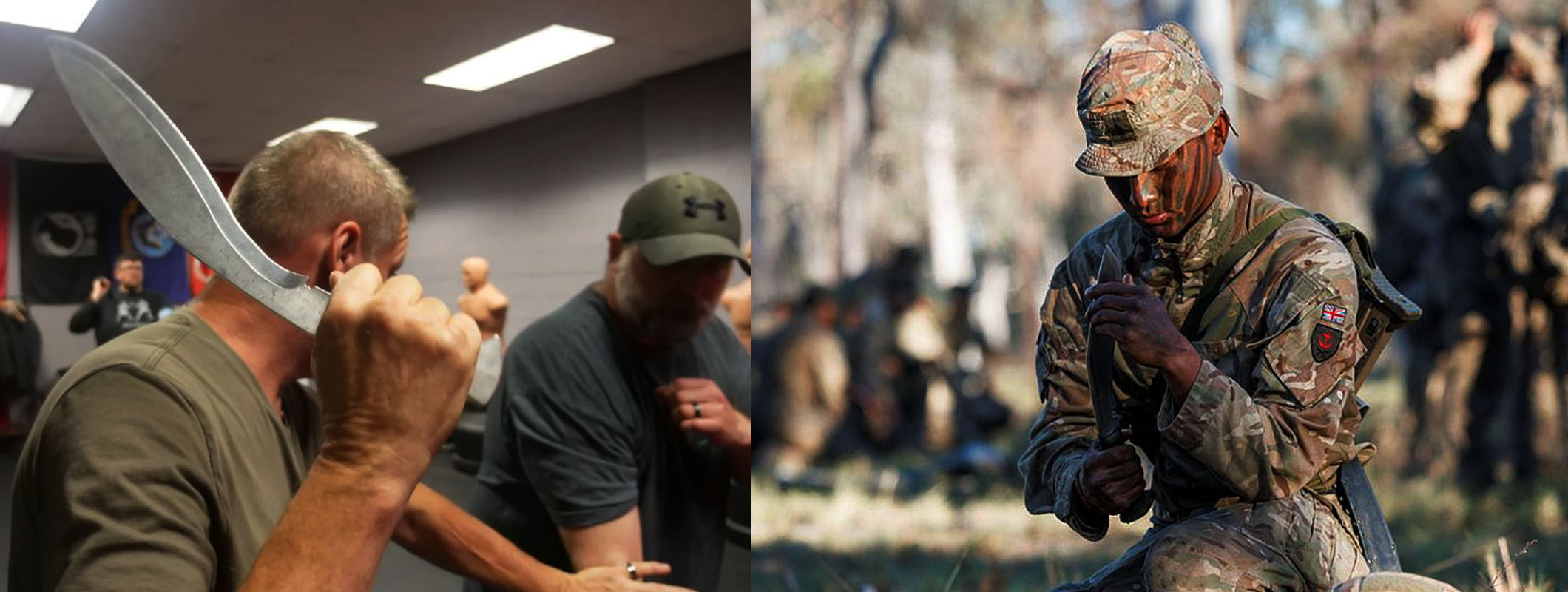
The kukri’s global reputation is closely tied to its use by the Gurkhas. For Nepalese soldiers serving in British and Indian forces since the early 19th century, the kukri served as:
- a daily utility blade
- a symbol of cultural identity
- a close-combat sidearm of last resort
Its effectiveness came primarily from familiarity, confidence, and environment, rather than specialized combat engineering.
Kukri Combat Techniques
Educational Note: The points below explain historical combat concepts only. They do not provide instructions, drills, target guidance, or actionable steps.
1) Cutting-Dominant Doctrine
Historically, kukri use emphasized cutting power over thrusting precision. The blade’s forward mass amplifies momentum, making decisive cutting outcomes more significant than speed or fencing-style exchanges.
2) Limb-Disabling Focus
Many historical blade traditions prioritized stopping capability by limiting an opponent’s ability to continue fighting. In that context, kukri use is often described as favoring actions that reduce mobility or weapon control rather than prolonged exchanges.
3) Force Interaction Concepts
Traditional martial discussion often frames responses to incoming force in broad categories: direct force interaction (where opposing momentum intersects) and redirective force interaction (where movement changes the path or outcome of an incoming action). These concepts appear across multiple historical traditions.
4) Mobility and Positioning
Historical doctrine repeatedly emphasizes that movement and positioning matter more than the blade alone. The kukri’s size and balance supported close-range engagement, especially in uneven terrain such as jungle, hills, and rural environments.
5) Psychological Impact
Beyond physical capability, the kukri carried a strong psychological presence. Its distinctive shape, reputation, and cultural symbolism could influence morale and decision-making before contact occurred—an important factor in historical conflict.
Kukri vs Modern Combat Knives
The table below summarizes design intent and practical characteristics. This is an educational comparison showing how these tools evolved for different needs and environments.
| Aspect | Kukri / Khukuri | Modern Combat Knives |
|---|---|---|
| Primary Design Purpose | Utility-first blade adapted for combat when required | Purpose-built fighting tools |
| Historical Origin | Centuries-old Himalayan tool-blade tradition | Modern military & tactical doctrine (20th–21st century) |
| Blade Geometry | Forward-curved, forward-weighted | Straight or mildly curved for control |
| Weight Distribution | Blade-biased for cutting power | Balanced or handle-biased for precision |
| Primary Strength | Slashing & chopping efficiency | Thrusting precision & close control |
| Utility Capability | Very high | Limited (combat-focused) |
| Learning Curve | Steeper due to balance and swing arc | Moderate due to standardized handling |
| Best-Suited Environment | Outdoor, rural, uneven terrain | Confined spaces and modern CQB contexts |
| Cultural Significance | Strong cultural & symbolic value | Minimal |
| Modern Military Role | Traditional and symbolic; limited modern issue | Active service as specialized tools |
Famous Khukuri Martial Arts Trainers
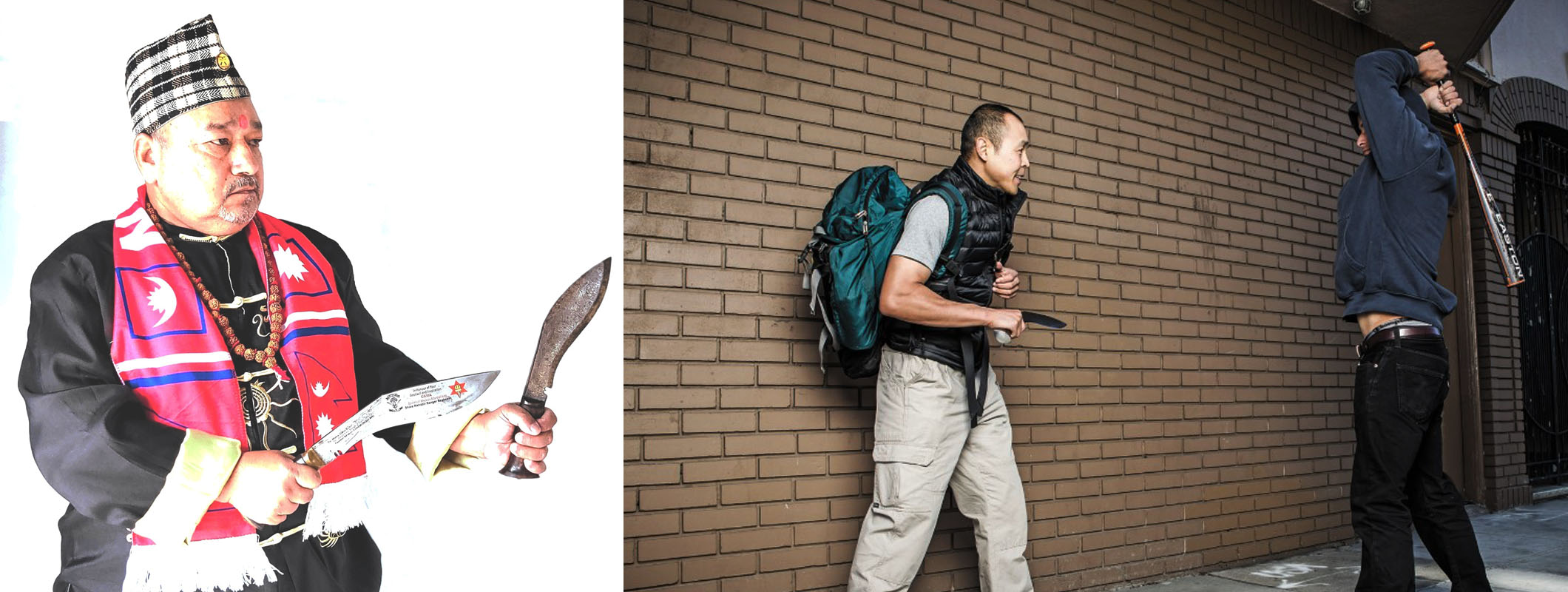
The following individuals are well known for their role in preserving, developing, or promoting khukuri (kukri) martial arts and combat traditions. They represent different lineages and interpretations rather than a single standardized system.
Maha Guru Baa Soke Dr. Jagdish Singh Khatri
Founder of the Nepal Khukuri Martial Arts (NKMA) Federation, Dr. Jagdish Singh Khatri is widely regarded as the pioneer of a formal and systematic khukuri martial arts curriculum in Nepal. Holding the rank of 10th Dan, his work focuses on organizing traditional khukuri combat knowledge into a structured martial framework aimed at cultural preservation and education.
Tim Anderson
A prominent Western authority on khukuri fighting systems, Tim Anderson is a direct student of Colonel Dwight McLemore. He runs the School of Two Swords Infinity and conducts international seminars focused on historical blade combat concepts, pressure-tested theory, and contextual fighting doctrine rather than sport-based practice.
David Daniel
Associated with the American Bando Association, David Daniel teaches the Bando Khukuri style, which derives from traditional Burmese martial systems. These systems historically influenced Gurkha combat methods and treat the khukuri as part of a broader martial structure rather than an isolated weapon art.
Kiran Rai
Often referred to in popular media as the “Nepali Bruce Lee,” Kiran Rai is a well-known Nepalese martial artist who promotes khukuri martial arts through demonstrations, exhibitions, and digital platforms. His public presence has helped bring wider international attention to Nepalese martial traditions and the cultural significance of the khukuri.
Simon (Tora Blade Concepts)
Simon is the founder of Tora Blade Concepts, a system focused on Southeast Asian curved blade traditions, particularly Siamese (Thai) daab or tora blade methods. While not a khukuri martial arts instructor, his work is often referenced in comparative blade studies due to shared principles such as forward-weighted cutting mechanics and flowing blade motion.
Educational note: There is no single globally standardized khukuri martial art. Khukuri combat knowledge has historically been transmitted through military tradition, cultural practice, and modern reconstruction and preservation efforts.
Modern Perspective
Today, the kukri is best understood as a utility-first blade with historical combat capability. It is a product of geography, culture, and necessity—a tool that could serve in emergencies rather than a modern knife designed solely for fighting.
Final Conclusion
Yes — the kukri/khukuri can be considered an effective combat-fighting knife, but only in proper historical and functional context. Its effectiveness came from blade geometry and forward weight, daily familiarity rather than specialized combat engineering, and use in environments where versatility mattered.
A more accurate conclusion is this:
The kukri is effective not because it was designed to fight, but because it was designed to work — and could fight when needed.
Educational Disclaimer: This article is intended solely for educational and informational purposes. It does not teach, promote, or encourage the use of weapons. Always comply with local laws and seek qualified professional instruction for any hands-on training.