Kopis vs. Falcata – The Ancient Curved Swords Compared
Among the many legendary swords of the ancient world, the Kopis and the Falcata stand out as two of the most fascinating. At first glance, these two forward-curving blades appear nearly identical. Both were designed to deliver powerful chopping strikes, both share Mediterranean roots, and both influenced the future development of curved swords across cultures. Yet, the kopis and the falcata are not the same weapon. They belong to different regions, reflect distinct warrior traditions, and carry unique cultural symbolism.

In this article, we will explore their origins, design features, battlefield use, cultural significance, and legacy. By the end, you will clearly see how the kopis and the falcata, while siblings in design, differ in function and meaning. This comprehensive comparison will be of interest not only to history enthusiasts but also to collectors and sword makers who wish to understand the deeper story behind these iconic blades.
Origins of the Kopis
The kopis originated in ancient Greece during the Classical period, around the 5th century BCE. It was a single-edged sword with a forward-curving blade that gradually widened toward the tip. Its unique geometry made it exceptionally effective for slashing and chopping, while still allowing thrusts. The word “kopis” itself is derived from the Greek word meaning “to cut” or “to strike,” which perfectly describes the weapon’s purpose.

Historians believe that the kopis developed from earlier Bronze Age sickle-swords and heavy utility knives. Greek cavalry in particular favored the kopis, as its forward-weighted design allowed devastating cuts from horseback. While straight swords like the xiphos were popular with infantry, the kopis offered a different style of combat: heavier, more forceful blows that could punch through armor and shields.
Greek vase paintings and carvings show warriors wielding kopides, often in cavalry contexts. Xenophon, the famous Athenian general and writer, even recommended that Greek cavalry carry kopides rather than straight swords because of their superior cutting power. This alone highlights the kopis as a weapon optimized for mounted combat.
Origins of the Falcata
The falcata emerged several centuries later in the Iberian Peninsula (modern Spain and Portugal). Most scholars agree that the falcata’s design was directly influenced by the kopis, brought to Iberia through Greek trade colonies such as Emporion. However, Iberian blacksmiths adapted the design into something distinctly their own. The falcata appeared around the 4th century BCE and became the signature weapon of Iberian warriors until the Roman conquest

Unlike the kopis, the falcata was not just a battlefield tool—it was a powerful cultural and symbolic object. Many falcatas were elaborately decorated with engravings, animal motifs, and inlaid designs. Archaeological finds reveal falcatas buried with warriors as grave goods, suggesting that the weapon symbolized status, honor, and identity within Iberian tribes.
The Romans came to fear the falcata’s devastating chopping power during their wars against Iberian tribes. Roman authors described how the falcata could split shields and helmets with shocking effectiveness. In fact, the falcata became so famous that it entered Roman military history as a weapon that nearly stopped their conquest of Hispania.
Blade Design
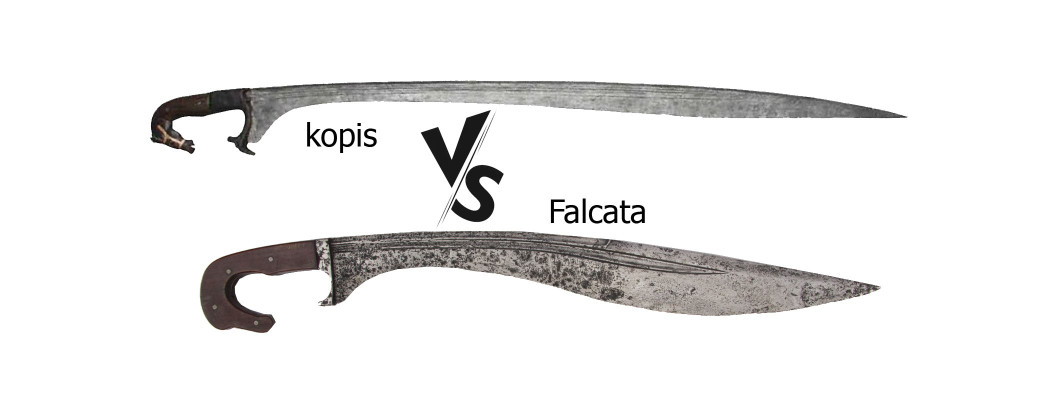
- Kopis: The kopis blade typically measured between 48 to 65 cm (19 to 25 inches). The curve was often gradual, beginning near the hilt and flaring slightly forward. This shape gave the kopis a balance between cutting and thrusting. Some variants were almost straight near the base, with only the tip curving forward.
- Falcata: The falcata’s curve was more dramatic. The blade began with a concave back near the hilt, then swelled outward in a broad belly before tapering sharply toward the point. This gave the falcata greater chopping power, making it function almost like a battle axe in sword form. Average blade length ranged from 60 to 70 cm (24 to 28 inches).
The different curvatures reflect the intended combat roles. The kopis was versatile, usable for thrusts, slashes, and mounted strikes. The falcata, however, was specialized for close combat and devastating downward blows against heavily armed foes.
Hilt and Handle Construction
- Kopis: The kopis had a simple, open grip. Its handle was usually straight, sometimes with a flared or knobbed pommel. This made the kopis easier to manufacture and suited its use as a cavalry sword.
- Falcata: The falcata’s hilt was far more elaborate. Many had a partially enclosed grip with a hook-shaped pommel that often depicted a horse’s head, bird, or other animal motif. This not only provided excellent hand protection but also symbolized strength and identity. The enclosed grip allowed the wielder to maintain a secure hold during powerful chopping strikes.
The falcata’s ornate handle designs reflect its dual role as both weapon and cultural artifact, while the kopis was a more practical military tool.
Combat Roles
- Kopis: Primarily a cavalry weapon, designed for slashing downward on infantry from horseback. Its curved design allowed devastating cuts while maintaining enough thrusting ability for versatility.
- Falcata: A close-combat sword of the Iberian tribes, effective against Roman infantry. Its heavy forward-curved blade could shear through shields and helmets, making it a terrifying weapon in one-on-one combat.
Cultural Symbolism
While the kopis was a practical military sword, the falcata carried profound cultural meaning. Iberian falcatas were often richly decorated with engravings of deities, animals, and tribal symbols. They were prestige weapons, carried by tribal elites and buried in warrior graves. The falcata was not only a weapon but also a statement of power, identity, and status.
The kopis, on the other hand, was seen as a soldier’s tool. While respected and effective, it did not carry the same ritual or symbolic weight as the falcata. This difference is why the falcata remains iconic in Spanish cultural memory, while the kopis is remembered mainly as part of the Greek military tradition.
Side-by-Side Comparison Table
| Feature | Kopis | Falcata |
|---|---|---|
| Origin | Ancient Greece (5th century BCE) | Iberia (Spain/Portugal, 4th century BCE) |
| Blade Length | 48–65 cm (19–25 inches) | 60–70 cm (24–28 inches) |
| Blade Shape | Gradual forward curve, versatile for cuts and thrusts | Exaggerated curve with concave back, optimized for chopping |
| Hilt | Open grip, simple pommel | Enclosed grip, animal-head pommel, ornate designs |
| Combat Role | Cavalry sword, versatile for slashing and thrusting | Close-combat chopping weapon, feared by Romans |
| Cultural Meaning | Practical battlefield weapon | Prestige weapon, symbol of tribal identity |

Legacy of the Kopis
The kopis influenced several later sword types. Its forward-curved blade design spread through trade and warfare across the Mediterranean. Some historians suggest that the Nepalese kukri and Indian talwar carry design DNA from kopides, though these weapons developed independently within their regions. The kopis remains a symbol of Greek cavalry innovation and is often studied in the context of Classical Greek warfare.
Legacy of the Falcata
The falcata holds a special place in Iberian history. It became a national symbol of resistance against Rome and remains a point of pride in Spanish cultural memory. Modern reproductions of falcatas are popular among collectors and reenactors who admire their beauty and cutting power. The falcata also appears in modern media, from films to video games, as a weapon of barbarian strength and tribal resilience.
Conclusion
So, is the falcata simply another name for the kopis? The answer is no. While the two swords share a common ancestry and similar design, they are distinct in origin, purpose, and meaning. The Kopis was the Greek cavalryman’s versatile sword, designed for devastating cuts from horseback. The Falcata, on the other hand, was the Iberian tribesman’s cultural icon, a prestige weapon designed to split shields and inspire fear in the Roman legions.
At Everest Forge, we continue this legacy of craftsmanship by hand forging swords inspired by these ancient designs. Whether you are a collector, martial artist, or history enthusiast, understanding the differences between the kopis and the falcata adds depth to your appreciation of ancient weaponry. These swords are not only tools of war but also stories of culture, identity, and human ingenuity.
Kopis vs. Falcata – Frequently Asked Questions
Are the Kopis and the Falcata the same sword?
No. They share a forward-curved profile, but the Kopis is Greek (5th–4th c. BCE) with a simpler open hilt, while the Falcata is Iberian (4th–1st c. BCE) with a more exaggerated blade belly and enclosed/zoomorphic pommel.
What is the main visual difference between a Kopis and a Falcata?
The Kopis usually has a gradual forward curve and open grip; the Falcata has a deeper belly with a concave back near the hilt and a hooked or enclosed grip, often shaped like an animal head.
Which sword came first?
The Kopis appears earlier in Classical Greece. The Falcata likely developed later in Iberia, influenced by Greek trade and colonization.
How were they used in combat?
Kopis: valued by Greek cavalry for powerful slashing from horseback but still capable of thrusts. Falcata: optimized for devastating chopping cuts in close combat against shielded infantry.
Why is the Falcata famous in Roman accounts?
Roman writers described the Falcata’s ability to split shields and helmets, noting its effectiveness during Rome’s campaigns in Hispania.
Did the Kopis have cultural symbolism like the Falcata?
Less so. The Kopis was a practical military tool. The Falcata often served as a prestige object—richly decorated and buried with warriors—signifying status and identity.
What are typical blade lengths?
Kopis: roughly 48–65 cm. Falcata: roughly 60–70 cm. Lengths vary by find and reproduction.
Which grip style is more secure?
The Falcata’s enclosed or hooked pommel locks the hand for heavy chops; the Kopis’s open hilt is versatile and quick for cavalry slashes.
Are modern reproductions historically accurate?
Accuracy varies. High-quality reproductions follow archaeological finds (blade geometry, fullers, hilt form). Decorative versions may alter proportions for looks or comfort.
Can Everest Forge make custom Kopis or Falcata builds?
Yes. We can forge custom specifications for blade geometry, distal taper, handle materials, engraving, and scabbards. Contact us with your measurements and timeline.