10 Sacred Daggers From Major World Religions and Spiritual Traditions
Daggers have existed in nearly every civilization, usually as tools for hunting, combat, or personal defense. Yet in many parts of the world, certain daggers carried meanings far deeper than simple survival. Some blades were regarded as holy or sacred objects connected to religion, ritual practice, and spiritual symbolism.
These daggers were often used in ceremonies, carried as symbols of faith, or believed to possess spiritual power. In some traditions they represented justice and protection, while in others they symbolized the destruction of evil forces, the cutting away of illusion, or the responsibility to defend the weak.
Across cultures—from the monasteries of Tibet to the deserts of Arabia and the knightly traditions of medieval Europe—sacred daggers became part of religious identity and ceremonial life. The following examples show how different faiths and civilizations gave spiritual meaning to the simple but powerful form of a dagger.
1. Phurba – The Ritual Dagger of Tibetan Buddhism
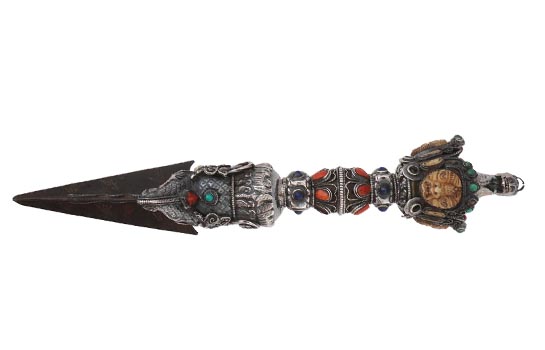
The Phurba, also known as a Kila, is one of the most recognizable ritual daggers in Tibetan Buddhism. Unlike ordinary blades, the phurba is used in spiritual ceremonies rather than combat. It plays an important role in tantric rituals aimed at overcoming negative forces and spiritual obstacles.
Traditional phurbas often have a three-sided blade. In Buddhist symbolism, these three sides represent the transformation of ignorance, attachment, and anger into wisdom. Many phurbas are intricately carved with sacred figures or protective deities such as Vajrakilaya, emphasizing their ritual purpose.
Because of its role in religious ceremonies, the phurba is widely regarded as one of the most important sacred daggers in Buddhist spiritual practice.
2. Kartika – The Crescent Ritual Knife of Hindu and Tantric Traditions
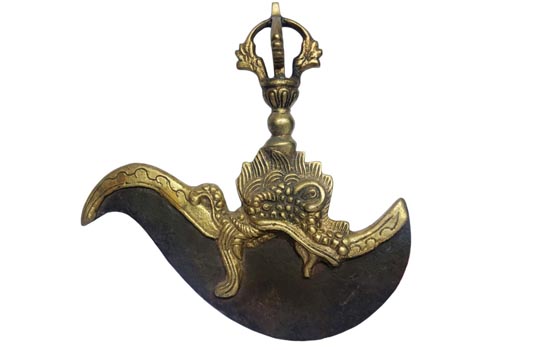
The Kartika is a distinctive crescent-shaped ritual blade used in both Hindu tantric traditions and Vajrayana Buddhism. It frequently appears in religious art, often held by powerful deities such as Kali or Vajrayogini.
In spiritual symbolism, the kartika represents the act of cutting through ego, attachment, and illusion. Rather than being a weapon of violence, it represents spiritual liberation and the removal of ignorance on the path toward enlightenment.
The unique curved shape of the kartika gives it an instantly recognizable appearance among sacred ritual tools of South Asian religious traditions.
3. Kirpan – The Sacred Dagger of the Sikh Faith
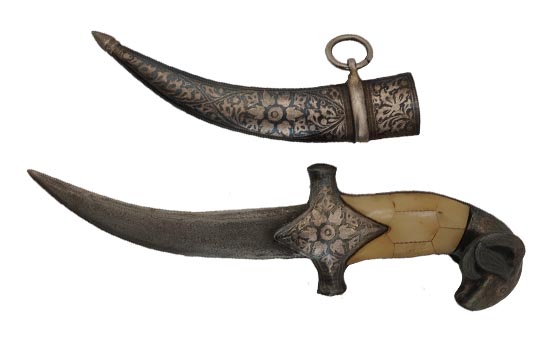
The Kirpan is one of the most well-known religious blades in the world and remains an active part of Sikh religious life. It is one of the Five Ks, the sacred articles of faith established by Guru Gobind Singh for initiated Sikhs.
The kirpan symbolizes courage, responsibility, and the duty to protect the weak and stand against injustice. For practicing Sikhs, carrying a kirpan is a reminder of moral obligation and spiritual commitment.
Unlike many historical ritual daggers, the kirpan is still worn today by millions of Sikhs around the world, making it one of the few sacred daggers that remains part of living religious tradition.
4. Jambiya – The Traditional Dagger of the Arabian Peninsula
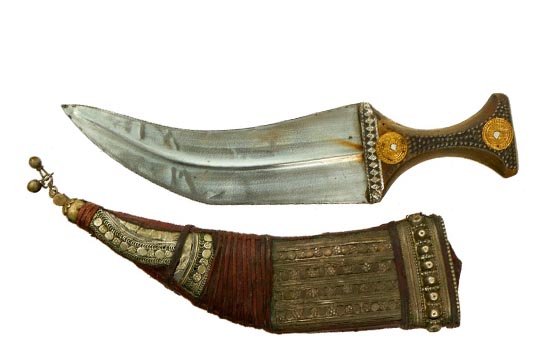
The Jambiya is a curved dagger traditionally worn in Yemen and across parts of the Arabian Peninsula. Although primarily a cultural symbol, it carries deep significance within societies shaped by Islamic heritage.
The jambiya is commonly worn during ceremonies, celebrations, and important social gatherings. Its ornate handle and decorated sheath often reflect the social status and cultural identity of the owner.
While not a ritual religious dagger in the strict sense, the jambiya represents honor, tradition, and dignity within many Islamic cultural communities.
5. Khanjar – The Ceremonial Dagger of Oman
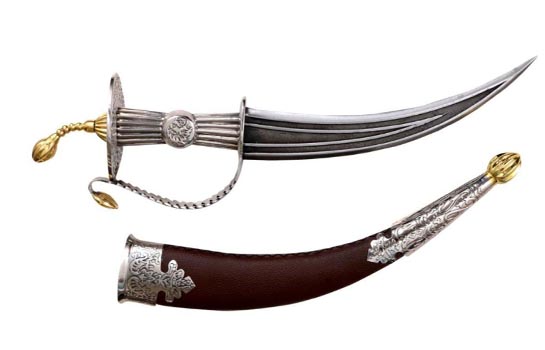
The Khanjar is another famous curved dagger from the Middle East, strongly associated with Oman. In fact, the khanjar appears on the national emblem of Oman, highlighting its importance within the country’s cultural heritage.
Traditionally worn during formal occasions and ceremonial events, the khanjar represents national pride, tradition, and historical identity. Many examples are beautifully crafted with detailed silverwork and elaborate scabbards.
Although the khanjar originally served as a weapon, it is now primarily regarded as a ceremonial and symbolic blade.
6. Misericorde – The Mercy Dagger of Medieval Christian Europe
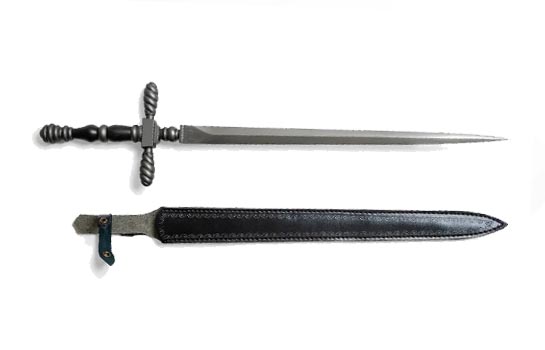
The Misericorde, sometimes called the mercy dagger, emerged during the Middle Ages in Christian Europe. The name comes from the Latin word for mercy, reflecting its association with compassion within the harsh realities of medieval warfare.
This slender dagger could be used to deliver a final blow to a mortally wounded soldier on the battlefield. In the context of medieval Christian chivalry, this act was seen as an expression of mercy rather than cruelty.
The misericorde therefore carries symbolic connections to Christian ideas of compassion, duty, and the moral responsibilities of knights.
7. Baselard – The Cross-Hilt Dagger of Medieval Europe
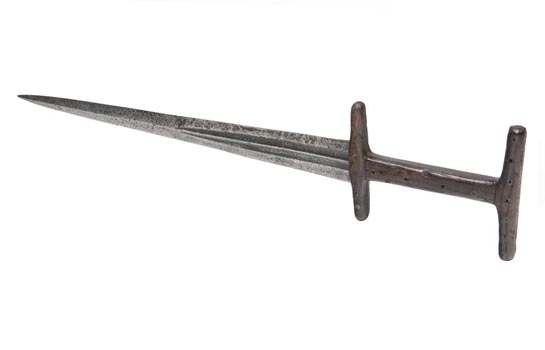
The Baselard was a dagger widely used throughout Europe during the 13th and 14th centuries. One of its most distinctive features was its hilt design, which often resembled the shape of a cross.
This cross-like appearance naturally connected the baselard with Christian symbolism in medieval society. During this period, religion strongly influenced politics, warfare, and daily life, and the cross-shaped dagger became a recognizable emblem within that world.
Although practical in combat, the baselard also carried symbolic meaning tied to faith and medieval Christian identity.
8. Rondel Dagger – Knightly Blade of Christian Europe
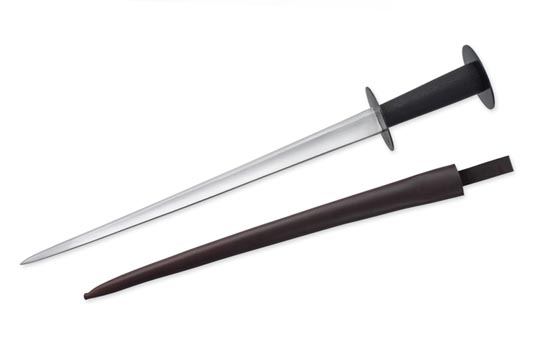
The Rondel dagger was commonly carried by knights during the late Middle Ages. Its design featured round discs at both the guard and pommel, which helped secure the hand while thrusting.
Some rondel daggers were decorated with religious engravings or crosses, reflecting the strong Christian identity of medieval European warriors.
Although primarily a battlefield weapon, the rondel dagger existed within a culture where religion and knighthood were closely intertwined.
9. Aztec Obsidian Ritual Dagger
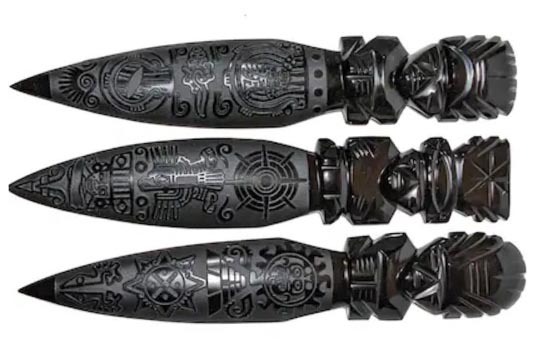
In ancient Mesoamerica, particularly within the Aztec civilization, obsidian daggers played an important role in religious ceremonies. Obsidian, a natural volcanic glass, can be sharpened to an extremely fine edge.
These blades were used by priests in sacred rituals dedicated to the gods. Such ceremonies were believed to maintain cosmic balance between the human world and the divine realm.
The obsidian ritual dagger therefore held a sacred role within the spiritual structure of Aztec religion.
10. Kris (Keris) – The Sacred Dagger of Southeast Asia
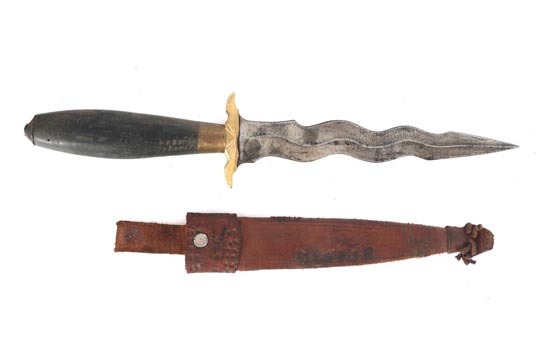
The Kris, also spelled Keris, is one of the most famous spiritual daggers in Southeast Asia, especially in Indonesia and Malaysia. Its distinctive wavy blade and patterned steel give it a unique appearance.
In many communities, the kris is believed to possess spiritual energy or protective power. Some examples are passed down through families for generations and treated as sacred heirlooms.
The forging of a kris traditionally involved ritual knowledge and symbolic craftsmanship, making it one of the most culturally significant daggers in Southeast Asian history.
The Spiritual Meaning Behind Holy Daggers
Sacred daggers reveal how deeply craftsmanship and spirituality can be connected. Across very different cultures and religions, blades were sometimes given meanings that went far beyond warfare. They could represent justice, mercy, protection, transformation, or divine authority.
From the Buddhist phurba to the Sikh kirpan and the mystical kris of Southeast Asia, these daggers demonstrate how spiritual belief often shaped the tools people created. Today many of these blades are preserved in museums, temples, and cultural collections, continuing to tell the story of humanity’s relationship between faith, tradition, and craftsmanship.
Design Your Own Custom Hand-Forged Dagger
If sacred and historical daggers inspire you, it is possible to create your own unique blade based on historical traditions, spiritual symbolism, or personal design ideas. Custom-forged daggers allow collectors and enthusiasts to bring historical inspiration into a real functional piece crafted by skilled bladesmiths.
At Everest Forge, we specialize in creating custom hand-forged blades including daggers, swords, kukris, and historical weapons. Each piece is forged with attention to balance, craftsmanship, and authentic design.
You can request a completely custom dagger inspired by historical styles such as medieval daggers, ritual blades, fantasy designs, or traditional weapons from different cultures.