What Is a Baselard?
A baselard is a medieval European dagger or short sword identified by its distinctive H-shaped (or I-shaped) hilt — a flat bar pommel and a matching bar guard, with the grip waisted between them. Named after the Swiss city of Basel, it was carried across Switzerland, Germany, France and England from the 13th to the 16th centuries, bridging the gap between an ordinary dagger and a full sword. At Everest Forge we hand-forge baselards the old way, and this is the guide we wish every collector could read before buying: what a baselard actually is, where the name comes from, how it was made, the types you will meet, and how to tell it apart from a Degen or a Swiss dagger.
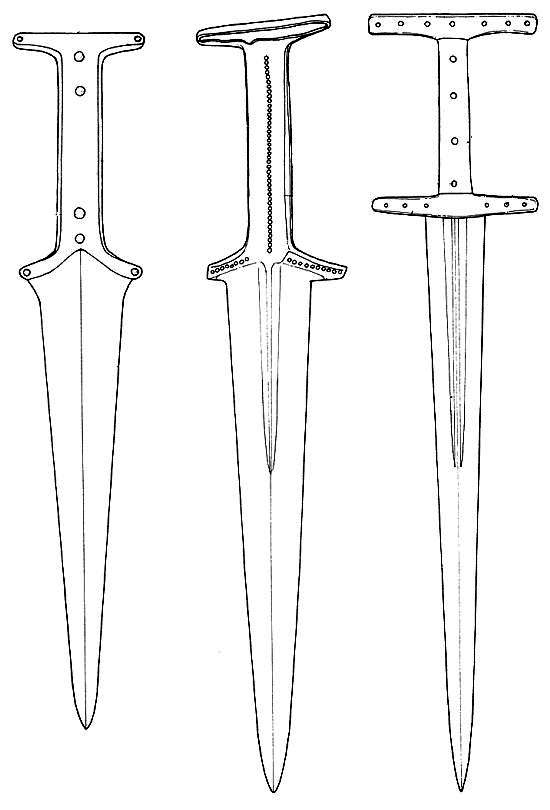
The short version: a baselard is the H-hilted medieval blade of late-medieval Switzerland and Germany. The name comes from the German Basler Messer — the "Basel knife" — and you will also see it spelled baslard, basilard or basler. It is broader and longer than a normal dagger but shorter and quicker than a sword, which is exactly why it stayed popular for three hundred years.
A Quick History of the Baselard
Origins in Basel
The baselard first appears in the late 13th century and takes its name from Basel, the Swiss city where the form first gained its reputation. Its combination of a practical size and a striking H-shaped grip made it instantly recognisable, and the city's name became the blade's name.

The Baselard family ran from belt-dagger to short sword, all sharing the H-hilt.
Spread across Switzerland and Germany
By the early 14th century the baselard had spread through the surrounding regions and into Germany. Merchants, townsmen and local militia favoured it because, unlike an expensive sword, a baselard was affordable and easy to wear at the belt. It became one of the most common sidearms in Central Europe.
Battlefield and civic life
Through the 14th and 15th centuries the baselard appears both on campaign and in town. Soldiers carried it as a secondary blade, and it shows up so often in civic life that French writers of the period used its name almost interchangeably with the everyday knife. It even appears in literature — William Langland's Piers Plowman mentions the baselard as a fashionable belt-companion. One of the most famous historical episodes involving a baselard is the 1381 death of Wat Tyler, leader of the Peasants' Revolt, at the hands of London's Lord Mayor William Walworth.
Decline and legacy
By the 16th century the classic baselard was fading as newer arms appeared, and the form branched into two distinctly Swiss descendants — the Schweizerdolch (Swiss dagger) and the Schweizerdegen (Swiss short sword). The baselard itself lived on in museums and collections, and remains one of the defining sidearms of the medieval world.
How a Baselard Is Forged
The blade. A classic baselard blade is straight and double-edged, with a diamond cross-section that gives two true edges and a reinforced point. It tapers cleanly for thrusting while keeping enough width through the body to cut.
The steel. We forge ours from reclaimed 5160 high carbon spring steel — recycled truck leaf-spring stock — oil-quenched, tempered, and full-tang. It is a modern, tough, functional steel rather than ancient bloomery iron or pattern-welded Damascus, which is the honest way to build a blade that is actually meant to be handled today.
The hilt. The H-hilt is peened over a full tang that runs the length of the grip, so the handle and blade are one continuous piece of steel. That is what separates a real baselard from a decorative wall-hanger with a glued or rat-tail tang.
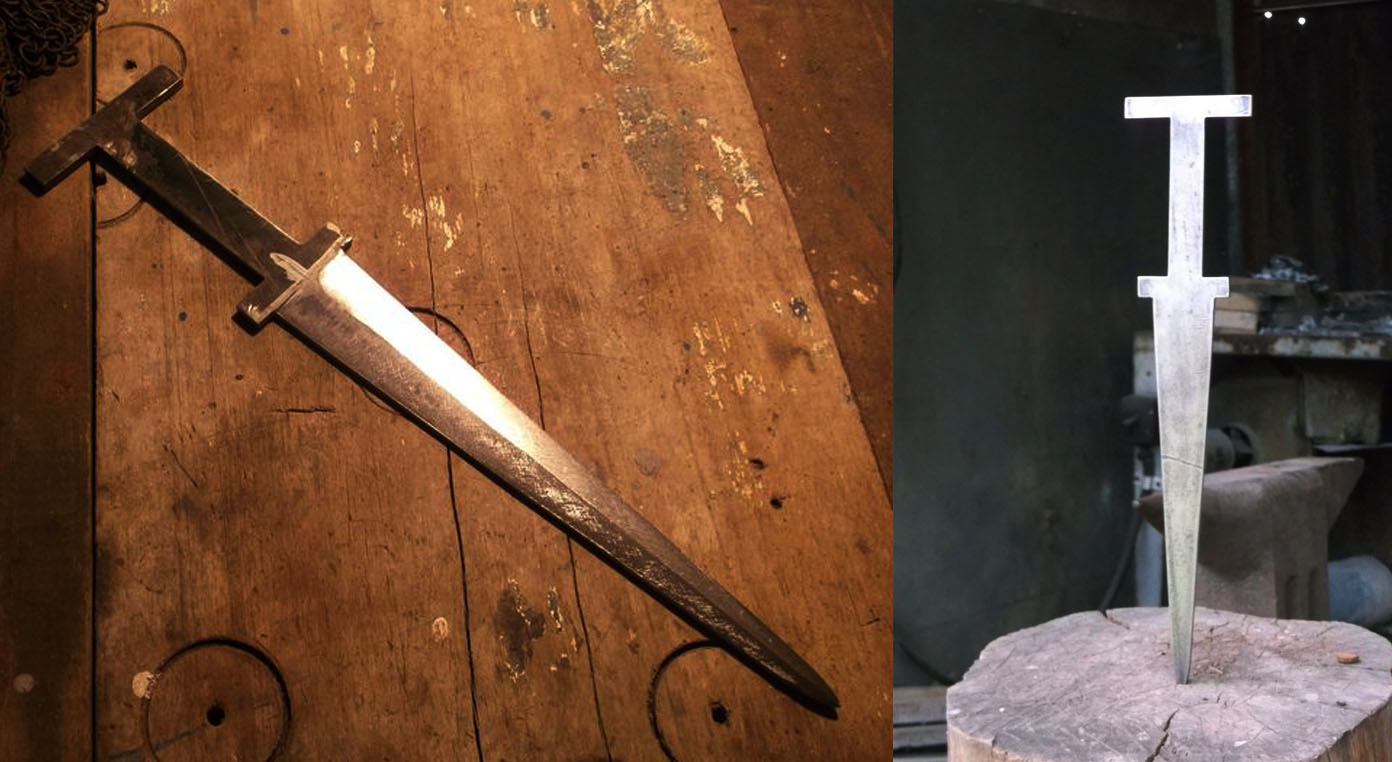
Every Baselard is forged by hand, from first heat to final edge.
If you have a specific blade length, hilt style, or museum piece in mind, our smiths can forge it to your exact specification — blade profile, fittings, handle material and engraving. Send us your idea and we will quote it.
Request a Custom Forge → Ask a Question →Anatomy of a Baselard
The blade. Most baselards have a straight, double-edged blade with a diamond cross-section, tapering to a thrusting point. Some later examples were made with a slightly broader, leaf-like profile, but the straight double-edged form is the classic.
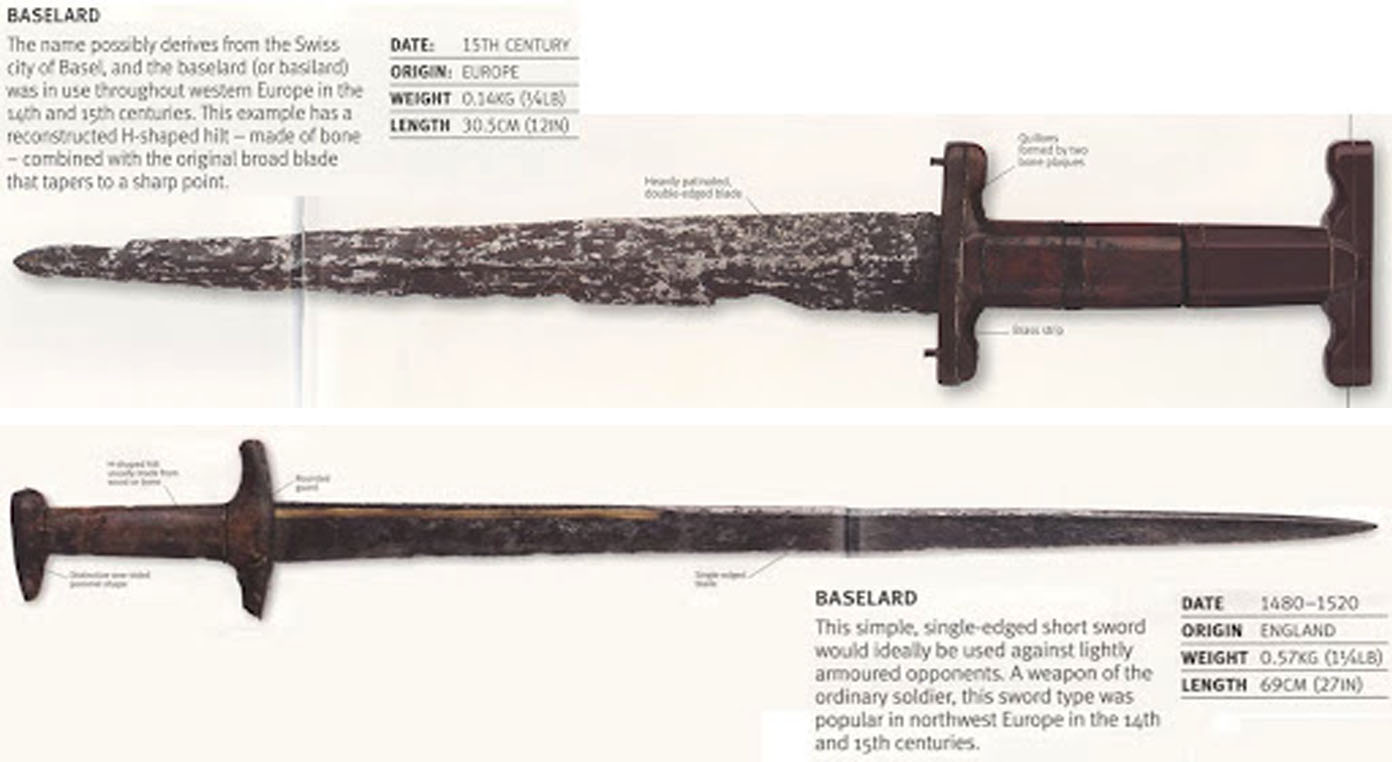
The anatomy of a Baselard — the bar guard and bar pommel give the H-hilt its shape.
The H-hilt. This is the feature that makes a baselard a baselard. A flat horizontal bar forms the pommel at the top, a matching flat bar forms the guard where the blade begins, and the grip is waisted between them — together they read as a capital "H" or "I". The cross-bars brace the hand and stop it sliding, which is what made the grip so secure and so recognisable.
The guard and pommel. On the earliest baselards both bars are plain and functional. On wealthier and later pieces the pommel and guard became a canvas for decoration — engraved bars, shaped terminals, and fine fittings that marked the owner's standing. The Swiss form that descended from the baselard later swapped the straight bars for a down-swept guard and a capped pommel.
Types of Baselard — The Everest Forge Range by Size
There is no single baselard. The form runs from a compact belt-dagger up to a full short sword, and the right one for you is mostly a question of length and role. Here is the family at a glance, then each piece in our Degen & Baselard collection.
| Baselard | Blade | Best for |
|---|---|---|
| Baselard Short Sword | 20.5 in (16-30) | The longest reach — a true European short sword |
| Baselard (Sword-Dagger) | 17 in (14-22) | The classic broad Baselard, the in-between size |
| Compact Baselard Dagger | 14 in (10-18) | The carry-size belt dagger |
| Swiss Baselard | 12 in (10-18) | The Swiss-dagger form with a down-swept guard |
The Baselard Short Sword
The longest of the family. A broad, straight, double-edged blade that crosses fully into short-sword territory — the European sidearm at its most commanding. Standard 20.5-inch blade, customisable from 16 to 30 inches.
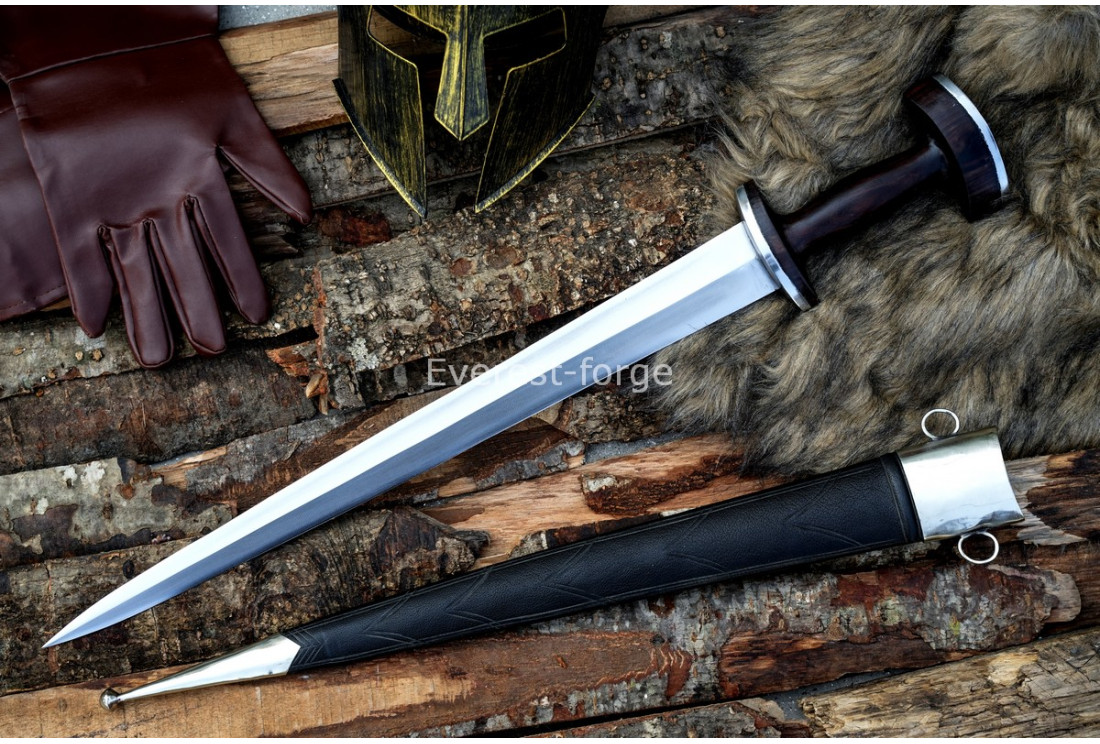
The Baselard Short Sword — the longest blade in the range.
The Baselard (Sword-Dagger)
The classic Baselard, known in Swiss-German as the Schwiizerdolch. A broad 17-inch blade with the full H-hilt — the true in-between blade that sits squarely between dagger and sword. This is the piece most people picture when they hear "baselard". Customisable from 14 to 22 inches.
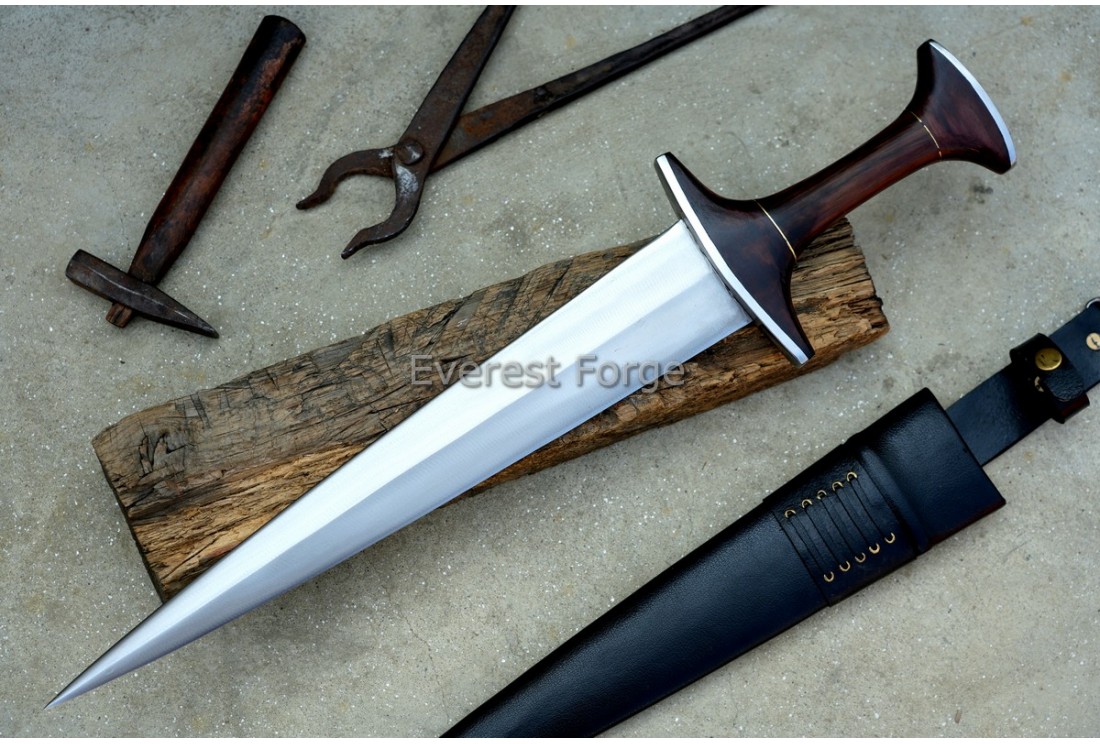
The 17-inch Baselard — the classic H-hilt sword-dagger.
The Compact Baselard Dagger
The smallest and most dagger-like of the three, carrying the same H-hilt in a hand-friendly carry size. A 14-inch standard blade, with rosewood, white-wood, horn or bone handles. Customisable from 10 to 18 inches.
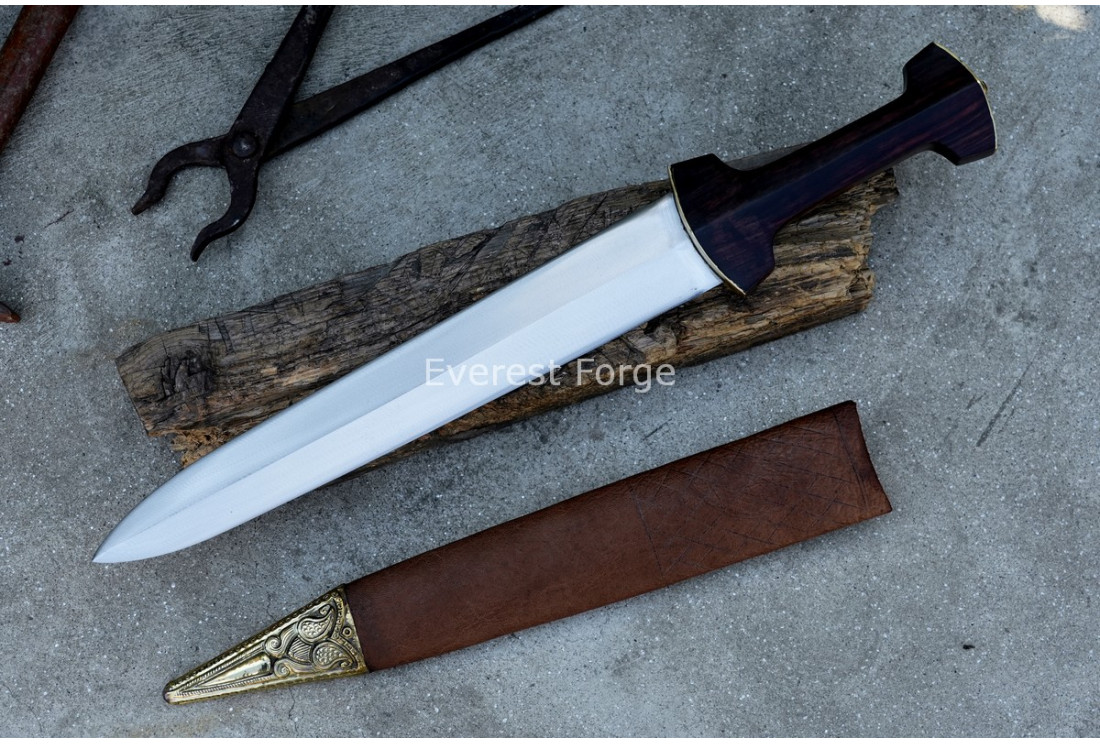
The compact 14-inch Baselard — the carry-size dagger.
The Swiss Baselard
The Swiss-dagger form that grew out of the baselard, with a shaped wood grip, a down-swept guard and a capped pommel rather than the straight bars. A broad 12-inch blade, customisable from 10 to 18 inches.
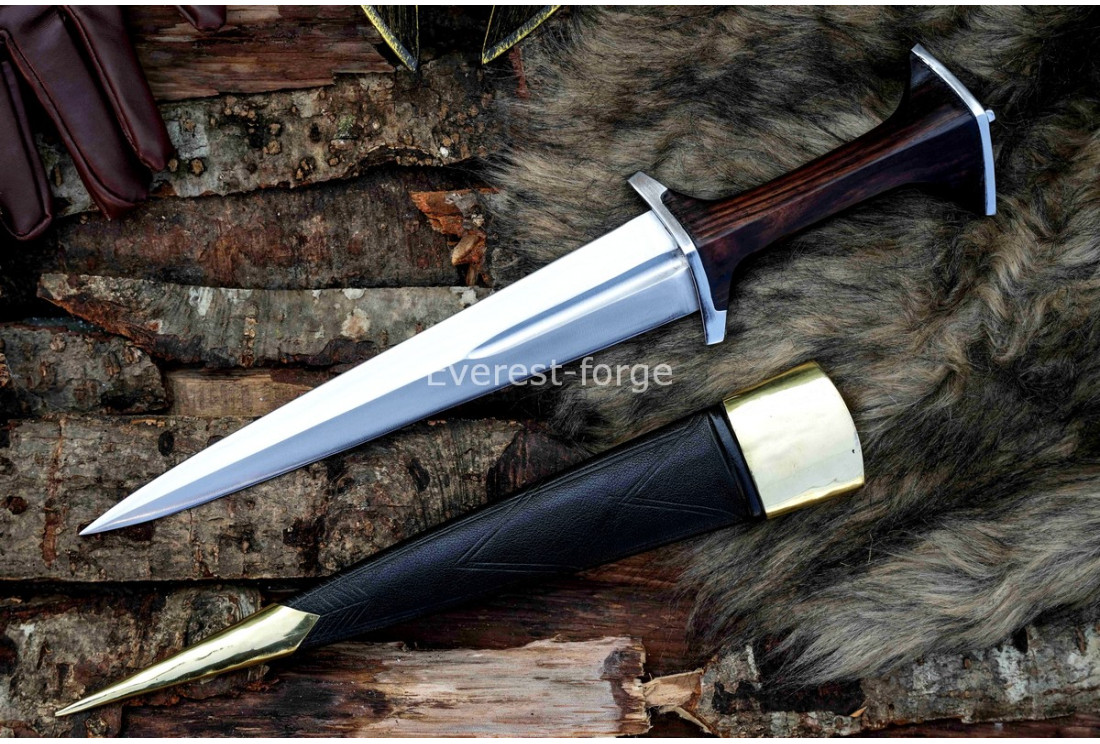
The Swiss Baselard — the later Swiss-dagger form of the baselard.
The Italian / English Baselard
A 15th-century variation in the Italian and English style, for collectors who want the regional form. Same H-hilt heritage, a different period flavour.
Baselard vs Degen vs Swiss Dagger — Clearing Up the Confusion
Three medieval blades get mixed up constantly, often because they overlap in time and place. Here is the honest distinction.
The Baselard is defined by its H-hilt — straight bar guard and bar pommel — and a straight, double-edged blade. It is a 13th-to-16th-century Swiss and German sidearm that bridges dagger and sword.
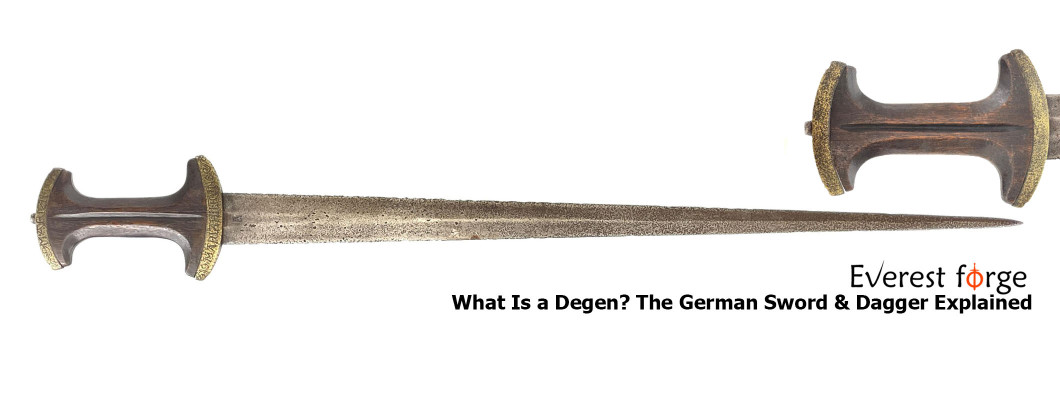
The Degen is later. Degen is simply German for "sword", and the Degen dagger is the slender, thrust-oriented side-blade of Renaissance and early-modern officers and nobles — usually with a curved guard and a shaped wood grip rather than the baselard's flat bars. If that is the blade you are after, see our Degen Medieval Swords range.
The Swiss dagger (or Holbein dagger) is the decorated descendant of the baselard, with curved crescent-shaped fittings and an ornate scabbard. Our Swiss Baselard follows this later Swiss form. So the easy rule: flat bars = baselard, curved guard and wood grip = degen, crescent fittings = Swiss/Holbein dagger.
Choosing and Owning a Baselard Today
A hand-forged baselard is one of the most rewarding pieces a medieval-arms collector can own — provided you buy a real one. The market splits into two very different products.
Decorative wall-hangers: stamped or cast stainless steel, hollow or rat-tail tangs, no real edge. They photograph well and fail at everything else.
Hand-forged functional baselards: real 5160 spring steel, full-tang, oil-tempered, sharpened, and customisable. Built to be drawn, handled, displayed with pride, and — if you wish — used for cutting practice. Every Baselard in our range is the second kind, forged to order in Kathmandu, with a choice of blade length, handle material and scabbard colour, and free engraving.
Beyond the collection cabinet, baselards are popular for medieval reenactment, living history, HEMA and historical-fencing practice (a blunt training edge is available on request), stage and film work, and wall display. Their distinct H-hilt makes them an instant conversation piece.
Browse the full hand-forged Baselard range, or commission a bespoke piece built to your own specification. Worldwide tracked shipping, duties and taxes prepaid.
Browse the Collection → Request a Custom Forge →Caring for Your Baselard
Clean and oil the blade. Wipe the blade with a soft, dry cloth after handling, and apply a thin film of mineral or blade oil to protect the high-carbon steel from moisture. A whetstone keeps the edge true, or a professional can re-sharpen it for you.
Look after the handle. Wooden grips benefit from occasional polishing; bone should be kept away from high heat; leather wraps need gentle conditioning to stay secure. Each material rewards a little care.
Display and store it well. Mount it securely and keep it out of direct sunlight, which can fade wood and leather. For long-term storage, keep the blade out of the scabbard in dry conditions, since trapped humidity can mark a carbon blade.
Frequently Asked Questions
What is a baselard?
A baselard is a medieval European dagger or short sword identified by its H-shaped hilt — a flat bar pommel and a matching bar guard with the grip between them. It was carried across Switzerland, Germany, France and England from the 13th to the 16th centuries, and is larger than an ordinary dagger but shorter than a sword.
What does "baselard" mean, and why is it called that?
The name comes from the German Basler Messer, meaning "Basel knife", after the Swiss city of Basel where the form first became popular. It is also spelled baslard, basilard or basler.
What is the H-shaped hilt?
The H-hilt is the defining feature of the baselard: a flat horizontal bar at the pommel, a matching flat bar at the guard, and a waisted grip between them, so the whole handle reads as a capital H or I. The cross-bars brace the hand and give a secure hold.
Is a baselard a dagger or a short sword?
It is both, depending on length. The form runs from a compact belt-dagger of around 10 to 14 inches up to a short sword of 20 inches or more. The classic mid-size baselard sits right between dagger and sword.
How long is a traditional baselard?
Historical baselard blades typically fall between about 10 and 30 inches across the family — longer than a normal dagger but shorter than a full sword. Our range covers that span, from a 12-inch Swiss Baselard to a 20.5-inch Baselard Short Sword, each customisable.
What is the difference between a baselard and a degen?
A baselard has the flat-barred H-hilt and a straight double-edged blade, and dates from the 13th to 16th centuries. A Degen is the later slender side-sword or dagger of officers and nobles, usually with a curved guard and a wood grip. Flat bars mean baselard; a curved guard and wood grip mean Degen.
What steel are your baselards made from?
We forge from reclaimed 5160 high carbon spring steel — recycled truck leaf-spring stock — oil-quenched, tempered, and full-tang. It is a modern, tough, functional steel built to be handled, not a stainless display blade.
Are your baselards sharp, or can I get one blunt?
The standard edge is a sharpened, double-edged working blade. A blunt training edge is available on request for HEMA sparring, stage rehearsal, or where a blunt blade is preferred — just note it on your order before forging.
How is the Swiss Baselard different from the others?
The Swiss Baselard follows the later Swiss-dagger form that descended from the baselard, with a shaped wood grip, a down-swept guard and a capped pommel rather than the straight H-bars. The other pieces in the range carry the earlier bar-style H-hilt.
Can I order a custom baselard?
Yes. Through our Custom Forge service you can specify blade length, finish, handle material, scabbard colour and engraving, or commission a fully bespoke baselard from your own reference. We confirm every detail before forging begins.
How should I care for a baselard?
Keep the blade clean and lightly oiled, sharpen it when needed, condition the handle material, and store it out of the scabbard away from humidity, heat and direct sunlight. With simple maintenance a hand-forged baselard lasts for generations.
Is it legal to own a baselard?
In most countries a hand-forged baselard can be owned and collected, but blade and import laws vary by country and region. It is the buyer's responsibility to check the rules that apply where they live before ordering.