
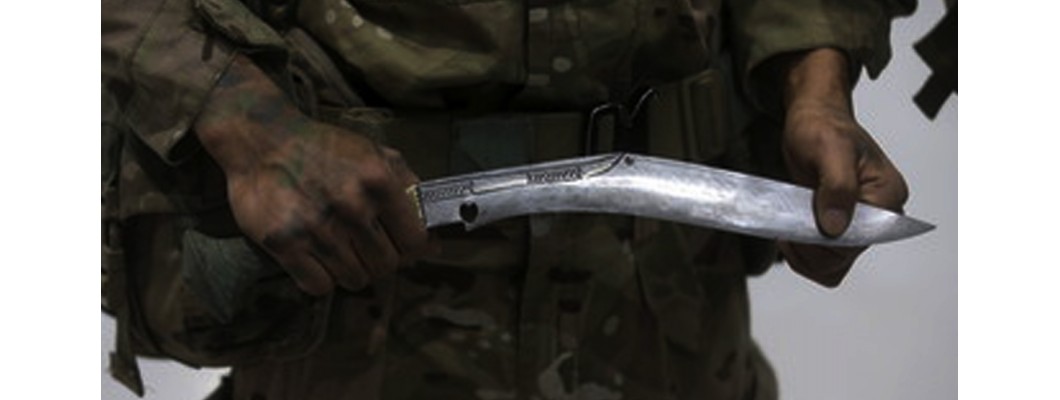
The Kukri (Khukuri): Nepal's Iconic Hand-Forged Blade
If you have ever seen a curved knife with a forward-leaning belly and wondered what it was, you were almost certainly looking at a kukri. The kukri is the national knife of Nepal, the standard-issue blade of the Gurkha soldier, and one of the most distinctive working blades in the world. It is also, depending on how you encounter it, a 2,500-year-old design, a household guardian worshipped annually at Dashain, a bushcraft tool celebrated by survivalists, a regimental emblem worn on cap badges across three continents, and the centrepiece of Nepali wedding altars and military retirement ceremonies. Few knives carry that much meaning. Few have earned it.
This is a buyer's introduction to the kukri — what it is, where it comes from, what people use it for today, and what to look for when buying one. If you have specific questions, the links throughout this article go to deeper references on our site. If you are ready to browse our hand-forged Nepali kukris, the full Everest Forge kukri catalogue is the place to start.
Quick Answer: What Is a Kukri?
A kukri (Nepali: khukuri, pronounced khoo-koo-ree) is a forward-curved single-edged knife originating from Nepal. The blade slopes inward in a pronounced curve, with a weighted belly that concentrates cutting force toward the front of the blade. This design gives the kukri the chopping power of a small axe combined with the precision of a knife — making it the most versatile single working blade most people will ever pick up.
The kukri is the national knife of Nepal, the standard-issue service blade of Gurkha regiments in the British and Indian armies, and a household working tool across the hill regions of Nepal. It has been carried continuously for over 2,500 years and remains in current military and civilian use today. The word khukuri is the original Nepali spelling; kukri is the international variation popularised through British military use after the Anglo-Nepalese War of 1814–1816. Both spellings are correct and refer to the same blade.
A 2,500-Year History in Three Paragraphs
The kukri's design lineage runs back to the ancient Greek kopis — a forward-curved chopping sword that travelled from the Mediterranean to South Asia with Alexander the Great's armies in the 4th century BC. The kopis design spread across the Indian subcontinent, evolved into shorter regional variants in the Indo-Nepali highlands, and eventually became the kukri shape we know today. Archaeological evidence of kukri-shaped blades in Nepal dates back to the early centuries AD, and the current refined form has been essentially stable for the last 500–600 years.
For most of its history, the kukri was a household and agricultural tool used by Nepali hill farmers for everything from chopping firewood to processing crops to ritual sacrifice. It became internationally famous after 1816, when the Anglo-Nepalese War ended with a treaty that allowed the British East India Company to recruit Nepali soldiers — the original Gurkhas. The Gurkhas brought their kukris into British military service, and the blade has been continuously issued to Gurkha regiments ever since. Every major conflict of the 20th century — both World Wars, the Falklands, the Gulf, Afghanistan — has featured Gurkha kukris in service.
Today the kukri exists simultaneously as a working tool, a military service weapon, a ceremonial object, a cultural symbol, and a globally-collected blade. The same Kathmandu workshops that supply the British and Indian armies also forge kukris for households across Nepal, for the international knife-enthusiast market, and for ceremonial and presentation purposes. For the full archaeological and historical detail, see our origin of the kukri page.
Why the Kukri Cuts Like Nothing Else
The kukri's distinctive forward curve is not decorative — it is the entire point of the design. Three things happen geometrically when you swing a kukri that don't happen with a straight knife:
- The weighted belly concentrates mass at the cutting edge. Most knives have a balance point in the handle. A kukri's balance point sits 2–3 inches forward of the handle, in the widest section of the blade. This means the cutting edge arrives at the target with momentum that the user did not have to generate through arm strength alone. The blade does most of the work.
- The forward angle increases effective cutting speed. Because the blade leans forward, the tip travels in a wider arc than the handle when you swing. The cutting edge accelerates relative to your hand — the same physics that makes a baseball bat hit harder at the tip than at the handle.
- The inward curve catches material on the draw stroke. When the kukri slices rather than chops, the inward curve naturally pulls vegetation and fibrous material onto the cutting edge. This is why kukris excel at clearing brush, harvesting crops, and slicing rope — the geometry does the gathering work for you.
Combine the three effects and a 10-inch kukri can outchop a 16-inch straight knife and outslice a 14-inch machete. This is not Gurkha mythology — it is straightforward physics, and it is the reason the kukri shape has remained essentially unchanged for centuries. Better designs were tried; this one won. To see how a hand-forged kukri is hammered into this shape in our Kathmandu workshop, see our forging guide.
What People Use a Kukri For Today
The kukri has six main contemporary use contexts, each served by a different category of blade. Match your use to the category and you will end up with the right blade.
1. Bushcraft, Camping, and Outdoor Work
The kukri is in active service with bushcraft enthusiasts, survival instructors, and outdoor workers worldwide. A 10–12 inch working kukri replaces an axe, machete, and large knife in a single tool — splitting kindling, clearing brush, building shelter, processing wood. For sustained outdoor use, a heavy-duty working kukri with full-tang construction is the right choice. See our heavy-duty working kukri collection.
2. Everyday Carry and Light Utility
Compact kukris in the 6–9 inch range work as everyday carry blades for users who want a kukri's chopping geometry in a more pocketable size. EDC kukris excel at camp food prep, garden trimming, opening packages, and light bushcraft. They are also the right entry-point for users wanting to learn kukri handling before moving up to a larger working blade. See our small EDC kukri collection.
3. Military Service and Service Replicas
The British Brigade of Gurkhas issues the current Service No. 1 kukri to every Gurkha soldier — specified under BSI 2008, 10.5-inch blade, 5160 spring steel, water-buffalo horn handle. Everest Forge produces this same specification for civilian collectors, current and former service personnel, and Gurkha-family members who want the authentic blade. See our current-issue military kukri collection.
4. Collection and Historical Replicas
Historical replica kukris reproduce documented kukris carried in specific campaigns (WWI Western Front, WWII Burma, Falklands), museum specimens, and regional patterns from specific periods of Nepali history. Hand-forged to period-accurate specification, not modernised. See our historical replica kukri collection.
5. Ceremony, Wedding Gifts, and Presentation
The Kothimora is the ceremonial kukri tradition — a working-quality blade housed in a silver-mounted scabbard, often decorated with traditional Nepali motifs. Kothimora kukris are presented at military retirements, diplomatic occasions, Gurkha weddings, and as major family heirloom gifts. The underlying blade is a full-quality Bhojpure or service-pattern kukri; what distinguishes the Kothimora is the silver mounts. See our Kothimora ceremonial kukri collection.
6. Traditional Regional and Household Use
Across Nepal, regional kukri patterns evolved for the specific geography, work, and culture of their origin: the broad-bellied Bhojpure, the slender Sirupate, the sickle-curved Salyani, the leaf-shaped Baspate. These are the working blades Nepali households have used for centuries — and the patterns most rooted in living tradition. See our traditional regional kukri collection.
Choosing Your First Kukri
If you are buying your first kukri, the two questions to answer are what size and what pattern.
Size guide
- 6–9 inch blade — Compact EDC and household size. Light, easy to carry, ideal for fine work and as a first kukri to learn handling on. Suits users with smaller hands or anyone wanting a versatile utility blade rather than a chopper. → Small EDC kukris.
- 10–12 inch blade — The classic working size. This is the standard Gurkha service length and the right size for most outdoor users. Balances chopping power with manageable weight. → Working kukris or military service kukris.
- 13–14 inch blade — Larger working and ceremonial size. More chopping mass, suits experienced users doing heavy outdoor work or buyers wanting a presence-piece for display or ceremony. → Working kukris.
- 15"+ blade — Oversized chopping and ceremonial. Significant chopping power, traditionally used for ritual sacrifice and large-scale brush clearing. Heavier, demands a confident user. → Large blade kukris.
Pattern guide
The seven main traditional patterns (and the contexts they suit):
- Bhojpure — Broad, heavy, deeply curved. The classic Nepali shape. Best for chopping-focused use and ceremonial blades.
- Sirupate — Slender, long, lightweight. Best for slicing, precision work, and users who prefer speed over mass.
- Angkhola — Single fuller along the blade reduces weight without losing rigidity. A lighter working pattern.
- Chirra — Multiple fullers (typically 2–3) along the blade. The lightest working pattern with retained chopping geometry. → Chirra fullered kukris.
- Salyani — Deeply curved, almost sickle-like. Specialised for sweeping vegetation cuts.
- Baspate — Balanced general-purpose pattern. The Nepali farmer's workhorse.
- Budhune — Compact household size (6–8 inches). Kitchen and small-task pattern.
For the complete glossary of every kukri term, pattern, and feature — see our kukri terminology guide. For handling and use specifics, see our handling guide.
The most common first-kukri choice
For most buyers, a 10–12 inch Bhojpure or service-pattern working kukri is the right starting point. Classic shape, useful working size, suits everything from outdoor use to display, and is the blade most Nepali users would recommend as the "first kukri" if asked.
What Makes an Authentic Hand-Forged Kukri
With kukris now sold by everyone from village smiths in Nepal to mass-production factories in China, "kukri" no longer means what it used to. The marks of an authentic hand-forged Nepali kukri:
- The cho (kaudi) notch. Every authentic Nepali kukri carries a small distinctive notch at the base of the cutting edge. The cho is interpreted as a stylised trishul (Shiva's trident) or a cow's hoof — both sacred in Hindu tradition — and dedicates the blade to a protective spiritual purpose. It also serves as a structural stress-relief point and a blood/fluid stop. Reproductions that omit the cho are dismissed by Nepali users as "not real kukris."
- Forged from 5160 high-carbon spring steel. Not stainless. The steel specified by the British Ministry of Defence for Gurkha service and used by every traditional Nepali workshop. Some smiths still forge from reclaimed truck leaf-spring stock, which is typically 5160 or a close equivalent.
- Differentially water-tempered. The cutting edge is water-quenched to hard steel; the spine is left softer. A faint temper line should be visible where the smith quenched only the edge. This is what allows the kukri to absorb impact through the spine without cracking at the tang.
- Hammer marks and slight asymmetry. Hand-forged blades show small variation between left and right side, subtle hammer-mark texture, and minor irregularities. Machine-stamped blades are eerily perfect — and that perfection is the giveaway.
- Water-buffalo horn or hardwood handle. Sealed with Laha (traditional Himalayan pine resin) on rat-tail tangs, or riveted on full-tang construction. Plastic or molded composite handles are factory production, not traditional hand work.
- Hand-stitched water-buffalo leather scabbard with karda and chakmak pockets. The scabbard should include the two small companion blades (karda utility knife + chakmak sharpening steel) in pockets on the back.
- Known forge attribution. A genuine hand-forged kukri has a workshop and smith behind it. If the seller cannot tell you who forged it, where, and from what steel, the blade is most likely mass-produced.
Read more about our forge testing standard at the Everest Forge battle-ready standard, and see our craftsmanship process at our craftsmanship page.
Caring for a Hand-Forged Kukri
5160 spring steel is high-carbon — meaning it holds an edge brilliantly but will rust if not maintained. The care routine is minimal once you have it:
- Wipe the blade dry after every use, especially if it has been wet or sweated on
- Apply a thin film of oil (mineral, camellia, 3-in-1, or traditional mustard oil) every 1–4 weeks
- Never store the kukri wet in the leather scabbard — moisture pits the blade within days
- Touch up the edge with the chakmak sharpening steel every few months of regular use
- For full sharpening, use a whetstone (medium 600–1000 grit, then fine 3000+ grit)
For the complete maintenance routine including rust removal, sharpening technique, scabbard care, and long-term storage — see our kukri maintenance guide.
Continue Learning About the Kukri
Everest Forge maintains a complete reference library on the kukri. Each page is the deep-dive for a specific topic touched on in this introduction:
- Kukri (Khukuri) Guide — The complete buyer's reference. Blade patterns, tang construction, military heritage, every detail.
- Origin of the Kukri — The full 2,500-year history from the Greek kopis to the modern blade.
- How a Kukri Is Forged — Inside the Kathmandu workshop, from 5160 spring steel bar to finished blade.
- Kukri Terminology Guide — Every part, pattern, and term explained. 45+ glossary entries.
- Kukri Handling Guide — Safe drawing, working grips, carry positions.
- Kukri Maintenance Guide — Sharpening with chakmak and whetstone, oiling, rust removal, scabbard care.
- Honor of the Kukri — The cultural and Gurkha tradition behind the blade.
- Kukri FAQ — Quick answers to common buyer questions.
Related to the kukri's blade-design lineage: curved blades — kukri, talwar, scimitar, and khopesh compared.
Buying a Kukri Outside Nepal — Country-Specific Guides
Everest Forge ships globally with DDP (Delivered Duty Paid) shipping, meaning import duties are included in the price and there are no surprise customs charges. If you are buying from outside Nepal, our country-specific guides cover the legal regulations, shipping timelines, and pattern recommendations for your region:
- Buying a Kukri from Canada — Canadian knife laws, import duties, and recommended patterns for Canadian customers.
- Buying a Kukri from the USA — US state-by-state knife laws, shipping times, and how Everest Forge custom kukris meet collector and working standards.
- Kukri Buying Guide for Australia — Australian import rules, bushcraft kukri recommendations, and regional knife legality by state.
Frequently Asked Questions
What is a kukri?
A kukri (Nepali: khukuri) is a forward-curved single-edged knife originating from Nepal, characterised by an inward-sloping blade with a weighted belly that concentrates cutting force toward the front of the blade. It is the national knife of Nepal and the standard-issue service blade of Gurkha regiments in the British and Indian armies. The kukri combines the chopping power of a small axe with the precision of a knife in a single working tool.
Where does the kukri originate from?
The kukri originates from Nepal, with a design lineage that traces back to the ancient Greek kopis — a forward-curved chopping sword that travelled to South Asia with Alexander the Great's armies in the 4th century BC. The kopis design evolved across the Indian subcontinent and became the kukri shape that has been continuously made in Nepal for over 2,500 years. The modern refined form has been essentially stable for the last 500–600 years.
How do you spell it — kukri, khukuri, or khukri?
All three spellings are correct and interchangeable. Khukuri is the original Nepali spelling. Kukri is the international/English-language variation popularised through British military use after 1816. Khukri is a common alternate Anglicised spelling. You will also see kukuri, khookri, kookri, and others — all refer to the same Nepali curved knife.
How do you pronounce kukri or khukuri?
Khukuri (the original Nepali) is pronounced khoo-koo-ree — three syllables, with stress on the first. The English pronunciation of "kukri" is typically KOO-kree — two syllables, slightly anglicised. Both are widely accepted in their respective contexts.
Why is the kukri curved?
The forward curve concentrates the blade's weight in the belly (2–3 inches forward of the handle) and accelerates the cutting edge during a swing. This means the blade does most of the chopping work through its geometry rather than through arm strength. The forward curve also catches material on the draw stroke — useful for clearing brush and slicing fibrous vegetation. The shape is not decorative; it is the entire reason the kukri cuts so effectively for its size.
What size kukri should I buy as a first kukri?
For most first-time buyers, a 10–12 inch blade is the right starting point — this is the classic Gurkha service size, balances chopping power with manageable weight, and suits everything from outdoor use to display. If you have smaller hands or want a more pocketable utility blade, a 6–9 inch compact kukri works well. If you specifically want chopping mass for heavy outdoor work, consider 13–14 inches.
What is the notch on a kukri blade?
The notch is called the cho or kaudi. It is the small distinctive notch hammered into the blade at the base of the cutting edge on every authentic Nepali kukri. The cho serves three purposes: structurally as a stress-relief point preventing cracks from propagating up the blade; functionally to stop fluids running back onto the handle; and spiritually as a stylised representation of Shiva's trident or a cow's hoof, both sacred in Hindu tradition. The presence of a cho is one of the most reliable markers of an authentic Nepali kukri.
What is a kukri used for?
The kukri is a working knife used for chopping wood, clearing brush, food preparation, bushcraft, household tasks, and outdoor work. It also serves as the standard-issue service knife of Gurkha soldiers and as a ceremonial object in Nepali culture — appearing in Dashain household worship, wedding ceremonies, and military presentation traditions. Modern buyers use kukris for bushcraft and survival, everyday carry, collection and display, gift-giving (especially Kothimora ceremonial kukris), and traditional cultural purposes.
How is a kukri different from a machete?
Both are large working blades, but the geometry is different. A machete has a straight or near-straight blade optimised for slicing through vegetation with sweeping cuts. A kukri has a forward-curved blade with a weighted belly that concentrates mass for chopping — making it more like a small axe in cutting power. In practice, a kukri can do most of what a machete does plus heavy chopping that a machete cannot, while a machete is lighter and faster for pure vegetation work. For combined bushcraft and chopping, kukris generally outperform machetes; for high-volume vegetation clearing alone, machetes are slightly faster.
Are kukris legal to own?
In most countries, owning a kukri is legal. Carrying one in public is regulated by local knife laws that vary significantly by country and (in the US) by state. As a general rule, fixed-blade knives over a certain length are restricted from public carry in most jurisdictions, though private ownership and use on private property are usually permitted. Always check your local knife laws before carrying a kukri in public. Our country-specific buying guides (linked above) cover the legal situation for Canada, the USA, and Australia in detail.
What steel are kukris made from?
Authentic hand-forged Nepali kukris are made from 5160 high-carbon spring steel — the same alloy specified by the British Ministry of Defence for current Gurkha service blades (BSI 2008). 5160 is high-carbon (not stainless), which means it requires oiling to prevent rust but holds an edge through hard work without rolling or chipping. Some traditional Nepali smiths still forge from reclaimed truck leaf-spring stock, which is typically 5160 or its close equivalent. Mass-produced "kukri-shaped" blades use a variety of cheaper steels — knowing your blade's steel is one way to distinguish authentic from imitation.
How long does a hand-forged kukri last?
With basic maintenance — regular oiling and proper storage — a hand-forged kukri lasts decades and is genuinely a multi-generation tool. The blade can be re-sharpened many times over its working life, the handle can be replaced if it ever cracks (one of the advantages of traditional rat-tail construction), and the scabbard can be re-stitched or rebuilt. Many Gurkha veterans retain their service kukris for life and pass them down to children and grandchildren as heirlooms. A well-made hand-forged kukri will outlive the buyer.
Ready to choose your kukri?
Every Everest Forge kukri is hand-forged by Kami-caste blacksmiths in Kathmandu — 5160 high-carbon spring steel, water-tempered, traditional construction. Free text personalisation. Photo approval before shipping. 30-day refund guarantee. DDP shipping with all duties included.

Leave a Comment