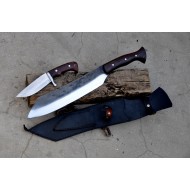
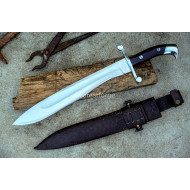
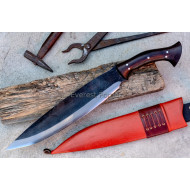
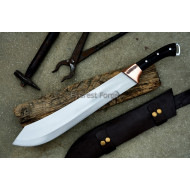
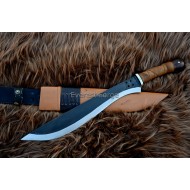
- Model: Machete
- Product Code: Machete0012Ko
- Location: Kathmandu,Nepal
Available Options
A Hand-Forged Curved Machete With a Jimped Spine
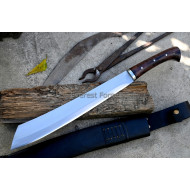
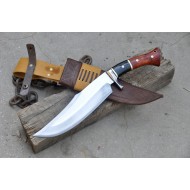
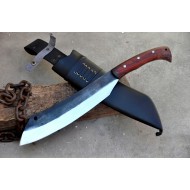
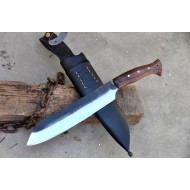
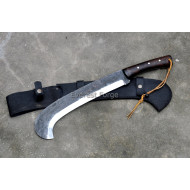
This is a hand-forged curved machete with a 12 inch single-edged blade that sweeps deep through its belly and widens as it goes, on a 6 inch handle of two-tone timber pinned through the tang between a polished steel bolster and a flared steel butt cap. The spine carries jimping just forward of the handle and there is a finger choil behind the ricasso. It comes with a plain leather sheath cut to the curve. Forged from 5160 high-carbon spring steel in our workshop in Tokha-3, Kathmandu, after your order arrives — so the stock thickness, the dimensions, the handle and the sheath are all yours to set at no extra cost.
The jimping and the choil are the quiet part of the design and they are the reason this blade does two jobs. Held normally with the hand behind the bolster it chops. Choked up, with a forefinger in the choil and a thumb on the filework, it trims and carves. A knife of this size with neither can only do the first, and most of them have neither.
The loud part is the weight, and the page is direct about it below rather than leaving you to find out.
An honest note. This is machete-shaped and it is not machete-weight. A true machete puts a 12 inch blade at roughly 250 to 400 grams — thin stock, light, built to be swung a few thousand times in an afternoon clearing soft growth. This one is 930 grams, which per inch of blade is two and a half to three and a half times that, and slightly above the stock we put into our own heavy kukris and khukuris. What you get is a chopper on a machete outline: it will go through seasoned wood and thick stems a real machete would skate off, and it will tire your arm far sooner on light clearing. That is a genuine trade rather than a fault, but it is the wrong tool if brush is the job — and the thin machete-weight build is free, so please ask for it rather than discovering the difference on the second hour.
Why It Is Built This Way
Full Specifications
Figures are taken from the blade shown and describe the standard build. Hand-forged work varies a little from piece to piece, so read these as close rather than exact. If a dimension matters, tell us before we start and we will build to it and measure the finished blade for you.
Build It Your Way
None of this costs extra, because none of it is made before you ask for it. Work down these six and put what you want in the order note.
Clearing brush? Order the thin build
The blade as photographed is a chopper, and for hard wood and camp work it is the right one. But if what you actually do is clear soft growth for hours at a time, thin stock with more distal taper through the forward half is a different tool entirely: lighter, faster, and far less tiring by the end of the afternoon. It costs nothing and adds no time. Tell us what you are cutting rather than which model you want, and we will put the right one on the fire.
Talk to the Forge →What It Does Well, and What It Does Not
What it does well
- It will cut things a real machete skates off. Seasoned wood, thick stems, bone: the stock is there to do it.
- Jimping and a choil placed where a hand actually goes, which turns one blade into a chopper and a close-work knife.
- A deep sweep carrying the mass forward, so the weight does the work on a downstroke instead of your shoulder.
- Steel bolster and butt cap at the two points a chopping knife loads hardest.
- A sheath genuinely cut to a blade that curves through most of its length, in plain leather with nothing pretending to be anything else.
- The thin machete-weight build is free, and we will tell you when it is the better choice rather than selling you the heavier one.
What it does not do
- It is not machete-weight. 77.5 grams per inch of blade against a true machete's 21 to 33 — two and a half to three and a half times the stock.
- That makes it tiring on a long session of light clearing, which is the one job a machete exists for.
- At 12 inches the blade is short for machete reach. Order 16 to 18 inches with the thin build if that is what you want.
- It is heavier per inch than our own heavy kukris and khukuris, which are deliberately thick chopping tools.
- Timber is handsome and it is not the best handle material for a tool that lives outdoors. Order micarta if it will.
- It is not stainless. 5160 rusts if left damp, and this is a blade that gets wet.
How to Order
Who It Is For
- Campers and smallholders who want one blade that chops seasoned wood and still trims, rather than a machete and a knife.
- Buyers who have snapped or bent a thin machete on something it was never meant to cut.
- Kukri and khukuri owners who want the same forward-mass idea on a different outline — and will recognise the weight immediately.
- Anyone who wants jimping and a choil placed where a hand actually goes rather than where they photograph well.
- Buyers who would rather be told a blade is not machete-weight than find out on the second hour of a clearing job.
- Anyone who intends to clear brush — with the recommendation that you order the thin build instead.
What Is Included
- The blade, hand-forged in Tokha-3, Kathmandu, Nepal.
- A plain leather sheath cut to the curve, contrast stitched, with two riveted retaining straps and a belt arrangement.
- A protective coat of oil on the blade for transit, wiped off before handling.
- Care instructions, and the Everest Forge manufacturer warranty against defects in materials and workmanship.
Build it around the job
Cane, bamboo, scrub, firewood, a boat, a smallholding: each of those wants a different length and a different thickness, and none of them wants the same blade. Tell us what you cut and how often, and we will design to that rather than adapt something from a photograph. It is the part of this work we are best at and it costs no more than picking from a list.
Start a Custom Forge Request →Related Blades and Reading
Shipping, Returns and Care
Dispatch and transit. Standard builds leave the workshop in 2 to 3 business days. Genuinely custom work — thinner stock, a longer blade, micarta scales, different jimping — runs 4 to 6 weeks depending on the queue. We ship by DHL or FedEx with tracking, typically 7 to 14 business days from Kathmandu, sheathed and braced in a rigid carton.
Duties, import and knife law. Import duty and local taxes are the buyer's responsibility and vary by country. A 12 inch blade is regulated differently in different places and is treated more strictly than a pocket knife almost everywhere, though a single-edged working tool is generally treated more leniently than a double-edged blade of the same size. Please check what applies where you live before ordering. If an unsharpened build would make the difference, we will supply one at no extra cost.
Returns and warranty. Because every blade is forged after the order, a custom build cannot be restocked, so please make sure the specification is right before you confirm. Anything damaged in transit, or showing a defect in materials or workmanship, is covered by the Everest Forge manufacturer warranty and we will repair or replace it. Photograph the packaging as well as the blade if something has gone wrong on the way.
Care. 5160 is a high-carbon steel and it is not stainless, and this is a blade that will get wet, so the habit matters more than the technique: wipe it down and oil it before it goes away, every time, rather than when it looks like it needs it. A working patina is fine and expected — orange bloom is what you are watching for, not grey. The jimping and the choil are the two places a cloth does not reach, and they are where rust will start; use a brush or a folded corner. The edge can be brought back with a file in the field. Do not store the blade in the sheath for long periods, since leather holds moisture against steel.
Questions About This Machete
Is this really a machete?
It is machete-shaped and machete-sized, and it is not machete-weight. That distinction is worth having before you order, because it changes what the blade is good at. A true machete has a 12 inch blade at roughly 250 to 400 grams: thin stock, light in the hand, meant to be swung several thousand times in an afternoon clearing soft growth. This one is 930 grams.
What you have instead is a chopper on a machete outline. It will go through seasoned wood, bone and thick stems that would fold a real machete, and it will tire your arm far sooner on light clearing. Neither is better; they are different tools. If sustained brush clearing is the job, ask for the thin build — it is free and it is covered below.
What is the filework on the spine for?
Thumb grip. The short row of cut notches sits just forward of the handle, exactly where your thumb goes when you choke up on a big blade for close work, and it gives the thumb something to bite on instead of a smooth polished spine. It is called jimping, and on a working knife it is the difference between control and hoping.
It matters most when your hands are wet or cold, which on a blade that lives outdoors is much of the time. It is also one of the few pieces of decoration on a knife that is genuinely functional — most spine filework on the market is cut where no thumb will ever reach it, which is worth checking on any seller's photographs. Ours is placed where the hand actually goes.
What is the notch cut into the edge behind the ricasso?
A choil, and it works with the jimping. It gives you somewhere to put a forefinger so you can grip the knife forward of the guard, which shortens the effective blade and turns a 12 inch chopper into something you can carve and trim with.
That combination — a finger choil below and jimping above — is what lets one blade do two jobs. Held normally with the hand behind the bolster it chops; choked up with a finger in the choil and a thumb on the jimping it does close work. A knife this size without either is a knife that can only do the first.
How heavy is it, and what does that change?
930 grams, which over a 12 inch blade works out at 77.5 grams per inch. A true machete runs between about 21 and 33 grams per inch, so this is two and a half to three and a half times the stock of the thing it is shaped like. It is also just above the top of the band we use for our own heavy kukris and khukuris, which are deliberately thick chopping tools.
In practice: more work done per stroke and fewer strokes before your arm complains. It bites into hard material a machete would skate off, and it is genuinely tiring on a long session of light clearing. Know which of those you need before you order, because the fix is free and it is the next question.
Can I have it built thinner, like a real machete?
Yes, at no extra cost, and if brush clearing is what you actually want the blade for, that is the build we would make you. Thinner stock with more distal taper through the forward half takes a great deal of weight out and brings the blade toward genuine machete handling — lighter, faster, far less tiring over a long session.
What you lose is the ability to chop seasoned wood without care, and some margin if the blade is ever levered or twisted in a cut. Tell us what you are cutting and we will tell you which build we would put on the fire. That conversation is more useful than a checkbox, and it costs you nothing but the time it takes to write it in the order note.
What size is it, and can I change it?
The standard build carries a 12 inch blade and a 6 inch handle, 18 inches overall. That is a default rather than a fixed specification — everything we make is forged after the order, so the dimensions are yours to set.
Twelve inches is short for a machete and about right for a chopper, which is consistent with everything else about this blade. If you want machete reach, 16 to 18 inches of blade is the usual range and we would pair that with the thinner build. If you want a camp chopper, this length is already correct.
What is the handle made of?
Two-tone timber scales pinned through the tang, with a polished steel bolster at the blade and a flared steel butt cap. The bolster and cap do the structural work at the two points where a chopping knife is most heavily loaded.
Grip material and colour are both selectable at no extra cost — horn, bone, micarta and leather over timber are all available. On a blade that will be used outdoors, micarta is worth considering: it is indifferent to damp and grips better wet than dry, which timber does not. We will match the sheath to whatever you choose.
Does it arrive sharp?
Yes, sharpened along the full working edge and ready to use, unless you tell us otherwise. On a blade with a belly this deep, the sweep is where the cutting happens and that is where the edge is finished most carefully.
Unsharpened builds are free for display or for an awkward import. A stage combat build — rebated edge, rounded tip — is also available at the same price, though on a working blade of this shape it is an unusual request.
What steel is it, and how is it heat treated?
5160 high-carbon spring steel, which we use across the whole range. The blade is forged to shape, quenched, and then tempered back by hand as a separate operation afterwards. Those two steps are distinct, and on a chopping tool the second matters more than on anything else we make: repeated shock finds an untempered edge immediately and chips it.
5160 is not stainless and is not meant to be. It rusts if left damp — and this is a blade that will get wet — and in exchange it takes and keeps an edge far better than any stainless we could sensibly forge, and it can be brought back with a file in the field rather than needing a workshop.
Where does it balance?
Forward of the bolster, which is correct for the shape and is most of the reason it cuts the way it does. The blade widens through the sweep so the mass arrives where the edge lands, and the steel butt cap claws a little of it back toward the hand.
We do not publish a single point-of-balance figure, because hand-forged work varies and a number an inch out is worse than none. Ask before dispatch and we will measure the actual knife we are sending you, from the bolster, and send you the figure.
What does the sheath include?
A leather sheath cut to the curve of the blade, stitched in contrasting thread, with two riveted retaining straps and brass studs, and a belt arrangement. Plain leather, no embossing — what you see is the hide.
It is built to this outline rather than to a pattern, which matters on a blade that sweeps this far: a sheath cut for a straight-backed knife will not take one that curves through most of its length. Colour, stitching and carry arrangement are all yours to specify.
How long does it take, and how is it shipped?
Nothing is held in stock. Every blade is forged after the order arrives, which is why the stock thickness, the dimensions, the handle material and the sheath are all free to change — there is no standard version already made. Standard builds dispatch in 2 to 3 business days; genuinely custom work runs 4 to 6 weeks depending on the queue.
It ships sheathed and braced in a rigid carton, by DHL or FedEx with tracking, typically 7 to 14 business days from Kathmandu. Import duty and local taxes are the buyer's responsibility and vary by country.
| Specification | |
| Blade: | 12 inches. Hand forged from 5160 carbon steel |
| Total Length: | 18 inches |
| Handle: | 6 inches. Full tang, pinned timber scales, steel bolster and butt cap |
| Weight: | 930 grams the blade, 1120 grams with the sheath |
| Note: | Handmade variation in weight, dimensions and finish may occur. Keep blade lightly oiled when not in use. |