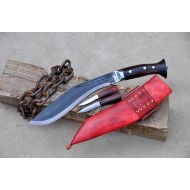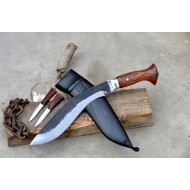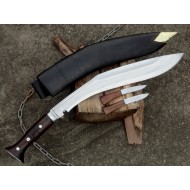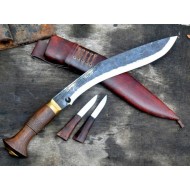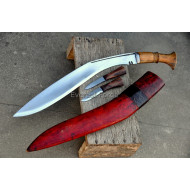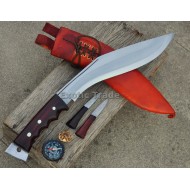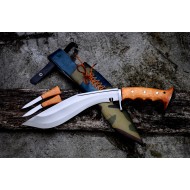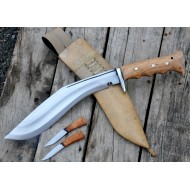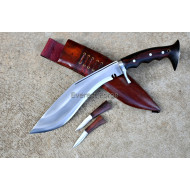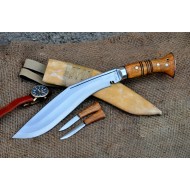
- Model: Signature Kukri/Khukuri
- Product Code: SCKOWN01
- Location: Kathmandu, Nepal
A Hand-Forged Fatman Scourge Kukri/Khukuri, Built the Way You Want It
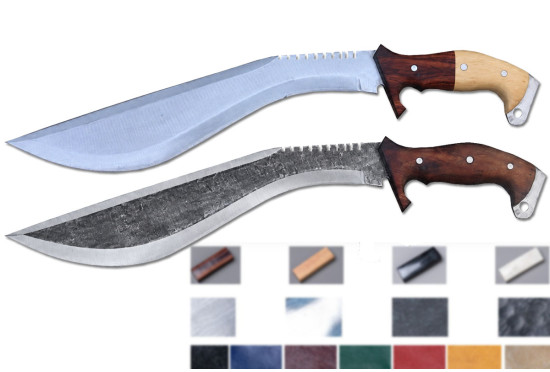
Choose the blade finish, the handle and the scabbard colour, then add your engraving — and we forge that exact khukuri. Every selection updates the preview on screen. There are 180 possible builds before personalisation, and each one is a piece our smiths in Kathmandu make routinely.
Underneath every combination is the same brute of a blade: 15 inches of hand-forged 5160 spring steel with an extra-wide belly and a convex edge, on a full tang riveted through a six-inch grip and carried in a stitched and laced leather scabbard. It is the biggest khukuri on our builder, and it is built for one thing above all — taking wood apart.
Your Three Choices
Blade length and construction are fixed on this pattern. For anything outside these options, use our custom forge service.
Why It Is Called the Fatman
Because of the belly. Every kukri/khukuri widens toward the front of the blade, which is what puts the mass where the cut lands. The Fatman takes that further than anything else we make: the belly is wider, the spine is heavier, and the forward curve is more aggressive, so the blade arrives at the wood carrying real momentum rather than needing you to supply it.
It grew out of our Scourge series, which is our tactical line of khukuris, and the two share a lineage but not a job. A Scourge is quick. The Fatman is not trying to be quick — it is trying to go through a branch in one swing. At 15 inches of blade it does what most people reach for a hatchet to do, and it does it with a blade you can also use to clear brush and butcher game.
The Convex Edge, and Why It Matters
This blade is ground with a convex edge, which is the geometry heavy Nepali khukuris have always used. Instead of two flat bevels meeting at a point, the steel curves gently into the edge, so there is more metal behind the cutting line.
Two things follow from that. It is far harder to chip or roll, which matters when a 15-inch blade meets a knot at speed. And it does not wedge: a flat-ground blade tends to stick in green wood, while a convex edge pushes the fibres apart and releases. What you give up is a little fine slicing ability, which nobody buys a Fatman for.
Sharpening is different too. A convex edge is maintained on a strop, a mousepad with sandpaper, or a slack belt — rolling the blade through the stroke rather than holding a fixed angle on a flat stone. Grind it flat on a bench stone over enough years and you will slowly turn it into a different knife. Our kukri/khukuri maintenance guide covers the method.
Which Blade Finish Suits a Chopper?
Handle and Scabbard
The grip is riveted through the full tang and shaped to be held hard. Rosewood is our standard: dense, stable and sure in a wet hand, and the best choice on a blade that puts real shock through the handle. Whitewood gives the strongest contrast against a dark blade. Buffalo horn is glossy black and takes a deep polish, though it is the least forgiving of very dry heated rooms. The three two-material grips — rosewood + whitewood, rosewood + horn and whitewood + horn — pair contrasting sections along the handle; because two materials wear at slightly different rates, the softer section shows handling marks first on a khukuri worked this hard.
The scabbard is leather with a stitched and laced closure, in six colours. Black and brown hide field dirt best on a blade that will see mud and sap; red, blue and green make a statement; white is the most striking and shows wear soonest.
Want a Fatman We Do Not List Here?
A longer or shorter blade, chirra fullers to take weight out, a guard, a karda and chakmak set or a fully traditional village pattern — anything outside this option list goes through our custom forge service, where we quote your build individually.
Request a Custom Forge →Why This Khukuri Works
Standard Build Specification
Blade and handle length are fixed on this pattern and do not change with your selections. Because every piece is hand-forged, small variation in weight, dimensions, grain, finish and sheath dye is normal.
An Honest Note on the Fatman
An honest note. Three things worth saying plainly. First, this is a heavy blade and it is meant to be. All that belly is what makes it chop, and it is also what you will feel in your shoulder after twenty minutes of clearing. It is not a knife for fine work, not a knife to carry all day, and not the khukuri to buy first — for general use our configurable survival khukuri or Defender suit better, and the 3 Chirra Beast gives chopping power with fullers taking some weight back out. Second, the convex edge wants convex sharpening; a bench stone used carelessly over years will flatten the geometry that makes this blade work. Third, 5160 is not stainless. It will rust if left wet or stored in a damp scabbard, so keep it lightly oiled.
The Fatman Suits
- Firewood, limbing and clearing, where one blade replaces a hatchet
- Landholders and bushcrafters who already own a normal khukuri and want the heavy one
- Game processing, where the wide belly does the work
- Anyone who wants to see their exact combination before it is forged
Look Elsewhere If
- This is your first khukuri — start with the survival or Defender builder
- You want to carry it all day — see the configurable EDC khukuri
- You want fine control for carving and food work
- You want a stainless blade that tolerates neglect
How Your Order Is Made
Caring for a Convex-Edged Khukuri
Wipe the blade dry after every session and keep a light film of oil on the steel; a blade this size collects sap along its whole length, so cover the full flat rather than the middle. Do not store the khukuri in its scabbard for long periods, because leather holds moisture against steel. Sharpen convex: a strop, a leather belt, or wet-and-dry paper over a mousepad, rolling the blade through the stroke so the curve is preserved. If the edge takes a dent from a knot or a hidden nail, take it back gradually rather than grinding a flat bevel into it. Check the handle rivets occasionally, since a chopper puts far more shock through the grip than a knife does.
Shipping, Returns and Warranty
Every piece is prepared at the forge in seven to ten days, and shipping adds a further seven to ten days. Orders to the USA and Canada travel with FedEx; everywhere else ships on a DDP service, which means duties and taxes are settled before the parcel moves so there is nothing to pay on delivery. Every piece carries the Everest Forge manufacturer warranty against defects in forging and heat treatment. Because a configured khukuri is made to your specification, it falls outside our standard returns window except where the blade is faulty — full terms are on our shipping and returns page. Import rules on large edged blades vary by country and are the buyer's responsibility to check before ordering.
Explore More Everest Forge Blades
Questions About the Fatman Scourge Kukri/Khukuri
What makes the Fatman different from a normal khukuri?
The belly. It is wider than any other khukuri we make, with a heavier spine and a more aggressive forward curve, so more mass sits where the blade meets the wood. The result chops harder than a standard khukuri of the same length, at the cost of being heavier in the hand and less suited to fine work.
What is a convex edge, and is it better?
Instead of two flat bevels meeting at a point, the steel curves gently into the cutting edge, leaving more metal behind it. On a heavy chopper that is better: it resists chipping, and it releases from green wood instead of wedging in it. On a fine slicing knife it would be worse. It is the geometry heavy Nepali khukuris have always used.
How do I sharpen a convex edge?
On something with give: a leather strop, a loaded belt, or wet-and-dry paper laid over a mousepad. Roll the blade through the stroke rather than holding one fixed angle, so the curve is kept. A flat bench stone used hard will slowly grind the convex into a flat bevel, which changes how the blade behaves in wood.
What is the extended tang at the butt for?
It gives a hard steel surface at the end of the handle for striking and driving — tapping in a peg, breaking something open, or a hammer-tap where you would not want to use the blade. It also adds a little counterweight behind the hand, which a blade this front-heavy needs.
Should I choose the Fatman or the 3 Chirra Beast?
Both chop hard. The Fatman is bigger and heavier at 15 inches of wide-bellied blade, and it hits the hardest of anything we make. Our 3 Chirra Beast is 12 inches with three fullers taking weight out, so it is quicker in the hand and easier to work with for long periods. Choose the Fatman if raw chopping power is the point.
Which handle should I choose?
Rosewood is our standard and the best on a blade that puts real shock through the grip: dense, stable and comfortable when wet. Whitewood gives the strongest contrast against a dark blade. Buffalo horn is glossy and striking, but can develop fine checks over years in very dry heated rooms. The two-material grips give a two-tone look on the same riveted full tang.
Which blade finish should I choose?
Raw forge and acid wash hide the marks a chopping blade collects, and black coated is the most rust-resistant and least reflective. Satin is the clean all-round choice and the standard build. Polished is the most imposing on a wall and will show its first scratch the first time you use it properly.
Does it come with karda and chakmak?
Not on this pattern, and not as an option in the builder. If you want the two companion pieces in scabbard pockets, ask through our custom forge service, or choose one of our khukuris that offers them, such as the configurable Defender.
Can I have a name or crest engraved?
Yes. Type the text into the personalisation field, or upload a crest, insignia, logo or photograph for us to reproduce. The wide flats on this blade give more room for artwork than any other khukuri in the range.
Is it too much knife for a first khukuri?
Honestly, for most people yes. The Fatman is the one you buy when you already know you want a heavy chopper. If this is your first, our configurable survival khukuri is a better place to start, and it will still split kindling and clear brush.
Will 5160 steel rust?
Yes, if you let it. 5160 is a high-carbon spring steel, not stainless, and on a chopping blade that trade is worth making: it absorbs impact instead of chipping, which harder stainless steels do not. Wipe it dry after every session, keep a light film of oil on it and do not leave it in the scabbard for months. Black coated and acid wash reduce the upkeep.
Can I order it left-handed or in another size?
Yes to left-handed: write "Left Handed" in the order note and the forge will take care of the rest. A different blade length, chirra fullers or a guard go through our custom forge service, where we quote your build individually.