
The Making — How Every Everest Forge Blade is Born
At Everest Forge, every blade begins its life not in a machine, but in the hands of a skilled blacksmith in Kathmandu, Nepal. Every sword, kukri, machete, dagger, knife, and spear we produce is individually forged, heat-treated, handled, and finished by craftsmen who have spent years perfecting their work. This is not mass production. No two blades are exactly alike. Each one carries the marks of real fire, real steel, and real hands.
This page covers everything — the materials we use, the options available to you, and the complete forging process from raw steel billet to finished blade.
Everest Forge — Built for Real Use
Every Blade Made to Order. Every Detail Your Choice.
Blade finish, handle material, scabbard style, and personalisation — all selected on the product page before you order. For something completely unique, submit a custom forge request and our smiths will build it from scratch.
Browse All Blades → Request Custom Forge →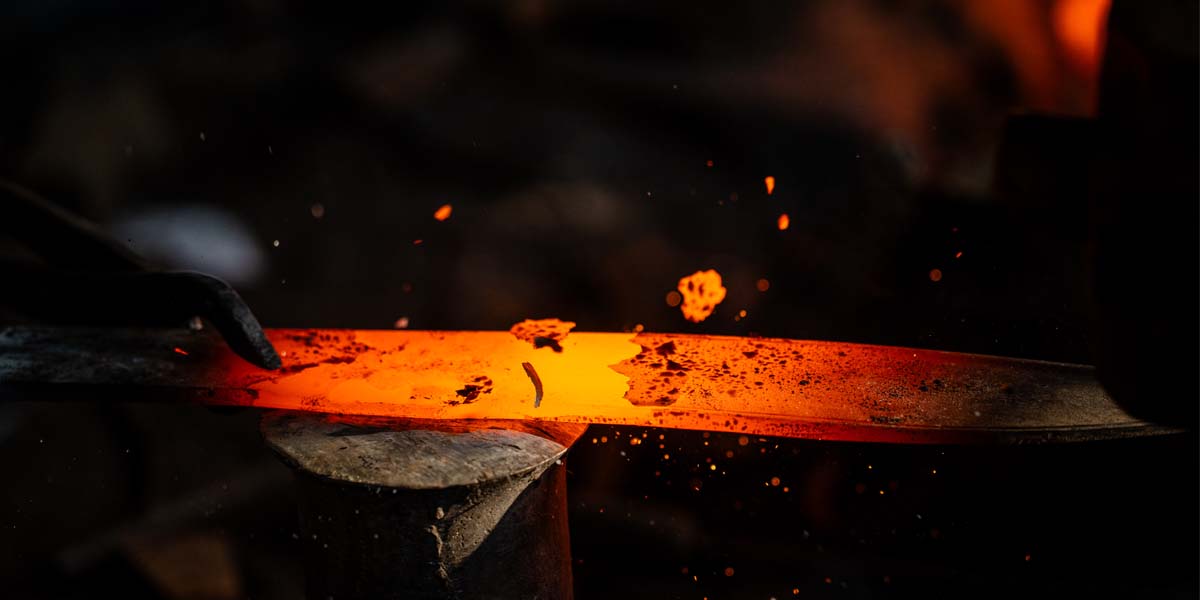
The Steel — Where It All Begins
The quality of any blade is determined first by the quality of the steel it is made from. At Everest Forge, we primarily use 5160 high carbon spring steel — the same material used in heavy-duty vehicle leaf springs, chosen for its extraordinary combination of toughness, flexibility, and edge retention. It is not the most expensive steel available. It is the right steel for blades that are built to be used.
5160 is a chromium-vanadium alloy steel with a high carbon content that allows it to take and hold a sharp working edge under hard use. Its flexibility means it absorbs shock and impact without cracking or chipping — critical for kukris chopping through hardwood, swords absorbing the force of a strike, and machetes clearing dense vegetation. For some specific designs we also work with EN45 and 1075 high carbon variants. All steel is selected and inspected before a single hammer strike is made.
To understand exactly why 5160 is our steel of choice and how it compares to other blade steels, read our full guide — Why 5160 Carbon Steel is Ideal for Swords, Knives, Kukris and Machetes.
Handle Materials — Your Options Explained
The handle determines how a blade feels in the hand — its grip, balance, durability, and character. At Everest Forge, every handle is fitted by hand. Below are the handle materials available across our range. Your selection is made directly on the product page before ordering.
Rosewood
Rosewood is one of the most widely used handle materials in traditional blade making — and for good reason. It is dense, naturally resistant to moisture, and warm in the hand. It takes finishing well, holds its shape over years of use, and develops a rich patina with age that synthetic materials cannot replicate. Rosewood handles are comfortable for extended grip and suit both working blades and display pieces.
White Wood
White wood is a lighter, cleaner-looking handle material with a natural pale appearance. It is used for blades where a traditional, unadorned aesthetic is the priority. It is lighter than rosewood and works well on blades where handle weight needs to be minimised to achieve a specific balance point. White wood handles can be left natural or finished with oil for added protection.
Horn
Buffalo horn is the traditional handle material for Nepali kukris and carries centuries of heritage. It is dense, hard, and naturally grippy even when wet — one of the most practical handle materials for outdoor and working blades that will be used in all weather conditions. Every piece of horn is slightly different in colour, pattern, and grain, which means no two horn-handled blades are exactly alike. Horn handles age well and become more characterful with use.
Bone
Bone handles carry a raw, traditional aesthetic that suits historical replica blades, daggers, and collector pieces. Bone is dense, hard, and takes carving and detailing well, which makes it a popular choice for decorative handles where surface work is part of the design. It provides a natural grip surface and pairs well with ornate fittings and guards.
Metal
Metal handles — typically brass, steel, or a combination — are used for blades where maximum durability and a distinctive visual weight are required. A metal handle adds significant heft and changes the balance profile of the blade, pushing the point of balance toward the handle. Metal handles are most commonly seen on ceremonial pieces, historical replicas, and blades designed for display where the visual impact of the full metal construction is part of the brief.
Combined and Joint Materials
Some of our designs use a combination of handle materials — horn and bone, wood and metal, or layered combinations that provide both the grip properties of one material and the visual character of another. Joint handle constructions are particularly common in traditional Nepali blade designs where different materials are used for different sections of the handle. If you want a specific material combination for a custom order, this can be requested through our Custom Forge page.
Leather
Leather-wrapped handles are used on specific blade types where a wrapped grip is part of the traditional or tactical design. Leather provides excellent grip, absorbs moisture from the hand during extended use, and conforms slightly to the grip over time. It is most commonly seen on survival blades, traditional working knives, and some spear designs. Leather wrapping can be combined with other handle materials for a hybrid construction.
All handles at Everest Forge are built using full tang construction — the blade steel runs the complete length of the handle and is secured with rivets or pins. There is no joint or separate connection point between blade and handle that can work loose or fail under stress. This is the strongest possible handle construction and it is used on every blade we forge.
Blade Finishes — Your Options Explained
The finish on a blade affects how it looks, how it resists surface marks, and how it performs over time. Your finish is selected on the product page before ordering. Here is what each option means.
Satin Finish
Satin is a smooth, semi-polished finish worked to a consistent sheen without the high reflectivity of a full mirror polish. It is the most versatile everyday finish — refined enough for display, practical enough for use, and resistant to showing minor handling marks. A satin finish suits both working blades and collector pieces and is the most commonly chosen option across our range.
Polished Finish
A polished finish is worked through progressively finer abrasives until the blade surface becomes fully reflective. This is the showcase finish — visually striking, immediately impressive, and the right choice for display pieces, collector blades, and presentation pieces where visual impact is the priority. A polished blade requires more care to maintain than a satin or raw finish, as fingerprints and light surface marks are more visible on a mirror surface.
Black Coated Finish
A black coated finish gives the blade a dark, non-reflective surface that eliminates glare and provides an additional layer of surface protection. It is a popular choice for tactical and survival blades where low visibility and corrosion resistance matter. The black coating gives the blade a purposeful, aggressive character that suits modern tactical designs and some historical interpretations.
Raw Forge Finish
A raw forge finish is exactly what it sounds like — the blade is left with the marks of the forging and grinding process visible on the surface. No polishing, no coating. This is the most honest finish we offer — the blade looks like what it is, a piece of steel that has been through fire and hammer. It is the right choice for buyers who want a blade that looks and feels like a working tool rather than a showpiece. A raw forge finish also requires the most attention to maintenance — the blade should be oiled regularly to prevent surface oxidation.
Scabbard Options — Your Options Explained
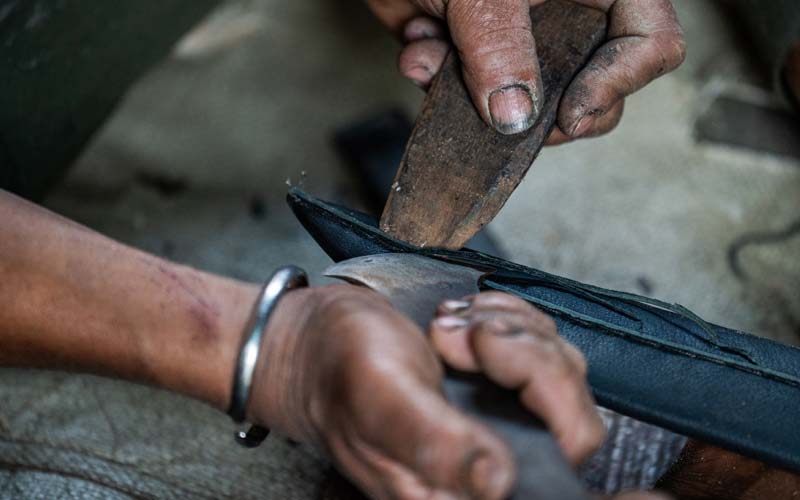
Every Everest Forge blade is paired with a handmade scabbard constructed to fit that specific blade. Your scabbard style is selected on the product page. Here is what each option provides.
Traditional Scabbard
The traditional Nepali scabbard uses a wooden core shaped to the exact profile of the blade, covered in leather and secured with traditional fabric or cord wrapping. The wooden core provides rigidity and protects the blade edge from contact with the scabbard walls. This is the style used on traditional kukris and Nepali blades for generations — the most authentic option for buyers who want the complete traditional Everest Forge experience.
Western Leather Scabbard
The western leather scabbard is a fully leather construction without a rigid wooden core — the style most commonly associated with hunting knives, swords, and European blade traditions. It is flexible, lightweight, and traditionally finished. Western leather scabbards are available in different leather colours and can be fitted with belt loops and frog attachments depending on the design. This style suits blades intended for carry and field use.
Wooden Scabbard
A wooden scabbard is a fully wooden construction — shaped, fitted, and finished in wood without a leather covering. It is the most rigid scabbard option and provides the maximum protection for the blade during storage and transport. Wooden scabbards are most commonly used for swords and longer blades where the rigidity of the wooden construction is preferred. They can be left natural, stained, or finished depending on the design brief.
The Forging Process — Step by Step
The forging process at Everest Forge follows the same fundamental sequence for every blade type — sword, kukri, machete, dagger, knife, or spear. What changes between blade types is the geometry, the profile, the heat treatment parameters, and the edge angle. The craft and discipline behind the process remain the same throughout.
Step 1 — Steel Preparation
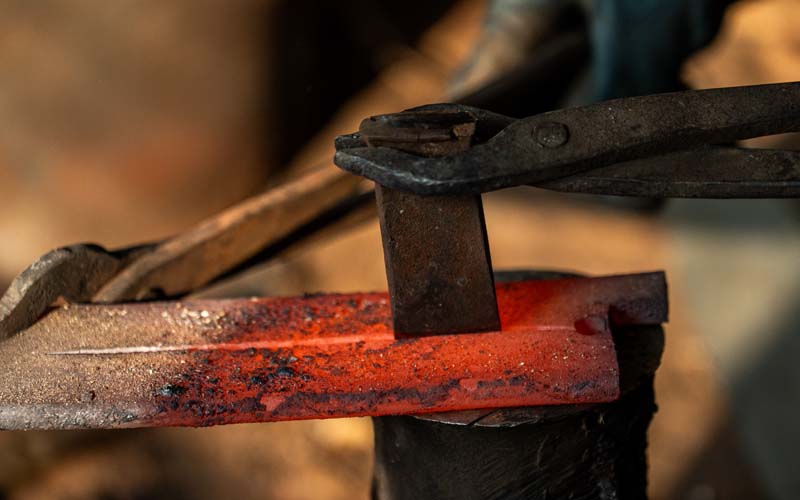
The raw billet is cut to the correct starting dimensions for the blade being forged. A sword billet is longer and heavier than a kukri billet, which is heavier than a knife billet. The steel is inspected for consistency before heating begins. Any inconsistencies are addressed at this stage. This preparation determines how cleanly the blade will form under the hammer.
Step 2 — Heating and Initial Forging
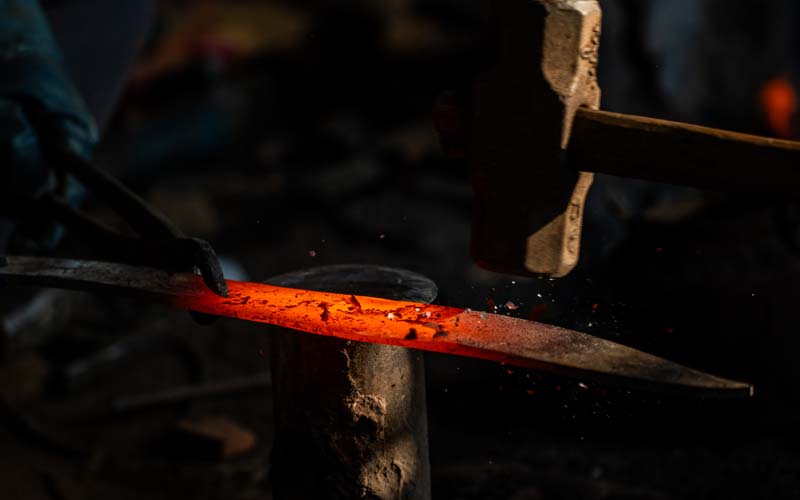
The billet is placed in the forge and brought to forging temperature. Our smiths judge this by eye — reading the colour of the glowing steel to determine when it is ready to work. At the correct heat, the metal moves under the hammer with precision. The blade profile begins to take shape through repeated hammer blows — drawing out the length, establishing the taper, and forming the geometry specific to the blade type.
For a kukri, the distinctive forward curve and belly are forged in at this stage. For a sword, the distal taper is established through careful controlled work. For a machete, the wide forward-weighted profile is hammered out for maximum chopping power. For a dagger, the symmetry of both edges is established from the beginning. For a spear, the socket and the transition from socket to blade are formed first. Each blade type requires a different approach from the first hammer blow.
The steel is returned to the forge multiple times across multiple heats. Each heat refines the profile and compresses the grain structure of the steel — building internal strength that no machine process can replicate.
Kukri — Dedicated Forging Guide
The Kukri Has Its Own Making Story
The kukri is one of the most technically demanding blades to forge correctly — its forward curve, belly geometry, and cho require specific knowledge and technique developed over generations in Nepal. We have written a dedicated step by step guide to the kukri forging process.
Read the Kukri Forging Guide → Browse Kukris →Step 3 — Normalising
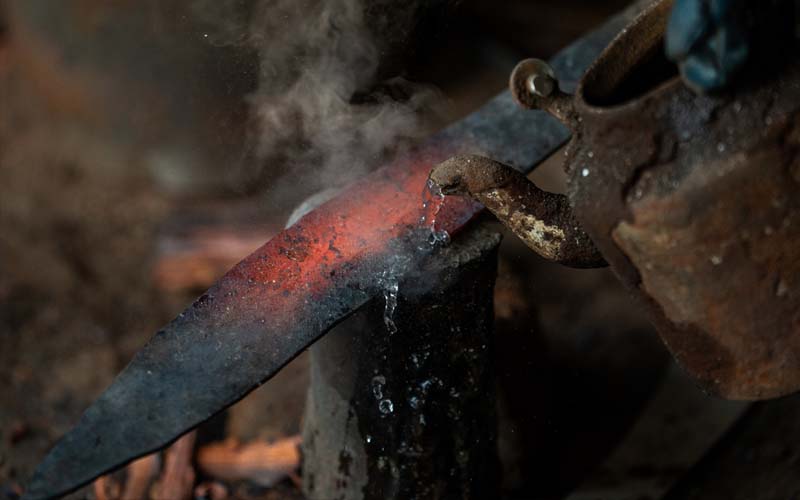
After initial forging, the blade undergoes normalising — a series of heating and slow cooling cycles to relieve internal stress in the steel and create a uniform grain structure throughout. This step is invisible in the finished blade but is critical for long-term performance and consistent heat treatment results.
Step 4 — Grinding, Shaping and Fuller Work
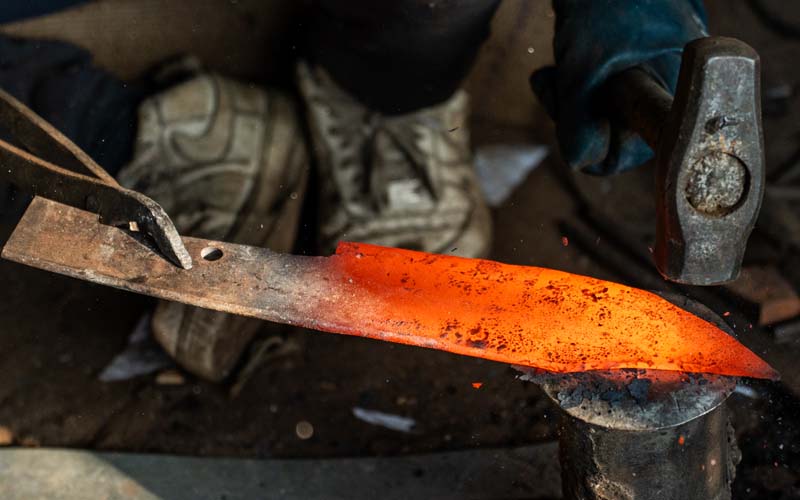
The bevel is established — the angle and geometry of the edge that determines how the blade cuts. Different blade types require different bevel geometries. A kukri and machete use a convex grind for chopping power and edge durability. A sword may use flat or hollow depending on its use. A hunting knife uses a flat or Scandi grind for easy field sharpening. A dagger carries a symmetrical grind on both faces.
If the design calls for a fuller — the groove that runs along the flat of the blade — it is forged or ground in at this stage. The fuller reduces weight without reducing structural strength and changes the stiffness profile of the blade. It appears on swords, on chirra kukri designs, and on some dagger profiles.
Step 5 — Heat Treatment
Heat treatment is the most technically demanding part of the entire process — the stage that separates a functional blade from a decorative one. Every Everest Forge blade is oil tempered. The blade is brought to critical temperature — the point at which the steel becomes non-magnetic and the carbon is fully in solution — and then quenched rapidly in oil. The speed of quenching locks the edge into a hard martensitic structure while the thicker spine retains more flexibility.
Tempering follows — a lower-temperature heat cycle that reduces brittleness while preserving hardness. The result is a blade with a hard sharp edge and a flexible spine that bends rather than breaks under lateral stress. Our smiths perform this process by hand, reading the temperature and making the call based on years of experience.
Step 6 — Handle Fitting and Assembly
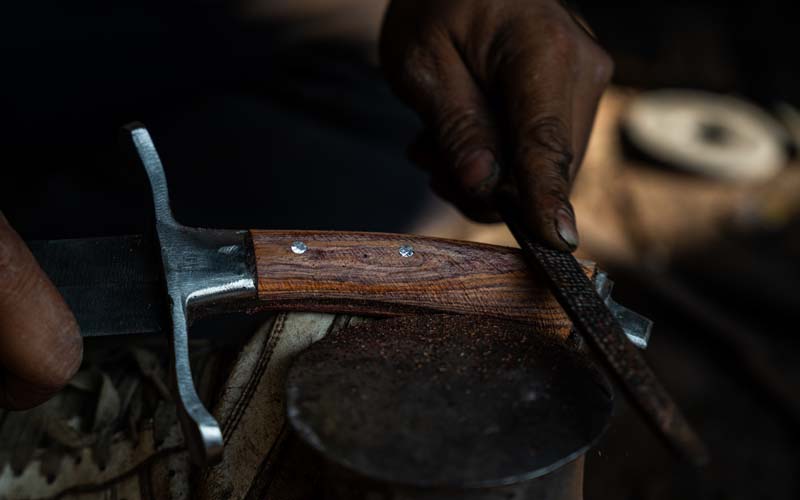
With heat treatment complete, your chosen handle material is shaped, fitted, and secured to the blade using full tang construction with rivets or pins. Guards, pommels, bolsters, and fittings are assembled to match the design. If engravings were specified — a name, initials, a date, a message, or a custom design — they are completed at this stage on the blade, guard, pommel, or scabbard.
Step 7 — Polishing and Finishing
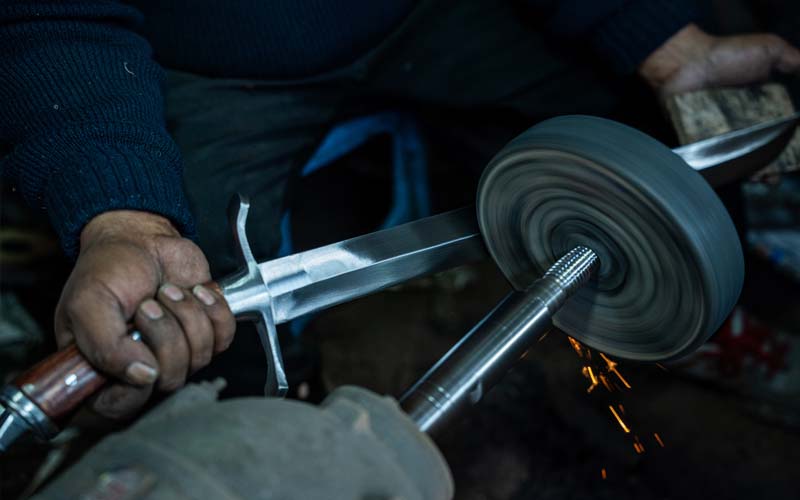
The blade receives its chosen finish — satin, polished, black coated, or raw forge. Each requires a different process and a different level of hand work. The edge is honed to its final working sharpness at this stage. Edge angle varies by blade type — a kukri or machete carries a more robust edge for chopping, while a hunting knife or dagger carries a finer more acute edge for cutting precision.
Step 8 — Quality Inspection and Testing
Before any blade is approved for shipping, it is tested. This means functional testing — controlled cuts on bamboo and hardwood to verify edge performance and blade integrity under real impact. Spine flex is checked. Handle fit is confirmed under force. Finish is inspected under direct light. Balance is verified against the specification for the blade type. A blade that fails any part of this inspection does not ship — it returns to the forge.
Step 9 — Customer Approval for Custom and Personalised Orders
For custom orders and blades with personalisation, photos and a short video of your completed blade are sent to you before shipping. You confirm that the blade matches your specification and that the personalisation is exactly as requested. Only once you give approval does the blade move to packaging and dispatch. This step gives you complete visibility before your blade leaves Nepal. For full details on this step read our After You Order page.
Step 10 — Packaging and Dispatch
Your blade is cleaned, protected, and packaged carefully with its scabbard to prevent any movement during international transit. Everest Forge ships worldwide using DHL Express with full tracking from dispatch. Delivery typically takes 7 to 10 business days after your blade ships from Kathmandu, Nepal.
Everest Forge — What Makes Us Different
Hand-Forged. Oil Tempered. Full Tang. Built for Real Use.
Every blade we forge is made to perform — whether for outdoor use, collection, martial arts, or heavy-duty work. Learn more about the craftsmanship and values behind Everest Forge.
Our Craftsmanship → Meet the Maker → About Everest Forge →Explore More About Everest Forge
> Why 5160 Carbon Steel is Ideal for Swords, Knives, Kukris and Machetes
> The Kukri Forging Process — Step by Step
> Our Craftsmanship | The Art of Hand-Forged Blades
> Meet the Maker | Hephaestus at Everest Forge
> Why Choose Us? | Quality Blades, Master Craftsmanship
> After You Order | What Happens Next
> Our Guarantee | Warranty, Replacement and Return Policy
> Legal and Import Guide | Know Before You Order
Frequently Asked Questions
What steel does Everest Forge use?
We primarily use 5160 high carbon spring steel — chosen for its toughness, flexibility, shock resistance, and edge retention. For some specific designs we also use EN45 and 1075 high carbon variants. Read our full guide on why 5160 is ideal for hand-forged blades.
What handle materials are available?
We offer rosewood, white wood, horn, bone, metal, combined joint materials, and leather. Each material has different properties in terms of grip, durability, moisture resistance, and aesthetics. Your handle material is selected directly on the product page before ordering.
What blade finishes are available?
We offer satin, polished, black coated, and raw forge finish. Satin is the most versatile everyday finish. Polished is for display and collector pieces. Black coated provides a non-reflective tactical surface. Raw forge finish leaves the blade with the marks of the forging process visible. Your finish is selected on the product page.
What scabbard options are available?
We offer a traditional scabbard with wooden core, a western leather scabbard, and a wooden scabbard. Each suits different blade types and carry preferences. Your scabbard style is selected on the product page before ordering.
What is full tang construction?
Full tang means the blade steel runs the complete length of the handle and is secured with rivets or pins. There is no joint between blade and handle that can work loose or fail under stress. All Everest Forge blades use full tang construction.
What is oil tempering?
Oil tempering is a heat treatment process in which the blade is heated to critical temperature and quenched rapidly in oil. This produces a hard edge for sharpness and a flexible spine for shock absorption — preventing chipping and cracking under real use.
Is there a dedicated guide for kukri forging?
Yes. The kukri is one of the most technically demanding blades to forge and has its own dedicated step by step forging guide. Read it at The Kukri Forging Process.
How long does it take to forge a blade?
Most standard blades are forged and ready within 3 to 5 days of production starting. Larger swords, complex custom builds, or blades with detailed engravings take longer. Everest Forge provides a realistic timeline with every order.