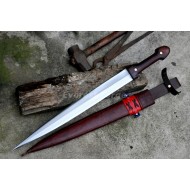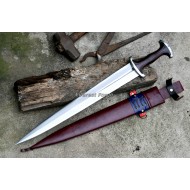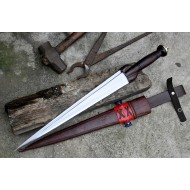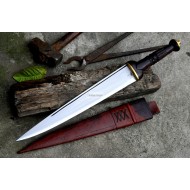

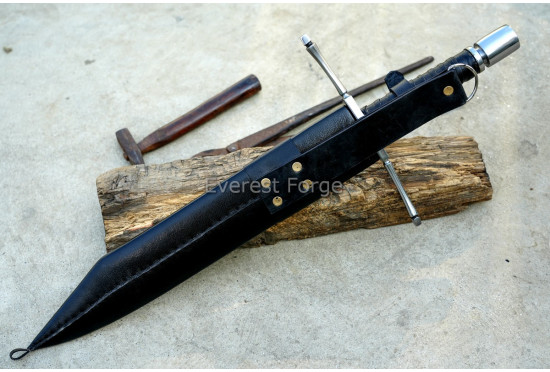


- Model: Hand forged Dagger
- Product Code: Dagger047
- Location: Kathmandu,Nepal
Available Options
Sword Breaker Dagger — Hand-Forged 16" Renaissance Parrying Dagger with Notched Blade in 5160 Spring Steel
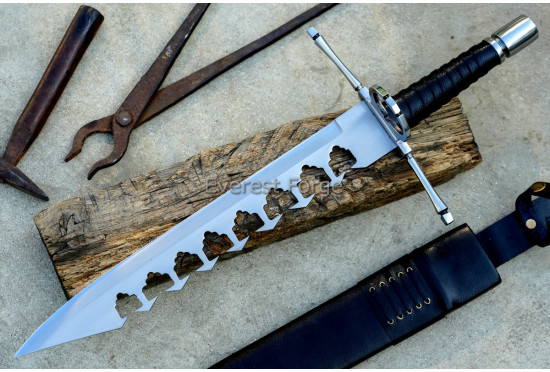
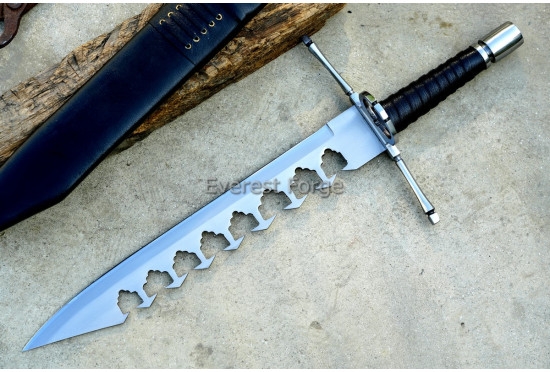
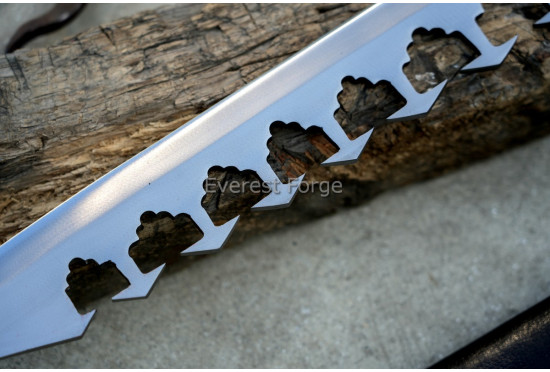
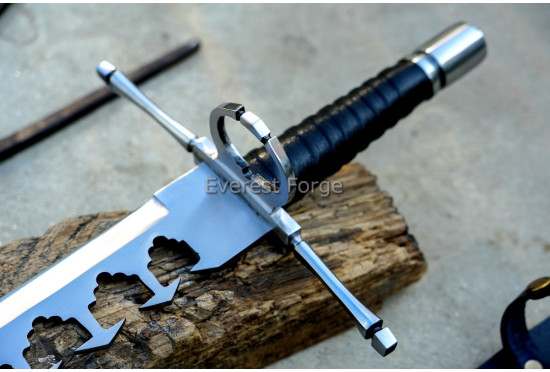
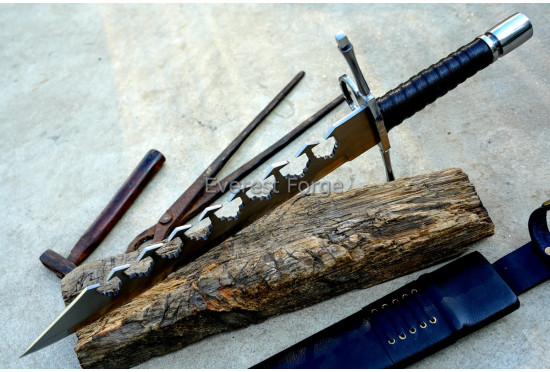
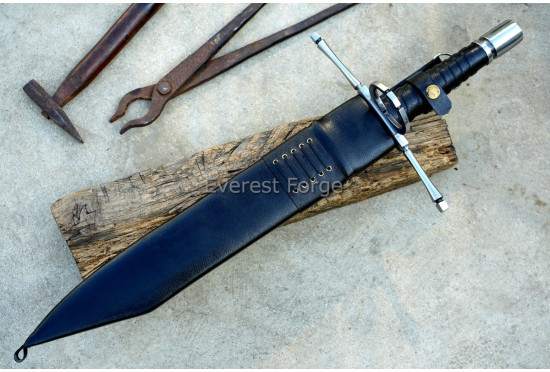
The functional Renaissance sword breaker (also known as a swordbreaker, sword catcher, or notched parrying dagger), hand-forged in Kathmandu, Nepal from 5160 high carbon spring steel, water-tempered, full tang, with a 7-inch leather-wrapped rosewood handle and hand-stitched leather scabbard. 16-inch default blade length with deep notched spine for catching, trapping, and disarming an opponent's blade — customizable from 10" to 20" (price adjusts with blade length), with optional finish upgrades, scabbard colour, handle wrap colour, and free personalized engraving.
The sword breaker is one of the most distinctive weapons in European martial history — a parrying dagger with deep notches cut along its spine, designed not to kill but to control. Used in the off-hand alongside a rapier or arming sword, the sword breaker's notched teeth could catch an incoming blade, twist it, trap it, and in rare cases snap it — turning a duel from raw force into a contest of timing and skill. Favoured by 16th and 17th-century duelists across Italy, Spain, and France, the swordbreaker remains one of the rarest and most sought-after weapons in Renaissance martial tradition.
This Sword Breaker Dagger by Everest Forge is not a stamped factory replica or a wall-hanger. It is a fully functional sword catcher, hand-forged in Nepal from reclaimed 5160 truck leaf-spring steel using the same battle-grade methods we use for our combat Roman gladii and Viking swords. The 16-inch blade is water-tempered for impact strength. The deep, precisely-spaced notches along the spine are forged and ground individually — the most demanding cut on any blade we make. The full tang runs the entire length of the rosewood handle, which is wrapped in leather for grip security under the lateral forces a sword breaker absorbs in real parrying use.
Whether you are a HEMA practitioner training in rapier-and-dagger systems, a Renaissance martial arts reenactor, a duelist of historical European fencing schools, or a serious collector seeking one of the rarest weapons of the European late Middle Ages and Renaissance, this hand-forged sword breaker is what you have been searching for. Made to order. Forged for use. Built to last decades.
Hand-Forged in Kathmandu — Made to Order
Order Your Sword Breaker Dagger — $224.99
16-inch hand-forged Renaissance parrying dagger in 5160 water-tempered spring steel. Full tang, sharpened working edge, deep notched spine for catching opponent blades, leather-wrapped rosewood handle, hand-stitched leather scabbard. Customizable blade length (10"–20" — price adjusts with length), finish options (mirror polish +$10, raw forge -$10), free choice of scabbard colour, handle wrap colour, and personalized engraving. Worldwide shipping via DHL Express & FedEx International. 30-day satisfaction guarantee. 6-month warranty on craftsmanship.
Read the Sword Breaker History →What Is a Sword Breaker? The Renaissance Dueling Dagger That Caught Blades
A sword breaker is a specialised parrying dagger with deep, comb-like notches cut along one edge of the blade. It first appeared in European arsenals around 1600, during the late Renaissance, at the height of the rapier-and-dagger dueling tradition. Where a standard parrying dagger could only deflect, the swordbreaker could capture — aligning an opponent's incoming rapier into one of its notches, then twisting the wrist to bind, disarm, or in some cases damage the trapped blade.
The name is dramatic, but slightly misleading. Renaissance rapiers and arming swords were forged from flexible, properly-tempered steel — built to withstand far more lateral force than a fighter's off-hand could generate. The sword breaker rarely "broke" anything in the literal sense. What it did was something more important in a duel: it controlled the opponent's primary weapon for the half-second a fencer needed to land a counter-thrust with their rapier or arming sword. Control was the goal. Disarmament was the result. The break, when it happened, was a bonus.
For this reason, swordsmen of the era sometimes called it the sword catcher rather than the sword breaker — a more accurate name for the weapon's actual combat function. Both terms remain in use today.
Why the Sword Breaker Is So Rare
Among Renaissance off-hand daggers, the sword breaker was always the rarest. Three reasons:
1. It was difficult to forge. The deep notches along the spine require precise hand-cut spacing, careful heat-treatment to avoid weakening the blade at the notch roots, and master-level grinding to keep the teeth sharp enough to bite without chipping. Every notch is a stress point. Get the geometry wrong and the dagger fails the first time it catches a blade. Only senior smiths attempted them.
2. It was expensive. Because of the forging difficulty, swordbreakers cost significantly more than equivalent main-gauche or trident daggers. They were owned by professional duelists, fencing masters, wealthy merchants' bodyguards, and noble heirs — not foot soldiers.
3. It required dedicated training. Catching a moving rapier in a notch demands precise timing, edge alignment, and footwork that took months or years of paired practice with a fencing master to develop. A standard parrying dagger could be used by a competent swordsman; the sword breaker required a specialist.
The combination of cost, skill, and difficulty meant that relatively few sword breakers were ever made. Surviving museum specimens are highly prized. Modern hand-forged reproductions like ours honour a weapon that even in its own era was already a sign of mastery.
Why This Sword Breaker Stands Apart
Real 5160 Spring Steel
Forged from reclaimed truck leaf-spring steel — the same battle-grade material we use in our combat Roman gladii and Viking swords. Tough, shock-absorbing, and built to withstand the lateral forces of catching and twisting an opponent's blade.
Hand-Forged Notched Spine
The defining feature of any sword breaker. Each notch is forged and ground individually by hand — not stamped, not laser-cut. Spacing is precise. Tooth geometry is consistent. The hardest cut on any blade we make.
Water-Tempered for Impact
Quenched in water and tempered to a working hardness that resists chipping when catching a strike. The notch roots are the most stress-prone area on any sword breaker — our heat treatment is engineered specifically to handle that load.
Full-Tang Construction
The 5160 steel runs the entire length of the rosewood handle as a single unbroken piece. No rat-tail tang, no welded joint, no glue-only fitting. Critical for a weapon designed to absorb sudden lateral forces during a parry-and-trap.
Leather-Wrapped Rosewood Grip
7-inch rosewood handle wrapped in genuine leather for shock absorption and grip security under the lateral wrist forces a sword breaker takes during real parrying. The leather can be re-wrapped over decades of use.
Made-to-Order Customisation
Choose blade length (10"–20" with price adjusting by length), finish options (mirror polish +$10, raw forge -$10), free choice of scabbard colour (6 options), handle wrap colour (6 options), and free personalized engraving. Made to your specifications — ideal for HEMA practitioners, reenactors, and collectors.
Product Specifications
Total Length
23 inches (58 cm) at default 16" blade
Blade Length
16 inches default — customizable 10" to 20"
Handle Length
7 inches, leather-wrapped rosewood, full-tang
Weight
Approximately 766g (1.7 lb)
Steel
5160 high carbon spring steel (reclaimed truck leaf spring)
Heat Treatment
Water-tempered for impact strength and edge retention
Tang
Full tang — steel runs entire handle length
Edge
Sharpened working edge (blunt option available on request)
Notched Spine
Hand-forged blade-catching notches along one edge
Scabbard
Hand-stitched leather over wood core
Origin
Hand-forged in Kathmandu, Nepal
Processing Time
3–5 business days (made to order)
Shipping
DHL Express & FedEx International — 5–10 business days worldwide
Warranty
6-month craftsmanship warranty — 30-day return guarantee
How a Sword Breaker Was Used in Combat
The Renaissance sword breaker was an off-hand weapon — held in the left hand (for right-handed fencers) while the rapier or arming sword stayed in the right. The fencer fought in what historical European martial arts (HEMA) practitioners now call "rapier-and-dagger" or "Espada y Daga" style. Both blades worked together as a single system — the sword for offence and reach, the swordbreaker for defence and control.
The combat technique unfolded in roughly three stages:
Stage 1 — the parry. When the opponent thrust with their rapier, the fencer angled the sword breaker's notched edge to intercept the incoming blade at a precise angle. Footwork mattered as much as wrist work — the dagger's notches needed to be aligned in three dimensions, not two.
Stage 2 — the catch. If timing and alignment were correct, the rapier's blade slid into one of the swordbreaker's deep notches. At that moment, the opponent's primary weapon was momentarily trapped — not held, but unable to retract or strike without first pulling free.
Stage 3 — the counter. With the opponent's blade caught, the fencer had a half-second window to act. Three options: twist the wrist to disarm or damage the trapped blade; bind the rapier in place while landing a thrust with their own sword; or release and reposition for the next exchange. The skilled swordbreaker fencer chose between these in real time based on the opponent's reaction.
Renaissance fencing masters like Ridolfo Capo Ferro (1580–1610) documented the technique in their treatises, with detailed plates showing footwork, edge alignment, and the precise moment of the catch. The technique survives today through HEMA reconstruction work and is practiced in fencing schools worldwide.
For a deeper exploration of the combat mechanics, read our blog post: How the Sword Breaker Dagger Was Used in Combat. For the broader history and origins, see Sword Breaker History — Origins, Use, and Legacy.
Customise Your Sword Breaker Dagger
Every Sword Breaker Dagger is hand-forged to order in our Kathmandu workshop. That means no warehouse stock and no mass production. Some options are free (scabbard colour, handle wrap colour, personalized text engraving). Others adjust the price up or down based on what you choose (blade length, finish). Either way, the dagger is built to your exact specifications. Tell us what you want when you place your order, and our smiths build it.
Blade Length (10"–20")
Default 16 inches matches the most common surviving Renaissance specimens. Smaller blades reduce the price (10" -$35, 12" -$20). Larger blades add a material charge (18" +$40, 20" +$95). Choose 10"–12" for a compact main-gauche-style breaker; 14" for a balanced fencing length; 18"–20" for a larger swordbreaker / short-sword crossover.
Blade Finish
Choose satin finish (default historical look), polished mirror finish (+$10, formal duel-display finish), raw forge finish (-$10, hammer marks visible), or blacked / coated (low-glare modern HEMA training finish).
Scabbard Colour
Default leather over wood core with stitched seam. Choose black, brown, yellow, red, green, or blue leather. Black and brown are the most historically accurate Renaissance choices.
Handle Wrap Colour
Default black leather wrap over rosewood. Choose black, brown, red, yellow, green, or blue leather. The wrap can be re-applied over decades of use.
Personalized Engraving
Add a name, initials, date, family motto, or a fencing-school motto engraved on the blade flat. Up to 30 characters at no extra charge. Popular with HEMA students, fencing masters gifting students, and collectors marking the weapon as theirs.
Custom Logo & Photo Engraving
Upload a custom logo, family crest, fencing-school sigil, or photograph for laser-engraved replication on the blade. Excellent for fencing-school orders, HEMA instructor presentation gifts, or one-of-a-kind heirloom pieces.
To order any combination of customisations, add the dagger to your cart and write your specifications in the order notes at checkout. We will email you a confirmation before forging begins.
Hand-Forged vs Mass-Produced Replica — What You're Actually Buying
Most sword breaker replicas on the market today fall into one of two categories. The first is stainless-steel decorative pieces — stamped or cast in factories, with shallow ornamental notches that would deform on first contact with a real blade. These are wall-hangers dressed up as functional weapons. The second is chrome-vanadium production blades from established replica brands — better than stainless, but typically rolled and machine-finished rather than hand-forged, with notches cut by mill rather than hammer-and-grind.
This sword breaker is in a third category. It is forged from real 5160 spring steel by Nepalese smiths who have made functional working blades for generations. The notches are forged in by hand. The heat treatment is calibrated specifically for the lateral stress a sword breaker takes. The full tang runs the entire handle length. If you handed this dagger to a Renaissance fencing master — or to a modern HEMA practitioner who trains with rapier and parrying dagger — they would recognise it as a real working sword breaker. If you handed them a stainless wall-replica, they would not.
The price difference reflects the fundamental difference: this is a real swordbreaker, not a film prop or a costume piece. It will outlive any decorative replica by decades and pass to the next generation as a true heirloom blade.
Who This Sword Breaker Is For
The Sword Breaker Dagger is a specialist weapon for specific buyers. If any of the following sounds like you, this is the right blade.
The HEMA practitioner
You train in Historical European Martial Arts — rapier, longsword, sword-and-buckler, or rapier-and-dagger systems. You want a sword breaker that's not just a costume piece but a real working off-hand weapon for paired drills with your training partners. Order the blunted training version (free option in your order notes) for sparring and contact drills, or the sharpened version for solo form practice and display.
The Renaissance martial arts reenactor
You participate in Renaissance fairs, reenactment groups, or the Society for Creative Anachronism (SCA). You want a historically accurate parrying dagger that looks correct in costume photos and feels right in the hand under the rules of your group. The 16" 5160 hand-forged sword breaker meets the authenticity standards of every reenactment community we know of.
The collector of rare historical weapons
You collect Renaissance arms and armour, parrying daggers, dueling weapons, or the obscure-and-specialised category of historical edged weapons. The sword breaker is one of the rarest weapons in Renaissance arsenals — even surviving museum specimens are uncommon — so a hand-forged modern reproduction belongs in serious collections of European late-medieval and early-modern weapons.
The fencing master or instructor
You teach historical fencing — Italian, Spanish, French, or German rapier traditions. You need teaching tools that demonstrate weapon types your students will only otherwise see in books or museums. A real sword breaker in your dojo is a powerful teaching aid — students can hold it, parry against it (blunted), and physically understand what the treatises describe.
The duelist of historical fiction
You are a fan of The Three Musketeers, Captain Alatriste, The Princess Bride, Renaissance-set historical novels, or Renaissance-period video games (Assassin's Creed, Kingdom Come Deliverance, For Honor). The sword breaker is one of the most cinematic Renaissance weapons — rare on screen, instantly recognisable, and visually striking. A real one in your collection connects you to that fiction in a tangible way.
The gift buyer
You are buying for a friend, partner, or family member who fences, reenacts, collects historical weapons, or studies military history. A custom-engraved Sword Breaker Dagger — with their name, a fencing-school motto, or a date — is a gift that gets remembered for life. Worldwide shipping with gift notes available.
How It's Made — The 4-Step Process
1
Steel Selection
5160 high carbon spring steel reclaimed from truck leaf springs — the same steel we use for our combat swords. Cut to billet size for your chosen blade length.
2
Hand Forging
Heated in a coal forge and shaped under the hammer. The blade is forged to profile, the tang drawn out, and the deep notches along the spine are hand-cut and ground individually by senior smiths.
3
Water Temper
Quenched in water for edge hardness, then tempered specifically for the lateral stress a sword breaker absorbs at the notch roots when catching an opponent's blade.
4
Finishing
Blade ground, sharpened, and finished. Rosewood handle fitted to the full-tang and leather-wrapped. Engraving applied if requested. Leather scabbard hand-stitched. Quality-checked before shipping.
Total time from order to dispatch: 3–5 business days for standard configurations. Custom engraving and unusual blade lengths may add 2–5 days.
What's Included
- Hand-forged Sword Breaker Dagger in your chosen blade length, finish, and handle wrap colour
- Hand-stitched leather scabbard in your chosen colour
- Personalized engraving if requested in your order notes (up to 30 characters at no extra charge)
- Care and maintenance guide with oiling instructions for the blade and leather components
- Certificate of origin identifying the Kathmandu workshop and date of forging
- Worldwide tracked shipping via DHL Express or FedEx International
- 30-day satisfaction guarantee — if you're not happy, return it for a full refund or rebuild
- 6-month craftsmanship warranty covering forging or fitting defects
Shipping, Returns & Warranty
Processing. Every Sword Breaker Dagger is made to order in our Kathmandu workshop. Forging and finishing takes 3–5 business days from the time your order is confirmed. Custom configurations with unusual blade lengths or extensive engraving may take an additional 2–5 days.
Shipping. We ship worldwide via DHL Express and FedEx International with full tracking from dispatch. Transit time is typically 5–10 business days depending on your country. Total time from order to delivery is generally 8–15 business days. Some countries restrict the import of bladed weapons — please check your local laws before ordering. Customs duties (if applicable) are the responsibility of the buyer and vary by country.
Returns. If you are not satisfied with your sword breaker for any reason, return it within 30 days for a full refund or a free re-build to different specifications. We cover return shipping if the issue is a craftsmanship defect.
Warranty. Every Sword Breaker Dagger carries a 6-month craftsmanship warranty against forging defects, handle separation, or scabbard failure under normal use. This warranty does not cover edge damage from misuse, rust from neglect, or damage from non-cutting impacts. For full terms, see our FAQ page.
Care & Maintenance
Oil the blade regularly. 5160 carbon steel is tough and battle-grade, but it will surface-rust if neglected — and the deep notches along the spine collect moisture and dust more readily than a smooth blade. Wipe down the entire blade, including inside each notch, with a thin coat of mineral oil, gun oil, or food-grade camellia oil after every handling and once a month during storage. A small brush or cotton swab helps reach the notch roots.
Care for the leather. The handle wrap and scabbard are real leather and benefit from periodic conditioning with leather balm or beeswax-based conditioner every 3–6 months. This prevents drying, cracking, and water absorption. The handle wrap can be removed and re-applied with fresh leather once it eventually wears.
Sharpen with a whetstone. The smooth cutting edges between notches take a fine edge readily. Use a 1000/3000 grit whetstone with a 20–25 degree angle. The notch tips do not need to be razor-sharp — their job is to catch and trap, not slice. A working edge is sufficient.
Care for the rosewood. Rosewood is naturally oily and durable, but a light rub with linseed or tung oil every 6 months keeps the wood from drying out under the leather wrap, especially in dry climates.
Inspect the notches and tang. Once a year, examine each notch for any sign of cracking at the root (where the notch meets the spine) and the tang pins for any looseness. The full-tang construction should remain rock solid for the lifetime of the blade, but inspecting is good practice for any working tool.
Full care guide on our FAQ page.
Everest Forge — Hand-Forged in Nepal Since 2010
Order Your Hand-Forged Sword Breaker Dagger — $224.99
16-inch hand-forged Renaissance parrying dagger in 5160 water-tempered spring steel. Full tang, sharpened working edge, deep notched spine, leather-wrapped rosewood handle, hand-stitched leather scabbard included. Customizable blade length (10"–20", price adjusts with length), finish options (mirror polish +$10, raw forge -$10), free choice of scabbard colour, handle wrap colour, and personalized engraving. Worldwide DHL & FedEx tracking. 30-day guarantee. 6-month warranty.
Browse All Daggers → Custom Forge a Variant →Frequently Asked Questions
What is a sword breaker?
A sword breaker (also written as swordbreaker, or called a sword catcher) is a specialised parrying dagger from the late Renaissance period, around 1600. It has deep, comb-like notches cut along one edge of the blade, designed to catch and trap an opponent's sword during a duel. It was used in the off-hand alongside a rapier or arming sword as part of the rapier-and-dagger fencing tradition. It is one of the rarest forms of historical European parrying dagger.
Did sword breakers actually break swords?
Rarely. Despite the dramatic name, the sword breaker's primary function was to catch, trap, and control an opponent's blade — not to snap it. Renaissance rapiers were forged from flexible, properly-tempered steel that could withstand far more lateral force than a fighter's off-hand could generate. The breaks that did happen were on lower-quality blades or thinner late-period smallswords. The real value of the sword breaker was creating a half-second window of control during a duel — long enough for the fencer to land a counter-thrust with their primary weapon. The name "sword catcher" describes the actual function more accurately.
How do you actually use a sword breaker in combat?
The technique unfolds in three stages: parry (intercept the opponent's incoming blade with the notched edge of the dagger), catch (align the timing and angle so the opponent's blade slides into one of the notches), and counter (twist to disarm, bind to immobilise, or release and reposition). Renaissance fencing master Ridolfo Capo Ferro (1580–1610) documented the technique in detailed treatises. We cover the full combat sequence in our blog post, How the Sword Breaker Dagger Was Used in Combat.
What's the difference between a sword breaker, a main-gauche, and a trident dagger?
All three are Renaissance parrying daggers used in the off-hand. The differences: main-gauche is a smooth-bladed parrying dagger with wide quillons and a hand guard — the most common type. Trident dagger has spring-loaded blades that fold open into a three-pronged catcher when triggered. Sword breaker (this product) has deep notches along the spine to actively catch and trap the opponent's blade. The sword breaker and trident were the rarest types because both required master smiths and significant additional cost over the standard main-gauche.
What blade length should I choose for a sword breaker?
Default is 16 inches, which matches the most common surviving Renaissance specimens and works for general HEMA, reenactment, and display. Choose 10"–12" for a compact main-gauche-style sword breaker (better for tight grips and modern HEMA paired-drill use). Choose 14" for a balanced length favoured by Italian schools. Choose 18"–20" for a larger swordbreaker / short-sword crossover, more in the Spanish tradition. The 16" default is the most balanced choice if you're not sure.
Is the sword breaker sharpened, and can I order it blunt for HEMA training?
Yes — every Sword Breaker Dagger ships with a sharpened working edge by default. For HEMA paired drills, reenactment sparring, or stage combat, mention "blunted training version" in your order notes at checkout — we'll round the point and remove the cutting edge while keeping the notch geometry exactly as designed. There is no extra charge. The blunt option is what most HEMA practitioners actually use for contact training. The sharp version is for solo form practice, display, and collectors.
Can the notches actually catch a real blade?
Yes — the notches on this sword breaker are forged and ground to functional Renaissance specifications. Used correctly with proper rapier-and-dagger fencing technique, they will catch and bind an incoming blade. Important: we strongly recommend practicing the technique with the blunted training version against a partner using a blunt rapier or feder, under the supervision of a qualified HEMA instructor. The technique requires precise timing and edge alignment that takes months of training to develop safely. Do not attempt blade-catching with sharp weapons.
What handle materials are available?
Default is rosewood wrapped in leather, which is the historically accurate Renaissance choice and provides the shock absorption and grip security needed under the lateral wrist forces a sword breaker absorbs in real parrying. The leather wrap is available in 6 colours. We can also offer plain rosewood (no leather), buffalo horn, bone, or antler on request — mention your preference in your order notes. The leather-wrapped rosewood remains the most functional choice for HEMA and reenactment use.
Can you add personalized engraving or a fencing-school logo?
Yes — this is one of our most popular customisations for sword breakers. Common requests: fencing-school mottos, the recipient's name or initials, a master-to-student dedication date, a family crest, or a Latin motto in keeping with the Renaissance aesthetic. Up to 30 characters of text engraving included free. For logos or photographs, upload your file at checkout. We've engraved sword breakers for HEMA schools, fencing instructors, and master-to-student presentation gifts.
Do you ship the Sword Breaker Dagger worldwide?
Yes — we ship to most countries worldwide via DHL Express and FedEx International with full tracking. Your GSC data shows our biggest demand is the United States (about 65% of orders), with strong secondary demand in Germany, Japan, Austria, and Poland. Some countries restrict the import of bladed weapons — including Australia, the UK, and parts of the EU. Contact us if you're unsure about your country's import laws before ordering. We can supply a blunted version to assist with import in restricted regions.
How long will the sword breaker take to arrive?
Forging and finishing in our Kathmandu workshop takes 3–5 business days — the notches require senior-smith work and we don't rush them. DHL Express or FedEx International delivery takes another 5–10 business days. Total time from order to delivery is typically 8–15 business days. Custom configurations with unusual blade lengths, multiple customisations, or extensive engraving may add 2–5 days to the forging stage. Tracking information is sent by email as soon as the dagger ships.
Are sword breakers legal to own and import?
In most countries, ownership and private collection of historical edged weapons including sword breakers is legal. Import laws vary — some countries restrict bladed weapons over a certain length, some require import licences, and some (Australia, UK, parts of EU and Asia) have stricter rules. We strongly recommend checking your country's import laws before ordering. For HEMA training and reenactment use, the blunted version may be easier to import in restricted regions. Contact us for country-specific guidance before ordering.
Where can I learn more about the history and combat use of the sword breaker?
We've published two in-depth blog articles on this weapon: Sword Breaker History — Origins, Use, and Legacy covers the weapon's emergence in 16th-century Europe, its evolution from earlier parrying daggers, the Italian and Spanish design schools, surviving museum specimens, and its place in Renaissance fencing tradition. How the Sword Breaker Dagger Was Used in Combat covers the actual fighting technique — the parry, catch, and counter sequence, footwork, and references to surviving fencing treatises. Both articles are free to read.
Can I order a fully custom sword breaker, sword breaker sword, or trident dagger?
Yes. We build fully bespoke parrying weapons through our Custom Forge service. We can forge: a longer sword breaker sword (20"–25" blade for two-handed bind work), a trident dagger with spring-loaded folding blades, a custom main-gauche with wider quillons, custom historical hand-guard designs, blade engraving in any pattern, or fully one-of-a-kind designs from your sketch or museum reference photo. Custom Forge starts at $75 USD and pricing scales with complexity.
| Specification | |
| Blade: | 16 inches long Blade is forged from carbon steel. |
| Total Length: | 21 inches long in total |
| Handle: | 6 inches full tang Handle Crafted from Rosewood., Wrapped in Leather. |
| Weight: | 513 Grams approx. |
| Note: | Each Sword Breaker Dagger is individually hand-forged at Everest Forge. Due to the artisanal process, slight variations in weight, finish, and handle texture may occur. This makes every piece unique and historically authentic—ideal for collectors, historical martial artists, and reenactors. |