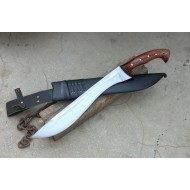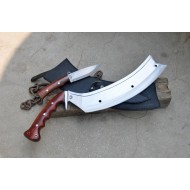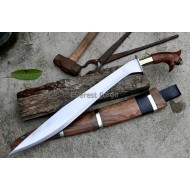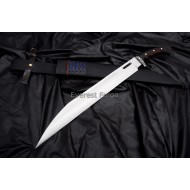
- Model: KHOPESH SWORD
- Product Code: DSekhmet’sClaw
- Location: Kathmandu, Nepal
Available Options
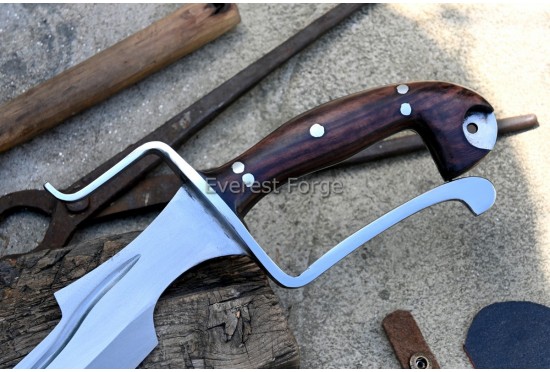
Sekhmet's Claw Khopesh with D-Guard · Egyptian Lion Goddess Weapon · Battle-Ready
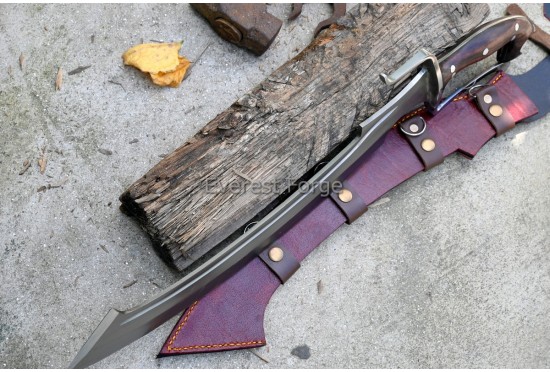
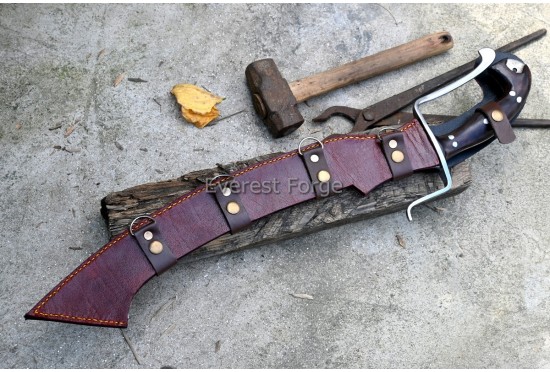
The Sekhmet Weapon — Hand-Forged Egyptian Sickle-Sword with Steel D-Guard
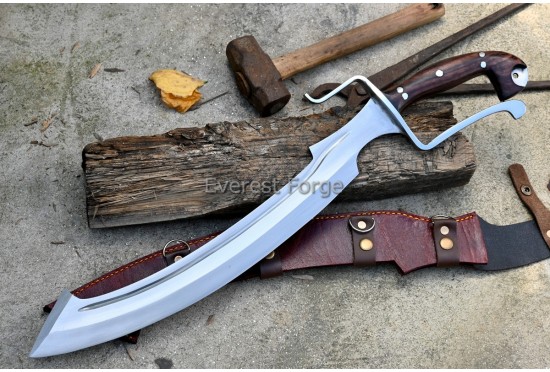
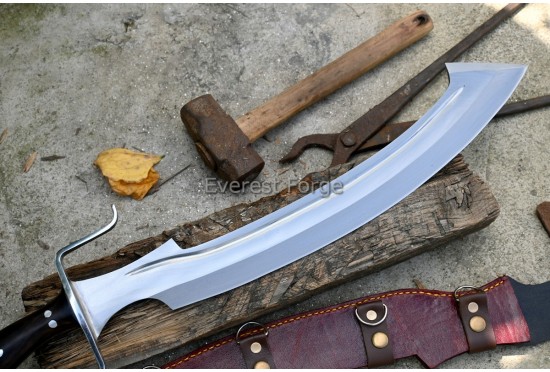
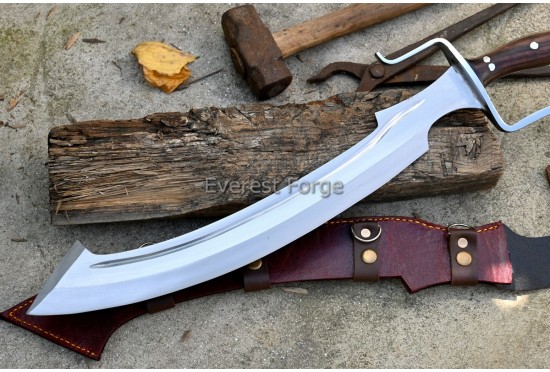
Sekhmet — "She Who Is Powerful" — was the lion-headed Egyptian goddess of war, born from Ra's fiery eye, protector of pharaohs, healer and destroyer in one. This is the weapon named for her: a hand-forged 19" Khopesh sickle-sword in 5160 spring steel, modernized with a full steel D-guard knuckle bow over the rosewood grip. The blade is Bronze Age authentic. The hand protection is European-tradition functional. The result is the Sekhmet's Claw built to actually wield — sparring, cutting practice, reenactment, or display. Then customized to you: finish, handle wood, blade length, scabbard color, engraving.
A Modern-Functional Hybrid — Honestly
We want to be straight about what this sword is and isn't. It is not a museum-accurate Bronze Age reproduction — and that's the point.
The Blade Is Ancient Egyptian
The 19" sickle-sword geometry is faithful to the New Kingdom Khopesh pattern — the same forward-curving hook, the same hooked inside edge, the same cut-and-pull mechanics Egyptian elite infantry used from 1550 BCE forward. This part is historically accurate.
The D-Guard Is European Engineering
The full-knuckle D-guard is a 16th-17th century European innovation — first used on cavalry sabres, naval cutlasses, military backswords, and most famously the American Civil War Confederate D-Guard Bowie. It is not historically Egyptian. We are not pretending it is.
The Combination Is Functional
Putting them together gives you what no historical Khopesh actually offered: hand protection in active use. If you'll display the blade, choose our standard Sekhmet's Claw for clean historical line. If you'll actually swing it, the D-Guard is the upgrade you want.
Why "Sekhmet's Claw"?
The name is not decoration — it's the entire identity of this sword. Sekhmet was the lion-headed Egyptian goddess of war, daughter of Ra, protector of pharaohs, healer and destroyer in one. Her sacred animal was the lion. A lion's claw is forward-curving and hooked — exactly the geometry of the Khopesh blade. When the goddess of war was depicted leading pharaohs into battle, this is the silhouette her power took in human hands.
The Eye of Ra. Ra grew angry with humanity's disobedience and sent a piece of himself — his burning eye — to earth as a lioness. That lioness was Sekhmet. She devastated the world with such fury that Ra himself ordered her to stop. She would not. Only when 7,000 jugs of beer dyed red with pomegranate juice were laid in her path did she drink, fall asleep for three days, and wake with her bloodlust sated.
Protector of the Pharaoh. Sekhmet led the pharaoh's armies into war. Her image appeared on royal battle insignia. Amenhotep III had hundreds of her statues placed in his funerary temple at Thebes. Her warriors were said to be filled with her divine fury.
Healer of Plague. The same goddess who brought disease as punishment could also cure it. Her priests were the royal physicians of ancient Egypt. She was the "Lady of Life." This duality — destroyer and healer in the same divine breath — is what made Sekhmet uniquely powerful in the Egyptian pantheon. A weapon named for her carries both halves of that meaning.
Wife of Ptah. Sekhmet was wife to Ptah, god of artisans and craftsmen — a fitting patron deity for any hand-forged blade. Together with their son Nefertem, lotus god of sunrise, they formed the Memphite Triad. This was the central divine family of New Kingdom Memphis, the same era when the Khopesh reached its peak as the pharaonic sidearm.
The Steel D-Guard — What It Does
The D-guard is a single piece of steel forming a closed loop from the cross-guard to the pommel, wrapping the back of your hand. It is not decoration; it is functional engineering.
Knuckle Protection
In any close-quarters sword exchange, the hand is the most exposed target — once you can't grip, the fight is over. The D-guard closes that vulnerability. This is why every cavalry sabre and military cutlass from 1700 onward had one.
Blade Trapping & Parrying
The closed steel loop gives you a structure to catch and bind an opposing blade — useful for sparring practice, HEMA-adjacent training, or actual stage combat where you need to control where the other blade ends up.
Secure Grip Under Force
Sweat, blood, exertion — all of them loosen a bare-handle grip. The D-guard adds a second point of mechanical contact between your hand and the weapon. The sword stays in your hand under cuts and impacts that would lose a standard handle.
As Reviewed by Medieval Review
The Sekhmet's Claw D-Guard Khopesh was featured by Medieval Review, an independent weapons-review channel on YouTube. Watch their full review of the blade, the D-guard build quality, and the cutting performance in real-world handling.
Video by Medieval Review. Embedded with credit. Everest Forge does not edit or alter independent reviews.
Customize Your D-Guard Sekhmet's Claw
The D-Guard Sekhmet's Claw shares the full customization range of our Sekhmet line — four finishes, eight handle materials including bone and horn, six blade lengths from 16 to 26 inches, six scabbard colors, and free engraving.
Choose Your Blade Length
The default 19-inch blade gives you an agile sparring-and-cutting profile — long enough for real reach, short enough for one-handed control under the D-guard. Customize from compact 16-inch up to ceremonial 26-inch.
- 16 inches (-$20) — compact, fast in the hand
- 18 inches — short sidearm
- 19-20 inches — default working scale
- 22 inches (+$20) — extended reach
- 24 inches (+$45) — pharaoh-guard scale
- 26 inches (+$75) — ceremonial / parade scale
Choose Your Handle Material
The grip beneath the D-guard is yours to choose. Eight materials and combinations — the same range as the standard Sekhmet's Claw.
- Rosewood — default, classical dense hardwood
- White-wood (Sadhan) (+$10) — lighter wood, contrasting grain
- Horn (+$10) — authentic Bronze Age handle material
- Bone (+$15) — premium ivory-tone
- Rosewood + Bone (+$15) — banded composite
- Rosewood + White-wood — two-tone wood
- Rosewood + Horn (+$15) — natural composite
- Horn + Bone (+$20) — full natural-material grip
Choose Your Blade Finish
- Satin Finish — brushed matte, lower glare
- Polished / Mirror Finish — high-shine collector finish
- Raw / Forge Finish — hammer-scale visible, authentic anvil aesthetic
- Blacked / Coated — black oxide, full tactical/Khonshu aesthetic
Choose Scabbard & Engraving
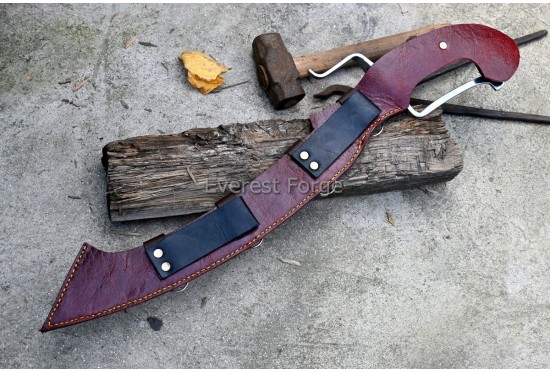
Six leather scabbard colors: Black, Brown, Yellow, Red, Green, Blue — hand-stitched leather over shaped wood core.
Free text engraving — name, initials, dedication, date, Sekhmet epithets ("Mistress of Life", "She Who Is Powerful", "Eye of Ra"), unit insignia, or short phrase. Approved by digital preview before any engraving touches the blade.
Custom logo or photo engraving — upload at checkout. Lion sigils, ankh motifs, family crests, character glyphs, or photo-to-engraving conversions.
Fully bespoke? Use Request Custom Forge for a one-to-one quote on alternative D-guard styles, blade geometry, or design-from-sketch builds.
Specifications
D-Guard or Standard Sekhmet's Claw?
Sekhmet's Claw comes in two configurations sharing the same blade. The difference is the handle — and the difference matters for what you'll actually do with the sword.
This Page · D-Guard Variant — $184.99
Same 19" 5160 sickle-sword blade, with a full steel D-guard knuckle bow wrapped around the rosewood grip. Hand protection for active use. Choose D-Guard if you'll actually swing the sword — sparring practice, HEMA-adjacent training, cutting drills, reenactment combat, stage combat, or simply prefer the protective-handle aesthetic. The pharaoh-guard infantry version.
Standard Variant — $174.99
Same 19" 5160 sickle-sword blade with a clean rosewood-only handle. Lighter, faster in the hand, and visually closer to museum-accurate Bronze Age presentation. Choose standard if you'll primarily display the blade, collect it, photograph it, or use it in cosplay where the clean visual line matters more than active hand protection. → View the standard Sekhmet's Claw
Same goddess. Same forge. Two grips for two use cases.
For Working-Blade Users, Cosplayers, and Egyptian-Pantheon Collectors
For Sparring & Working-Blade Use
The D-guard makes this the Sekhmet's Claw you can actually wield safely. Pell-and-target cutting practice, water-bottle cutting drills, sparring against non-blade training partners, HEMA-adjacent solo drilling, and stage combat applications all benefit from hand protection. The 5160 spring steel handles repeated impact better than 1070 carbon. Pair with our Training Blades for blunt sparring partners.
For Cosplay & Character Builds
Sekhmet has real pop-culture presence: Marvel Comics Sekhmet (Black Panther antagonist, mentioned in Captain America: Civil War); Moon Knight Egyptian-deity ecosystem (Hathor transforms into Sekhmet); Godzilla: King of the Monsters (one of the 17 Titans); Ronin Warriors; Re:Zero; tabletop RPG Egyptian campaigns. The D-guard reads particularly well for warrior-goddess or pharaoh-guard cosplay builds. The Blacked finish + custom engraving combination works for Khonshu or Moon Knight crossover characters.
For Egyptian Mythology Collectors
The D-Guard variant is the "working priestess" presentation — the Sekhmet weapon configured to be wielded, not just displayed. Buyers building Egyptian-pantheon collections often own both variants — standard for display, D-Guard for handling. Pair with our full-size Egyptian Khopesh and Bronze Age Swords for a complete pharaonic display.
For D-Guard Sword Collectors
If you collect knuckle-bow and D-guard hilted swords specifically, the Sekhmet's Claw joins our Khyber Sword with D-Guard, D-Guard Scimitar, and Custom Sabre with D-Guard in our D-Guard sword family. This is the only one with an ancient Egyptian blade geometry under the knuckle bow.
How Our D-Guard Sekhmet's Claw Compares
A handful of competitors sell D-guard khopesh variants. Here's the honest comparison.
D-Guard Sekhmet's Claw Khopesh — Buyer FAQ
Why is it called "Sekhmet's Claw"?
Sekhmet was the lion-headed Egyptian goddess of war — protector of pharaohs, daughter of Ra, healer and destroyer in one. Her sacred animal was the lion. A lion's claw is forward-curving and hooked — exactly the geometry of the Khopesh blade. The name connects the weapon's shape to the goddess's identity. The D-Guard variant adds a steel knuckle bow over the grip — making this the version of Sekhmet's weapon you can actually wield safely.
Is the D-Guard historically Egyptian?
No, and we don't claim it is. The D-guard knuckle bow is a 16th-17th century European innovation — first used on cavalry sabres, naval cutlasses, and military backswords. Most famously, the American Civil War Confederate D-Guard Bowie. The Egyptian Khopesh blade geometry IS historically accurate. The combination of the two is a modern-functional hybrid — ancient blade design with modern hand-protection engineering. If you want a museum-accurate Bronze Age Sekhmet's Claw with no D-guard, see our standard Sekhmet's Claw.
What is the D-Guard made of?
Forged steel — a single-piece knuckle bow running from the cross-guard to the pommel, riveted into the handle structure. Steel is the more tactical/military aesthetic compared to brass, and provides superior impact resistance under sparring or working use. The D-guard and the blade are both quenched and tempered to working hardness.
Why choose D-Guard over the standard Sekhmet's Claw?
Three reasons. First, if you'll actually swing or spar with the sword, the D-guard protects your hand from incoming strikes — the most exposed and most fight-ending target in any close exchange. Second, the closed steel loop gives you blade-trapping and parrying capability for HEMA-adjacent training or stage combat. Third, sweat and exertion loosen bare grips; the D-guard adds a second mechanical contact point that keeps the sword in your hand. If you'll display the blade, the standard variant is the cleaner historical line. If you'll wield it, D-Guard is the upgrade.
Is this a real sword or a display replica?
Real, fully functional. The blade is 5160 high-carbon spring steel, hand-forged from a single billet, full-tang, water-tempered, and hand-sharpened. The D-guard is forged steel, structurally integrated. It meets our published Battle Ready Standard. The third-party Medieval Review YouTube video on this page documents the cutting performance and build quality independently.
Why 5160 spring steel?
5160 is a chromium-bearing high-carbon alloy originally developed for heavy-duty truck leaf springs. It is tougher and more shock-absorbing than 1070 or 1095 carbon — exactly the trait you want in a sword that will actually be wielded against resistance. Most Pakistani eBay sellers using your search terms use unspecified "carbon steel"; we use verified 5160 from reclaimed truck suspension stock.
What is the default blade length, and can I change it?
Default is 19 inches — matched to the agile working-warrior profile. Customize from 16 inches (compact) up to 26 inches (full ceremonial / pharaoh-guard scale). The D-guard scales proportionally with longer blade lengths.
Is the engraving really free?
Yes. Free text engraving is included with every D-Guard Sekhmet's Claw — names, initials, dates, Sekhmet epithets ("She Who Is Powerful", "Mistress of Life", "Eye of Ra"), hieroglyph-style motifs, or short phrases. You can also upload a logo, lion sigil, ankh, family crest, or photo for custom engraving. Approve a digital preview before any engraving touches the blade.
Is this Khopesh suitable for cosplay?
Yes, particularly for warrior-goddess, pharaoh-guard, Marvel Sekhmet, Moon Knight Egyptian-deity, and Khonshu-aesthetic builds. The D-guard reads as more visually striking on camera and at conventions than the clean standard handle — it photographs better at angle. The Blacked finish + custom engraving combination is a strong choice for Khonshu / Moon Knight crossover builds. Check venue weapon policies before traveling with a steel blade.
I've seen "Sekhmet's Claw" swords on eBay for less — are they the same?
No. Several Pakistani eBay sellers use the "Sekhmet's Claw" name without authorization. The differences are in steel grade (we use verified 5160; theirs is unspecified "carbon steel"), construction (we hand-forge on the anvil; theirs is factory-ground), D-guard quality (we use forged steel single-piece; cheaper builds use bent strip or omit it entirely), customization (we offer 4 finishes, 8 handles, 6 lengths, free engraving; theirs is fixed configuration), and origin (we are in Kathmandu, Nepal with a master smith; most knockoffs ship from Wazirabad or Sialkot, Pakistan).
What if I want a different D-guard style?
The default is a closed steel knuckle-bow D-guard. For alternative styles (S-guard, basket hilt, half-basket, decorative scrollwork, brass instead of steel), use our Request Custom Forge service for a one-to-one quote. We have produced custom D-guard variants for collectors of antique cavalry sabres and Confederate Bowie-style builds.
How long does it take to make and ship?
Each D-Guard Sekhmet's Claw is hand-forged to order with your customization choices. Standard production is typically 2 to 4 weeks. We ship worldwide via DHL Express or FedEx with full tracking. International transit is typically 5 to 10 business days after dispatch.
Learn More About Everest Forge
| Specification | |
| Blade: | 19 inches Long polished Blade Made from 5160 Leaf spring of Truck |
| Total Length: | 25 inches Long in Total |
| Handle: | 6 inches Full tang Handle made from Rosewood D-Guard Handle |
| Weight: | 720 Grams Approximately |
| Note: | All dimensions and weights are approximate due to the handmade nature of the product. |