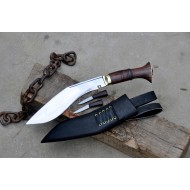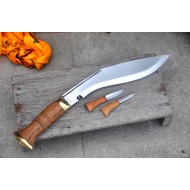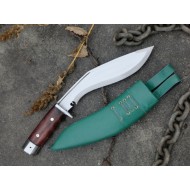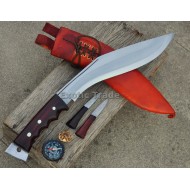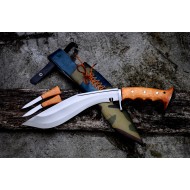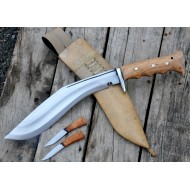
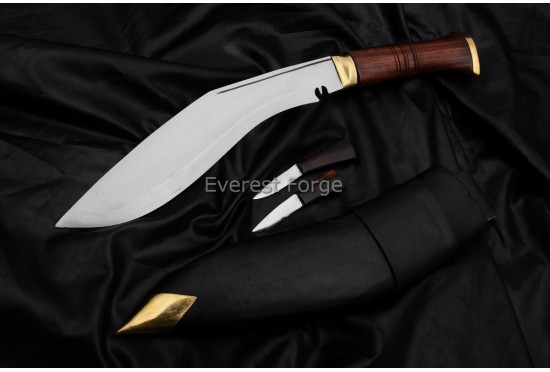
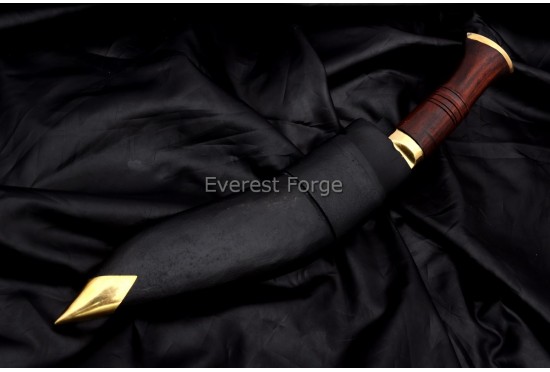
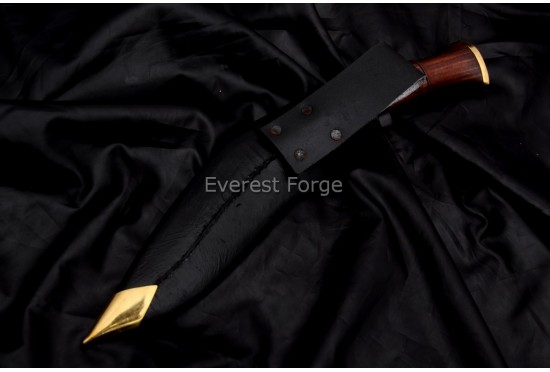
- Model: official issue kukri
- Product Code: officialkhukuri003
- Location: Kathmandu, Nepal
Available Options
The Nepal Army Training Khukuri — Wooden-Handle Working Variant of the Standard Nepalese Military Issue
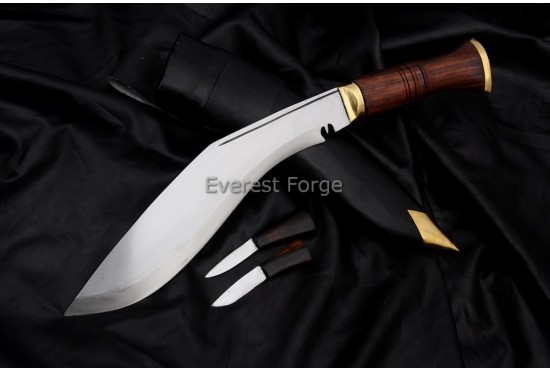
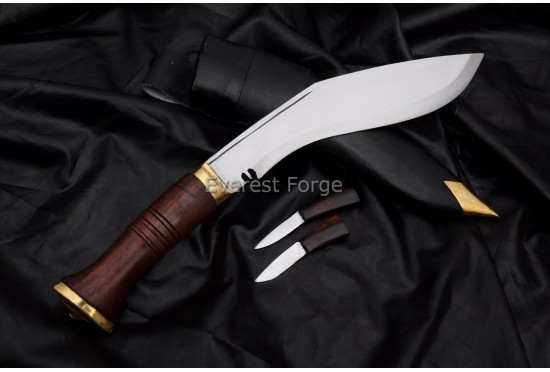
The Nepal Army Training Kukri — also written Nepal Army Training Khukuri — is the wooden-handle working variant of the standard Nepalese military issue. Where the standard horn-handle Nepal Army khukuri serves the parade-and-issue role, this wooden-handle khukuri is the durable, lower-cost, hard-use blade carried for training exercises, field deployments, and daily working duty across Nepal's mountain and jungle terrain.
Forged in our Kathmandu workshop by hereditary Kami caste blacksmiths — the same smiths who supplied the Nepal Army standard issue under the 2015–2018 contract — this training variant is built to the same blade specification but with a treated hardwood handle in place of buffalo horn. Same steel, same forge, same caste of smiths, different role in the soldier's kit.
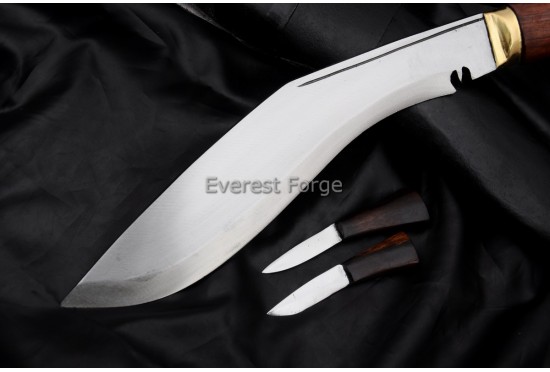
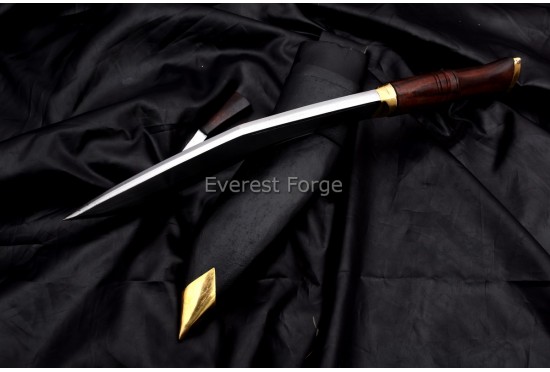
- Blade: 9" polished 5160 high-carbon spring steel, water-tempered
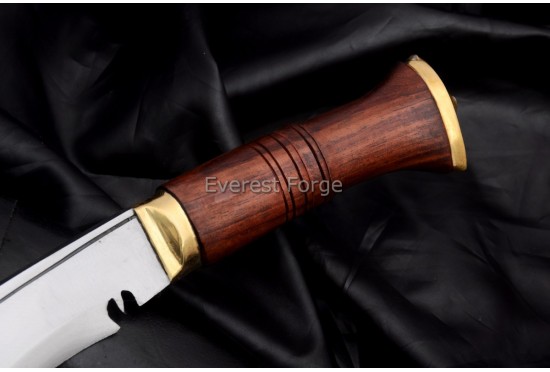
- Handle: 5" treated hardwood, rat-tail tang construction
- Total length: ~14"
- Weight: ~600g with scabbard
- Scabbard: Cotton-covered buffalo leather over wood core, hand-stitched
- Included: Karda (utility knife) + Chakmak (sharpener)
- Forged by: Kami caste smiths, Tokha-3 Kathmandu, Nepal
Why a Wooden-Handle Variant Exists
Across military forces worldwide, "issue" and "training" versions of the same weapon are common. For the kukri, the British Brigade of Gurkhas distinguishes between the polished Service No.1 (ceremonial) and the semi-polished Jungle PRI (training). The Nepalese Army follows a similar pattern — the standard horn-handle issue blade serves parade and ceremonial duty, while wooden-handle variants are used during training rotations, in field exercises, and as duty blades by units operating in conditions where the horn-handle issue would see excessive wear.
Reasons soldiers reach for the wooden-handle khukuri over the standard horn issue:
- Durability under repeated impact — treated hardwood absorbs shock from chopping and batoning without the cosmetic chipping that horn can show after hard use
- Lower cost replacement — wooden handles are easier and cheaper to repair or replace than buffalo horn, important for training units running through high blade-rotation
- Grippier in wet or cold weather — wood grip stays more secure than smooth-polished horn when hands are wet, gloved, or in low temperatures
- Easier to maintain in the field — wood doesn't need the periodic oiling that horn benefits from; a soldier on extended deployment can leave it untouched for months
- Lower visual signature — wood doesn't catch light the way polished horn does
This is the working blade for buyers who want a kukri to USE, not to display.
Same Blade, Different Role
The Nepal Army Training Kukri shares the exact blade specification of the standard Nepal Army issue:
- 9-inch polished 5160 high-carbon spring steel — the same metallurgy used across the Nepal Army issue range
- Water-tempered for differential hardness — edge 58–60 HRC, belly 45–46 HRC, spine 22–25 HRC. The traditional khukuri tempering process that keeps the cutting edge hard while the spine absorbs shock
- Rat-tail tang construction — same as the standard Nepal Army issue. The tang extends through the handle and is peened at the pommel. Traditional Nepalese military pattern, not a full-tang Western shortcut
- 9" working size — same standard issue length, optimised for mountain and jungle handling
What changes between the two:
- Handle material: treated hardwood (this listing) vs traditional buffalo horn (standard Nepal Army Kukri)
- Intended role: training / field / working (this listing) vs parade / issue / ceremonial (standard)
- Visual character: matte working aesthetic (this listing) vs polished traditional aesthetic (standard)
If you want the standard parade-and-issue Nepal Army khukuri with traditional horn handle, see the Standard Nepal Army Kukri. If you want a working blade designed to be carried hard and used regularly, you're on the right page.
Why This Specific Wooden-Handle Training Kukri
What separates this khukuri from generic "wooden-handle Nepal Army" listings:
Direct supply lineage. Everest Forge held the Nepal Army supply contract from 2015 to 2018, forging the standard issue blade specification. The training variant on this page is built by the same workshop, the same smiths, to the same blade spec — just with the wooden-handle build for working role.
Kami caste lineage. Our smiths are Kami — the hereditary blacksmith caste of Nepal that has forged khukuris for Nepal's armed services across generations. Meet the smiths who forge every blade.
5160 spring steel, water-tempered. Same metallurgy as the standard issue, not a cost-reduced training-grade alloy. The wooden handle saves you cost, not the blade.
Treated hardwood handle. The hardwood is sealed and treated to resist moisture absorption, swelling, and cracking — important for a working blade that will see weather, sweat, and field conditions.
Authentic rat-tail tang construction. Traditional Nepalese military pattern. The tang runs through the handle and is peened at the pommel. Same construction as the standard issue.
Direct-from-forge shipping. No middleman. The khukuri is forged in our Kathmandu workshop after you order. Photo approval before dispatch — we send finished photos for your sign-off before shipping.
DDP worldwide shipping. Duties and taxes paid upfront via DHL Express / FedEx. You pay one price; nothing more on arrival. Tracked door-to-door, typically 10–14 days from order to delivery.
Who Buys the Wooden-Handle Training Variant
Working buyers — those who want a khukuri to actually use for chopping, clearing, batoning, bushcraft, and outdoor utility, not a piece to display on a wall.
Training-cohort khukuri gifts — instructors or graduating cohorts commissioning matching training kukris with cohort engraving. The wooden-handle version is the natural choice for "training memento" pieces.
Veterans who want their training-issue khukuri — soldiers who carried wooden-handle khukuris during their training rotation and want to own that specific configuration as a memory piece, separate from any ceremonial issue blade they may have.
Bushcraft and outdoor users — single-tool chopping load for overland kits, hunting camp utility, survival kit configurations. The wood-handle working build is the natural fit for buyers who would otherwise pick a Cold Steel kukri or similar working blade.
Lower-budget kukri buyers — those who want authentic forging, real military lineage, and proper 5160 steel, but don't need the buffalo horn aesthetic premium of the standard issue.
Backup khukuri for serving personnel — those who own a standard horn-handle issue blade for parade and want a working duty blade they don't mind beating up.
Full Specification
| Blade length | 9" (22.86 cm) |
|---|---|
| Total length | ~14" (35.56 cm) — tip to pommel |
| Handle length | 5" (12.7 cm) — rat-tail tang |
| Steel | 5160 high-carbon spring steel, hand-forged |
| Heat treatment | Water-tempered for differential hardness |
| Blade hardness | Edge 58–60 HRC, Belly 45–46 HRC, Spine 22–25 HRC |
| Blade finish | Polished |
| Handle material | Treated hardwood, rat-tail construction |
| Scabbard | Cotton-covered buffalo leather over wood core, hand-stitched |
| Weight | ~600g (1.32 lb) with scabbard |
| Origin | Tokha-3, Kathmandu, Nepal |
| Production | Hand-forged after order (5–7 days forging time) |
Each kukri is individually hand-forged. As a handcrafted product, each piece may show slight variations in finish, size, or handle tone — adding to its authenticity and artisanal quality.
What's Included
- Nepal Army Training Kukri — polished 9" blade with treated hardwood handle, rat-tail tang construction
- Karda — small utility knife (traditional companion blade)
- Chakmak — sharpening steel / fire striker (traditional companion tool)
- Cotton-covered buffalo leather scabbard over wood core — hand-stitched, with karda + chakmak pockets
- Free text personalisation — up to ~30 characters, engraved on the blade
- Certificate of authenticity from Everest Forge
- Photo-approval images sent before dispatch
The Nepal Army Pair — Issue + Training
For collectors building an authentic Nepal Army kit, both kukris together represent the complete soldier's blade set — the parade-and-issue khukuri carried for ceremony, and the working-and-training khukuri carried for everything else:
- Standard Nepal Army Kukri — official horn-handle issue blade with polished finish and traditional aesthetic ($89.99)
- Nepal Army Training Kukri (this listing) — wooden-handle working variant for training, field, and duty use ($89.99)
Buy both at checkout and we'll engrave a matching motif on each — for example, the same service year, family name, or unit marker — at no extra cost.
Import & Knife Law — Read Before Ordering
- UK: Curved blades over 50 cm fall under specific legislation. This blade is 22.86 cm — well under the limit — but carry in public requires lawful reason.
- Australia: Some states require permits for certain blade types. Check your state's edged-weapons schedule.
- USA: Federally legal for import as a knife. Carry and ownership rules vary by state and city — check local statutes.
- EU: Importable in most member states with applicable duties. We ship DDP (duties paid).
- Canada, NZ: Generally importable; carry rules vary by province/jurisdiction.
Related Khukuri Patterns
The Nepal Army Training Kukri sits alongside the rest of the modern current-issue family. Buyers commonly consider:
- Standard Nepal Army Kukri — horn-handle parade-and-issue variant ($89.99)
- Nepal Police Kukri — 9" official-issue Nepalese law enforcement blade with cross pommel ($89.99)
- Jungle PRI Training Kukri — the British Brigade of Gurkhas training counterpart ($89.99)
- Browse all current-issue military khukuris — the full active-service range
For heavier working blades built for the same use case but with thicker stock or larger blade length, see our heavy-duty working khukuri range. Want to understand the parts of a kukri? See our Kukri / Khukuri Terminology Guide.
Frequently Asked Questions
What's the difference between this and the standard Nepal Army Kukri?
Same blade specification (9-inch polished 5160 steel, water-tempered, rat-tail tang construction), same forge, same Kami caste smiths. The difference is the handle: this listing has a treated hardwood handle for training and working use; the standard Nepal Army Kukri has a traditional buffalo horn handle for parade and ceremonial use. Different role in the soldier's kit, same blade DNA.
Is this an "official issue" kukri?
This is the wooden-handle working variant of the official Nepal Army issue pattern. The standard official-issue blade uses buffalo horn — but wooden-handle versions are used in training and field deployment contexts. Everest Forge held the Nepal Army supply contract from 2015 to 2018 for the standard pattern; this variant is built to the same blade specification by the same workshop.
Why would I choose wooden handle over the traditional horn?
Three reasons. (1) You plan to USE the kukri for chopping, batoning, bushcraft, or outdoor work — wood handles take repeated impact without showing cosmetic damage the way horn can. (2) You want a working blade that stays grippy when wet, cold, or gloved. (3) You want authentic Nepalese military lineage without the buffalo horn aesthetic premium. The standard horn-handle is the better choice for display, parade, or ceremonial pieces.
What wood is used for the handle?
Treated hardwood — typically rosewood, sissoo, or similar dense tropical hardwood depending on availability. The wood is sealed against moisture and treated for working durability. Each piece may show slight variation in tone and grain — this is normal for a hand-finished natural-material handle.
Is the wooden handle as durable as horn?
Durable in different ways. Horn is harder and more "premium" but can chip on repeated heavy impact. Wood absorbs shock better, is easier to refinish or replace if damaged, and tolerates working use better long-term. For display and ceremonial use, horn is the better choice. For working use, wood is the better choice.
What is "rat-tail tang" construction?
Rat-tail tang means the steel of the blade extends as a narrow rod through the handle to the pommel, where it is peened (riveted) to lock the assembly. It is the traditional Nepalese military construction method, used on both the standard Nepal Army issue and this training variant. Different from full-tang construction (where the steel forms the full silhouette of the handle), which is used on the British Brigade BSI Service No.1.
Can I get a name, service year, or unit marker engraved?
Yes — free of charge. Add your engraving text at checkout. Up to approximately 30 characters. The engraving is applied by hand on the left side of the blade. Common requests on this product: training year and unit ("NA 2018"), training cohort marker, name in English or Nepali Devanagari script, or family dedication.
What is the blade hardness (Rockwell)?
The blade is water-tempered for traditional differential hardness: edge 58–60 HRC for cutting performance, belly 45–46 HRC, spine 22–25 HRC for shock absorption. This zoned tempering is what allows a working khukuri to chop hard material without the spine cracking.
What's included with the kukri?
You receive the Nepal Army Training Kukri, traditional Karda (small utility knife), Chakmak (sharpening steel), hand-stitched cotton-covered buffalo leather scabbard over wood core with karda/chakmak pockets, certificate of authenticity, and photo-approval images sent before dispatch.
How long until it ships, and how is it sent?
Forging takes 5–7 days from order. Shipping via DHL Express or FedEx International Priority, fully tracked, typically 5–7 days delivery. Total order-to-door: approximately 10–14 days. All shipments are DDP — duties and taxes paid upfront, nothing to pay on arrival.
What is your refund policy?
30-day full refund or replacement if you're not satisfied with the kukri. We also send photo-approval images before dispatch — if anything looks off, we re-forge before it ever ships. See our full warranty and refund policy.
Should I buy the standard horn-handle issue or this wooden-handle training variant?
Depends on your use case. If you want to display the kukri, give it as a ceremonial gift, or own the traditional parade-spec blade, choose the standard horn-handle Nepal Army Kukri. If you plan to use the kukri for outdoor work, bushcraft, training, or any hard-use scenario, choose this wooden-handle training variant. For a complete authentic Nepal Army kit, many buyers own both. Add the pair at checkout and we'll engrave a matching motif on each at no extra cost.
| Specification | |
| Total Length: | 14 inches (35.56 cm) from tip to pommel. |
| B Length: | 9 inches (22.86 cm), polished 5160 high-carbon steel. |
| H Length: | 5 inches (12.7 cm), rat-tail Rosewood Handle. |
| Weight: | Approx. 600 grams including blade and sheath. |
| Note: | This is a handcrafted item; slight variations in measurements may occur. Designed for both ceremonial display and practical use. |