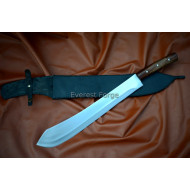
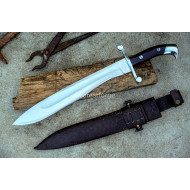
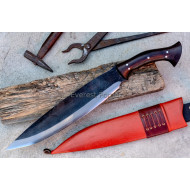
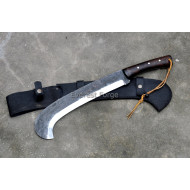
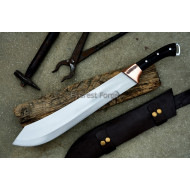
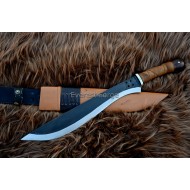
- Model: Machete
- Product Code: Bolo15
- Location: Kathmandu,Nepal
Available Options
A Hand-Forged Bolo Knife With an Exposed Full Tang
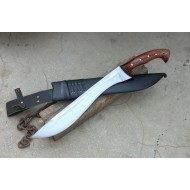
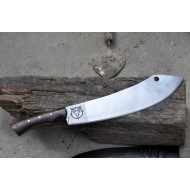
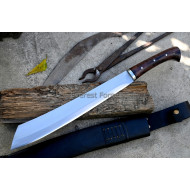
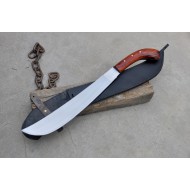
This is a hand-forged bolo: a broad working knife whose blade starts narrow at the shoulder and widens through its forward half into a deep belly before sweeping up to the point. The handle is rosewood pinned to a full-length, full-width tang, with the steel visible as a continuous line along both edges of the grip. It is forged from 5160 high-carbon spring steel in our workshop in Tokha-3, Kathmandu, and comes with a shaped leather sheath. Nothing is held in stock: it is forged after your order arrives, so the dimensions, the handle, the finish and the sheath are all yours to set at no extra cost.
The bolo is the working knife of the Philippines and the shape is an argument rather than a style. Carrying the width forward puts the mass where the edge lands, so the blade does the work on a downstroke instead of asking your arm to. It is the same problem the khukuri solves with a different outline, which is part of why it sits comfortably in a Nepali forge: our smiths have spent their lives making forward-weighted choppers.
At 740 grams over a 15 inch blade this is built to a working weight rather than a display one — inside the range Philippine bolos actually occupy, and below the thicker stock we put into our heavy kukris. It will swing all afternoon.
An honest note. Two things, and the first matters. The sheath is not crocodile. It is cowhide with a crocodile pattern embossed into the grain, and we would rather say so here than let the photographs do the implying. There is a way to tell embossed from genuine on anybody's product shots and it is in the questions below. Second, this is a bolo forged in Nepal rather than a Philippine-made one. The shape is the real thing and the provenance is ours, and we are not going to blur that.
Why It Is Built This Way
Full Specifications
Figures are taken from the knife shown and describe the standard build. Hand-forged work varies a little from piece to piece, so read these as close rather than exact. If a dimension matters, tell us before we start and we will build to it and measure the finished knife for you.
Build It Your Way
None of this costs extra, because none of it is made before you ask for it. Work down these six and put what you want in the order note.
If it is going outdoors, order micarta
Rosewood is the handsomer material and it is our default across the range, but a bolo is a blade that gets used in the rain, left in a shed and picked up with wet hands. Micarta does not care about any of that: it is dimensionally stable in damp, it grips better wet than dry, and it will outlast the timber by a wide margin on a tool that works. It costs nothing extra. Rosewood is the right answer for a knife that hangs on a wall; micarta is the right answer for one that does not.
Talk to the Forge →What It Does Well, and What It Does Not
What it does well
- A genuine working weight. 740 grams over a 15 inch blade sits inside the range Philippine bolos actually occupy, which is not something we can say about every blade we make.
- Forward mass where it belongs, so the blade does the work on a downstroke rather than asking your arm to.
- A tang you can see. The steel line runs the full length of the grip, so full-tang construction is something you check rather than something we assert.
- Full tang the whole length and width, visible along both edges of the grip so you can check it rather than trust it.
- An edge in 5160 that can be brought back with a file in the field, which matters on a tool you take somewhere.
- Everything configurable at no extra cost, including micarta scales for anyone who will use it in the wet.
What it does not do
- The sheath is not crocodile. It is embossed cowhide and we say so on the page rather than letting the photographs imply otherwise.
- It is forged in Nepal, not the Philippines. The shape is a bolo; the provenance is ours and we do not dress it up.
- It is not stainless. 5160 rusts if left damp, and this is a blade that gets wet.
- The forward balance that makes it cut is the same thing that makes it tiring to use for precise work. It is a chopper, not a carving knife.
- Rosewood is handsome and it is not the best choice for a tool that lives outdoors. Order micarta if it will.
- At 21 inches it needs a proper sheath and a belt, not a pocket.
How to Order
Who It Is For
- Anyone who wants a chopper that is actually built to a working weight rather than to a display one.
- Smallholders, gardeners and campers who need one blade that clears, splits and prepares without being three tools.
- Kukri owners curious about the bolo, which solves the same problem with a different outline — forward mass, broad belly, one hand.
- Buyers who would rather be told a sheath is embossed cowhide than discover it themselves.
- Anyone who wants to see the tang rather than take a maker's word for it.
- Bushcraft and survival buyers who want an edge they can restore with a file rather than a diamond plate and patience.
What Is Included
- The bolo, hand-forged in Tokha-3, Kathmandu, Nepal.
- A leather sheath with an embossed crocodile pattern, contrast stitching, brass studs and a retaining strap.
- A protective coat of oil on the blade for transit, wiped off before handling.
- Care instructions, and the Everest Forge manufacturer warranty against defects in materials and workmanship.
Want it built for one job?
A cane bolo with a longer, thinner blade. A heavier one for splitting. A shorter camp version with a finger swell added. A pair with matching sheaths. Tell us what you actually cut and we will build to that rather than to a catalogue photograph, and quote before anything goes on the fire.
Start a Custom Forge Request →Related Blades and Reading
Shipping, Returns and Care
Dispatch and transit. Standard builds leave the workshop in 2 to 3 business days. Genuinely custom work — a different length, micarta scales, a plain sheath — runs 4 to 6 weeks depending on the queue. We ship by DHL or FedEx with tracking, typically 7 to 14 business days from Kathmandu, sheathed and braced in a rigid carton.
Duties, import and knife law. Import duty and local taxes are the buyer's responsibility and vary by country. A 15 inch blade is regulated differently in different places and is treated more strictly than a pocket knife almost everywhere. Please check what applies where you live before ordering. If an unsharpened build would make the difference, we will supply one at no extra cost. Note also that because the sheath is embossed cowhide rather than genuine crocodile, there are no CITES permits involved and it ships anywhere ordinary leather does.
Returns and warranty. Because every blade is forged after the order, a custom build cannot be restocked, so please make sure the specification is right before you confirm. Anything damaged in transit, or showing a defect in materials or workmanship, is covered by the Everest Forge manufacturer warranty and we will repair or replace it. Photograph the packaging as well as the knife if something has gone wrong on the way.
Care. 5160 is a high-carbon steel and it is not stainless. This is a blade that will get wet, so the habit matters more than the technique: wipe it down and put a light film of oil on before it goes away, every time, rather than when it looks like it needs it. A working patina will form and that is fine — it is orange bloom you are watching for, not grey. The edge can be brought back with a file in the field and taken up on a stone at home. Do not store it in the sheath for long periods, since leather holds moisture against steel, and that goes double for a sheath this thick. The rosewood scales want a rub of oil once or twice a year.
Questions About the Bolo
What is a bolo, and is this one?
A bolo is the large working knife of the Philippines: a broad blade that carries its width forward rather than tapering away from the handle, used for clearing brush, cutting cane, splitting coconuts and everything else a farm needs a blade for. The shape is the argument — putting the width and the weight out toward the tip means the mass arrives where the edge lands, which is why a bolo cuts far above what its length suggests.
This is that shape, honestly made: 15 inches of blade, narrow at the shoulder, widening through the forward half into a deep belly and sweeping up to the point. What it is not is a Philippine-made bolo. It is forged in Nepal by smiths who have spent their lives making a closely related blade, and the page says so rather than implying otherwise.
Is the sheath real crocodile?
No. It is cowhide with a crocodile pattern embossed into it, and we would rather tell you that on the product page than let you work it out when it arrives. The texture is pressed into the grain under heat and pressure; the leather underneath is ordinary, good-quality cowhide.
How to tell embossed from genuine on anyone's photographs: real crocodile scales vary in size and shape across a hide and never repeat, while an embossed pattern repeats on a regular pitch because it comes off a plate. Look for the same cluster of scales appearing twice. There is also a practical advantage to embossed that nobody mentions: genuine crocodile and alligator are CITES-listed, and shipping them across borders needs permits. Embossed cowhide ships anywhere without paperwork. If you want the real thing we will not supply it, for exactly that reason.
How do I know the tang really runs the full length?
Look along the top and bottom edges of the handle. On this knife there is a continuous line of steel running the whole way from the bolster to the butt, with the rosewood scales pinned either side of it. That line IS the tang. You can see it in the photographs and you can see it on the knife in your hand, which is the point — it is a claim you can check rather than one you have to accept.
What you are checking against is a partial or rat-tail tang: a narrower piece of steel that stops somewhere inside the handle, hidden by the scales. On a knife that gets swung, every shock load concentrates at the point where that steel ends, and that is where cheap choppers break. It is invisible from outside on a hidden-tang knife, which is why the visible line matters. If a seller will not show you the edge of the handle, ask why.
How heavy is it?
740 grams, which for a 15 inch blade works out at about 49 grams per inch. For once that number is straightforwardly good news: Philippine bolos of this blade length run somewhere between 500 and 900 grams, so this sits comfortably inside the range rather than above it.
It also sits below the 55 to 75 grams per inch we see on our heavy kukris, which are deliberately thick-stocked choppers. So this is a working weight rather than a display weight. It will swing all afternoon without punishing your forearm, and it is light enough that the forward balance reads as authority rather than as dead weight.
What size is it, and can I change it?
The standard build carries a 15 inch blade and a 6 inch handle, 21 inches overall. That is a default rather than a fixed specification — everything we make is forged after the order, so the dimensions are yours to set.
Fifteen inches is a sensible working length: long enough to clear brush with a real stroke, short enough to control in thick growth and to carry without it catching on everything. Shorter takes it toward a large camp knife; longer takes it toward a machete and starts to need two hands on heavy work. Tell us what you want to cut and we will tell you what we would build.
What is the handle made of?
Rosewood scales pinned through a full-length tang, with a steel bolster at the blade and the tang itself visible as a line along both edges of the grip. The shape is a plain, comfortable working grip rather than a heavily sculpted one. Rosewood is our default across the range: dense, hard, dimensionally stable and about as handsome as timber gets.
On a working knife specifically, micarta is worth considering and costs nothing extra. It is completely indifferent to damp, it grips better wet than dry, and a bolo is a blade that gets used in the rain more often than most. Horn, bone and leather over timber are all available too, and the sheath is matched to whatever you choose.
How does a bolo compare with a kukri?
They solve the same problem with different outlines, which is part of why this one sits comfortably in a Nepali forge. Both carry mass forward so the weight arrives with the edge. A kukri does it with a kink in the spine, putting the belly at an angle to the handle. A bolo does it by simply widening, keeping the edge in one continuous sweep.
In the hand the kukri bites harder into a single hard target because the angle concentrates the blow, while the bolo slices further through soft growth because the edge stays in contact longer. If you are clearing brush and cane, the bolo. If you are splitting and chopping seasoned wood, the kukri. Our kukri range runs to 276 blades if you want to compare properly.
Does it arrive sharp?
Yes, sharpened along the full working edge and ready to use, unless you tell us otherwise. On a bolo the belly does most of the cutting and that is where the edge is finished most carefully.
Unsharpened builds are free, for display or for an awkward import. A stage combat build — rebated edge, rounded tip — is also available at the same price, though on a working blade this shape it is an unusual request.
What steel is it, and how is it heat treated?
5160 high-carbon spring steel, which we use across the whole range. The blade is forged to shape, quenched, and then tempered back by hand as a separate operation afterwards. Those two steps are distinct and on a chopping tool the second one matters more than on anything else we make: a bolo takes repeated shock, and an untempered blade chips its edge or cracks rather than absorbing it.
5160 is not stainless and is not meant to be. It rusts if left damp — and this is a blade that will get wet — and in exchange it takes and keeps an edge far better than any stainless we could sensibly forge, and it can be brought back with a file in the field. We do not make pattern-welded or laminated blades at all, by choice.
Where does it balance?
Forward of the bolster, which is the whole point of the shape. The blade widens through its forward half, so the mass sits where the cut lands. That is what makes a bolo feel like it is doing the work for you on a downstroke.
We do not publish a single point-of-balance figure, because hand-forged work varies and a number an inch out is worse than none. Ask before dispatch and we will measure the actual knife we are sending you, from the bolster, and send you the figure.
What comes with it?
A leather sheath with a crocodile-pattern embossed face and contrast stitching, with brass studs, a retaining strap and a belt arrangement. Cowhide, embossed — see the second question above.
The sheath is cut to this blade's outline, which on a shape that widens toward the tip is not optional: a sheath made for a straight-sided blade will not take a bolo, and a bolo forced into one will cut its way out through the welt. Colour, stitching and carry arrangement are all yours to specify.
How long does it take, and how is it shipped?
Nothing is held in stock. Every blade is forged after the order arrives, which is why the dimensions, the handle material, the finish and the sheath are all free to change — there is no standard version already made. Standard builds dispatch in 2 to 3 business days; genuinely custom work runs 4 to 6 weeks depending on the queue.
It ships sheathed and braced in a rigid carton, by DHL or FedEx with tracking, typically 7 to 14 business days from Kathmandu. Import duty and local taxes are the buyer's responsibility and vary by country.
| Specification | |
| Blade: | 15 inches. Hand forged from 5160 carbon steel |
| Total Length: | 21 inches |
| Handle: | 6 inches. Full tang visible along both edges, rosewood scales, steel bolster |
| Weight: | 740 grams the knife, 1080 grams with the sheath |
| Note: | Handmade variation in weight, dimensions and finish may occur. Keep blade lightly oiled when not in use. |