Menu
Your Cart

Hand-Forged Spartan Sword, D-Guard Hilt

Hand-Forged Spartan Sword, D-Guard Hilt
$294.99
Ex Tax: $294.99
  • Model: SINGLE EDGED SWORD
  • Product Code: SPARTAN0024
  • Location: Kathmandu,Nepal

Available Options

A Hand-Forged Spartan Sword With a D-Guard Hilt and Flared Blade

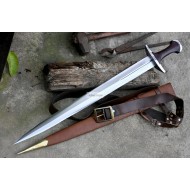
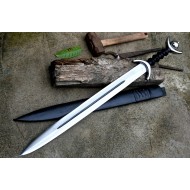
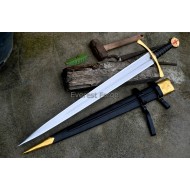
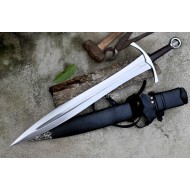
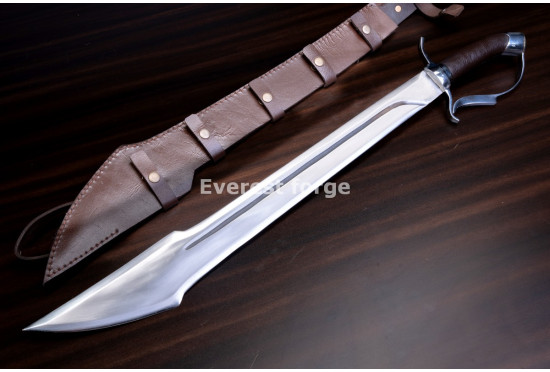
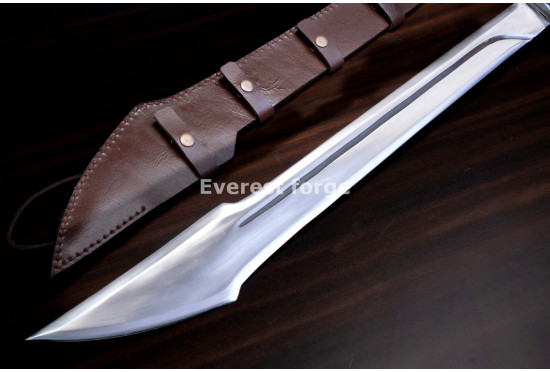
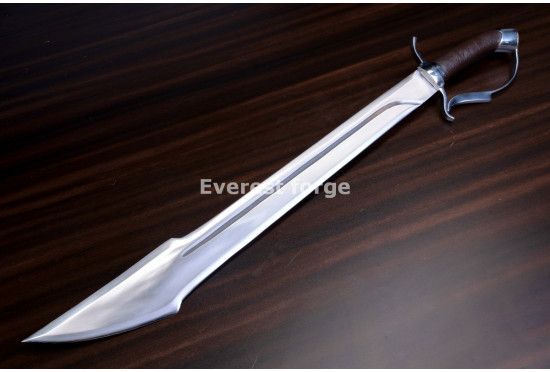
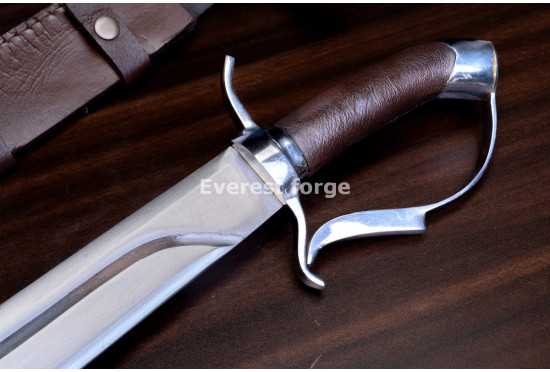
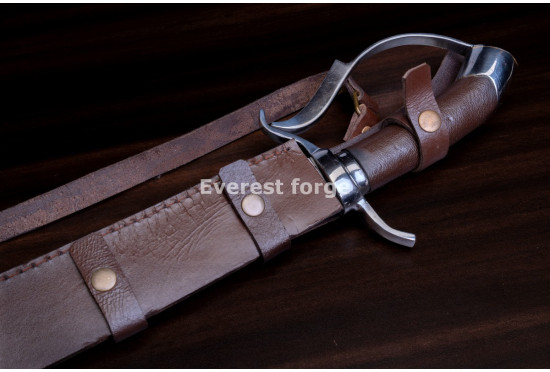
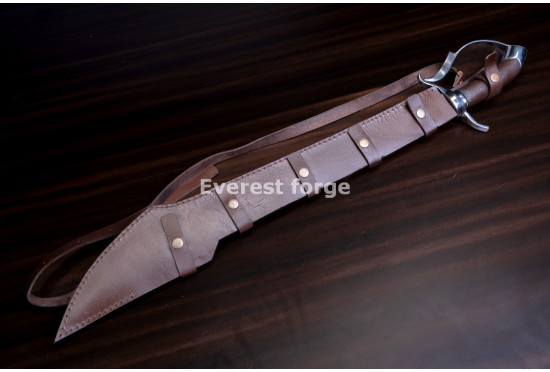
This is a 24 inch hand-forged Spartan sword: a single-edged blade with a long fuller running inside the spine, narrowing through the middle and then flaring out into a broad angular belly before drawing to the point. The hilt is a custom build rather than a stock pattern — a polished steel D-guard sweeping from the guard back to the pommel cap, a short downturned quillon on the reverse, a leather-wrapped grip and a fitted steel ferrule. Overall length is 30 inches and it weighs approximately 1240 grams. Forged from 5160 high-carbon steel in Tokha-3, Kathmandu, and supplied in a riveted brown leather scabbard on a full shoulder baldric.

An honest note. This is a modern design, not a reconstruction, and the name is a market term rather than a historical one. What Spartans actually carried was the xiphos — a short, leaf-shaped, double-edged blade of roughly thirty to forty-five centimetres — or a kopis, the forward-curved cutting sword. Neither looks like this. The D-guard is a European fitting that appears from the sixteenth century onward, roughly two thousand years after Sparta, and the flared blade is a designer's silhouette rather than an excavated form. None of that makes it a worse object; it is a well-built sword and it looks like what people picture. But we sell historical reconstructions on other pages and we are not going to blur the two. If you want the real thing, a true xiphos is the first option below and it is a sword we would enjoy making.

Made to your specification

Have This Sword Forged Your Way

Blade length, guard form, which side the D-guard sits on and the carry rig are all decided at the forge. Send a sketch or a description and our smiths will quote it.

Start a Custom Forge Order →

Why This Sword Is Built the Way It Is

A Guard That Encloses the HandThe D-guard runs from the cross back to the pommel and takes a cut that a simple cross would let through. It is the most protective single fitting you can put on a sword hilt.
Mass Where the Cut LandsThe blade narrows through the middle and flares into a broad belly toward the point, which moves the centre of mass forward. It is why a 30 inch sword hits harder than its length suggests.
Built as a Custom HiltThe D-guard, quillon and ferrule are forged and fitted for this piece rather than assembled from a stock pattern. That is also why the guard can be built to whichever side you need.

Specifications

Blade Length24 inches
Handle Length6 inches, of which 4 inches is grip
Overall Length30 inches
Blade Steel5160 high-carbon spring steel, oil-quenched and tempered
Blade ProfileSingle-edged, narrowing through the middle then flaring into a broad angular belly before the point
FullerSingle long fuller running inside the spine
GuardPolished steel D-guard from cross to pommel, with a short downturned quillon on the reverse
GripLeather wrapped over a shaped core, fitted steel ferrule and pommel cap
Standard BuildSatin blade, leather grip — size, finish and grip material are selectable above
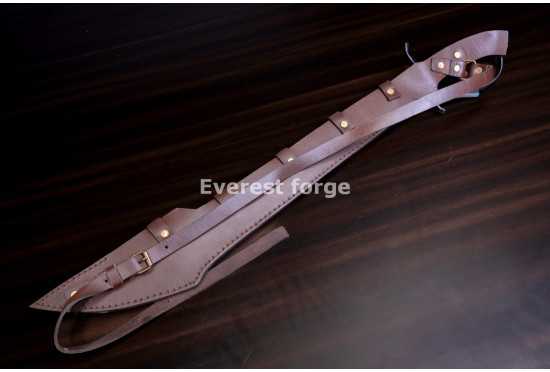
CarryRiveted brown leather scabbard on a full shoulder baldric with buckle
WeightApproximately 1240 grams for the sword, 1660 grams with scabbard and baldric
OriginHand-forged in Tokha-3, Kathmandu, Nepal

Build Options

A True XiphosThe sword Spartans actually carried: short, leaf-shaped, double-edged, roughly thirty to forty-five centimetres of blade, with a simple cross and a cap pommel. A completely different object and a genuinely historical one.
Which Side the D-Guard Sits OnA knuckle guard is handed. Say in the order comments which hand you will hold it in and we will build it to suit. Mirrored costs nothing extra.
Blade LengthTwenty to twenty-eight inches. Shorter is easier to wear and quicker in the hand; longer exaggerates the silhouette, which on this design is much of the point.
Guard FormThe D-guard shown, a plain cross, an S-guard, or a full basket if you want maximum protection. All forged rather than fabricated from bar.
Grip MaterialLeather over a core as standard. Cord under leather, wire wrap, rosewood or horn, all cut and fitted in the same workshop.
Carry RigThe shoulder baldric shown, a belt frog, or a back rig. Tell us how you intend to wear or display it.

Is This the Right Sword for You?

Buy This If You Want

  • The silhouette people picture when they think of a Spartan sword
  • A fully enclosed hand, which is the most protection a single fitting can give
  • Forward mass, so a 30 inch sword cuts like something heavier
  • A custom-forged hilt rather than a stock guard bolted to a blade
  • A striking display or costume piece that is a real sword underneath

Look Elsewhere If You Want

  • A historical Greek sword — that is the xiphos or the kopis, and we build both
  • To shift your grip during use, which a closed knuckle guard prevents
  • An ambidextrous sword, since a D-guard is handed and has to be built one way
  • A stainless blade needing no care, since 5160 is carbon steel and will rust if left wet
  • A sparring or HEMA trainer, which needs rolled edges and a rebated point from the first heat
Fifteen years at the anvil

Or Let Us Build You the Real One

A true xiphos, leaf-bladed and short, is a sword almost nobody forges properly and one our smiths would enjoy. Ask us and we will quote it against a museum reference.

Talk to the Forge →

How to Order

Choose your blade length, finish and grip material from the options above the description.
Say in the order comments which hand you will hold it in, so the D-guard is built to the correct side.
We confirm the build by email and start forging. Preparation takes seven to ten days.
Your sword ships tracked and arrives a further seven to ten days later.

Who This Sword Is For

  • Collectors of modern forged swords who want the look without being told it is ancient
  • Costume, cosplay and prop work where the silhouette has to read instantly in a single frame
  • Film, stage and photography armourers needing something dramatic that is genuinely forged
  • Anyone commissioning a custom hilt, since this piece is already a custom build rather than a stock pattern

What Is Included

  • One hand-forged sword, sharpened and ready
  • Fitted riveted leather scabbard on a full shoulder baldric
  • Certificate of hand-forging from the workshop
  • Everest Forge manufacturer warranty against defects in forging and heat treatment

Explore the Collection

Shipping, Returns and Care

Every piece is prepared at the forge in seven to ten days, and shipping adds a further seven to ten days. Orders to the USA and Canada travel with FedEx; everywhere else ships on a DDP service, which means duties and taxes are settled before the parcel moves so there is nothing to pay on delivery. Every piece carries the Everest Forge manufacturer warranty against defects in forging and heat treatment.

Long blades are restricted in some countries and in some states and provinces within them. It is your responsibility to check that this sword may lawfully be imported and possessed where you live before ordering, because a parcel seized by customs cannot be returned to us and cannot be refunded. Ask us before you buy if you are unsure and we will tell you what we know about your destination.

5160 is a high-carbon steel and it will rust if left wet or stored damp. Wipe the blade dry, keep a light film of oil on it, and pay attention to the fuller and to the inside of the D-guard, which are the two places a cloth will not reach on this piece. Do not store the sword in the scabbard for long periods. The leather grip and the baldric take an occasional conditioning.

Frequently Asked Questions

Did Spartans actually carry a sword like this?

No, and it is worth setting out properly rather than leaving it at no. A Spartan hoplite carried one of two swords, both short. The xiphos was a straight double-edged blade with a leaf shape, widest toward the point, generally somewhere between thirty and forty-five centimetres long, with a simple cross and a cap pommel. The kopis was the alternative: forward-curved, single-edged, built to cut. Sparta had a reputation even among other Greeks for carrying the shorter of the short, and an anecdote preserved in Plutarch's collection of Spartan sayings has a Spartan asked why their swords were so short answering that it was because they fought close to the enemy. Neither weapon resembles this one. The flared blade is a modern designer's silhouette and the enclosed knuckle guard is a European fitting that does not appear until the sixteenth century, some two thousand years after the period. We build both historical types and the xiphos is offered as a custom order above.

Why were Greek swords so short?

Because the sword was not the main weapon and was never meant to be. A hoplite fought with a spear, roughly two to two and a half metres of it, in a formation where the man beside you was close enough to touch. The sword came out when the spear broke or when the lines collapsed into a press, and in that press a long blade has nowhere to go: you cannot draw it back to cut, you cannot swing without hitting your own file, and a short stabbing weapon used underhand or overhand at body distance is simply more useful. That is a formation problem rather than a metallurgical one — Greek smiths could make longer blades and did, for cavalry and for other peoples. The length follows the tactics. It is also why the Roman gladius that succeeded it is short for the same reasons, and why sword length across the ancient Mediterranean tracks how armies fought rather than how well anyone could forge.

What does the D-guard do, and what does it cost?

It encloses the hand, and it is the most protection a single fitting can provide. A cross stops a blade at the guard but leaves the fingers and the back of the hand exposed to anything that comes over or around it; a bar running from the cross back to the pommel closes that entirely, which is why the fitting appears in Europe from the sixteenth century onward and why it survives on military sabres into the twentieth. The costs are real and worth knowing. You cannot shift your grip, choke up on the blade or change hands without taking the hand out of the guard. It adds weight at the hilt, which moves the balance rearward on a sword whose whole design puts mass forward. And it makes the sword handed, because the bar has to sit on the outside of your hand. That last point is why we ask which hand you will hold it in before forging.

Which hand is it built for?

Whichever you tell us. A knuckle guard is not symmetrical: the bar must sit on the outside of the hand, away from your body, so the sword is built one way round and cannot simply be turned over. The piece shown is built to one side, and we will forge it to the other at no extra cost and with no extra lead time. Say so in the order comments, and if it is a gift and you are not certain, tell us that too and we will suggest the more common arrangement rather than guessing silently. If you want a sword that works either way, order the plain cross or the S-guard instead, both of which are symmetrical and available above. This is the same question our parrying dagger raises about its side ring, and the answer is the same: it costs nothing to get right and it cannot be corrected afterwards.

Why do modern designs give Greek swords this shape?

Because it reads. A blade that narrows through the middle and then flares dramatically into a broad angular belly makes an outline you can recognise at a glance, from a distance, in silhouette, at speed — which is exactly what a design has to do on a screen or across a room. Historical swords are generally subtler in outline, because they were solving handling problems rather than recognition problems, and a real xiphos in silhouette looks like a leaf on a stick. There is nothing dishonest in the modern approach; it is design doing its job. It also happens to produce a sword that cuts well, because moving mass forward toward the point is a genuine principle rather than a cosmetic one, arrived at independently by the kukri, the falcata and the yatagan among others. So this is a piece where the drama and the function happen to agree. We would simply rather call it a modern design that works than an ancient one that never existed.

What is a xiphos, and would you build one?

Yes, gladly, and it is the sword we would point a historically minded buyer toward. A xiphos is short, straight and double-edged, with a leaf-shaped blade at its widest around two-thirds of the way toward the point and drawing to a sharp tip, a simple straight cross, and a cap pommel. Blades commonly run thirty to forty-five centimetres, which is around twelve to eighteen inches, so the whole sword is shorter than the blade on this one. It hung from a baldric under the left arm and was drawn across the body. Almost nobody forges it properly, partly because it is not a dramatic outline and partly because getting a leaf blade to taper correctly in both plan and section is more difficult than it looks. Send us a museum reference or let our smiths work from the general form, and it is a custom order rather than a listed product.

What does the flare near the point do?

It moves the centre of mass forward, which makes the sword cut harder than its length and weight suggest. A blade that is narrow through the middle and broad toward the tip carries more steel at the far end of the swing, so more mass arrives at the moment of impact. The cost is handling: a forward-heavy sword is slower to change direction and more tiring in the wrist, which is why swords built this way tend to be shorter than balanced ones. Our kopis page goes into that trade properly, since the whole forward-curved family is built around it. What is worth saying here is that the flare on this blade is more abrupt and more angular than a historical forward-weighted sword would use, because it is drawn for the eye first. It works. It is just not how a smith solving only a handling problem would have shaped it.

What steel is it, and how is it heat treated?

5160 high-carbon spring steel, brought to temperature in the forge, quenched in oil and tempered back so the edge is hard while the body of the blade stays springy. It is the standard through our workshop and a good match for a single-edged cutting sword: tough enough to take a hard cut without chipping, and flexible enough through the spine to absorb it. It is not stainless, deliberately, because the stainless grades that genuinely resist rust give up the toughness a cutting blade depends on. The D-guard and fittings are forged steel, polished, and fitted rather than welded to the blade.

Is it full tang?

The tang runs the full length of the hilt with the pommel cap fitted over the end, which is through-tang construction. That is the correct build here, because a D-guard, a ferrule, a wrapped grip and a pommel all have to be assembled onto a narrow tang and clamped between the guard and the cap. Done properly it is strong, and on a sword with an enclosed guard the D-guard itself adds a second load path between the blade and the pommel, which is one of the unremarked advantages of the fitting. If you would prefer a visible full-width tang, that means a different hilt design without the enclosed guard, and we would build the sword around it from the start.

How sharp does it arrive?

Sharp and ready, with the edge put on a stone by hand at the forge. If you would prefer it shipped blunt — for display, for costume or convention use, for a gift, or because of the rules where you live — say so in the order comments and we will send it unsharpened at no extra cost and rebate the point as well. On a piece bought largely for its appearance that is a common and sensible request, and it costs nothing.

How does it carry on the baldric?

Across the body, with the scabbard hanging along the back or the hip depending on how you set the buckle, and the hilt sitting where the off hand can steady it. A 30 inch sword on a belt swings and fouls your legs; a baldric spreads the weight across the shoulder and keeps the scabbard against the body. The rig here is riveted leather with a buckle so the drop can be adjusted, which matters more than it sounds, because two inches of drop is the difference between a clean draw and catching the point in the scabbard throat. If you want a belt frog or a back rig instead, tell us and we will make it up. For display, the baldric is also the most useful thing to hang the piece by.

Where is this made, and by whom?

In our own workshop in Tokha-3 on the northern edge of Kathmandu, Nepal, by around ten smiths, most from families that have forged blades for generations. Everest Forge has operated since 2010, and we forge, grind, heat treat, fit the hilts and cut the leather in the same building. This piece is a custom hilt build rather than a stock pattern, which is worth saying because it is also an offer: the D-guard, the quillon and the ferrule were forged and fitted for this sword, and the same smiths will do that to your drawing rather than ours.

Specification
Blade: 24 inches. Hand forged from 5160 carbon steel
Total Length: 30 inches
Handle: 6 inches (4 inch grip). Leather wrapped over a shaped core, steel ferrule and pommel cap
Weight: Approx 1240g sword, 1660g with scabbard and baldric
Note: Some variation in weight, dimensions and finish may occur as each piece is hand forged. Keep the blade lightly oiled when not in use

Write a review

Note: HTML is not translated!
Bad Good
Captcha