

- Model: Signature Kukri/Khukuri
- Product Code: SIGNATURE13KO
- Location: Kathmandu, Nepal
Available Options
A Single Fuller Kukri, With a Knife Made From a File
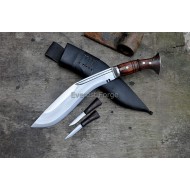
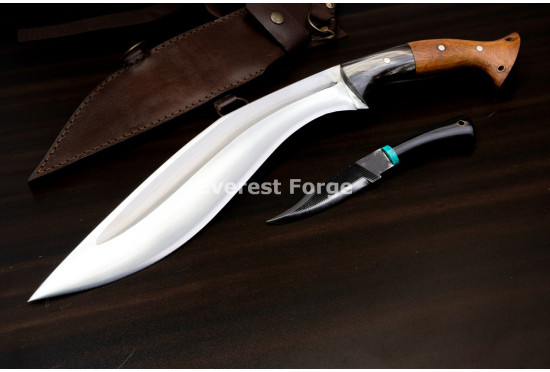
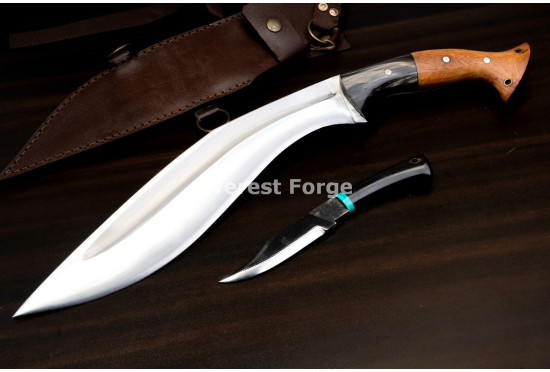
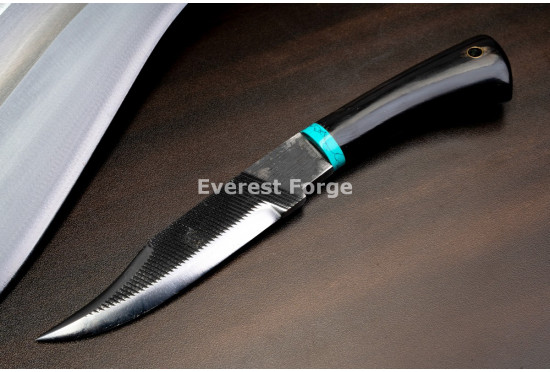
Nepali smiths have always worked with the steel in front of them. Kukris are forged from vehicle leaf springs because leaf springs are good steel and they are available; the companion knife that comes with this one is made from an old sharpening file for exactly the same reason. Look at its blade and you can still see the file teeth left on the flat, unground. That is not a texture applied to look interesting. It is what the blade used to be.
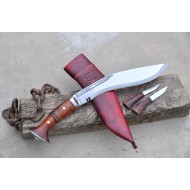
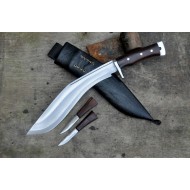
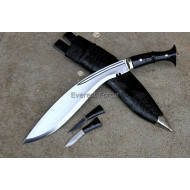
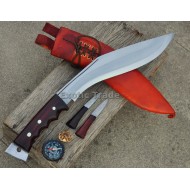
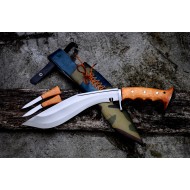
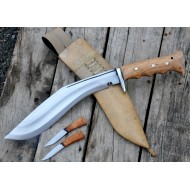
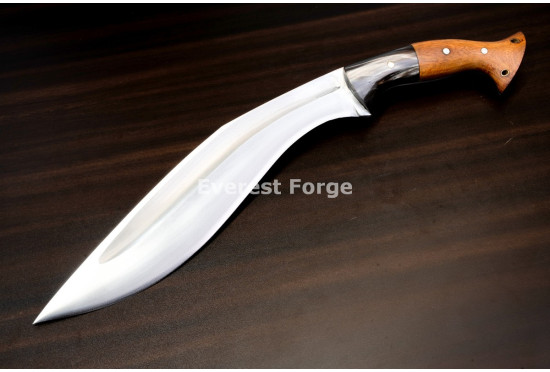
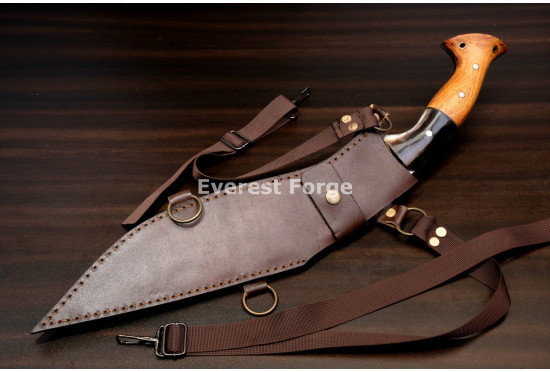
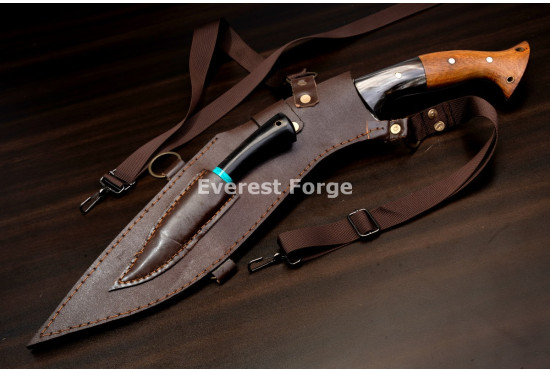
The kukri itself is a 13 inch blade hand-forged from 5160 high-carbon steel, oil-quenched and tempered, with a single fuller ground down the flat, a deep belly and a hand-cut cho at the base. It weighs 840 grams. The 7 inch hilt is the longest we fit, built from two materials over a full tang: dark horn at the blade end where the hand does not sit, light wood behind it where it does, pinned through with three rivets and drilled for a lanyard. The scabbard is brown leather with a fitted pocket for the companion, three brass D-rings set along its length, and an adjustable nylon harness with snap hooks.
An honest note. A blade made from a file is a genuine piece of the tradition rather than a novelty, but it needs saying that a file cannot simply be sharpened and used. File steel is very hard and correspondingly brittle — that is what makes it work as a file — and a blade left in that state will chip or snap. Ours are re-forged, re-hardened and tempered back to a working temper, which is the whole job and the reason this is a knife rather than a curiosity. The file teeth are left visible on the flats deliberately, where they do no harm. The other thing worth knowing: at 840 grams over a 13 inch blade this is a solid kukri rather than a light one, so read the specifications before you decide.
Want This Built Your Way?
A different blade length, another fuller arrangement, a traditional karda and chakmak in place of the file knife, a different grip material, or your own drawing entirely. Our smiths in Kathmandu forge to specification and quote before any work begins.
Start a Custom BuildWhat You Are Looking At
Standard Build and Specifications
Blade length, blade finish, grip material and fuller arrangement are all selectable, so the figures above describe the standard build rather than every version. Because each piece is forged, ground and fitted by hand, weights and dimensions vary slightly between examples, and the file knife varies more than most since no two files start out identical.
Build Options
Is This the Right Kukri for You?
Choose This One If
- The file knife appeals to you — it is the most honestly Nepali thing in this listing
- You have large hands, or want room to shift your grip on a heavy swing
- You want a full tang under a traditional-looking jointed hilt rather than a hidden one
- You want to set your own carry angle rather than accept one
- You want mass: 840 grams over 13 inches is a solid working blade
Look Elsewhere If
- You want a light blade — our bushcraft kukri and deep-fullered 13 inch are both considerably lighter
- You want the traditional karda and chakmak — we will fit them, but the file knife is what ships
- You want decoration — there is none on this piece at all
- You want belt carry — this is built around a shoulder harness, though we will change it
How to Order
Who This Kukri Is For
- Buyers who care how things are made — a blade re-forged from a file is a working example of a tradition rather than a story about one
- Anyone with large hands who has found standard kukri grips cramped
- Woodsmen and campers wanting a solid working kukri with a companion, carried over the shoulder
- Buyers who distrust hidden tangs and want to see the steel run the full length
- Anyone who wants function without ornament — there is nothing decorative on this piece
What Is Included
- One hand-forged single fuller kukri, sharpened and ready to use
- One companion knife re-forged from a sharpening file, sharpened
- Brown leather scabbard with fitted companion pocket and three brass D-rings
- Adjustable nylon harness with snap hooks
- Everest Forge manufacturer warranty
- Care instructions
More From the Everest Forge Collection
Shipping, Returns and Care
Stock builds dispatch from our workshop within 2-3 business days. Custom and made-to-order builds take 4-6 weeks from confirmation, and we photograph the finished piece before it leaves us. We ship worldwide with DHL and FedEx, fully tracked, typically 7-14 business days in transit. Every blade carries the Everest Forge manufacturer warranty against defects in forging and construction.
Blade laws vary by country, state and province and it is the buyer's responsibility to check local restrictions before ordering. Note that this package contains two blades. We cannot advise on your jurisdiction and we cannot refund a blade seized in transit.
5160 is a high-carbon steel and it will rust if you let it. Wipe both blades dry after use and keep them lightly oiled. Two places need more than a wipe along the flat: the bottom of the fuller, which a cloth will bridge without touching, and the file teeth on the companion, which are dozens of small cut recesses and will hold moisture and residue indefinitely if you only wipe across them. Use an oiled cloth corner or an old toothbrush on the file knife rather than a rag. The joint where horn meets wood on the hilt is worth a moment too, since a seam holds damp against both materials at once.
Forged by Hand, Not Assembled
Every blade we sell is forged, ground, heat-treated and fitted by our own smiths in Kathmandu. If you want something we do not list, we will make it.
Talk to Our SmithsFrequently Asked Questions
Is the small knife really made from a file?
Yes, and the file teeth left visible on its flats are the evidence rather than the decoration. Nepali smiths have always worked from repurposed steel: kukris are forged from vehicle leaf springs because springs are good steel and they turn up, and files are the same proposition at a smaller scale. A file is high-carbon steel of decent quality, it comes in a useful size, and when it is worn out for filing it is still perfectly good steel. What matters is what happens next. A file as it comes is very hard and correspondingly brittle, which is exactly what a file needs to be and exactly what a knife must not be — sharpen a file and use it as a blade and it will chip at the edge or snap at the tang. Ours are re-forged to shape, re-hardened and then tempered back to a working temper. That last step is the whole job.
Why leave the file teeth on the blade?
Because they tell you what it is, and grinding them off would cost work to hide something worth showing. The teeth are left on the flats, well away from the edge, where they do nothing except record where the steel came from. The edge itself is ground clean and sharpened conventionally, so the cutting part of the blade is a normal ground bevel. There is one honest drawback and it is worth knowing before you buy: file teeth are dozens of small recesses, and on carbon steel every recess is somewhere moisture and residue can sit. A wipe across the flat will not clean them. You need a brush or an oiled cloth worked into the pattern, and if you cut anything acidic you need to do it promptly. If that sounds like more upkeep than you want, we will grind the flats smooth instead.
What does single fuller mean?
A fuller is a groove ground down the flat of a blade, and this one has a single fuller rather than the two, three or four our chirra kukris carry. It removes material from the middle band of the blade's width, where bending stress is lowest and the steel is doing the least work, so the blade sheds weight without losing meaningful strength. One is the most common arrangement in Nepal, and it is worth saying plainly that it is also the most sensible: our four chirra kukri is honest that the returns fall away sharply past the second groove, so a single fuller does most of the work that multiple fullers do, at a fraction of the grinding. If you want more, we grind up to four. If you want the practical answer, this is it.
What is the horn and wood joint handle?
The grip is built from two materials rather than one, joined partway along: dark horn at the front where the hilt meets the blade, light wood behind it where your hand sits. It is not only a visual decision. The front of a kukri hilt is the end that gets wet, gets blood and sap on it, and sits against a scabbard throat, and horn is more tolerant of all three than most timbers are. Wood behind it is warmer in the hand, lighter, and easier to shape comfortably. The trade-off is that any joint is a seam, and a seam between two materials that expand at different rates with humidity is a place to keep an eye on. Keep it oiled and it will be fine; ignore it in a wet climate for years and it is where a problem would start.
Why does a full tang matter under a hilt like this?
Because a jointed traditional hilt normally is not built this way, and that is the interesting thing about this piece. The usual Nepali arrangement fits sectioned pieces of horn and wood over a narrow tang and sets them with laha, a natural resin, which is light and entirely traditional and works well — but the adhesive is the weakest element and heat, damp and hard shock all work against it. Here the tang runs the full width and length of the grip with three pins straight through it, so the two materials are mechanically fixed to steel rather than glued around it. You get the look and the material logic of a traditional jointed hilt with the construction of a modern full-tang knife. On a blade weighing 840 grams that is the right way round.
Why three rings on the scabbard?
So you can decide how it hangs. The harness clips to brass D-rings set at three points along the leather, and which pair you use changes the angle the kukri sits at against your body: clip high and it rides close and near-vertical, clip low and it lies more diagonally across the back, and the middle setting splits the difference. That matters more than it sounds on a 19 inch package worn over the shoulder, because the angle determines whether the point digs into you when you bend and whether the grip is where your hand expects it when you reach. Most harness scabbards give you one fixed geometry and you either get on with it or you do not. Set yours once and leave it.
Is 840 grams heavy for a 13 inch blade?
It is on the solid side and we would rather you knew that up front. For comparison within our own range, our deep-fullered 13 inch runs 720 grams and our traditional chirra 740, so this is meaningfully more blade than either at the same length. In the hand that reads as authority: it chops harder per stroke and it does not deflect. Over a long day it reads as weight, and the 7 inch grip helps there more than you would expect, because being able to shift your hold along the handle changes which muscles are working. If you want the same profile lighter, we can take the grind higher and thin the section, or grind a second fuller. If you want light as a priority rather than an adjustment, our bushcraft kukri is built for it.
What is the notch at the base of the blade?
That is the cho, sometimes written kaudi, and it is the diagnostic mark of a genuine kukri. It terminates the edge in a rounded cut rather than letting the edge run straight into the hilt, so a crack starting at the edge has somewhere to stop instead of running back toward the tang. It also carries religious meaning that different communities in Nepal read in different ways. Ours are cut by hand on every blade, which is why no two are exactly alike. We apply the test in both directions: a curved knife with no cho did not come from this tradition whatever a listing calls it, and we have declined to call our own pieces kukris on that basis.
What steel are the two blades?
Different, and deliberately so. The kukri is 5160 high-carbon spring steel, oil-quenched and tempered, which is what we forge nearly everything from — it is the family of steel used for vehicle leaf springs and it is chosen for toughness rather than for maximum hardness, so a hard-used edge rolls rather than chipping. The companion is whatever the file was made from, which is typically a high-carbon tool steel and generally harder than 5160 once re-tempered. That suits a small knife: it will hold an edge longer than the kukri does and is less likely to be asked to survive impact. The practical consequence for you is that the two blades want slightly different treatment on a stone, and neither is stainless.
How do I sharpen them?
The kukri has a convex edge, which is stronger at the edge and better suited to impact, so work it with a stone in small circles or with a file rather than dragging it through a fixed-angle pull-through sharpener, which grinds a flat bevel into a convex edge and undoes it. The companion is simpler: a small flat bevel on a straightforward profile, easy to maintain on any stone. Two notes specific to it. Being harder steel it takes longer to sharpen but needs it less often, so do not force it — let the stone work. And keep the stone off the file teeth on the flats, which are decoration at this point and will only take the edge off your abrasive.
How do I look after it?
Standard carbon steel care, with the file knife needing genuinely more attention than most blades in our range. Those teeth are dozens of small recesses and every one of them will hold water and residue that a cloth drawn across the flat simply bridges. Use an old toothbrush or an oiled cloth worked into the pattern, and do it every time rather than occasionally. The kukri is easier: dry it, oil it, and give the bottom of the fuller a moment with a cloth corner since that is the one place a wipe will miss. Also worth a look each time is the seam where horn meets wood on the hilt. Do not store either blade in the scabbard for long periods in a damp climate.
Can I have a different companion or size?
Both. The file knife is what ships as standard, but we will fit a traditional karda and chakmak, or a skinner if you want a game knife, and the scabbard pocket is cut to match whichever you choose — which means deciding at the point of order rather than later. On size, we forge this profile from belt-sized blades up to two-handed pieces. The 7 inch grip is worth a specific mention: it is the longest we fit and it exists to give a large hand room and to allow a second hand on a heavy swing, so if your hands are on the smaller side say so and we will shorten it rather than have you fight the handle.
| Specification | |
| Blade: | 13 inches. Hand forged from 5160 carbon steel. Single fuller ground down the flat |
| Total Length: | 20 inches |
| Handle: | 7 inches, FULL TANG with three pins and a lanyard hole, jointed horn and light wood |
| Weight: | Approx. 840 g blade, approx. 1210 g total |
| Note: | As each piece is forged, ground and fitted by hand, slight variation may occur - and the file knife varies more than most, since no two files start out identical. Brush the file teeth rather than wiping them. |