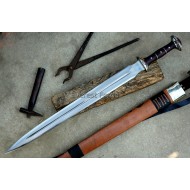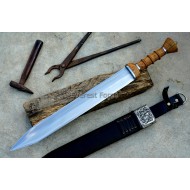
- Model: Gladius Sword
- Product Code: Gladius0025
- Location: Kathmandu, Nepal
Available Options
Hand-Forged Roman Gladius Sword — Fulham Type Broad Blade in 5160 Carbon Steel
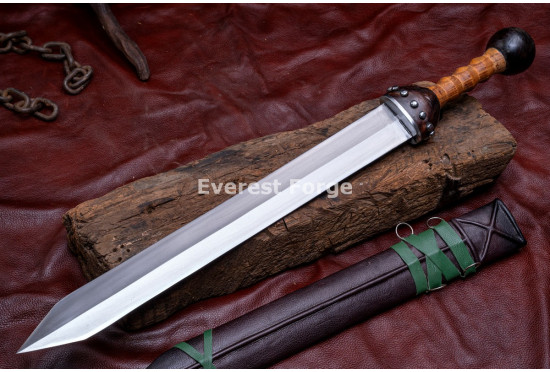
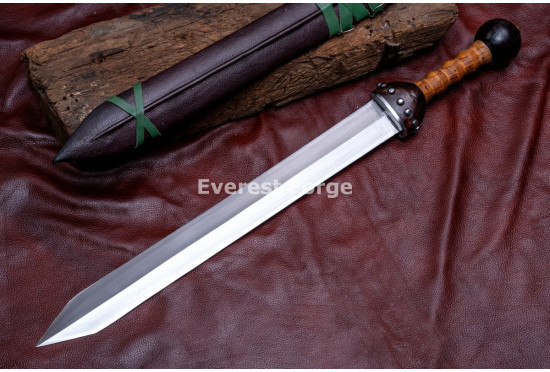
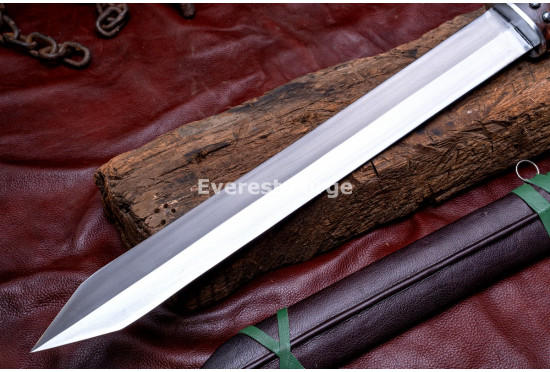
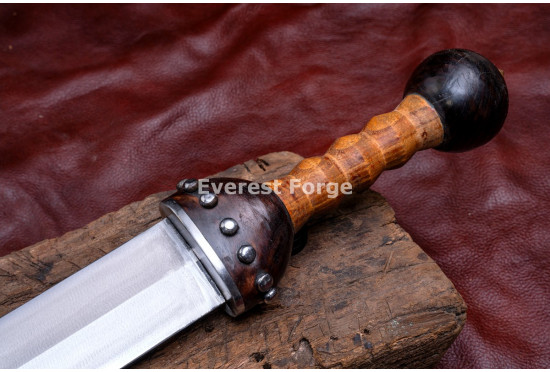
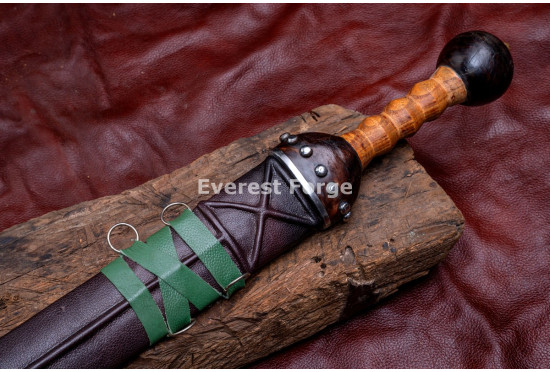
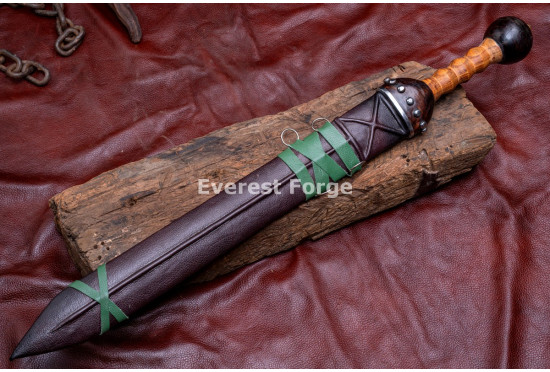
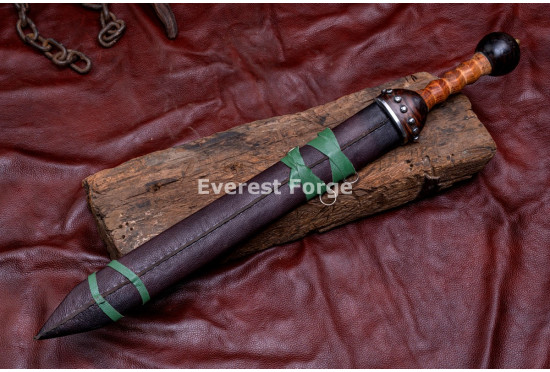
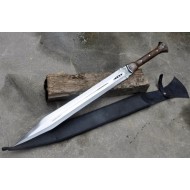
This is a hand-forged, fully functional Roman gladius built in the Fulham pattern — the short thrusting sword of the Roman legionary, forged in Nepal from 5160 high-carbon spring steel, oil-tempered, full tang, and sharpened to a true edge. It carries a broad, straight-edged blade running into a long triangular point in a clean satin finish, a riveted steel guard collar, a ribbed wooden grip, and a turned globular pommel, paired with a brown leather scabbard. Every sword is made to order in your chosen length, finish, and engraving.
The standard blade is 20 inches on an 8-inch handle with a 4-inch grip section, for an overall length around 28 inches at about 1.25 kg. That is short, broad, and stiff — a sword built to punch through at close quarters from behind a shield, which is exactly what the gladius was for. The oil-tempered 5160 steel and full tang make it a real working sword, not a cast wall-hanger.
An honest note. This is a modern, hand-forged gladius made by our smiths in Kathmandu, built in the spirit of the historical type rather than as a museum reproduction of a specific excavated piece. It is also heavier than the originals — surviving Roman gladii are notably light, and ours carries more stock through the spine and edge so it stands up to modern cutting. If you want a strict museum-weight blade, ask for it through Custom Forge and we will grind the section down.
Bespoke Service
Forge a Gladius to Your Own Design
Want a different pattern, a narrower blade, a horn or bone grip, or your own engraving? Our Custom Forge service builds swords to your spec, by hand in Kathmandu.
Request a Custom Forge →What Is a Fulham Type Gladius?
The gladius was the standard sword of the Roman legions from roughly the 3rd century BC to the 3rd century AD, worn at the belt and drawn for close work behind the shield wall. Three main patterns are recognised by blade profile. The Mainz type has a waisted blade that pinches at the middle and swells again before a long point. The Pompeii type, latest of the three, has straight parallel edges and a short triangular tip. The Fulham type sits between them — straight edges like a Pompeii, carrying the long tapering point of a Mainz. It takes its name from a sword recovered from the Thames at Fulham in London, associated with the Roman invasion of Britain in the middle of the first century AD, whose blade runs to roughly 50 cm. This one is a modern hand-forged interpretation of that pattern in 5160 spring steel.
Specifications
Customize Your Gladius
Every sword is forged to order. Set your options before you add to cart:
Hand-Forged, Not a Wall-Hanger
This Gladius
- Hand-forged 5160 high-carbon spring steel
- Oil-tempered, hard edge and flexible spine
- Full tang, peened over the pommel
- Forged distal taper, so the point stays lively
- Sharpened, balanced, made to your spec
A Wall-Hanger
- Cast stainless, brittle under load
- No real heat treatment
- Rat-tail tang that snaps
- Flat, lifeless blade
- Blunt, display-only
How It Is Made
Who It Is For
- Collectors of Roman military equipment who want a named pattern, not a generic short sword
- Reenactors and living-history groups portraying first-century legionary kit
- Collectors who want a short, wearable sword rather than a full-length blade
- Cutting and test-cutting practitioners who want a stiff, broad single-hand blade
- Gift buyers personalizing a blade with a name, date, or legion number
- Collectors who value hand craftsmanship and made-to-order detail
What Is Included
- One hand-forged Fulham type Roman gladius, built to your chosen spec
- Brown leather scabbard with suspension rings
- Ribbed wooden grip with riveted steel collar and turned globular pommel
- Any personalization or engraving you ordered
- A satin-finished, sharpened blade
- Everest Forge manufacturer warranty
Explore More Hand-Forged Swords
Shipping, Returns & Care
Shipping
In-stock specs dispatch within 2 to 3 business days; fully custom builds take roughly 4 to 6 weeks to forge before dispatch. We ship worldwide by DHL or FedEx in 7 to 14 business days, tracked. Import and blade laws vary by country, so please check your local rules before ordering.
Returns & Warranty
Every blade is backed by the Everest Forge warranty against forging and material defects. If something is wrong with your order, we will repair, replace, or refund it. Personalized and custom-engraved blades are made to order, so please confirm your spec carefully before purchase.
Care
Wipe the blade clean and dry after handling, and apply a light coat of oil before storage to protect the high-carbon steel from moisture. Do not store the sword inside the leather scabbard for long periods, as leather holds moisture against steel. With basic care, a 5160 blade will outlast its owner.
From The Forge
Build a Gladius That Is Yours Alone
Beyond the options here, our Custom Forge service shapes a blade to your own length, width, grip, and engraving — including strict museum-weight reproductions, direct from the maker in Kathmandu, roughly 4 to 6 weeks from order.
Start a Custom Forge →Frequently Asked Questions
What is a Roman gladius?
The gladius was the standard short sword of the Roman legions, in service from roughly the 3rd century BC to the 3rd century AD. It was worn at the belt and drawn for close work behind the shield, where a short stiff blade could be thrust in the gaps of a formation. Three main patterns are recognised — Mainz, Fulham, and Pompeii — distinguished by blade profile rather than by length alone. This one is a modern, hand-forged interpretation of the Fulham pattern in 5160 spring steel.
What is the Fulham type, and how is it different from Mainz and Pompeii?
The difference is blade profile. Mainz blades are waisted — they pinch in at the middle and swell again before a long point. Pompeii blades, the latest of the three, have straight parallel edges and a short triangular tip. Fulham sits between them: straight edges like a Pompeii, but with the long tapering point of a Mainz. The type is named after a sword recovered from the Thames at Fulham in London, linked to the Roman invasion of Britain in the middle of the first century AD, whose blade runs to roughly 50 cm — close to the length we forge this one at.
Is this a real, functional sword?
Yes. This is a real, fully functional gladius, not a cast display piece. It is hand-forged from 5160 high-carbon spring steel, full tang, oil-tempered, and sharpened to a true cutting edge before it ships. It is built to be handled and cut with, and finished cleanly enough to display as a centrepiece.
What steel is it, and is it oil-tempered?
The blade is forged from 5160 high-carbon spring steel, the same alloy used in heavy-duty truck leaf springs, prized for toughness and edge retention. It is oil-tempered for a hard cutting edge backed by a flexible, shock-absorbent spine. On a short broad blade like a gladius that toughness matters more than extreme edge retention, which is why we favour 5160 here.
Is it full tang?
Yes. The tang runs the full length of the handle and is peened over at the pommel, so the grip components are mechanically captured between the collar and the pommel. There is no rat-tail, no weld, and no glued-in stub to fail.
Does it arrive sharpened?
Yes, sharpened as standard and finished by hand. If you need it blunt for reenactment, stage use, display, or to satisfy import rules where you live, choose the display-blunt option or tell us in your order notes. There is no extra charge either way.
How does the weight compare with an original Roman gladius?
It is heavier. Surviving Roman gladii are notably light, generally under a kilogram complete with hilt, because they were built thin and used by trained soldiers inside a formation. Ours carries more stock in the spine and edge so it holds up to modern cutting and to handling by people who did not grow up with one. If you want a strict museum-weight piece, ask for it through Custom Forge and we will grind the section down.
Can I order a different blade length or a narrower blade?
Yes. Blade length and blade width are both adjustable to order. Send us the dimensions you want and we will confirm what the Fulham profile will carry without losing its balance — a gladius that gets too long stops behaving like a gladius. Use Custom Forge to start that conversation.
What are the grip and pommel made of?
The standard build is a ribbed wooden grip over a full tang, with a turned globular pommel and a riveted steel collar at the guard. Roman originals were commonly bone, ivory, or wood, and the ribbing reproduces the finger grooves seen on surviving hilts. Buffalo horn, bone, and rosewood are available on request, and the grain varies slightly from piece to piece.
Does it come with a scabbard, and how was a gladius worn?
Yes. Every sword ships with a brown leather scabbard with suspension rings, made by hand to fit the blade size you order. Historically a legionary wore the gladius high on the right hip, suspended from a belt or baldric, so it could be drawn with the right hand without fouling the shield arm. Officers wore it on the left. The rings let you rig it either way with your own straps.
Can I use it for test cutting?
Yes, within reason. It handles tatami mats, water bottles, and light green targets well, and the stiff broad section rewards a committed thrust. Do not use it on bone, metal, seasoned hardwood, or anything you would not put a good knife through, and check the peen and edge after every session.
Do you ship worldwide, and how long does it take?
Yes. We ship worldwide from Nepal by DHL or FedEx in 7 to 14 business days with tracking. In-stock specs dispatch within 2 to 3 business days; fully custom builds take roughly 4 to 6 weeks to forge first. Import and blade laws vary by country, so please check your local rules before ordering.
| Specification | |
| Blade: | 20 inches. Hand forged from 5160 carbon steel |
| Total Length: | 27 inches Long in total |
| Handle: | 8 inches overall with a 4 inch grip section. Full tang, wood with steel fittings and turned globular pommel |
| Weight: | Approx 1250 grams total (blade approx 1000 grams) |
| Note: | As every piece is forged by hand, slight variation in weight, dimensions and finish may occur. Keep the blade lightly oiled when not in use. |