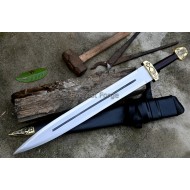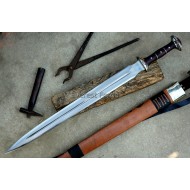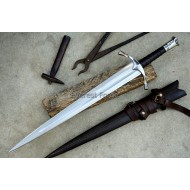
- Model: Roman Gladius Sword
- Product Code: GLADIUS0050
- Location: Kathmandu, Nepal
Available Options
A Hand-Forged Roman Gladius With a Brass-Fitted Scabbard
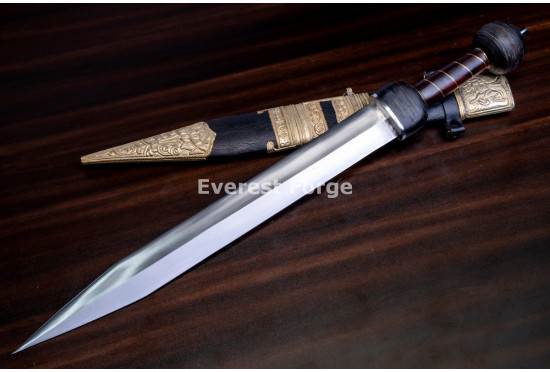
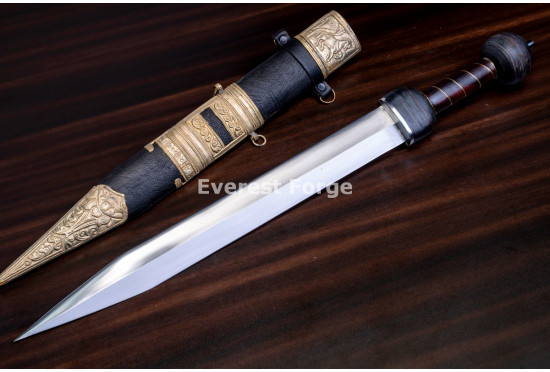
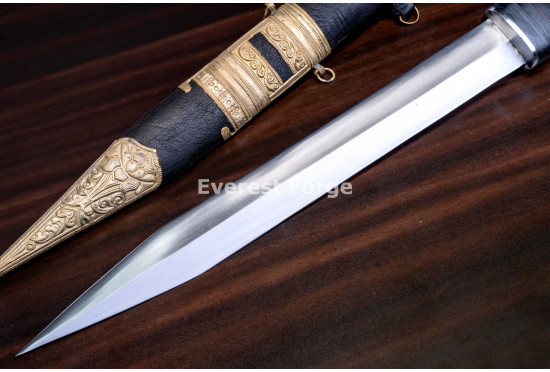
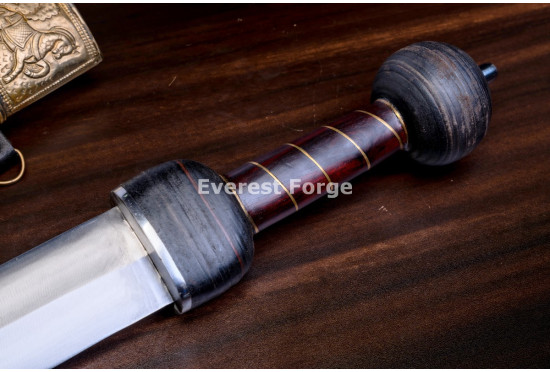
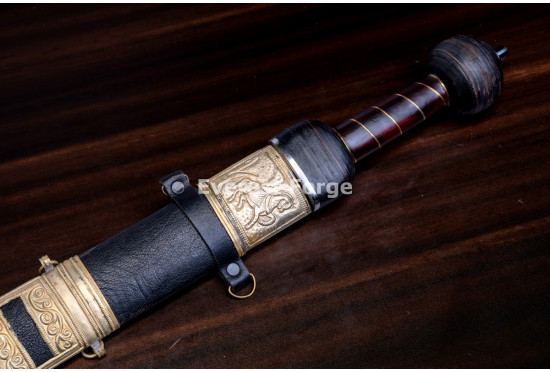
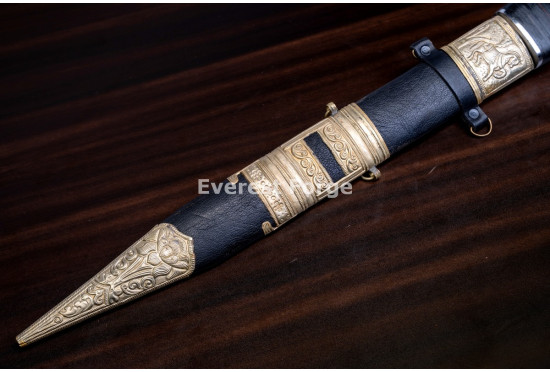
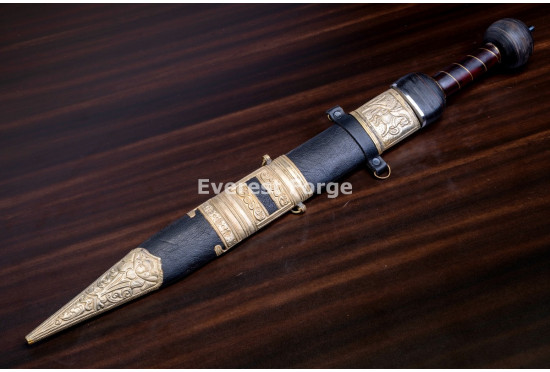
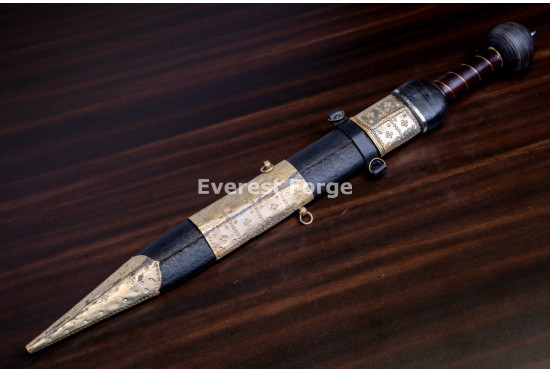
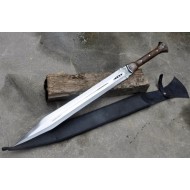
This is a Roman gladius in presentation dress, hand-forged in Tokha-3, Kathmandu, Nepal from 5160 high-carbon steel, oil-quenched and tempered. The blade runs 20 inches, holding its width along most of its length before drawing into a long triangular thrusting point, with a satin polish across the flats. The hilt follows the Roman pattern: a dark bulbous guard, a ribbed rosewood grip banded with fine rings, and a large rounded pommel. What sets this piece apart is the scabbard — black leather dressed with embossed brass plates worked in scrollwork and figured panels, with a matching throat and a decorated chape. Overall it stands 28.5 inches. It ships sharpened.
An honest note. Two things worth stating. First, this is a decorated presentation piece rather than a plain legionary sword, and that distinction is historically real — Roman scabbards ranged from plain leather-over-wood for the ranks to elaborately embossed metal-plated work for officers and gifts, the famous example being the Sword of Tiberius. The decoration on this scabbard is in that spirit rather than copied from a specific find. Second, the fittings are brass-toned rather than certified solid brass, and the Romans used tinned bronze rather than modern brass in any case. The blade, the proportions and the hilt pattern are period-correct; the dress is interpretive.
Want a Specific Roman Pattern?
Our smiths will forge to a named type — Mainz, Fulham or Pompeii proportions — or reproduce the scabbard decoration from a particular find you supply. Send the reference, a museum photograph or a drawing and we will quote it.
Start a Custom Build →Why This Gladius Is Built the Way It Is
Full Specifications
How You Can Configure It
Is This the Right Sword for You?
Buy This If You Want
- A gladius in presentation dress rather than plain issue leather
- A scabbard with worked relief on the throat, body and chape
- Real forged 5160 with a proper heat treatment behind the decoration
- Correct Roman hilt architecture — guard, ribbed grip, ball pommel
- A display piece that carries detail at arm's length as well as in the hand
- The option to have it built to a named Roman type on a custom order
Look Elsewhere If You Want
- A plain legionary sword — this is the decorated version
- A strict archaeological reproduction of a specific excavated find
- Certified solid brass fittings; ours are brass-toned
- A cutting sword; the gladius is a thrusting weapon by design
- A stainless blade that needs no oiling or care
- Identical units; every piece is forged and fitted by hand and varies
How to Order
Who This Gladius Suits
- Roman and ancient-world collectors who already own a plain gladius and want the dressed version beside it.
- Display buyers after a piece where the scabbard is as much of the object as the blade.
- Reenactors portraying officers or centurions, where decorated kit is appropriate and a blunted edge can be specified.
- Film, stage and cosplay users needing detail that survives a close camera.
- Gift and presentation buyers marking a retirement or a milestone, with an inscription on the blade or the plates.
What Is Included
- One hand-forged Roman gladius, sharpened and ready to display
- Black leather scabbard with embossed brass-toned plates, throat and chape
- Care and oiling instructions
- Everest Forge manufacturer warranty against defects in forging and heat treatment
Other Hand-Forged Swords
Shipping, Returns and Care
Shipping. Standard builds dispatch in 2 to 3 business days. Custom builds take 4 to 6 weeks. We ship worldwide by DHL or FedEx, 7 to 14 business days, fully tracked. Sword laws vary by country and by state — please check what applies where you live before ordering, as we cannot deliver into a restricted address.
Returns. Standard builds can be returned unused and in the original scabbard within 30 days. Custom builds, altered dimensions and inscribed pieces are made to your specification and cannot be returned unless there is a fault in forging or heat treatment.
Care. Three materials, three routines. The blade is high-carbon steel: wipe it dry after handling, since fingerprints will etch a satin finish within days, and keep a thin film of oil on it in storage. The brass-toned plates will dull over time; a soft dry cloth restores them, and metal polish will strip the finish, so keep it away — this matters more here than on a plain sword, because embossed relief traps polish in the recesses where you cannot get it out. The black leather should be kept out of direct sunlight and conditioned once or twice a year. Do not store the blade sheathed for long periods.
Frequently Asked Questions
Why were Roman scabbards decorated like this?
Because a Roman sword was a statement of rank and standing as much as a weapon, and the scabbard was where that statement was made. A legionary's scabbard was leather over a wooden core with modest metal fittings. Move up the ranks and the fittings multiply: embossed plates across the throat and the body, a worked chape at the tip, figured panels showing military or mythological scenes, all in tinned bronze that read as silver at a distance. The most famous survivor is the so-called Sword of Tiberius, found at Mainz, whose scabbard carries a full presentation scene in embossed bronze — almost certainly a gift rather than issue kit. Decorated scabbards also travelled as diplomatic gifts and retirement pieces, which is exactly the role this sword fills today. The decoration on ours is worked in that tradition rather than copied from a specific find, and we say so rather than implying an archaeological pedigree it does not have.
Are the fittings solid brass, and what does brass actually do on a sword?
They are brass-toned rather than certified solid brass, and we would rather be exact than let the photographs imply otherwise. As to what the metal does: copper alloys have been used for sword fittings for three thousand years for reasons that are practical before they are decorative. They do not rust, so a fitting in contact with leather and sweat survives where steel pits. They are soft enough to be worked in relief with a punch, which is how embossed plates like these are made and why you almost never see comparable relief work in steel. They are dense, so a pommel or a chape in copper alloy adds useful counterweight for its size. And they take and hold a bright finish that contrasts with a steel blade. One historical footnote: the Romans used tinned bronze rather than brass as we know it, which read closer to silver than gold — so a bright yellow gladius scabbard is a modern aesthetic, not a Roman one.
Is this a Mainz, a Fulham or a Pompeii gladius?
It is built to the general Roman pattern rather than to one named type, and it is worth explaining why the names matter. The three are distinguished mostly by the blade: a MAINZ has a waisted blade that narrows through the middle and a long point; a POMPEII has near-parallel edges and a short triangular point; a FULHAM sits between them with straight edges and a longer point. This blade is broad with near-parallel edges and a long point, which puts it closest to the Fulham end of the range, but we would not put a type name on it without measuring against the published proportions. If you want a specific named type, our smiths will forge to those proportions on a custom order — say which and we will build it.
Why is the gladius so short?
Because of how it was used, not because Romans could not make long swords — they could, and their cavalry carried the longer spatha. The legionary fought in close formation behind a large shield, with the man to his left and right within arm's reach. In that space a long sword cannot be swung without endangering your own line, but a short blade can be driven straight forward through the gap between shields the moment one opens. The gladius is built entirely around that motion: short enough to work in the press, broad enough to be rigid, and pointed enough to punch through. It is why the point takes up nearly a third of the blade, and why Roman training emphasised the thrust over the cut — a thrust needs two inches of penetration to be decisive where a cut needs a full swing.
What steel is it and how is it heat treated?
5160 high-carbon spring steel, oil-quenched and then tempered back. 5160 holds a point and flexes under load rather than snapping, which is exactly what a thrusting sword needs. It is also considerably better steel than anything available in the first century, when blades were pattern-welded or piled from bloomery iron of variable carbon content precisely because consistent steel could not be relied upon. It is the same family Nepali smiths have traditionally drawn from vehicle leaf spring.
Does it arrive sharp?
Yes. It ships with a working edge on both sides and a sharpened point, finished by hand. It is not a blunt wall-hanger with a sword-shaped profile ground into it. If it is going into a display case, a costume, or a reenactment group whose rules require blunt kit, ask for it blunted in the order note before we ship and we will finish it that way at no extra cost.
Is the tang full length?
Yes. The tang runs the full length of the hilt with the guard, grip and pommel fitted to it, so the assembly is held by steel rather than by adhesive. On a thrusting sword this matters in a specific way: a thrust loads the hilt in compression straight back along the blade's axis, which is the direction a poorly assembled hilt fails in. A full-length tang with a properly seated pommel puts that load through steel rather than through a glue line.
Can I have it built to different dimensions?
Yes. Blade length is selectable, and beyond the listed options our smiths will forge to a dimension or a named Roman type you specify. When the length changes the point is redrawn rather than simply scaled, because a gladius point that is proportionally too short or too long stops behaving like a gladius. Grip length can be adjusted as well, which matters more than people expect on a four inch Roman grip — it was sized for a hand wearing nothing, and larger modern hands often want another half inch.
Is the decorated scabbard included, and can I have a plain one instead?
The decorated scabbard is included and it is fixed on this piece — it is what distinguishes this gladius from a plain one, so it is not an option to be removed. If you want a plain leather scabbard with simple fittings, that is a different build and our custom forge will make it. We can also work a specific decorative scheme, an inscription or a legion device into the plates on a custom order, which is one of the more rewarding things the workshop does.
How do I look after the blade, the brass and the leather?
The blade is high-carbon steel: wipe it dry after handling and keep a thin film of camellia, mineral or light gun oil on it in storage. The brass-toned plates need a soft dry cloth and nothing else — metal polish strips the finish, and on embossed relief it also packs into the recesses where you will never get it out, leaving a white residue in every hollow. If they dull over years, that patina is generally more attractive than a bright polish anyway. The black leather should stay out of direct sunlight and get a light conditioner once or twice a year. Do not store the blade sheathed for long periods, because leather traps damp against steel.
Will every sword look exactly like the photograph?
No, and on this piece the variation is more visible than usual, because so much of it is hand work. The blade is drawn out under a hammer, so width and the exact start of the point differ slightly. The scabbard plates are worked in relief by hand, so the depth and crispness of the scrollwork vary from piece to piece — this is the part collectors tend to like rather than mind. Rosewood is a natural timber, so grain and colour differ on every grip. Weights and dimensions vary by a few percent. The steel, heat treatment, construction and edge are consistent.
Where is it made and by whom?
Hand-forged in Tokha-3, Kathmandu, Nepal, by our own smiths. Everest Forge is a working forge rather than a reseller putting a name on imported blanks — the steel is cut, drawn, quenched, tempered and ground, the grip turned and ribbed, the fittings worked and embossed, and the scabbard cut and stitched, all under one roof. Nepal has a long tradition of relief metalwork in copper alloy, which is why the scabbard plates on this piece are made in the same workshop as the blade rather than bought in.
| Specification | |
| Blade: | 20 inches. Hand forged from 5160 carbon steel |
| Total Length: | 28.5 inches |
| Handle: | 8.5 inches total with a 4 inch grip, full tang, ribbed and banded rosewood grip with bulbous guard and large rounded pommel |
| Weight: | 1470 grams approx, as shipped with the scabbard |
| Note: | handmade variation in weight, dimensions and finish may occur; keep blade lightly oiled when not in use |