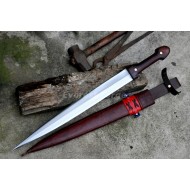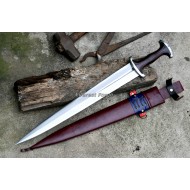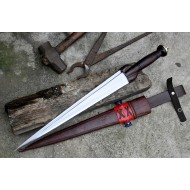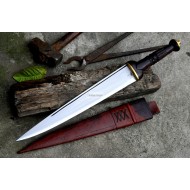
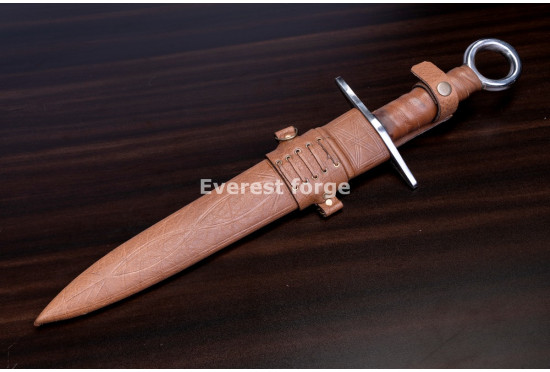
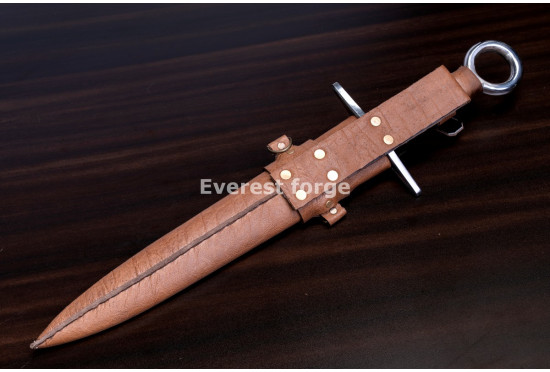
- Model: Hand forged Dagger
- Product Code: DAGGER108
- Location: Kathmandu,Nepal
Available Options
A Hand-Forged Medieval Quillon Dagger With a Ring Pommel
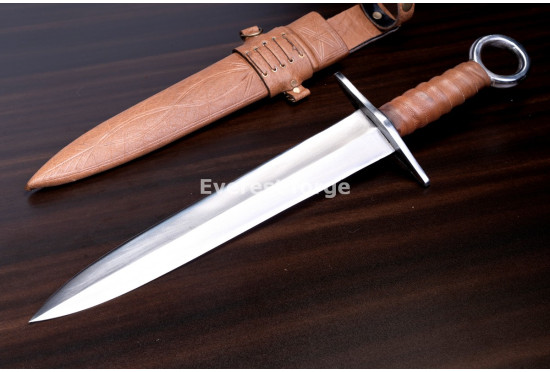
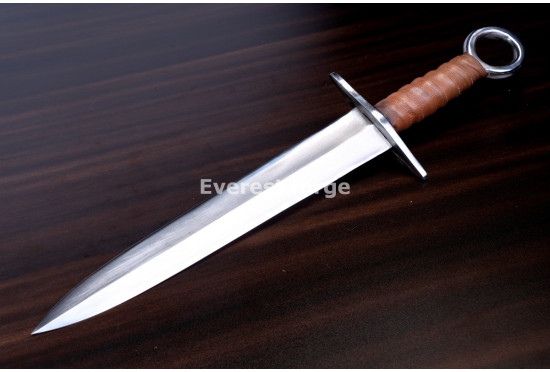
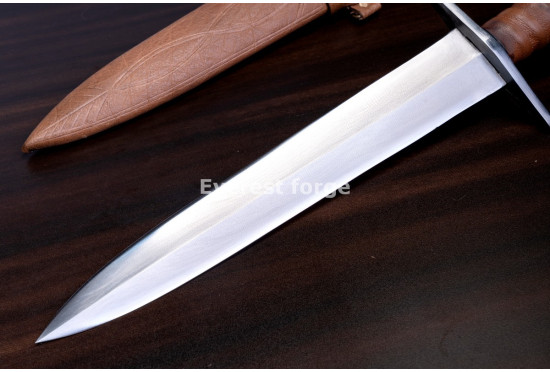
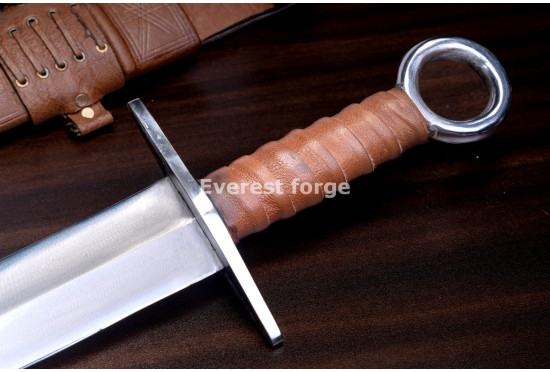
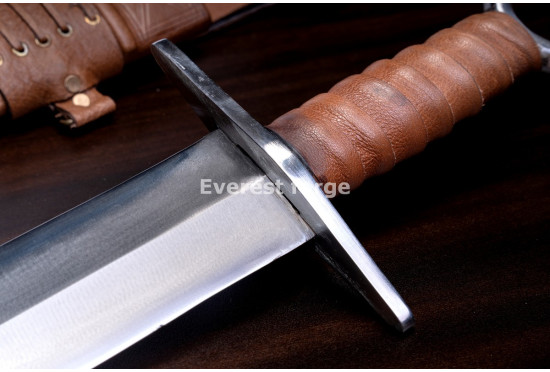
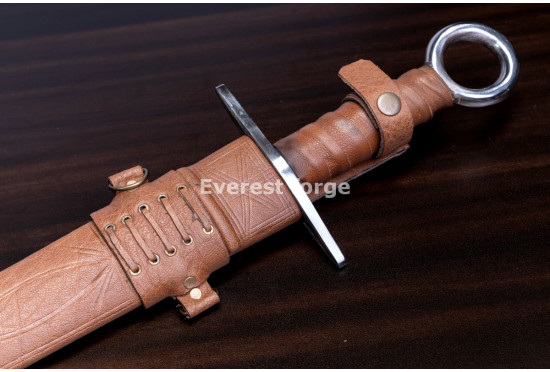
This is a quillon dagger, hand-forged in Tokha-3, Kathmandu, Nepal from 5160 high-carbon steel, oil-quenched and tempered. The blade runs 13 inches, double edged and drawing in a long even taper to a fine point, with a raised medial ridge running its length so the section stands as a flattened diamond rather than a flat plate. The hilt is built like a sword's in miniature: a straight steel cross with squared terminals, a leather-wrapped grip of 4.5 inches, and a polished steel ring closing the end. Overall it stands 20 inches. It ships sharpened, in a tooled brown leather scabbard with a laced throat.
An honest note. Two things. The name is right — a quillon dagger is defined by its sword-style cross guard, and at 13 inches of blade this sits inside the historical range, where surviving examples run from around 10 inches up to 16. What is less standard is the pommel: the common medieval forms are the wheel, the disc and the scent-stopper, and while annular and ring pommels do appear, they are the less usual choice. Second, this is a working interpretation rather than a copy of a specific excavated dagger. The proportions, the section and the hilt architecture are period-correct; the exact fittings are ours.
Want a Different Medieval Dagger?
Our smiths will forge to a named type — a rondel with its disc guard, a bollock dagger, a baselard, or a quillon dagger with a wheel or scent-stopper pommel — or work from a museum photograph you supply. Send a reference and we will quote it.
Start a Custom Build →Why This Dagger Is Built the Way It Is
Full Specifications
How You Can Configure It
Is This the Right Dagger for You?
Buy This If You Want
- A named medieval type rather than a generic decorative dagger
- A proper diamond section, not a flat blade with bevels ground on
- Real forged 5160 with a full heat treatment
- A tooled scabbard with a laced throat rather than a plain sleeve
- A companion piece to a medieval sword, at matching scale
- A smith who will build a rondel, bollock or baselard instead if you prefer
Look Elsewhere If You Want
- A strict museum copy — the fittings are ours, not from a specific find
- The most typical medieval pommel; wheel and disc are more common than ring
- A utility or camp knife; a double-edged thrusting blade is poor at both
- A short sword — at 13 inches this is a dagger, and we build swords separately
- A stainless blade that needs no oiling or care
- Identical units; every piece is forged by hand and varies slightly
How to Order
Who This Dagger Suits
- Medieval collectors who want the sidearm that went with the sword, not just the sword.
- Reenactors and living-history groups, for whom a dagger was the one weapon almost everyone carried.
- HEMA students reading the dagger material in the German and Italian sources, with a blunted build available.
- Display buyers pairing it with an arming sword or longsword at matching scale.
- Gift buyers wanting a compact forged piece that can be etched and will sit on a desk or a wall.
What Is Included
- One hand-forged quillon dagger, sharpened and ready to use
- Tooled brown leather scabbard with a laced throat
- Care and oiling instructions
- Everest Forge manufacturer warranty against defects in forging and heat treatment
Other Hand-Forged Blades
Shipping, Returns and Care
Shipping. Standard builds dispatch in 2 to 3 business days. Custom builds take 4 to 6 weeks. We ship worldwide by DHL or FedEx, 7 to 14 business days, fully tracked. Blade laws vary by country and by state, and double-edged blades are treated more strictly than single-edged ones in a number of jurisdictions — please check what applies where you live before ordering, as we cannot deliver into a restricted address.
Returns. Standard builds can be returned unused and in the original scabbard within 30 days. Custom builds, altered dimensions and etched pieces are made to your specification and cannot be returned unless there is a fault in forging or heat treatment.
Care. 5160 is a high-carbon steel and it will rust if you neglect it. Wipe the blade dry after handling, since fingerprints will etch a satin finish within days, and keep a thin film of oil on it in storage. On a diamond-section blade the two shallow valleys either side of the medial ridge are where a cloth skips and oil pools, so work along them rather than across. The leather grip wrap and the tooled scabbard should be kept out of direct sunlight and conditioned once or twice a year. Do not store the blade sheathed for long periods, because leather traps damp against steel.
Frequently Asked Questions
What are the main types of medieval dagger?
Five names cover most of what survives, and they are distinguished by the hilt rather than the blade. The QUILLON DAGGER, as here, has a straight cross guard — essentially a sword hilt at dagger scale — and it is the type most often shown paired with a sword in period art. The RONDEL has flat discs at both ends of the grip instead of a cross, which lets you put the heel of your hand on the top disc and drive the point with your bodyweight; it is the armour-fighting dagger. The BOLLOCK dagger, politely catalogued as a kidney dagger by Victorian curators, has two rounded lobes at the base of the grip in place of a guard, and it was the everyday civilian sidearm across northern Europe for centuries. The BASELARD has a distinctive capital-I hilt, with a bar at the top and bottom of the grip. The CINQUEDEA is Italian and immediately recognisable by a very broad triangular blade, sometimes five fingers wide at the ricasso, which is where the name comes from. A MISERICORDE is not a shape at all but a role — any narrow dagger used to finish a downed opponent through a visor or a gap in plate. We build all of these to order.
Why does a dagger use a diamond section instead of a fuller?
Because they solve opposite problems. A fuller is a groove that removes material from the middle of a blade's section, and it is a weight-saving device: on a long sword blade every gram out at the end of a long lever costs you control, so you take steel out of the place it contributes least. A dagger has no weight problem — it is already short and light — but it has a stiffness problem, because a thrust puts the entire force of your arm and bodyweight down the blade's long axis, and a flat blade under that load wants to buckle sideways. A diamond section solves it by putting a raised ridge down the centre, which is structurally the same trick as an I-beam turned on its side: material concentrated along the axis of bending resists deflection far better than the same material spread flat. That is why thrusting daggers, estocs and armour-piercing blades are diamond or triangular in section while cutting swords are fullered. Look at any blade's cross-section and you can usually tell what it was made to do.
Is 13 inches long for a dagger?
It is at the upper end, and it is legitimate. Surviving medieval quillon daggers run from around 10 inches of blade up to about 16, and pieces at the longer end blur into the category of the short sword or the "hand-and-a-half dagger" that period inventories sometimes list separately. At 13 inches this sits comfortably inside the range. Where the line genuinely falls is around 16 to 18 inches: past that the proportions stop working as a dagger — the grip becomes too short to control the length, and it wants a sword hilt instead. If you order a custom build much longer than this one, we will tell you that rather than take the order quietly.
What steel is it and how is it heat treated?
5160 high-carbon spring steel, oil-quenched and then tempered back. On a thrusting blade the heat treatment matters in a particular way: too soft and the point rolls or takes a set on a hard thrust, too hard and it snaps rather than flexing. Correctly tempered 5160 sits well in that band, holding a point while bending and returning. It is also the steel family Nepali smiths have traditionally drawn from vehicle leaf spring, so our forge reads it by colour and by sound at the anvil. Every blade is inspected before it is packed, and if a piece reaches you with a fault in the forging or the heat treatment we will replace it or refund you.
Does it arrive sharp?
Yes. It ships with a working edge on both sides and a sharpened point, finished by hand. It is not a blunt wall-hanger with a dagger-shaped profile ground into it. If it is going into a display case, a costume, or a HEMA or reenactment context whose rules require blunt kit, ask for it blunted in the order note before we ship and we will finish it that way at no extra cost.
Is the tang full length?
Yes. The tang runs the full length of the hilt with the cross, grip and ring pommel fitted to it, so the assembly is held by steel rather than by adhesive. On a thrusting weapon this matters in a specific direction: a thrust loads the hilt in compression straight back along the blade's axis, driving the whole assembly toward your hand, and that is precisely the direction a badly built hilt fails in. A full-length tang with a properly seated pommel puts that load through steel rather than through a glue line.
Why did almost everyone in medieval Europe carry a dagger?
Because it was the one weapon that was simultaneously a tool, a status marker and a sidearm, and because it was affordable. A sword was expensive and in many towns its carry was regulated; a dagger was cheap, small enough to wear all day without thinking about it, and nobody questioned it. It cut your food at table, which is a use people forget — forks were not yet common and diners brought their own blade. It was the fallback when a sword or a polearm was lost or too long for the distance. And in armoured fighting it was the finisher, because a dagger point could find the gaps a sword could not. Period art shows daggers hanging from the belts of soldiers, merchants, farmers and clergy alike, and they turn up in wills and inventories more often than any other weapon.
Can I have a different pommel?
Yes, and if you are after the historical mainstream you probably should. The three common medieval quillon-dagger pommels are the WHEEL, a flat disc seen edge-on, which is the same form that dominates arming swords of the period; the DISC, broader and flatter; and the SCENT-STOPPER, so called because it resembles a perfume-bottle stopper, tapering and faceted. The ring fitted here is a less usual choice, and while annular pommels do appear on surviving pieces they are not the first thing a curator would expect. All three alternatives are available on a custom build, and any of them will move this dagger closer to the standard type.
Can it be paired with one of your swords?
Yes, and it is worth doing, because a sword and dagger worn together is how these were actually carried — the dagger on the right hip, the sword on the left, and both visible in most period depictions of an armed man. Our smiths will match the fittings, the grip wrap colour and the scabbard tooling between this dagger and any sword we build, so the two read as a set rather than as two separate purchases. Order both and put a note on the order asking for them to be matched, and we will build them together.
Is the scabbard included?
Yes. A tooled brown leather scabbard with a laced throat and a belt fitting comes with the dagger, cut around this specific blade profile. If you change the blade length on a custom build the scabbard is made to the new dimensions. A different tooling pattern, a plain finish or a belt frog can be specified, and if you are having a matching sword built we will tool both to the same pattern.
How do I look after the blade and the leather?
Wipe the blade dry after handling, since fingerprints are acidic enough to etch a satin finish within days, and keep a thin film of camellia, mineral or light gun oil on it in storage. The detail people miss on a diamond-section blade is the two shallow valleys either side of the medial ridge: a cloth passed across the blade bridges over them, so work along the ridge rather than across it. The leather grip wrap and the tooled scabbard want conditioning once or twice a year and no direct sunlight, which fades and dries dyed leather faster than anything else. Do not store the blade sheathed for long periods.
Will every dagger look exactly like the photograph?
No, and that is inherent to hand forging. Every blade is drawn out under a hammer, so the exact line of the medial ridge and the width at the ricasso carry small differences from piece to piece. The ring is formed and polished by hand, so no two are identical. Leather is dyed, wrapped and tooled by hand, so the wrap spacing and the tooling vary. Weights and dimensions vary by a few percent either way. What is consistent is the steel, the heat treatment, the construction and the edge. We build these as handmade objects and a small amount of cosmetic variation is part of that rather than a fault.
| Specification | |
| Blade: | 13 inches. Hand forged from 5160 carbon steel |
| Total Length: | 20 inches |
| Handle: | 7 inches total with a 4.5 inch grip, full tang, straight steel cross with squared terminals, leather-wrapped grip and steel ring pommel |
| Weight: | 840 grams approx, as shipped with the scabbard |
| Note: | handmade variation in weight, dimensions and finish may occur; keep blade lightly oiled when not in use |