- Model: Dagger
- Product Code: persian01
- Location: Kathmandu,Nepal
Available Options
A Hand-Forged Persian Dagger
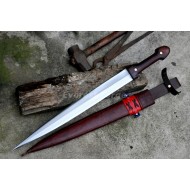
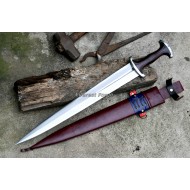
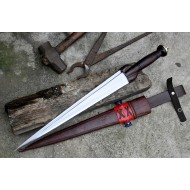
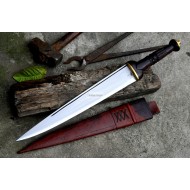
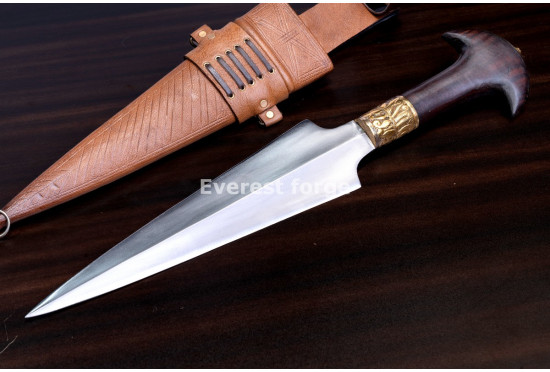
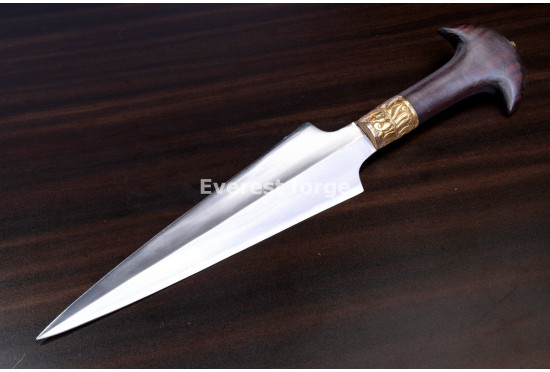
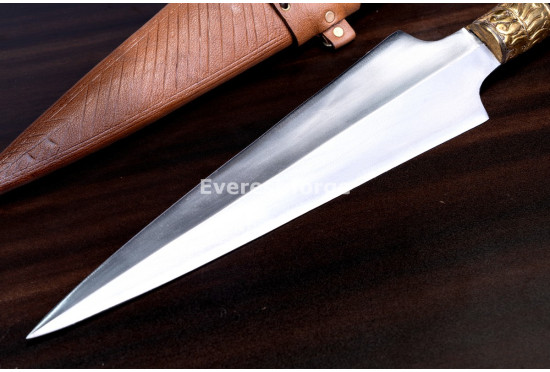
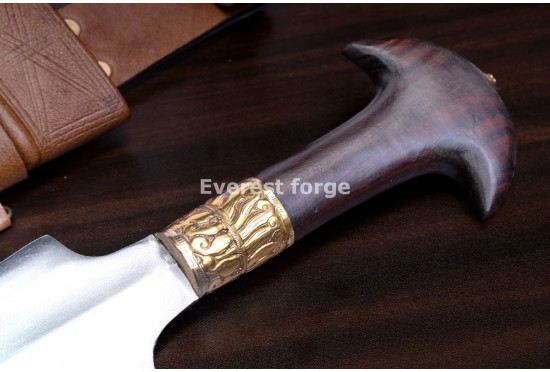
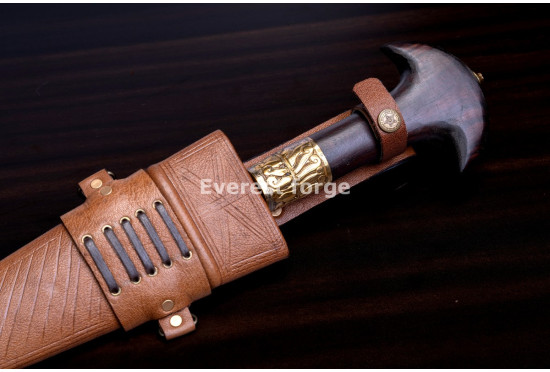
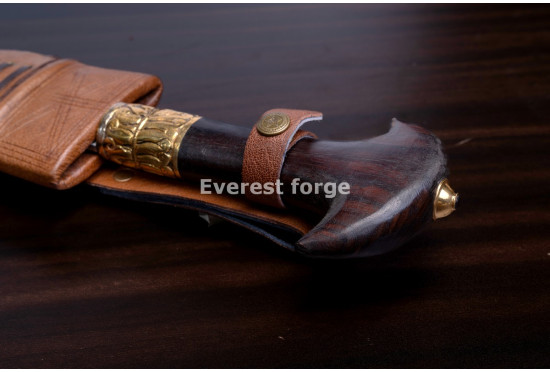
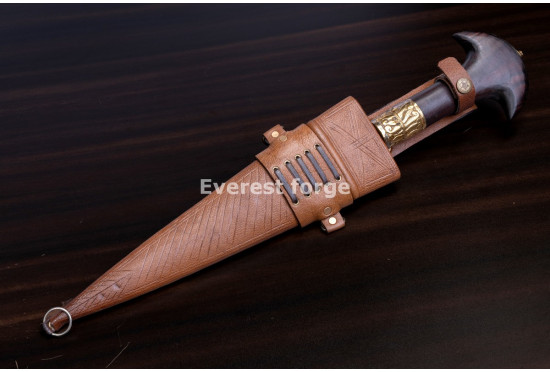
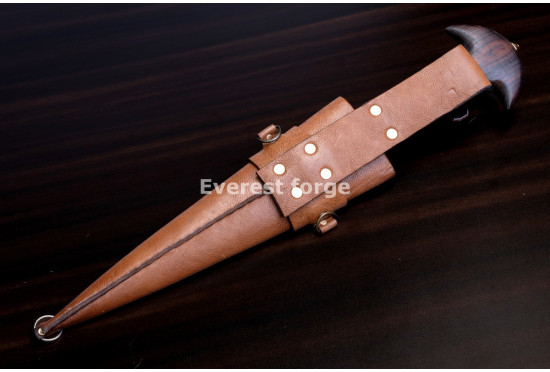
This is a large Persian-pattern dagger, hand-forged in Tokha-3, Kathmandu, Nepal from 5160 high-carbon steel, oil-quenched and tempered. The blade runs 12 inches, single-edged and heavy in the hand, stepping down at a squared ricasso before running in a long straight taper to an acute point, with a thick spine carried the full length and a satin polish on the flats. The hilt follows the Persian and Afghan pattern exactly: no guard at all, a cast brass ferrule worked in relief where the blade meets the wood, a shaped rosewood grip, and a flared pommel, its two lobes swept back over the hand. Overall it stands 18.5 inches. It ships sharpened, in a tooled leather scabbard with a laced panel and a suspension ring.
An honest note. We call this a Persian dagger rather than giving it a specific type name, and that is deliberate. The Persian, Afghan and North Indian dagger family contains half a dozen closely related patterns — kard, pesh-kabz, choora, khanjar, Khyber knife — and they are told apart by details of blade section and profile rather than by general appearance. This piece sits squarely in that family and its hilt is textbook for it, but naming one specific type without measuring the blade section would be guesswork dressed as expertise, and we would rather not. It is also a working interpretation rather than a copy of a museum piece: the proportions and the hilt architecture are right, the fittings are ours.
Want a Specific Persian or Afghan Pattern?
Our smiths will forge to a named type — a recurved pesh-kabz, a straight kard, a choora, or a khanjar with a curved blade — or work from a museum photograph you supply. Horn, bone and ivory-toned grips are all available. Send a reference and we will quote it.
Start a Custom Build →Why This Dagger Is Built the Way It Is
Full Specifications
How You Can Configure It
Is This the Right Dagger for You?
Buy This If You Want
- A large Persian-pattern dagger with real presence in the hand
- The guardless hilt and flared pommel that define the regional style
- Real forged 5160 with a proper heat treatment
- A cast brass ferrule worked in relief rather than a plain collar
- A tooled scabbard with a suspension ring, not a plain sleeve
- A smith who will build a named pesh-kabz, kard or khanjar to order
Look Elsewhere If You Want
- A named museum type — we build those to order rather than claim one here
- A push dagger; this has an in-line grip and is held conventionally
- A guard between your hand and the blade; this pattern has none by design
- A utility or camp knife; a thrusting dagger is poor at both
- A stainless blade that needs no oiling or care
- Identical units; every piece is forged and fitted by hand and varies
How to Order
Who This Dagger Suits
- Collectors of Islamic and Persian arms, a field with far less competition than European or Japanese collecting.
- Display buyers after a piece where the hilt and scabbard carry as much interest as the blade.
- Collectors filling geographic gaps who already own European, Ottoman and North African pieces.
- Reenactors and living-history groups covering Central Asia, Persia and the North-West Frontier.
- Anyone commissioning a named type who wants to see the workshop's hand before ordering a pesh-kabz or khanjar.
What Is Included
- One hand-forged Persian dagger, sharpened and ready to use
- Tooled leather scabbard with a laced panel and suspension ring
- Care and oiling instructions
- Everest Forge manufacturer warranty against defects in forging and heat treatment
Other Hand-Forged Blades
Shipping, Returns and Care
Shipping. Standard builds dispatch in 2 to 3 business days. Custom builds take 4 to 6 weeks. We ship worldwide by DHL or FedEx, 7 to 14 business days, fully tracked. Blade laws vary by country and by state — please check what applies where you live before ordering, as we cannot deliver into a restricted address.
Returns. Standard builds can be returned unused and in the original scabbard within 30 days. Custom builds, altered dimensions and etched pieces are made to your specification and cannot be returned unless there is a fault in forging or heat treatment. If anything about your piece is not right, tell us and we will replace it or refund you.
Care. Three materials, three routines. The blade is high-carbon steel: wipe it dry after handling, since fingerprints will etch a satin finish within days, and keep a thin film of oil on it in storage, paying attention to the shoulder where the blade steps down at the ricasso. The cast brass ferrule needs a soft dry cloth only — metal polish strips the finish and packs into relief work where it dries white in every hollow and is close to impossible to remove. The rosewood grip and the tooled leather scabbard both want a light conditioner once or twice a year and no direct sunlight. Do not store the blade sheathed for long periods.
Frequently Asked Questions
What are the main Persian and Afghan dagger types?
Five names cover most of what you will encounter, and unlike European daggers they are told apart mainly by the BLADE rather than the hilt, because the hilts across the region are broadly similar — guardless, with a shaped grip and a flared pommel. The KARD is the simplest: straight, single-edged, thick-spined, tapering to a point, and it is the everyday knife of the family. The PESH-KABZ is the specialist: broad at the forte, then a distinct recurve where the edge dips inward, running out to a needle-fine reinforced point. It was designed to defeat mail, the point sized to enter a link and the T-section spine to drive it through without buckling. The CHOORA is the Afghan and Mahsud development of the pesh-kabz, usually with a more pronounced flared pommel. The KHANJAR is curved rather than straight, double-edged, and is worn across a wide swathe of the Islamic world with strong regional variation. The KHYBER KNIFE, or salawar yataghan, is the large one — broad at the ricasso, T-backed, and long enough at 15 to 24 inches that it sits between dagger and short sword. Our smiths build all of them to order.
Why does this dagger have no guard at all?
Because the design solves the problem from the other end, and it is one of the clearest differences between European and Persian blade thinking. A European dagger puts a crossguard in FRONT of the hand: it stops your hand sliding forward onto the edge and it catches an opposing blade. Persian, Afghan and Indian daggers of this family put the work BEHIND the hand instead, with a flared or flared pommel that stops the grip sliding backward out of your palm when you drive the point into something. The two approaches assume different uses. A guard matters most when blades are meeting blades; a pommel matters most when you are thrusting hard into a resisting target and the risk is losing the weapon backward rather than cutting your own fingers. It also makes the dagger far easier to carry and draw, since there is nothing projecting sideways to catch on a sash or a scabbard throat — which is why these were worn tucked into a belt across the region.
Why is the spine so thick?
Because on a single-edged thrusting blade the spine is the structure, and this whole family of daggers was built around defeating armour. When you drive a point into something that does not yield, the blade wants to buckle sideways, and what resists that is depth of material along the axis of the thrust. A single-edged blade can put all of that material into the unsharpened back, giving a deep, stiff section without the blade becoming wide or heavy — the classic form is a T-section, flat across the top and wedging down to the edge. The result is a dagger that is narrow enough to enter a gap and stiff enough to keep going. It has a practical side benefit too: a thick unsharpened spine is a surface you can safely put a thumb or a palm on to press the point through something, which you cannot do on a double-edged blade.
What steel is it and how is it heat treated?
5160 high-carbon spring steel, oil-quenched and then tempered back. On a thrusting blade the heat treatment matters in a particular way: too soft and the point rolls or takes a permanent set under load, too hard and it snaps rather than flexing. Correctly tempered 5160 holds a point while bending and returning. It is also the steel family Nepali smiths have traditionally drawn from vehicle leaf spring, so our forge reads it by colour and by sound at the anvil. Every blade is inspected before it is packed, and if a piece reaches you with a fault in the forging or the heat treatment we will replace it or refund you.
Does it arrive sharp?
Yes. It ships with a working edge, sharpened by hand and ready out of the scabbard. It is not a display piece with an edge suggested rather than ground. If it is going into a display case, a costume, or a reenactment group whose rules require blunt kit, ask for it blunted in the order note before we ship and we will finish it that way at no extra cost.
Is this a push dagger?
No. A push dagger has its grip set at ninety degrees to the blade, so you hold it in a closed fist with the blade projecting between your fingers and the force travels straight down your forearm. This dagger has an in-line grip and is held exactly as you would hold any conventional knife. The flared flared pommel can make the silhouette read as T-shaped in a photograph, which is where the confusion comes from, but it is a pommel rather than a transverse handle. If you specifically want a push dagger or an Indian katar — the H-shaped transverse-gripped dagger with side bars running along the forearm — that is a different object and our custom forge will build one.
Is the tang full length?
Yes. The tang runs the full length of the hilt with the ferrule, grip and pommel fitted to it, so the assembly is held by steel rather than by adhesive. On a guardless thrusting dagger this matters more than usual, because there is no crossguard spreading load into the hilt — every force from the blade passes directly through the ferrule and the tang into the grip. A short or partial tang under repeated thrusting will loosen at the ferrule, and that is the first place to check on any dagger of this pattern.
Can I have it built as a named type?
Yes, and it is the most interesting commission in this family. Tell us which — a pesh-kabz with its recurve and needle point, a plain kard, a choora with a heavier flared pommel, or a curved khanjar — and our smiths will forge the blade to that pattern. If you have a museum photograph or a plate from a reference book, send it; working from a specific example gives a much better result than a general description. Horn, bone and ivory-toned grips are all available and any of them will move the piece closer to a historical original than rosewood does.
Can I have a shorter blade?
Yes. Blade length is selectable, and beyond the listed options our smiths will forge to a dimension you specify. Worth knowing that most historical daggers in this family are shorter than this piece — a kard or a pesh-kabz carried as an everyday sidearm typically runs well under a foot of blade, because it was worn tucked into a sash all day. This one is built larger, which gives it presence as a display piece and more authority in the hand. If you want traditional carry proportions, ask for them.
Is the scabbard included?
Yes. A tooled leather scabbard with a laced panel and a suspension ring comes with the dagger, cut around this specific blade profile. The ring lets it hang from a belt or a cord rather than sitting in a fixed loop, which is how daggers of this pattern were commonly carried. If you change the blade length on a custom build the scabbard is made to the new dimensions, and a plain finish or a belt frog can be specified instead.
How do I look after the blade, the brass and the leather?
Three materials, three routines. The blade is high-carbon steel: wipe it dry after handling and keep a thin film of camellia, mineral or light gun oil on it in storage, paying attention to the shoulder where the blade steps down at the ricasso, which a cloth passes straight over. The cast brass ferrule wants a soft dry cloth and nothing else — metal polish strips the finish and packs into relief work, drying to a white residue in every hollow that is very difficult to lift out. The rosewood grip and the tooled leather scabbard both want a light conditioner once or twice a year, and both should be kept out of direct sunlight.
Will every dagger look exactly like the photograph?
No. Every blade is drawn out under a hammer, so the width at the ricasso and the exact line of the taper differ from piece to piece. The pommel is shaped by hand, so the sweep of the ears varies. Rosewood is a natural timber, so grain and colour differ on every grip, and the brass ferrule is cast and then finished by hand, so the crispness of the relief varies. Weights and dimensions vary by a few percent either way. We build these as handmade objects and a small amount of cosmetic variation comes with that rather than being a fault — but if a piece reaches you and you are not happy with it, tell us and we will put it right.
| Specification | |
| Blade: | 12 inches. Hand forged from 5160 carbon steel |
| Total Length: | 18.5 inches |
| Handle: | 6.5 inches, guardless hilt with cast brass ferrule, shaped rosewood grip and flared pommel |
| Weight: | 870 grams approx, as shipped with the scabbard |
| Note: | handmade variation in weight, dimensions and finish may occur; keep blade lightly oiled when not in use |