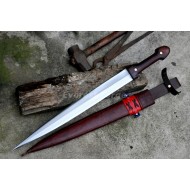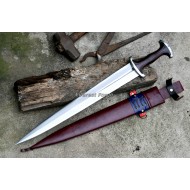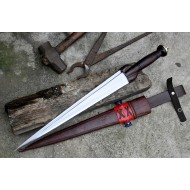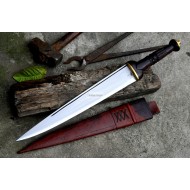
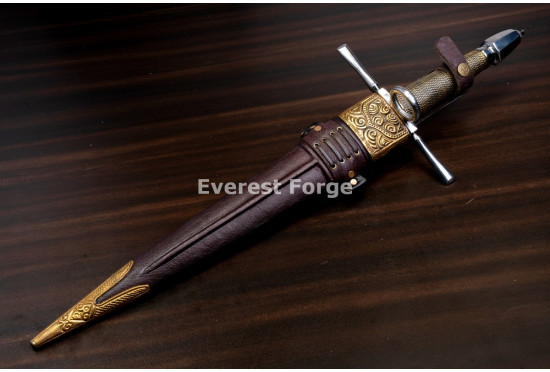
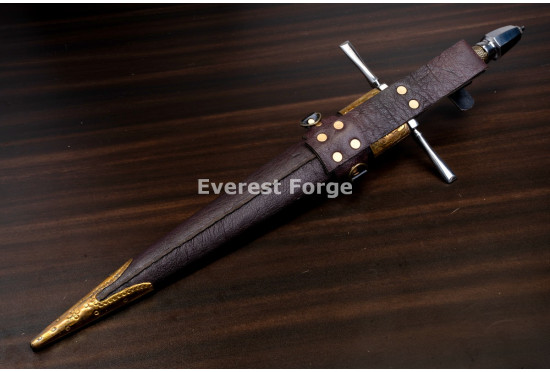


- Model: Hand forged Dagger
- Product Code: SIDERINGDAGGER
- Location: Kathmandu,Nepal
Available Options
What Is a Side Ring Parrying Dagger?
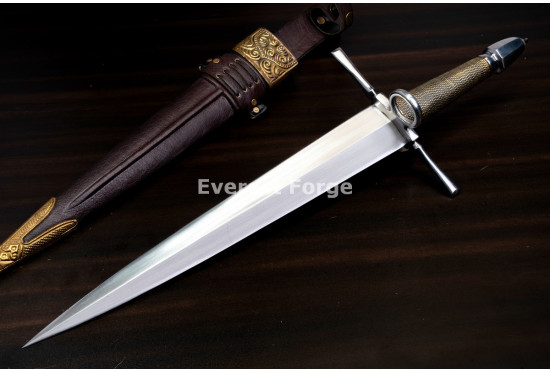
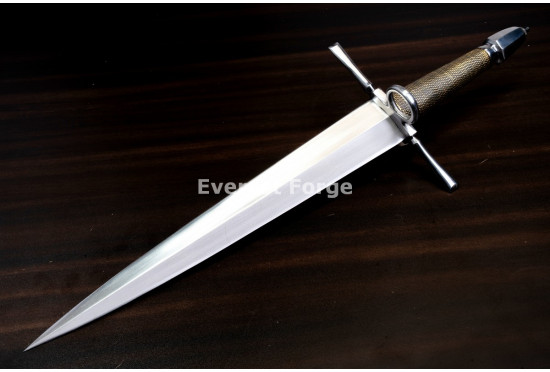
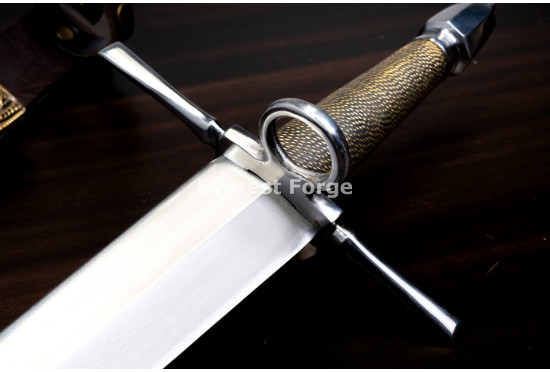
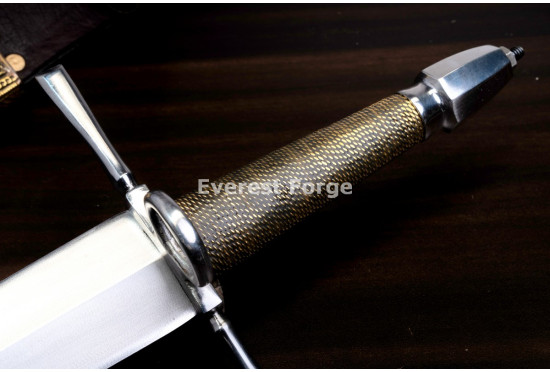
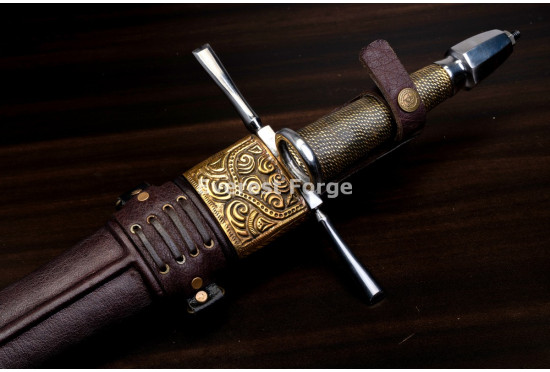
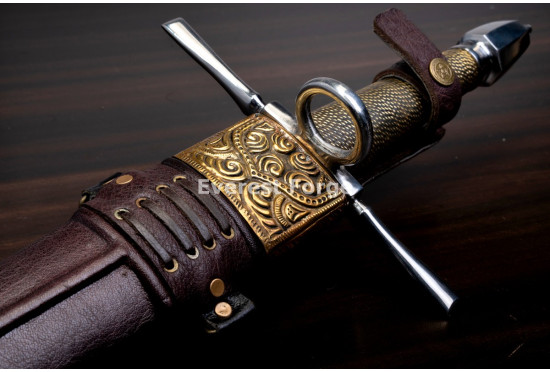
A parrying dagger is not a sidearm. It is a companion weapon, held in the left hand while a rapier works in the right, and its job is defence rather than attack. This one is built in the classic Renaissance pattern: long slim quillons reaching well past the width of the blade, and a steel side ring set on the outer face of the guard in the plane of the blade to cover the hand. The blade is 15 inches and double-edged, the grip is wrapped in brass wire, the pommel is a faceted steel barrel, and the whole piece runs to 22 inches overall. Hand-forged in Nepal from 5160 high-carbon spring steel, in a leather scabbard with cast brass mounts at both ends.
Because it was made to be used alongside another weapon rather than on its own, almost everything about it is different from the medieval daggers elsewhere in our range. The guard is long where theirs are short, slim in section where theirs are broad, and it carries a ring they have no use for. If you have wondered why some daggers look like small swords and others look like this, the answer is that these two were doing entirely different jobs.
An honest note. Two things worth saying before you order. First, this is a sharp weapon, not a training tool. It is forged, hardened, tempered and sharpened on both edges, and it is not suitable for sparring, drilling with a partner or any other contact practice. If you fence, what you want is a blunt trainer with a thickened edge and a rolled or flared tip, and we will forge one to your specification. Do not buy this and blunt it yourself; the geometry is wrong for it. Second, the piece is historically informed rather than a reproduction of a documented original. The form, the ring placement and the construction are orthodox for a late 16th century left-hand dagger, but the foliate work on the brass mounts is our smiths' own hand rather than a copied European pattern.
Please check your local law before ordering. This is a double-edged fixed blade of 15 inches, and both facts carry legal weight. A great deal of knife legislation treats double-edged daggers as a restricted category in their own right, independent of size, and blade length thresholds then apply on top. At 15 inches this piece sits above ordinary knife allowances in most places and may be regulated as a sword or a bladed weapon rather than as a knife. Import rules frequently differ from possession and carry rules, so check all three for your own address. We ship worldwide but we cannot advise on your jurisdiction. If the second edge is the obstacle, we will sharpen one side and leave the other blunt at no extra cost.
Need a Blunt Trainer Instead?
Thickened edges, a rolled or flared tip, and a blade tuned for flex rather than sharpness. Tell us what your club or your ruleset requires and our smiths will forge to that specification rather than to ours.
Specify a Trainer →Why This Dagger Is Built the Way It Is
Full Specifications
Blade length, blade finish and grip material are selectable on this listing. The figures above describe the standard build as photographed; what you receive will match the options you choose at checkout. Small variations in weight, dimension and finish are normal in hand-forged work, and cast and chased fittings vary more than machined ones do.
Build It Your Way
Every option below is forged, cast or wound to order in the same workshop. None of them is a part bought in and fitted afterwards.
What This Dagger Does Well, and What It Does Not
What It Is Good At
- Display, particularly beside a rapier, which is the company it was designed to keep
- Collecting the Renaissance forms, which are badly under-represented next to medieval ones
- Handling. At 840 grams it is genuinely light for its length, because the blade is doing less work than a sidearm blade would
- Costume and film work at close quarters, where the ring and the quillons read immediately as Renaissance
- Grip security. A full wire wrap holds through a glove and through a sweating hand
What It Is Not Good At
- Training or sparring. It is sharp, and the geometry is wrong for blunting. Order the trainer build instead
- Utility work. A double-edged blade cannot be gripped by the spine or used against a board
- Carry. The quillons and ring make it bulky, and at 15 inches it is outside ordinary knife allowances in most places
- Strict reenactment. The form is orthodox but the mount decoration is our own vocabulary
- Low maintenance. Mirror-polished steel, brass and leather all want different treatment
How to Order a Custom Dagger
Looking for a Medieval Dagger Instead?
We forge the quillon dagger in plain and decorated builds, and the bollock hilt in period and modern forms. Those are sidearms rather than companion weapons, and they are built accordingly.
See the Quillon Daggers →Who This Dagger Is For
- Rapier owners who want the companion weapon the rapier was designed to be used with
- Collectors of Renaissance arms, a period far less served by reproduction makers than the Middle Ages
- Historical fencers who want a sharp reference piece to sit alongside their trainers, not to replace them
- Costume and film buyers working in the 16th and 17th centuries, where a medieval dagger would read wrong
- Anyone commissioning a matched pair, since this hilt vocabulary scales onto a rapier without redesign
It is not for you if you want something to train with, in which case order the trainer build, or something to carry and use, in which case any of our single-edged knives will serve you better and be legal in more places.
What Is Included
- The hand-forged parrying dagger, sharpened and ready for display
- A leather scabbard with cast brass locket and chape, laced throat and studded belt fitting
- A certificate of authenticity from the workshop
- Care instructions for high-carbon steel, brass fittings and leather
- Everest Forge manufacturer warranty against forging and material defects
Other Blades From the Everest Forge Workshop
Shipping, Returns and Care
Dispatch. Stock pieces leave the workshop within 2-3 business days. Custom builds take 4-6 weeks depending on the queue, and decorated or trainer builds sit at the longer end because the casting, chasing and blade tuning are done after the forging.
Shipping. Tracked worldwide by DHL or FedEx, typically 7-14 business days in transit from Kathmandu. Customs paperwork is completed accurately and in full. At 15 inches and double-edged, this piece attracts more import scrutiny than an ordinary knife; please check your own country's rules before ordering.
Returns and warranty. Covered by the Everest Forge manufacturer warranty against defects in forging and materials. Custom builds made to your own specification cannot be returned for a change of mind, which is exactly why we confirm everything in writing first.
Care. Three materials, three different needs. The steel is mirror-polished high-carbon, so wipe it after every handling and keep a light film of oil on it; our wheel pommel dagger page explains why a mirror finish is the least forgiving one we sell. The brass mounts and the grip wire will tarnish to a warm dull gold, which most owners leave alone; if you prefer them bright, use a brass polish and keep it off the steel. Pay particular attention to the inner face of the side ring and the underside of the quillons, which a cloth drawn along the blade never reaches. Feed the leather once or twice a year, keeping conditioner off both metals, and do not store the dagger sheathed for long periods.
Parrying Dagger Questions Answered
What is a parrying dagger?
A dagger made to be used in the left hand at the same time as a sword in the right, which is why it is also called a left-hand dagger. It belongs to the Renaissance, roughly 1550 to 1650, when civilian duelling with the rapier became widespread across Italy, Spain, France and eventually England. The rapier is long, fast and superb at attacking, and correspondingly poor at defending itself, so a second weapon in the off hand took over the defensive work. The dagger caught, deflected and trapped the opponent's blade while the rapier looked for an opening. Everything about the shape follows from that division of labour: the guard is large because it is what meets the incoming blade, and the blade itself is comparatively unimportant.
Is this a main gauche?
Yes. Main gauche is simply French for left hand, and in English it has come to mean exactly this weapon: the companion dagger to a rapier. The two terms are interchangeable in ordinary use, though if you want to be precise, some writers reserve main gauche for the heavier Spanish-style daggers with a wide triangular knuckle plate and use parrying dagger for the broader family that includes ring-guarded pieces like this one. Nobody will misunderstand you either way. You will also see left-hand dagger, and occasionally companion dagger.
What does the side ring actually do?
It closes a gap. Long quillons protect the hand well from a blade arriving across them, but once two blades are in contact and sliding, an opposing point can travel down the length of your blade and pass the cross on the flat side, arriving at your fingers from a direction the quillons cannot cover. The ring sits in that plane, on the outer face of the guard, and stops it. That is also why it is on one side only. The outer face is the side exposed to the opponent when the hand is held in a natural guard; the inner face is turned toward your own body and does not need it, and a ring there would foul the dagger against your hip when worn. Some patterns do carry rings on both faces, and we build that version on request, but the single outer ring is the more common historical arrangement and the more practical one to wear.
Why are the quillons long and slim rather than short and broad?
Because this guard is genuinely for parrying, and almost no other dagger's is. On a medieval sidearm the cross has one job, which is stopping the hand sliding onto the blade when a thrust lands, so it can be short and shaped for looks; our fishtail guard dagger page goes into that in detail. Here the guard is the working part of the weapon. Length matters because a longer quillon covers more angles and gives you more chance of intercepting a blade that is not arriving exactly where you expected. Round rod section matters because a flat bar with corners tends to catch and bind against an incoming edge, where a round section lets it slide and be guided. And the slightly spread ends stop a caught blade running off the tip. It is a design solved by fencers rather than by decorators, which is why it looks so different from everything else in our dagger range.
How is the hilt assembled?
The tang runs the full length of the dagger and is threaded at the butt, and the pommel is drawn down onto that thread to compress guard, grip core and pommel into one rigid assembly. It is a different method from the peened construction used on medieval hilts, where the tang end is hammered over into a solid block, and each has honest advantages. A peen cannot loosen but also cannot be undone: if the grip covering wears out, the hilt has to be destroyed to renew it. A threaded assembly can be taken apart, re-tightened years later, and rewrapped, which on a wire-wrapped grip is a real benefit because wire is the covering most likely to need attention. The trade is that a thread can back off over time if it is not properly secured, so check it occasionally and nip it up if it moves. If you would prefer a peened hilt, say so when you order.
How does it compare with the medieval daggers in your range?
It is a different kind of object, not a variation. Our quillon daggers and bollock daggers are sidearms: weapons carried alone, used alone, and shaped so that the blade does the work. This is a companion weapon whose guard does the work, which is why it has long rod quillons and a ring where they have short shaped crosses and none. There is a practical consequence too. At 840 grams it is lighter than most of the medieval pieces despite its length, because a parrying dagger does not need a heavy blade and benefits from being quick in the hand. Buy a medieval dagger if you want a sidearm. Buy this if you own or want a rapier, or if you are interested in how Renaissance fencing actually worked.
Can I use this for HEMA or sparring?
No, and please do not try. This is sharpened on both edges and pointed, and no responsible club will let it near a drill floor. It is not simply a question of the edge either, which is why blunting it yourself is not the answer: a training dagger is a different build from the forge up, with edges left thick, a tip rolled or flared so it cannot pierce, and the blade tuned to flex on a thrust rather than to stay rigid. Grinding the edge off a sharp blade gives you a rigid steel bar with a spike on the end, which is more dangerous than the sharp version rather than less. What we will happily do is forge you a proper trainer. Tell us your club's ruleset or the standard you fence to and we will build to that specification. Plenty of people own both, one for the floor and one for the wall.
Is it sharpened on both edges, and how is the blade ground?
Both edges as standard. The blade is broad at the forte with a stepped shoulder where the grind begins, and tapers evenly from there to a fine point. On a parrying dagger the blade is the less important half of the weapon, so it is ground for stiffness and a good point rather than for cutting power, and the width at the base is there to resist a blade sliding down onto the guard rather than to add mass. If a double edge is a problem where you live, we will sharpen one side and leave the other blunt at no extra cost, and the piece looks identical.
Is a blade this long legal where I live?
We cannot answer that for you, and you should be wary of any seller who claims they can. Two separate provisions tend to apply. A great many jurisdictions treat double-edged daggers as their own restricted category regardless of size, and blade length thresholds apply independently on top of that. At 15 inches this sits above the ordinary knife allowance in most places, which means it may be regulated as a sword or a bladed weapon rather than as a knife, and import rules are frequently different again from possession and carry rules. Check all three for your own address before ordering. If length is the obstacle, an 11 or 13 inch build costs no more and is a perfectly historical proportion for the type.
Is this historically accurate?
The form is, the ornament is ours. A side ring on the outer face, long rod quillons with spread terminals, a wire-wrapped grip, a faceted pommel and a leather scabbard with cast mounts are all correct for a late 16th to mid 17th century left-hand dagger, and the way the hilt goes together is the period arrangement rather than an imitation of its appearance. What is not documented is this exact piece: the foliate scrollwork chased into the brass locket and chape is our smiths' own vocabulary, not a European pattern copied from an original in a collection. If you need something defensible at a strict living history event, tell us the region and date you portray and we will build the mounts to suit, or leave them plain.
What steel is it, and how is it heat treated?
5160 high-carbon spring steel, the same stock our smiths use for kukris and swords, forged down from leaf spring in the Nepali tradition. It is oil-quenched and then tempered back, producing a blade that holds an edge but stays tough rather than brittle. Toughness is worth more than usual on a weapon of this kind, because a parrying dagger is designed to be struck as much as to strike, and a hard, brittle blade is exactly the wrong thing to put in the path of an incoming point. It is not stainless and it will take a patina with use.
Will my dagger look exactly like the photographs?
Close, but not identical. The blade profile is drawn out by eye against a pattern and the taper is ground by hand, the quillons and ring are forged and filed individually so their sweep varies a little, the brass mounts are cast and then chased by hand so the foliate detail differs in its particulars, and the grip wire is wound one at a time. What does not vary is the specification: length, steel, construction, heat treatment and sharpness are held to the same standard on every piece. Our kukri machete page sets out in more detail what can and cannot differ between two blades from the same bench.
| Specification | |
| Blade: | 15 inches. Hand forged from 5160 carbon steel |
| Total Length: | 22 inches |
| Handle: | 7 inches with a 4.5 inch grip, long rod quillons with spread ends and a steel side ring on the outer face, full brass wire wrap over a shaped core, faceted steel barrel pommel drawn down on a threaded tang |
| Weight: | 840 grams the dagger, 1090 grams with the scabbard |
| Note: | handmade variation in weight, dimensions and finish may occur; keep blade lightly oiled when not in use |