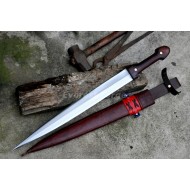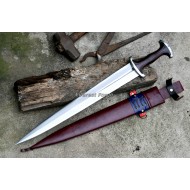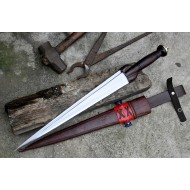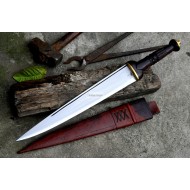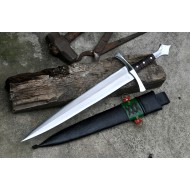
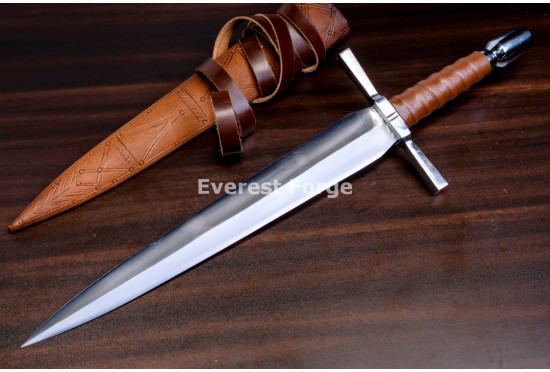
- Model: Hand forged Dagger
- Product Code: DAGGER1007
- Location: Kathmandu,Nepal
Available Options
Hand-Forged Medieval Quillon Dagger — Barrel Pommel and Diamond Blade
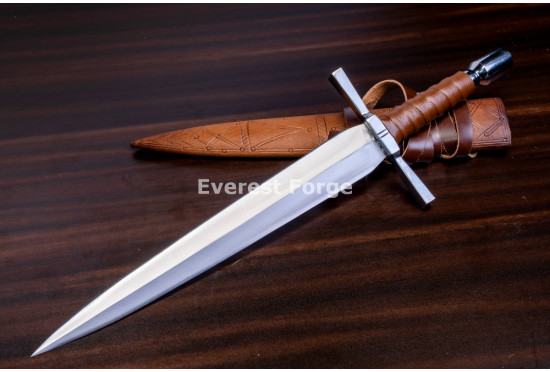
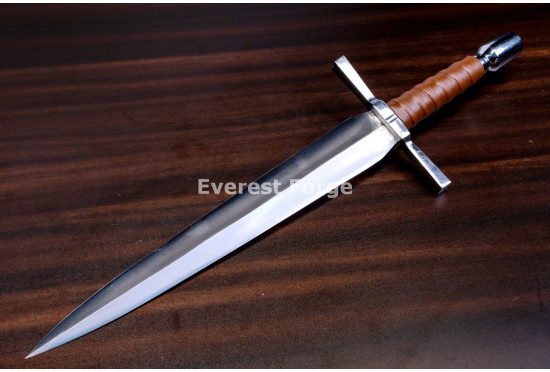
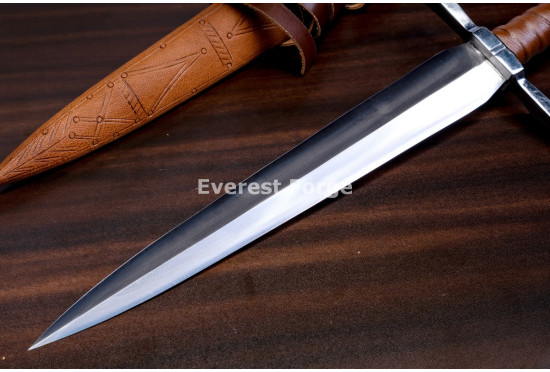
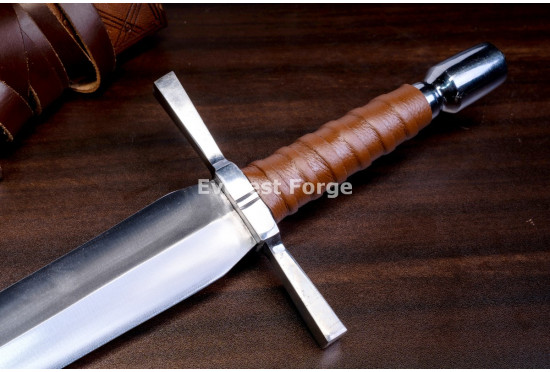
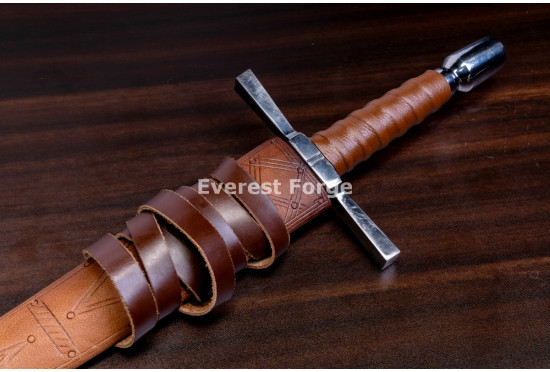
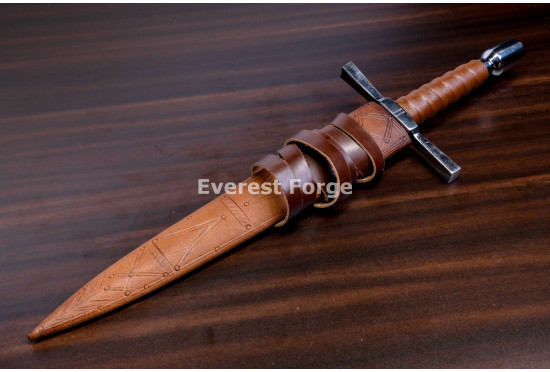
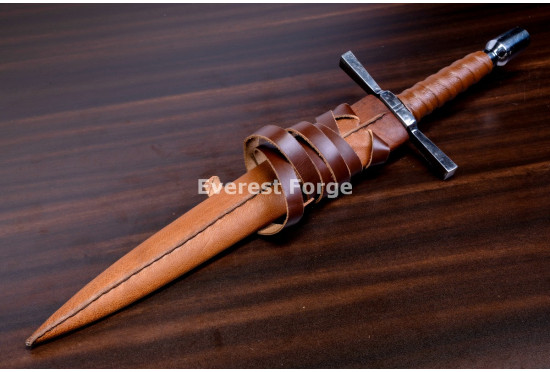
This is a hand-forged, fully functional medieval quillon dagger — a broad double-edged blade of diamond section running in a long even taper to a fine point, forged in Nepal from 5160 high-carbon spring steel, oil-tempered, full tang, and sharpened to a true edge. The hilt is deliberately plain: a straight steel cross with squared terminals, a leather-wrapped grip, and a cylindrical barrel pommel in polished steel. It ships with a tooled leather sheath with riveted detail. Every piece is made to order in your chosen size, finish, and materials.
The standard build gives a 15-inch blade on a 7-inch hilt with a 4.5-inch grip, around 22 inches overall, at about 1.15 kg. That is a large dagger built for the thrust — a stiff diamond section, a long taper and a point fine enough to find a gap, on a hilt with no decoration to get in the way.
An honest note. This is the plain one. Our other quillon dagger carries an engraved knotwork roundel on a disc pommel and is dressed as a knightly sidearm meant to match a sword; this has a bare cylindrical pommel and a straight squared cross, and looks like what a working dagger looked like. Neither is more authentic than the other — plain and decorated hilts both survive in quantity — but they are different objects and you should buy the one you actually want. It is also worth saying that at fifteen inches this sits at the top of the dagger range and a museum would note it as close to the short-sword boundary, and that a double-edged blade of this size faces tighter import restrictions in a number of countries than a single-edged one.
Bespoke Service
Forge a Dagger to Your Own Design
Want a shorter historical blade, a different pommel form, a decorated hilt, or a matched set with one of our swords? Our Custom Forge service builds to your spec, by hand in Kathmandu.
Request a Custom Forge →Built for the Thrust
Everything about this dagger points one way. The blade is diamond section — it rises from each edge to a ridge down the centre — which makes it stiff enough to drive hard without flexing, and that stiffness is the whole requirement of a thrusting weapon. The taper is long and even rather than abrupt, so the point is fine while the base stays broad and strong. The cross is straight and squared, sized to stop a hand rather than to be admired. And the barrel pommel sits behind the hand as a plain counterweight with nothing carved into it. A medieval dagger was carried by nearly everyone and used for nearly everything, but the ones built like this were built for one job in particular, and they are the reason the type survived into the age of plate armour when a sword edge had stopped being much use.
Specifications
The figures above are the standard build. Blade size, blade finish and grip wrap are all selectable options — set them before you add to cart and the piece you receive will match what you choose.
Customize Your Dagger
Hand-Forged, Not a Wall-Hanger
This Dagger
- Hand-forged 5160 high-carbon spring steel
- Oil-tempered, hard edge and flexible spine
- Full tang secured at the pommel
- Diamond section forged and ground, with a real distal taper
- Sharpened, balanced, made to your spec
A Wall-Hanger
- Cast stainless, brittle under load
- No real heat treatment
- Rat-tail tang that snaps at the guard
- Flat blade with no section and no taper
- Blunt, display-only
How It Is Made
Who It Is For
- Collectors of medieval European arms who prefer plain working hilts to decorated ones
- Reenactors and living-history groups needing a sidearm without ornament
- Buyers who want a large stiff thrusting blade rather than a cutting dagger
- Anyone building a pair alongside one of our swords — ask and we will match the fittings
- Larp and costume users, who should order the display-blunt option
- Not for buyers in jurisdictions restricting double-edged blades — ask about a single-edged build
What Is Included
- One hand-forged medieval quillon dagger, built to your chosen spec
- Tooled leather sheath with riveted detail
- Leather-wrapped grip with polished steel cross and barrel pommel
- Any personalization or engraving you ordered
- A sharpened diamond-section blade
- Everest Forge manufacturer warranty
Explore More Medieval Blades
Shipping, Returns & Care
Shipping
In-stock specs dispatch within 2 to 3 business days; fully custom builds take roughly 4 to 6 weeks to forge before dispatch. We ship worldwide by DHL or FedEx in 7 to 14 business days, tracked. Import and blade laws vary by country, and double-edged blades face tighter restrictions than single-edged ones in a number of places, so please check your local rules before ordering.
Returns & Warranty
Every blade is backed by the Everest Forge warranty against forging and material defects. If something is wrong with your order, we will repair, replace, or refund it. Personalized and custom-engraved pieces are made to order, so please confirm your spec carefully before purchase.
Care
Wipe the blade clean and dry after handling, and apply a light coat of oil before storage to protect the high-carbon steel from moisture. Pay attention to the join where the blade meets the cross, which traps moisture and is easy to miss. Treat the leather wrap and sheath with a conditioner two or three times a year, and store the dagger outside its sheath rather than in it.
From The Forge
Build a Matched Sword and Dagger
Medieval daggers were often made to match their owner's sword, sharing the same cross, pommel and wrap. Our Custom Forge service will build a dagger and sword as a matched pair. Roughly 4 to 6 weeks from order.
Start a Custom Forge →Frequently Asked Questions
How does this differ from your other quillon dagger?
The pommel and the dressing. This one has a plain cylindrical barrel pommel, a straight squared cross and a natural leather wrap — an undecorated working hilt. Our other quillon dagger carries an engraved knotwork roundel set into a disc pommel, a cross with spatulate terminals and an oxblood wrap, and is dressed as a knightly sidearm meant to match a sword. The blades are close: this one is 15 inches, that one 16, and both are diamond section. So the choice is genuinely about how you want it to look rather than what it does. Buy this one if you prefer a plain martial hilt; buy the knotwork dagger if you want decoration. If you want the decoration on this blade length, or this hilt at that length, ask through Custom Forge — both are straightforward.
Was there a fighting system for the dagger?
Yes, and it is one of the best-documented parts of medieval European martial arts. Dagger material appears in nearly every surviving fight manual: Fiore dei Liberi devotes a substantial section to it in the Flower of Battle around 1409, Hans Talhoffer illustrates it repeatedly through the fifteenth century, and it appears in the Codex Wallerstein and many others. What survives is not what people expect. The systems are overwhelmingly about grappling — disarms, joint locks, arm breaks, throws, controlling the opponent's weapon arm — with the thrust as the conclusion rather than the whole technique. The reason is practical: dagger fighting happens at a distance where you are already in contact, so wrestling and blade work are the same skill. Much of the material is also about defending unarmed against a dagger, which tells you how commonly people expected to face one.
What is a misericorde?
Misericorde comes from the Latin for mercy, and it is the name given to a narrow, very stiff dagger used to deliver a killing blow to a fallen and mortally wounded man in armour — the mercy stroke. It is less a distinct type than a role that stiff thrusting daggers filled, and the daggers described that way are usually rondels or quillon daggers with exactly the characteristics this one has: a strong diamond or triangular section, a fine point, and no interest in cutting. The reason the role existed is armour. Once plate became common a sword edge was nearly useless against a standing man, so fights ended on the ground with someone finding a gap at the visor, the armpit or the groin with a stiff point. That is what a dagger like this was for, and it is why so many medieval daggers are built to be rigid rather than sharp.
How was a dagger like this carried?
Usually on the belt on the right hip, roughly where a sword's scabbard was not, and often hung nearly vertically rather than angled. That placement matters and it is the opposite of the sword arrangement: a sword hangs on the left and is drawn across the body, while the dagger sat on the strong side to be drawn straight up with the same hand without fouling the sword belt. Manuscript illustrations show it worn very visibly, and that was the point — a dagger was ordinary equipment for nearly every free man, used for eating, for work and for defence, and it was not hidden. Concealment was actually what got daggers legislated against in several medieval cities, since a knife carried out of sight implied intent that an openly worn one did not. Our sheath is built for open belt carry.
What is a barrel pommel?
A pommel turned as a plain cylinder rather than shaped into a disc, wheel, brazil-nut or scent-stopper. It is one of the simplest forms and it appears throughout the medieval period on working weapons where the pommel was doing a job rather than making a statement. Functionally it is a counterweight: it sits behind the hand and pulls the balance back from the blade, and on a thrusting dagger it also gives the heel of your hand something solid to drive against, which is where the real force in a thrust comes from. A cylinder is easy to turn accurately and presents no corners to catch on clothing, which is why plain forms like this outnumber decorated ones among surviving finds even though the decorated ones fill museum cases. Disc, wheel and brazil-nut pommels are all available if you want a different silhouette.
Is this historically accurate?
In form, largely. A straight cross, a leather-wrapped grip, a plain turned pommel and a stiff diamond-section blade is exactly what a great many medieval quillon daggers looked like, and the plainness is authentic rather than a shortcut — most surviving working daggers are undecorated. What we are not claiming is a reproduction of a specific find: the dimensions are ours, and the satin finish is brighter than a period blade would have carried. Note also that at fifteen inches the blade sits at the very top of the dagger range; most stopped nearer twelve, and a museum would flag this as close to the short-sword boundary. A shorter blade squarely inside the historical range is available through Custom Forge.
Is this a real, functional dagger?
Yes. It is hand-forged from 5160 high-carbon spring steel, full tang, oil-tempered, and sharpened along both edges before it ships. The cross and pommel are solid steel and the tang is secured at the pommel rather than glued into a stub. It is stiff enough to be driven hard and keen enough to cut. Do not use the point as a pry bar and do not cut anything you would not put a good knife through.
What steel is it, and is it oil-tempered?
The blade is forged from 5160 high-carbon spring steel, the same alloy used in heavy-duty truck leaf springs, prized for toughness and edge retention. It is oil-tempered for a hard cutting edge backed by a flexible, shock-absorbent spine. On a stiff thrusting blade that toughness matters most at the point — a hard, brittle tip is the first part to snap under a bad angle, and 5160 gives you one that bends and comes back.
Is it full tang?
Yes. The tang runs the full length of the hilt and is secured at the pommel, so the cross and grip are mechanically captured on the tang itself. There is no rat-tail, no weld and no glued-in stub. This matters more on a thrusting weapon than people expect: driving a point into something loads the whole hilt in compression against the pommel, and a threaded or glued assembly works loose over time in a way a properly secured one does not. It also matters that you cannot see it — a wrapped grip hides the construction entirely, and a hollow handle with a stub inside looks identical from the outside until the day it fails.
What are the grip, fittings and sheath made of?
The grip is a shaped wooden core under a leather wrap. The cross and the barrel pommel are polished steel — solid, not cast alloy or plated pot metal. The sheath is leather with tooled panels and riveted detail, made by hand to fit the blade size you order, which is why a custom blade length always means a custom sheath and adds to the lead time. Because leather is a natural material, colour and finish vary slightly between pieces, and dyed leather will soften in tone with handling and age.
Does it arrive sharpened, and what can I change?
Yes, sharpened along both edges as standard, finished by hand. Choose the display-blunt option if you need it unsharpened for reenactment, larp, display, or to satisfy import rules where you live, at no extra charge. As for changes — blade length, blade section, pommel form, finish and wrap colour are all selectable, and the figures on this page describe the standard build. The two worth thinking about are blade section, since a fullered blade gives you something lighter and quicker that thrusts less stiffly, and pommel form, since it changes the whole character of the hilt.
Do you ship worldwide, and how long does it take?
Yes. We ship worldwide from Nepal by DHL or FedEx in 7 to 14 business days with tracking. In-stock specs dispatch within 2 to 3 business days; fully custom builds take roughly 4 to 6 weeks to forge first. Import and blade laws vary by country and double-edged blades face tighter restrictions than single-edged ones in many places, so please check your local rules carefully before ordering.
| Specification | |
| Blade: | Hand forged from 5160 carbon steel, double-edged diamond section with a long even taper |
| Total Length: | 15 inch blade, 7 inch hilt with 4.5 inch grip, approx 22 inches overall |
| Handle: | Full tang secured at the pommel, wood core under a leather wrap, polished steel straight cross and cylindrical barrel pommel |
| Weight: | Approx 1150 grams total at standard build (blade approx 940 grams) |
| Note: | As every piece is forged by hand, slight variation in weight, dimensions and finish may occur. Blade size, blade finish and grip wrap are all selectable options - the figures above describe the standard build. Keep the blade lightly oiled when not in use. |