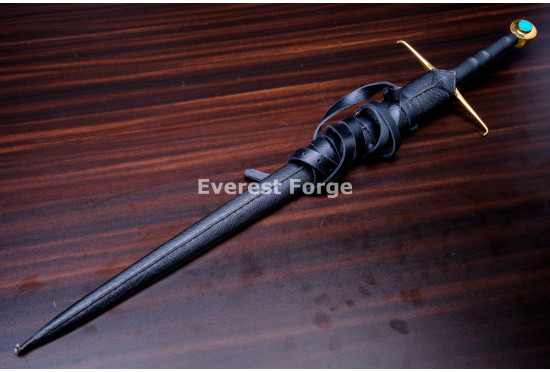
- Model: Arming Sword
- Product Code: Armingsword0029
- Location: Kathmandu,Nepal
Available Options
Hand-Forged Medieval Knight Sword — Brass Guard and Turquoise Disc Pommel
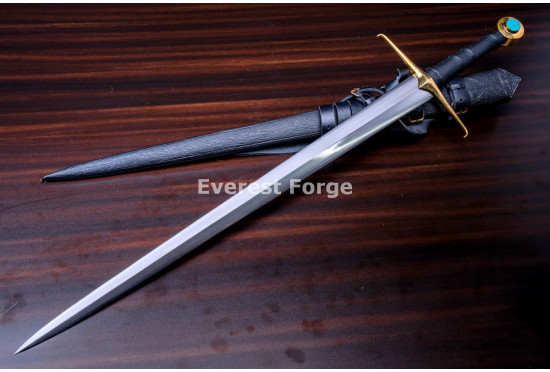
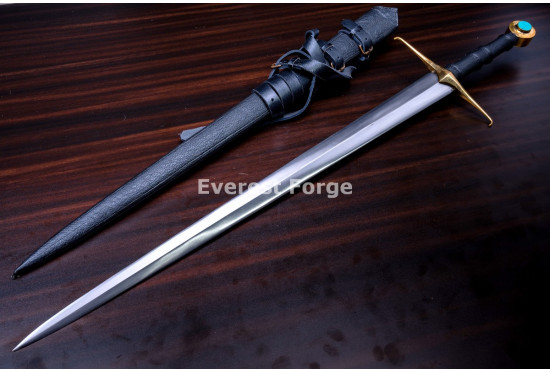
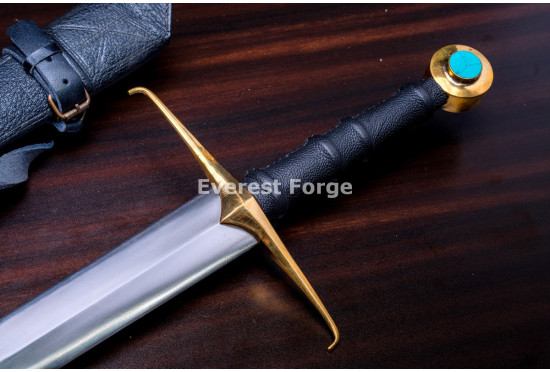
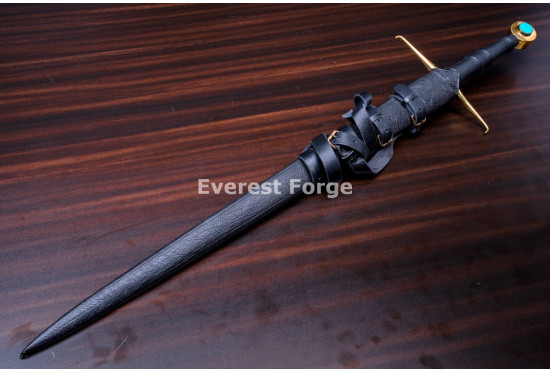
This is a hand-forged, fully functional medieval knightly sword — a straight double-edged blade with a long even taper to an acute point, forged in Nepal from 5160 high-carbon spring steel, oil-tempered, full tang, and sharpened to a true edge. The blade is finished satin. What sets it apart are the fittings: a brass-finished swept guard whose quillons curve toward the blade, and a brass-finished disc pommel set with a turquoise-coloured cabochon, above a black leather-wrapped grip. It ships with a black leather scabbard with matching fittings. Every sword is made to order in your chosen length, finish, and engraving.
The standard blade is 29 inches on a 9-inch hilt with a 6.7-inch grip, for an overall length around 38 inches at about 1.58 kg. That grip length makes it hand-and-a-half: it works properly in one hand with a shield, and takes a second hand behind the first when you want leverage on a cut. The oil-tempered 5160 steel and full tang make it a working sword rather than a cast wall-hanger.
An honest note. This is a decorative interpretation rather than a historical reconstruction, and the fittings are why. Medieval European swords were fitted almost universally in iron and steel; brass and bronze furniture appears occasionally on later and eastern pieces, but gold-coloured fittings on a 13th or 14th century knightly sword are a modern choice. So is the set stone. Both look striking, which is the point, but if you are collecting or reenacting to a period standard this is not the sword for you — buy one of our steel-fitted patterns instead and we will happily point you at the right one. The blade underneath is a proper knightly blade and the construction is sound.
Bespoke Service
Forge a Sword to Your Own Design
Want steel fittings instead of brass, a different stone or none at all, a plain cross, or your own engraving? Our Custom Forge service builds swords to your spec, by hand in Kathmandu.
Request a Custom Forge →What Sets This Sword Apart
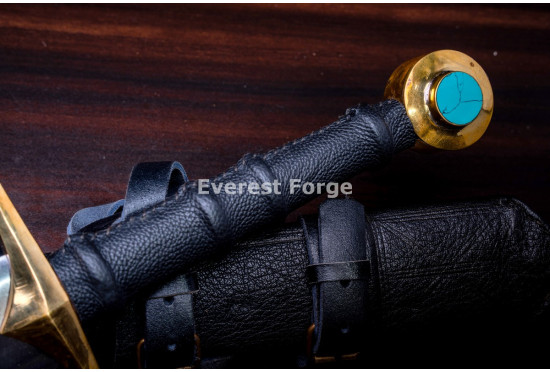
The blade is a straightforward medieval knightly form: straight, double-edged, tapering evenly from the shoulder to an acute point, built to cut and thrust in roughly equal measure. Everything distinctive is in the hilt. Where almost every medieval sword — and every other sword we make — carries iron or steel furniture, this one carries a brass-finished guard and pommel. The guard sweeps rather than running straight, with both quillons curving gently toward the blade. The pommel is a flat disc carrying a turquoise-coloured cabochon set into its face, which is the detail people notice first. Only those two fittings are brass-finished — the grip between them is black leather wrapped over a shaped wooden core.
Specifications
Customize Your Sword
Every sword is forged to order. Set your options before you add to cart:
Hand-Forged, Not a Wall-Hanger
This Sword
- Hand-forged 5160 high-carbon spring steel
- Oil-tempered, hard edge and flexible spine
- Full tang secured at the pommel
- Guard and pommel shaped and finished by hand, stone set into the disc
- Sharpened, balanced, made to your spec
A Wall-Hanger
- Cast stainless, brittle under load
- No real heat treatment
- Rat-tail tang that snaps at the guard
- Gold paint over pot metal, plastic stone glued in place
- Blunt, display-only
How It Is Made
Who It Is For
- Collectors who want a display sword with colour and contrast rather than another steel-fitted blade
- Buyers looking for a medieval sword that stands out on a wall
- Costume and larp users, who should order the display-blunt option
- Gift buyers — the set stone and the brass finish photograph well and make an impression
- Anyone wanting the blade with different fittings — order it in steel and the sword changes character entirely
- Not for period reenactment or historical collecting — see the honest note above
What Is Included
- One hand-forged medieval knightly sword, built to your chosen spec
- Black leather scabbard with matching fittings
- Leather-wrapped grip between a brass-finished guard and set disc pommel
- Any personalization or engraving you ordered
- A satin-finished, sharpened blade
- Everest Forge manufacturer warranty
Explore More Medieval Swords
Shipping, Returns & Care
Shipping
In-stock specs dispatch within 2 to 3 business days; fully custom builds take roughly 4 to 6 weeks to forge before dispatch. We ship worldwide by DHL or FedEx in 7 to 14 business days, tracked. Import and blade laws vary by country, so please check your local rules before ordering.
Returns & Warranty
Every blade is backed by the Everest Forge warranty against forging and material defects. If something is wrong with your order, we will repair, replace, or refund it. Personalized and custom-engraved blades are made to order, so please confirm your spec carefully before purchase.
Care
Wipe the blade clean and dry after handling and keep a light coat of oil on it, as with any carbon steel. The fittings want different treatment from the blade: brass-finished metal dulls with handling and skin contact, so wipe it with a soft dry cloth after handling and use a proper metal polish sparingly if you want it bright. Avoid getting polish on the set stone or into the leather. Treat the wrap and scabbard with a leather conditioner two or three times a year, and store the sword outside its scabbard.
From The Forge
Build a Sword That Is Yours Alone
Beyond the options here, our Custom Forge service will build this blade in steel fittings, with a different stone or none, a plain cross, or a bare wooden grip. Roughly 4 to 6 weeks from order.
Start a Custom Forge →Frequently Asked Questions
Why brass fittings rather than steel?
Appearance, mostly, and we would rather say so than invent a functional reason. Medieval European swords were fitted almost universally in iron and steel, because that is what a smith had and because steel is harder and takes impact better. Brass and bronze furniture does appear on swords — more often on eastern pieces, on later civilian swords, and on dagger and knife fittings than on medieval knightly swords — but gold-coloured fittings on a sword of this period are a modern decorative choice. The practical trade-off is worth knowing: brass is softer than steel, so a brass-finished cross will mark and dent more readily than a steel one if you actually knock it about. That matters not at all on a display sword and quite a lot on one you intend to use hard. Steel fittings are available on a custom build if you want the sword to take more abuse, and they change its character completely.
What is the stone set in the pommel?
A turquoise-coloured cabochon — a domed, polished stone with no facets — set into the face of the disc pommel. Setting a stone in a pommel is not a purely modern idea: pommels on high-status medieval swords were sometimes inlaid with enamel, coloured glass, or a reliquary compartment, and the pommel face is the one flat surface on a sword large enough to carry decoration where it can be seen. That said, a turquoise cabochon in this style is our design rather than a documented arrangement. Other colours are available, and a plain undecorated pommel is an option if you would rather have the sword without it.
How do I look after the brass fittings?
Differently from the blade, which is the main thing to understand. Carbon steel wants oil; brass-finished metal does not, and oil will simply attract dust to it. What brass does is dull and darken with handling, because skin oils and moisture react with the surface — some owners like that and let it develop, others want it bright. If you want it bright, wipe it with a soft dry cloth after every handling and use a proper metal polish two or three times a year, applied on a cloth rather than poured on. Keep polish away from the set stone and out of the leather, both of which it will damage. If you would rather the fittings needed no attention at all, order the sword in steel.
How does this differ from your other medieval swords of this size?
The fittings, almost entirely — the blade is a conventional knightly form and several of our swords share its dimensions. Our Oakeshott Type XII is the same 29-inch length but carries a fullered blade classified to a documented type, with plain steel fittings and a wheel pommel, and it is the one to buy if you care about historical classification. Our fantasy leaf-blade sword is the same length again but with a leaf-shaped blade that swells through the lower half, making it a much heavier cutter. Our medieval fantasy longsword is fullered and steel-fitted. This one is the decorative option: a brass-finished guard and stone-set disc pommel, built to be looked at. If the brass is what drew you in, this is the right sword; if it is not, one of the others will suit you better and we would rather you bought that.
Is it one-handed or hand-and-a-half?
Hand-and-a-half. The 6.7-inch grip is longer than a true arming sword, which runs nearer four inches and is strictly single-hand. This length lets you use the sword one-handed with a shield in the usual way, and bring the off hand onto the grip behind the first when you want more leverage on a cut or better control in a bind. At 1.58 kg it is comfortable one-handed for extended handling. Note that "arming sword" strictly means the single-hand form, so this sits in the longsword or hand-and-a-half family despite the blade length.
Is this a historically accurate medieval sword?
The blade is; the hilt is not. A straight double-edged blade of this length with an even taper to an acute point is a perfectly ordinary knightly blade and would not look out of place in a museum case. The brass-finished fittings and the set stone are modern decorative choices — medieval swords of this period were fitted in iron and steel, and while high-status pommels sometimes carried enamel or glass inlay, a brass guard and a stone-set pommel together are not a documented arrangement. We build the same blade with plain steel fittings if you want something period-appropriate.
Is this a real, functional sword?
Yes. It is hand-forged from 5160 high-carbon spring steel, full tang, oil-tempered, and sharpened to a true cutting edge before it ships. The tang is secured at the pommel rather than glued or threaded into a stub. It handles tatami mats, water bottles and light green targets well. Bear in mind that brass-finished fittings mark more easily than steel, so if you intend to cut with it regularly the steel-fitted version will stay looking better.
What steel is it, and is it oil-tempered?
The blade is forged from 5160 high-carbon spring steel, the same alloy used in heavy-duty truck leaf springs, prized for toughness and edge retention. It is oil-tempered for a hard cutting edge backed by a flexible, shock-absorbent spine. On a long double-edged blade with an acute point that flex is essential — a hard, brittle sword of this length would be dangerous rather than durable.
Is it full tang?
Yes. The tang runs the full length of the hilt and is secured at the pommel, so the guard and grip are mechanically captured on the tang itself. There is no rat-tail, no weld, and no glued-in stub. This matters more on a wrapped grip than people expect, because the leather hides the construction underneath — a hollow handle with a stub tang inside looks identical from the outside until the day it fails.
What are the grip and scabbard made of?
The grip is a shaped wooden core under a black leather wrap. The scabbard is black leather with fittings matched to the hilt, made by hand to fit the blade size you order — which is why a custom blade length always means a custom scabbard and adds to the lead time. Because leather is a natural material, colour and finish vary slightly between pieces. Store the sword outside its scabbard rather than in it: leather is tanned with acids and holds damp against carbon steel.
Does it arrive sharpened, and can I order it in steel?
It arrives sharpened as standard along both edges, finished by hand. Choose the display-blunt option if you need it unsharpened for larp, stage use, display, or to satisfy import rules where you live — there is no extra charge. And yes, steel fittings are available on a custom build, along with a plain cross, a different stone or no stone, and any wrap colour. Ordering it in plain steel gives you a completely different sword from the same blade, and it is worth thinking about which version you actually want on the wall.
Do you ship worldwide, and how long does it take?
Yes. We ship worldwide from Nepal by DHL or FedEx in 7 to 14 business days with tracking. In-stock specs dispatch within 2 to 3 business days; fully custom builds take roughly 4 to 6 weeks to forge first. Import and blade laws vary by country, so please check your local rules before ordering.
| Specification | |
| Blade: | 29 inches. Hand forged from 5160 carbon steel |
| Total Length: | 38 inches |
| Handle: | 9 inches overall with a 6.7 inch grip section. Full tang, wood core under a black leather wrap, with a brass-finished swept guard and brass disc pommel set with a turquoise-coloured cabochon |
| Weight: | Approx 1580 grams total (blade approx 1170 grams) |
| Note: | As every piece is forged by hand, slight variation in weight, dimensions and finish may occur. Brass-finished fittings will dull with handling; polish occasionally if you want them bright. Keep the blade lightly oiled when not in use. |